June 29, 2026
The Hidden Cost of Mining's Exit: Why Rehabilitation Liability Is Reshaping Resources Regulation
Every operating mine carries two price tags. The first is visible: capital expenditure, operating costs, logistics, and labour. The second is often invisible until it becomes unavoidable: the cost of restoring the land once extraction ends. Across Australia, governments have spent decades grappling with how to ensure that second price tag is paid by the industry that created it, not by taxpayers who had no say in where the mine was built.
Queensland's approach to this problem sits within a purpose-built mechanism called the Financial Provisioning Scheme, and after several years of post-transition experience, the state has undertaken a targeted Queensland financial provisioning scheme review. The 2024-25 reforms that followed represent the most significant recalibration of the scheme since its original introduction, touching everything from contribution rates to threshold settings and risk classification architecture.
Understanding these changes matters not just for compliance teams inside resource companies, but for anyone tracking how Australian mining regulation is evolving in response to competing pressures: fiscal responsibility, investment competitiveness, and environmental accountability.
When big ASX news breaks, our subscribers know first
What the Financial Provisioning Scheme Actually Does
The Queensland Financial Provisioning Scheme (FPS) was established under the Mineral and Energy Resources (Financial Provisioning) Act 2018, replacing an older system of individual bonds and sureties that had proven administratively burdensome and financially inefficient for both operators and the state.
The central purpose of the scheme is deceptively straightforward: resource companies must financially account for the cost of rehabilitating land affected by their operations. If a company collapses, is abandoned, or otherwise fails to rehabilitate its sites, the scheme fund can step in to cover those costs rather than the burden defaulting to Queensland taxpayers. Understanding mine reclamation importance is, consequently, fundamental to appreciating why robust financial provisioning mechanisms exist at all.
The mechanism operates through the Estimated Rehabilitation Cost (ERC), which is the scheme's foundational metric. The ERC represents the projected financial quantum required to return a site to an agreed environmental standard following the cessation of resource activities. Every operator's contribution obligation, risk classification, and compliance pathway flows directly from this figure.
The FPS functions as a risk-transfer instrument: it moves the financial exposure associated with rehabilitation liability from the public balance sheet onto the entities generating that liability, scaled to their assessed capacity to honour those obligations.
The scheme covers a broad range of resource activities and tenure types across Queensland, including coal, metalliferous minerals, and petroleum operations, each of which carries distinct rehabilitation profiles and cost structures.
Why the Post-Transition Review Was Necessary
No regulatory scheme operates perfectly in its initial configuration. The FPS, which shifted Queensland from a bond-based model to a tiered contribution fund, required a period of practical operation before its structural tensions became visible.
The targeted review that preceded the 2024-25 amendments identified several recurring friction points:
- Administrative inefficiency for smaller operators whose ERC fell well below thresholds that would justify the compliance overhead of annual risk assessments
- Misalignment between contribution rates and actual risk profiles in the moderate risk band
- Gaps in the risk classification framework that left mid-tier operators without a category accurately reflecting their financial position
- Inequitable fee structures for large, stable operations whose risk profiles had not materially changed between assessment cycles
The review also examined the state's overall financial exposure through the scheme's fund, assessing whether existing fund thresholds adequately captured the risk concentration posed by highly rated large-scale operators. Furthermore, the Queensland Financial Provisioning Scheme annual report data informed several of the specific numerical adjustments adopted in the subsequent legislative response.
These findings informed a legislative response delivered through the Mineral and Energy Resources and Other Legislation Amendment Act 2024, commonly referred to as the MEROLA Act 2024.
The MEROLA Act 2024: A Legislative Overview
The MEROLA Act 2024 received assent on 18 June 2024, but the Queensland Government deliberately delayed its commencement until 1 October 2025. This transition window gave industry participants time to recalibrate their compliance frameworks, update internal ERC calculations, and engage with the Scheme Manager's updated guidance materials before the new obligations took effect.
The amendments address six distinct areas of the FPS framework, each responding to a specific finding from the post-transition review.
Summary of Key Changes Under the MEROLA Act 2024
| Reform Area | Previous Setting | Revised Setting (From 1 October 2025) |
|---|---|---|
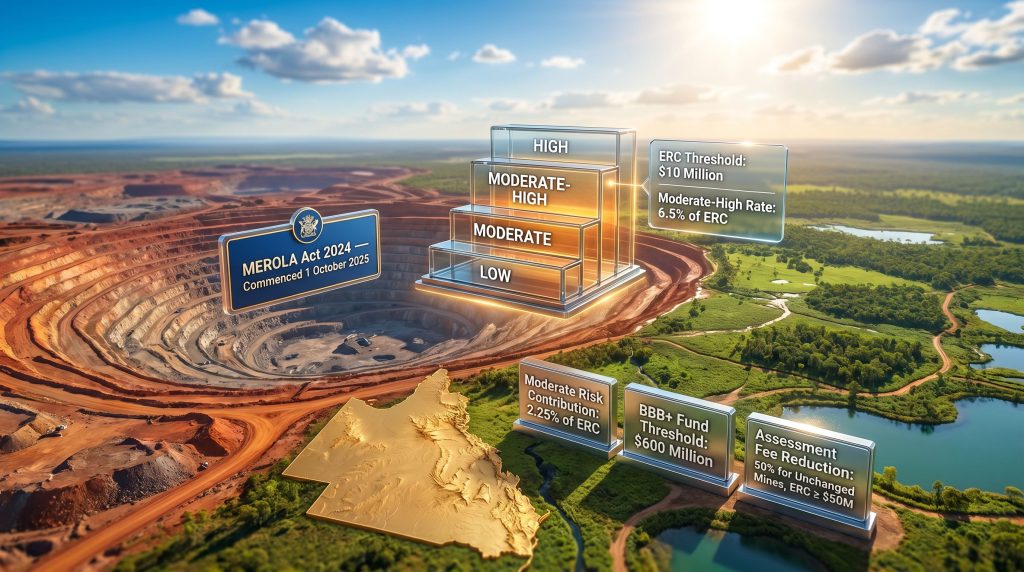
| Prescribed ERC Threshold | $100,000 | $10 million |
| Moderate Risk Contribution Rate | 2.75% of ERC | 2.25% of ERC |
| New Risk Category Introduced | N/A | Moderate-High at 6.5% of ERC |
| Fund Threshold (BBB+ Rated Entities) | Not separately defined | $600 million |
| Fund Threshold (All Other Entities) | $450 million | $450 million (unchanged) |
| Annual Review (High Risk, ERC < $10M with surety) | Required annually | Exempted from annual review |
| Assessment Fees (Unchanged Mines, ERC ≥ $50M) | Standard fee | 50% fee reduction |
The most structurally significant change is the expansion of the prescribed ERC threshold from $100,000 to $10 million. This single adjustment effectively reclassifies a substantial cohort of smaller operators into a simplified compliance category, removing them from the resource-intensive annual review cycle that was designed for, and is more appropriately calibrated to, larger and more complex operations.
Understanding the Four-Tier Risk Classification System
At the heart of the reformed FPS is a risk classification framework that determines how much each operator contributes to the scheme fund. The four tiers are structured as follows:
- Prescribed: ERC below $10 million. Operators face simplified obligations and are not subject to the full annual review cycle.
- Moderate: ERC above the prescribed threshold with a financial health profile indicating lower risk. Contribution rate of 2.25% of ERC (reduced from 2.75%).
- Moderate-High: A newly introduced category carrying a contribution rate of 6.5% of ERC, designed to capture operators whose financial position sits between the Moderate and High categories but whose rehabilitation liability warrants closer attention.
- High: The highest risk classification, applied to operators whose financial profile indicates material vulnerability. This tier carries the highest contribution obligations.
The introduction of the Moderate-High category addresses a structural gap that existed in the original framework. Previously, operators who graduated from Moderate were pushed directly into the High risk category, creating a cliff-edge effect that was commercially disruptive and did not accurately reflect graduated financial risk. This mirrors broader mining sustainability transformation trends, where graduated, proportionate regulatory responses are increasingly favoured over blunt, binary mechanisms.
The Moderate-High category effectively smooths the risk gradient between classification tiers, allowing operators whose financial metrics have weakened, but not critically, to occupy an appropriate position within the framework without facing the full burden of a High risk classification.
How the Annual Review Allocation Day Works
One of the less publicised but operationally significant changes introduced under the reforms is the concept of a grouped annual review allocation day. Under this mechanism, operators managing multiple tenures or operating within corporate group structures can consolidate their risk assessments around a single annual review date, anchored to the submission of audited financial statements.
This approach substantially reduces the administrative friction previously associated with staggered individual assessments, which created irregular compliance cycles and inconsistent visibility over group-level risk. For large portfolio operators with dozens of environmental authorities, this change alone represents a meaningful reduction in compliance costs.
Who Benefits, and by How Much?
The practical impact of the reforms varies considerably across operator profiles. The table below illustrates the key benefits for different segments of the industry:
| Operator Type | Key Benefit Under the Reformed Framework |
|---|---|
| ERC below $10M (Prescribed) | Removed from complex annual review cycle |
| Moderate Risk Category | Contribution rate reduced by 0.5 percentage points |
| High Risk with ERC below $10M and existing surety | No longer subject to mandatory annual reassessment |
| Large operators with BBB+ credit rating | Fund threshold raised to $600M, improving capital efficiency |
| Unchanged mines with ERC at or above $50M | Assessment fees reduced by 50% |
For moderate risk operators, the reduction from 2.75% to 2.25% of ERC may appear incremental in percentage terms, but against large ERC bases, the financial impact is material. An operator with an ERC of $200 million, for instance, would see annual contributions fall by $1 million under the revised rate.
Large operators holding BBB+ credit ratings benefit from an expanded fund threshold of $600 million, up from the general threshold of $450 million. This allows investment-grade entities to satisfy a greater proportion of their FPS obligation through fund participation rather than alternative surety instruments, improving balance sheet flexibility.
The next major ASX story will hit our subscribers first
Step-by-Step: How Operators Navigate the Revised Framework
For resource companies assessing their compliance position under the post-October 2025 framework, the determination process follows a structured sequence:
- Calculate the Estimated Rehabilitation Cost (ERC) across all relevant environmental authorities
- Compare the ERC against the $10 million prescribed threshold to determine whether the operator qualifies for simplified prescribed obligations
- For ERCs exceeding $10 million, prepare and submit audited financial statements to the Scheme Manager for risk category assessment
- Receive a formal risk classification of Low, Moderate, Moderate-High, or High based on the financial assessment
- Apply the applicable contribution rate to the total ERC to determine the annual fund contribution
- Confirm surety instrument status for High risk operators with ERC below $10 million, as these entities are now exempt from annual review requirements
- Identify the relevant annual review allocation day for grouped assessments where applicable
- Assess eligibility for the 50% fee reduction on streamlined assessments applicable to unchanged mines with ERC at or above $50 million
Operators undertaking a definitive feasibility study for new projects should, in addition, incorporate FPS contribution modelling into their financial projections from the earliest planning stages, as contribution rates can materially affect project economics over the operational life of a mine.
How Queensland Compares to Other Australian Jurisdictions
The FPS review does not occur in isolation. Each Australian state and territory applies its own approach to mining rehabilitation financial assurance, and Queensland's reformed framework can be assessed against this national landscape.
| Jurisdiction | Scheme Type | Key Feature |
|---|---|---|
| Queensland | Risk-rated contribution fund | Tiered ERC-based contributions; post-2025 reforms reduce admin burden |
| Western Australia | Mine Rehabilitation Fund (MRF) | Pooled fund model; annual levy based on disturbance area |
| New South Wales | Financial Assurance (FA) | Bond-based system; operator holds individual security instruments |
| South Australia | Mining rehabilitation bonds | Site-specific bonds with government-set amounts |
Western Australia's Mine Rehabilitation Fund, introduced in 2013 and progressively expanded, operates on a levy-per-hectare disturbance basis rather than a financial risk assessment model. This makes it simpler to administer but less responsive to the actual financial capacity of individual operators. New South Wales retains a bond-based model where operators hold individual security instruments, placing the administrative and capital burden more directly on the operator rather than pooling risk across the sector.
Queensland's risk-rated contribution model represents a more sophisticated approach than either, attempting to calibrate obligations to both the scale of rehabilitation liability and the financial health of the entity responsible for it. The post-2025 reforms refine this calibration further, making it one of the more nuanced financial assurance frameworks operating in the Australian mining sector.
The Tensions That Remain
The reforms are not without their critics, and several legitimate policy tensions persist within the revised framework.
The prescribed threshold debate is perhaps the most significant. Raising the ERC threshold from $100,000 to $10 million removes a large cohort of operators from intensive compliance oversight. While this reduces administrative burden, it also creates a class of operators whose rehabilitation liabilities, though individually modest, are collectively significant across Queensland's tenure base. Critics may reasonably ask whether the state retains adequate visibility over rehabilitation risk within this prescribed cohort.
The Moderate-High rate at 6.5% has attracted scrutiny from mid-tier operators who argue that the commercial implications of this classification are substantial enough to constrain capital allocation decisions. A company tipping from Moderate at 2.25% to Moderate-High at 6.5% faces a near-tripling of its contribution rate, which on a large ERC could represent tens of millions of dollars in additional annual obligations. Whether this cliff-edge effect has been sufficiently softened by the new intermediate category will only become clear as the first cohort of operators is assessed under the new framework.
Environmental advocacy perspectives tend to focus on whether any loosening of compliance requirements around smaller operators undermines the fundamental purpose of the scheme. The FPS was designed to ensure that rehabilitation costs are never borne by the public. Furthermore, questions around natural capital in mining and how broader ecosystem values are incorporated into ERC calculations are becoming increasingly prominent in policy discussions. Any structural change that reduces scrutiny over a segment of operators, even one with individually lower ERCs, invites questions about whether the aggregate guarantee remains robust.
The core tension in any financial provisioning reform is that the same mechanism must simultaneously be stringent enough to protect the public from uncovered rehabilitation costs and flexible enough not to deter the investment that generates state royalty revenue in the first place.
Frequently Asked Questions: Queensland Financial Provisioning Scheme Review
What is the Queensland Financial Provisioning Scheme?
The FPS is a state-administered mechanism under the Mineral and Energy Resources (Financial Provisioning) Act 2018 that requires resource companies to financially provide for the cost of rehabilitating land disturbed by their operations, protecting Queensland taxpayers from being left to cover those costs.
When did the 2024-25 FPS amendments take effect?
The legislative amendments delivered through the MEROLA Act 2024 commenced on 1 October 2025, following a deliberate transition period after the Act received assent on 18 June 2024.
What is the new prescribed ERC threshold?
The threshold was raised from $100,000 to $10 million, meaning operators below this level are classified as prescribed and face simplified compliance obligations.
What is the Moderate-High risk category?
A newly introduced classification tier carrying a contribution rate of 6.5% of ERC, positioned between the Moderate (2.25%) and High risk categories to create a more graduated risk spectrum.
Has the fund threshold changed for large operators?
Yes. Entities holding a BBB+ credit rating now access a fund threshold of $600 million, up from the general threshold of $450 million, which remains unchanged for all other entities.
Where can operators access updated compliance guidance?
The Scheme Manager has published updated guidelines reflecting all post-October 2025 changes through the Queensland Department of Resources. Detailed guidance on the legislative framework and obligations under the Mineral and Energy Resources (Financial Provisioning) Act 2018 is also publicly accessible.
What the FPS Reform Signals About Queensland's Policy Direction
Taken as a whole, the Queensland financial provisioning scheme review and the legislative response it produced represent a deliberate move toward risk-proportionate environmental governance. The framework increasingly attempts to match the intensity of regulatory oversight to the actual financial risk profile of each operator, rather than applying uniform obligations across a heterogeneous industry.
This approach has implications that extend beyond compliance. It signals to investors that Queensland is willing to calibrate its regulatory settings in response to evidence, reducing the risk of blunt, industry-wide rule changes that create disproportionate burdens on lower-risk operators. At the same time, the introduction of the Moderate-High category and the preservation of stringent oversight for genuinely high-risk operators demonstrates that the state is not prepared to compromise the underlying integrity of the rehabilitation guarantee.
Looking further ahead, the most consequential questions for the FPS may not be about contribution rates at all. The methodology used to calculate ERC has not been fundamentally reformed in this cycle, yet it is increasingly being scrutinised as climate-related risks, including flooding, extreme weather events, and longer rehabilitation timelines, begin to materially affect the actual cost of site restoration. Robust mining waste management practices are, consequently, becoming ever more integral to accurate ERC modelling.
A scheme that gets the risk classification architecture right but relies on an ERC methodology that systematically underestimates future rehabilitation costs remains exposed to exactly the kind of unfunded liability it was designed to prevent.
Future iterations of the Queensland financial provisioning scheme review will likely need to confront this dynamic ERC question directly, particularly as more complex mine sites approach the end of their operational lives and the gap between estimated and actual rehabilitation costs becomes harder to ignore.
Readers seeking additional context on Queensland's resources regulatory landscape can explore reporting from The Australian Mining Review at australianminingreview.com.au, which covers ongoing developments in mining policy, financial provisioning, and sector regulation across Australian jurisdictions.
Want to Identify the Next Major ASX Mineral Discovery Before the Broader Market?
Discovery Alert's proprietary Discovery IQ model delivers real-time alerts on significant ASX mineral discoveries, transforming complex mineral data into clear, actionable investment insights for both short-term traders and long-term investors. Explore how historic discoveries have generated substantial returns on Discovery Alert's dedicated discoveries page, and begin your 14-day free trial today to position yourself ahead of the market.