June 27, 2026
The Satellite Orebody Model Reshaping Pilbara Iron Ore Economics
Few strategic shifts in Australian iron ore development have been as quietly consequential as the rise of the satellite orebody model. Rather than building entirely new mine-to-port supply chains at enormous capital cost, major producers are increasingly identifying discrete orebodies within reach of existing infrastructure and threading them into already-operational processing and export systems. The result is a more capital-efficient approach to reserve extension that is now defining the next generation of Pilbara output growth.
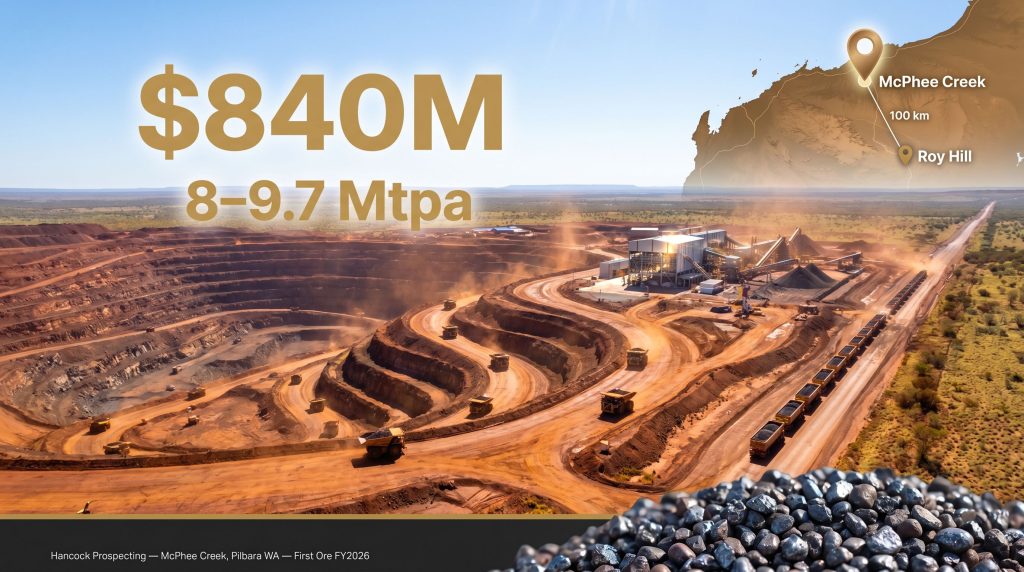
The Hancock McPhee Creek mine online milestone in FY2026 is one of the clearest expressions of this strategy yet. Representing an $840 million capital commitment and roughly 19 months of construction, McPhee Creek transforms what was once a peripheral exploration asset into a functioning contributor to one of Australia's most significant private iron ore operations. Understanding why this project matters requires looking well beyond the headline tonnage figures.
When big ASX news breaks, our subscribers know first
From Atlas Iron Acquisition to First Ore: A Seven-Year Development Arc
The McPhee Creek deposit did not originate within Hancock Prospecting's exploration pipeline. Its entry into the portfolio came through the 2018 acquisition of Atlas Iron, a mid-tier Pilbara producer that had assembled a collection of smaller orebodies across the region during the iron ore boom years. For several years post-acquisition, McPhee Creek remained in feasibility limbo while Hancock assessed how best to integrate it with the existing Roy Hill infrastructure network.
The development sequence unfolded over nearly a decade:
- 2018 – Hancock Prospecting acquires Atlas Iron, bringing McPhee Creek into its asset portfolio
- 2019 – Feasibility studies commence on the McPhee Creek orebody and its integration potential with Roy Hill
- 2021 – Formal project approval granted following internal evaluation
- Early-to-mid 2020s – Environmental impact assessment processes and native title negotiations advance
- FY2024-25 – Construction commences; ground broken on the greenfield site
- FY2026 – First ore achieved, approximately 19 months after construction began
What makes this timeline instructive is not simply its length, but the concentration of complexity in the regulatory and approvals phase. The physical construction itself was delivered efficiently. The delays that elongated the project's pre-construction period were predominantly environmental and regulatory in nature, a pattern that is increasingly common across new Pilbara developments.
Project Fundamentals: Scale, Location, and Infrastructure Logic
McPhee Creek sits in the Pilbara region of Western Australia, positioned approximately 100 kilometres north of the Roy Hill Mine and roughly 30 kilometres north of Nullagine. The mine is operated through Hancock Prospecting's subsidiary, HanRoy Iron Ore Projects Pty Ltd, and is designed to deliver between 8 and 9.7 million tonnes per annum (Mtpa) of iron ore at full production capacity.
The satellite architecture at McPhee Creek is fundamentally different from conventional integrated mine-to-port operations. Primary crushing is conducted on-site, and the resulting product is transported by road train to Roy Hill for full processing, blending, and eventual export through the Roy Hill port facility. This design choice substantially reduces the standalone capital requirement while leveraging billions of dollars of already-depreciated Roy Hill infrastructure.
Key project parameters at a glance:
| Metric | McPhee Creek Detail |
|---|---|
| Owner / Operator | Hancock Prospecting / HanRoy Iron Ore Projects Pty Ltd |
| Location | Pilbara, WA (~100 km north of Roy Hill Mine) |
| Capital Investment | $840 million |
| Designed Capacity | 8 to 9.7 Mtpa |
| First Ore Milestone | FY2026 |
| Construction Duration | ~19 months |
| Processing Hub | Roy Hill Mine (road train haulage) |
| Land Tenure | Nyamal People (mine site); Palyku People (transport corridor) |
The road train haulage solution is worth examining in more detail. Operating across roughly 100 kilometres of Pilbara terrain, this logistics arrangement requires a continuous and coordinated fleet operation to maintain ore flow consistency. Road train haulage in the Pilbara is a well-established practice, used extensively by smaller producers who lack dedicated rail corridors, but operating it at the throughput volumes McPhee Creek is designed to achieve represents a meaningful logistical undertaking. Furthermore, Pilbara iron logistics expansion across other operations demonstrates just how rapidly this infrastructure is evolving across the region.
What the $840 Million Capital Package Actually Delivers
Breaking down what an $840 million greenfield iron ore investment actually constructs helps contextualise the scale of this commitment. The capital envelope for McPhee Creek covers:
- Open-pit mining infrastructure, including haul roads, drill and blast capability, and equipment mobilisation
- Primary crushing facilities on-site, allowing ore to be reduced to a transportable size before road train dispatch
- A purpose-built road transport corridor connecting the mine to Roy Hill, traversing land held under Palyku People native title
- Camp and accommodation infrastructure for the operational workforce at a remote Pilbara location
- Environmental compliance infrastructure required under the conditions of project approval
- Connecting utilities and communications systems appropriate for a remote operation of this scale
Critically, McPhee Creek does not include a dedicated beneficiation plant, rail spur, or port facility. These functions are all handled downstream at Roy Hill, making the capital cost comparison with standalone operations somewhat misleading. Per-tonne of designed capacity, $840 million across 8 to 9.7 Mtpa represents a highly capital-efficient greenfield build, precisely because it avoids duplicating infrastructure that Roy Hill already provides.
How McPhee Creek Extends Roy Hill's Production Life
Roy Hill is one of Australia's largest single-owner iron ore operations, with a designed capacity of 55 million tonnes per annum and a port, rail, and processing system built to that throughput. As the primary Roy Hill orebody progressively depletes, identifying supplementary feed sources becomes critical to maintaining utilisation of this fixed infrastructure base at economically optimal levels.
McPhee Creek functions as a reserve extension mechanism in this context. By feeding crushed ore into the Roy Hill processing system, it contributes to keeping plant utilisation rates high even as the core deposit's accessible reserves diminish over time. This is the economic logic underpinning the satellite orebody model: the incremental cost of processing additional tonnes through an already-operational system is dramatically lower than the average cost per tonne when the system was first built.
The blending dimension adds further strategic value. McPhee Creek ore, when combined with Roy Hill product, allows Hancock's export team to optimise the grade and chemistry profile of outbound shipments. Iron ore is not a homogeneous commodity; the iron ore demand outlook for higher-quality product remains particularly important, as Chinese steel mills and other buyers pay differential prices based on iron content, silica levels, alumina content, phosphorus levels, and moisture. A satellite orebody with complementary chemistry to the primary deposit can meaningfully improve the blended product's realised price in the seaborne market.
Regulatory and Native Title Dimensions: A Dual-Jurisdiction Challenge
Perhaps the least-discussed but most operationally significant aspect of the McPhee Creek approval process is its dual native title structure. The mine site itself is situated on Nyamal People land, while the road transport corridor connecting McPhee Creek to Roy Hill passes through land held under the native title rights of the Palyku People. This means Hancock was required to negotiate, consult, and reach agreement with two distinct traditional owner groups under separate but overlapping regulatory frameworks.
Pilbara projects with multi-group native title footprints face a layered approval process that can substantially extend pre-construction timelines. Each group requires separate consultation, impact assessments, and heritage surveys, and the absence of agreement with either party can delay or block project progression entirely.
Western Australia's regulatory environment for resource projects on native title land has matured considerably over the past decade, but complexity has grown alongside it. Projects that would have moved from approval to construction within 12 to 18 months in earlier eras now routinely require multi-year engagement processes before a shovel enters the ground. McPhee Creek's protracted approvals timeline reflects this industry-wide dynamic rather than any project-specific failure.
This regulatory complexity carries an important lesson for investors and industry analysts assessing the viability of future Pilbara greenfield proposals: the approvals timeline risk is now frequently more material to project delivery schedules than the construction timeline risk itself.
The next major ASX story will hit our subscribers first
McPhee Creek in the Context of a New Wave of Pilbara Greenfield Activity
McPhee Creek does not exist in isolation. It is part of a broader wave of mid-scale Pilbara iron ore developments that have reached construction or commissioning phase in the mid-2020s. The most directly comparable project is Mineral Resources' Lamb Creek development, where ground was broken in December 2025.
| Project | Operator | Designed Capacity | Key Feature | Status (2026) |
|---|---|---|---|---|
| McPhee Creek | Hancock Prospecting | 8 to 9.7 Mtpa | Satellite feed to Roy Hill | First ore achieved FY2026 |
| Lamb Creek | Mineral Resources | 7.5 Mtpa | Extends Iron Valley hub by 5+ years | Ground broken December 2025 |
| Iron Valley | Mineral Resources | Existing + extension | Operational Pilbara hub | Operational |
Both McPhee Creek and Lamb Creek are open-pit operations designed to extend the life of existing Pilbara processing hubs rather than establish entirely new supply chain systems. This convergence of strategic approach across different operators reflects a broader industry conclusion: building new hub infrastructure in the Pilbara is increasingly difficult to justify economically when existing infrastructure has remaining useful life and available throughput capacity.
The capital discipline this model imposes is also notable. Neither project attempts to replicate the scale of a Rio Tinto or BHP mega-project. Instead, both are calibrated to a throughput level that can be absorbed by existing downstream systems without requiring major capacity upgrades, keeping capital requirements within a range that private operators and mid-tier listed companies can fund without market-disrupting equity raises. In addition, Australia's iron ore advantages in infrastructure maturity and geological endowment continue to underpin this capital-efficient model across the Pilbara.
Economic Footprint: Royalties, Employment, and Australia's Export Position
At a designed capacity of up to 9.7 Mtpa, McPhee Creek will generate substantial royalty flows to the Western Australian state government over its operational life. Western Australia's iron ore royalty regime applies a rate of 7.5% on the value of iron ore fines and 5% on lump ore, meaning that at any realistic iron ore price scenario, a near-10 Mtpa operation produces hundreds of millions of dollars in annual royalty revenue over a multi-decade mine life.
The regional employment contribution is also material. Remote Pilbara operations of McPhee Creek's scale typically support:
- Several hundred direct operational roles across mining, crushing, and maintenance functions
- Road transport employment tied to the continuous haulage operation between the mine and Roy Hill
- Construction-phase employment that peaked during the 19-month build period
- Indirect supply chain and services employment across Newman, Port Hedland, and Perth
For Australia's iron ore export position, McPhee Creek's addition to the production ledger reinforces the country's status as the world's dominant iron ore exporter. Australia supplies approximately 53 to 55% of global seaborne iron ore trade, and incremental production additions from projects like McPhee Creek contribute to sustaining that market share as older orebodies in existing operations begin to thin. However, iron ore surplus risks remain a consideration for producers as global supply continues to grow alongside demand uncertainty.
The Speculative Dimension: What McPhee Creek Signals About Future Reserve Strategy
Looking beyond the immediate production milestone, the Hancock McPhee Creek mine online event raises a speculative but well-grounded question: how many additional satellite orebodies within the Atlas Iron legacy portfolio might follow a similar development pathway?
Atlas Iron assembled its asset base during a period when smaller, independently viable deposits were being progressed as standalone operations. Under Hancock's ownership and with Roy Hill as an integrating hub, the economic calculus for several of those deposits may have shifted considerably. Deposits that could not justify standalone mine-to-port infrastructure investment might now be viable as satellite crushing operations feeding into Roy Hill's processing system. Consequently, the China steel and iron ore market will remain central to evaluating how aggressively Hancock pursues further satellite development across the portfolio.
It is worth noting that this analysis is speculative and not confirmed by any Hancock Prospecting announcement. Investors and industry observers should treat this as a structural hypothesis about the strategic optionality created by the Atlas Iron acquisition, not as a statement of confirmed project pipeline.
What is not speculative is that the McPhee Creek model, now that it has been executed and has achieved first ore at McPhee, provides Hancock with a proven template for future satellite development. The engineering configuration, regulatory approach, road train logistics design, and Roy Hill integration workflow have all been stress-tested through a live greenfield build. Replicating elements of that template for a subsequent orebody would carry meaningfully lower execution risk than McPhee Creek itself faced.
Frequently Asked Questions: Hancock McPhee Creek Mine
Who owns and operates the McPhee Creek iron ore mine?
McPhee Creek is owned by Hancock Prospecting, the private resources company associated with Gina Rinehart, and is operated through the subsidiary entity HanRoy Iron Ore Projects Pty Ltd.
Where is McPhee Creek located?
The mine is situated in the Pilbara region of Western Australia, approximately 100 kilometres north of the Roy Hill Mine and around 30 kilometres north of the town of Nullagine. The mine site sits on Nyamal People land, with the transport corridor passing through Palyku People land.
What is McPhee Creek's production capacity?
The mine is designed to produce between 8 and 9.7 million tonnes per annum of iron ore at full ramp-up.
How does ore from McPhee Creek reach export markets?
Ore undergoes primary crushing at the mine site before being transported by road train to the Roy Hill Mine approximately 100 kilometres away. At Roy Hill, the ore is processed, blended with Roy Hill product, and ultimately exported through the Roy Hill port facility.
When did the Hancock McPhee Creek mine achieve first ore?
First ore was confirmed in FY2026, approximately 19 months after construction commenced.
What was the total capital investment?
The project represents a capital commitment of approximately $840 million.
How did McPhee Creek enter Hancock's portfolio?
The deposit was acquired as part of Hancock Prospecting's 2018 takeover of Atlas Iron. Feasibility work began in 2019, and formal project approval was granted in 2021.
Key Takeaways for Industry Observers and Investors
The commissioning of McPhee Creek concentrates several important signals for those tracking Australian iron ore sector dynamics:
- The satellite orebody model is now a proven and capital-efficient mechanism for extending the operational life and throughput utilisation of major Pilbara processing hubs
- Regulatory and native title complexity is the primary schedule risk in new Pilbara greenfield developments, not physical construction timelines
- An $840 million private capital commitment to a new iron ore mine reflects continued long-term conviction in seaborne iron ore demand, despite ongoing price volatility
- The dual native title framework at McPhee Creek (Nyamal and Palyku People) represents a model that future Pilbara developers will need to navigate with increasing frequency
- The Atlas Iron acquisition of 2018 is proving its strategic value as Hancock systematically develops the legacy portfolio into Roy Hill's extended production system
- McPhee Creek's first ore milestone positions Roy Hill for continued high-utilisation throughput well beyond the depletion horizon of the primary deposit alone
This article is intended for informational purposes only and does not constitute financial advice. Statements regarding future production, economic contributions, and strategic optionality involve inherent uncertainty. Readers should conduct independent research before making any investment or business decisions related to the information presented.
Want to Track the Next Major ASX Mineral Discovery Before the Market Moves?
Discovery Alert's proprietary Discovery IQ model scans ASX announcements in real time, instantly identifying significant mineral discoveries and turning complex data into actionable opportunities for both short-term traders and long-term investors — explore historic discovery returns on the Discovery Alert discoveries page and begin your 14-day free trial to position yourself ahead of the broader market.