June 27, 2026
Why the Mining Industry Is Rethinking How Complex Projects Get Built
The economics of mineral extraction have shifted dramatically over the past two decades. As shallow, easily accessible ore bodies become increasingly rare, mining companies are confronting a new operational reality: the deposits that remain are deeper, geologically more complex, and technically harder to access than anything the previous generation of engineers routinely managed. This shift has triggered a structural reassessment of how projects are organised, staffed, and delivered — and it is precisely within this context that United Mining Services mining and mineral processing solutions have gained significant relevance.
The consequence is a growing preference for integrated engineering providers capable of managing entire project lifecycles rather than isolated scopes of work. Fragmented contracting models, once the default approach, are now recognised as a significant source of schedule risk, cost overrun, and interface failure. The question for mining companies is no longer just who can do the work, but who can manage the full chain of complexity from concept through commissioning without losing continuity or accountability along the way.
Furthermore, the mining industry evolution over recent decades has accelerated demand for providers who can absorb technical complexity across the full project spectrum rather than deliver isolated scopes.
When big ASX news breaks, our subscribers know first
The Strategic Case for Integrated Turnkey Engineering in Mining
Turnkey delivery means something very specific in mining and mineral processing contexts. It is not simply a bundled service offering. It represents a transfer of technical accountability from the mine owner to the engineering contractor across every phase of project development, including concept definition, detailed design, procurement, construction, commissioning, and post-commissioning optimisation.
The structural difference between fragmented and integrated delivery models becomes clearest when something goes wrong. In a multi-contractor environment, interface disputes, misaligned design assumptions, and procurement delays compound each other. A single-source provider absorbs and manages those interfaces internally, maintaining schedule coherence and cost discipline.
| Delivery Model | Risk Profile | Cost Predictability | Schedule Control |
|---|---|---|---|
| Fragmented multi-contractor | High | Low | Difficult |
| EPCM single-source | Moderate | High | Centralised |
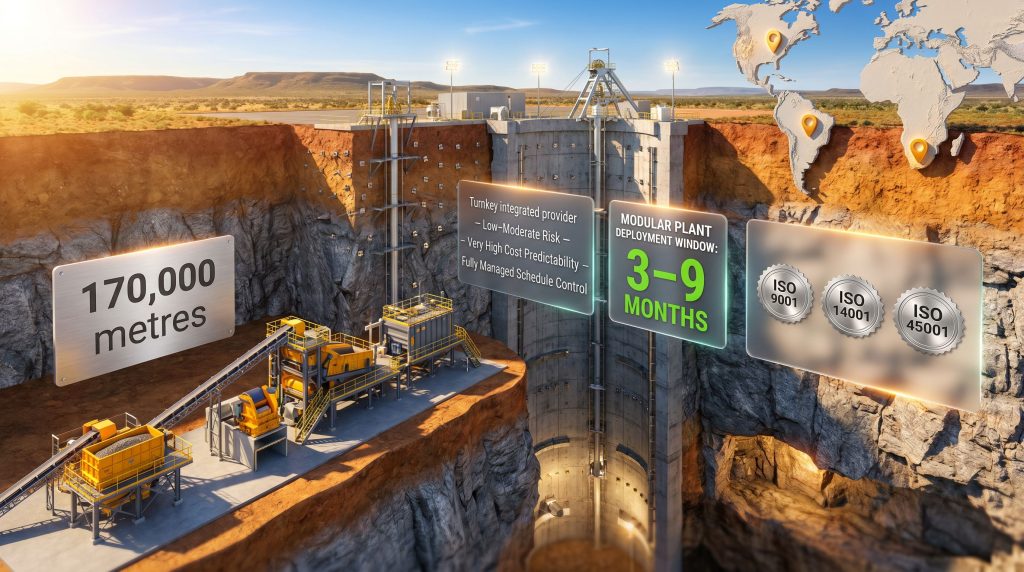
| Turnkey integrated provider | Low to Moderate | Very High | Fully managed |
This structural advantage is precisely why United Mining Services mining and mineral processing solutions have attracted attention across multiple geographies and commodity types. The UMS Group positions itself as a genuine end-to-end provider, drawing on institutional knowledge accumulated across more than 250 completed projects worldwide to reduce the uncertainty that typically accompanies complex ore body development.
How UMS Group Structures Its Core Technical Divisions
Mining Engineering Technical Services: The EPCM Backbone
The METS division sits at the heart of the UMS Group's technical offering. Its scope encompasses underground mine structure design, shaft and headgear engineering, decline development planning, and the full suite of EPCM methodology applied to mining infrastructure. What distinguishes this division from conventional engineering consultancies is the integration of procurement and construction management into a single unified workflow, rather than treating them as downstream handoffs.
This matters in practice because procurement timing directly influences construction sequencing, and construction feedback loops back into design refinement. When these functions are separated across different organisations, critical information is lost or delayed. When they operate within a single division under unified project governance, the feedback is immediate and actionable.
The multidisciplinary composition of METS teams reflects the technical complexity of the environments they serve. Professional engineers spanning civil, mechanical, electrical, and structural disciplines work alongside geologists, rock mechanics practitioners, and project control specialists. This breadth is not an organisational luxury; it is a functional requirement for underground mining environments where geotechnical uncertainty can alter a project's economics overnight.
In addition, robust drilling programs during earlier exploration phases provide the geotechnical data that METS teams depend on when making critical underground design decisions.
Shaft Sinkers Division: A Distinct and Demanding Capability
Shaft sinking is among the most technically specialised activities in all of mining. Excavating a vertical or near-vertical opening from surface to ore body level demands purpose-built equipment, deep geotechnical expertise, and personnel who have accumulated years of hands-on experience in conditions that most engineers will never encounter. Ground pressures at depth, groundwater ingress, and the geometric precision required for shaft alignment create a working environment where errors carry disproportionate consequences.
The UMS Shaft Sinkers division operates as a standalone construction contracting capability within the group, covering both surface and underground construction services as well as shaft optimisation and rehabilitation for existing infrastructure. The rehabilitation component is particularly significant from a capital efficiency perspective: extending the productive life of an existing shaft through targeted engineering intervention can deliver value equivalent to a new development at a fraction of the cost.
UMS has accumulated over 170,000 metres of vertical shaft sinking across global projects. This benchmark reflects decades of specialised underground construction experience and positions the group among the most technically credentialled operators in this niche segment of the mining services market.
Mineral Processing Solutions: From Raw Feed to Refined Output
The METS Process Division
The processing arm of METS operates at the interface between mine extraction and downstream value creation. Its engineering scope spans beneficiation-stage design and construction, covering the full range of process configurations that mining operations require to convert raw ore into a saleable product.
Core processing capabilities delivered through this division include:
- Crushing and screening systems designed and commissioned for primary and secondary processing circuits
- Material handling infrastructure including conveyor systems, transfer points, and bulk handling solutions
- Beneficiation project delivery across gravity separation, flotation, and density-based process configurations
- Tailings reclamation engineering focused on recovering residual mineral value from historical tailings deposits across multiple commodity types
The tailings reclamation capability is worth examining in more detail. As environmental scrutiny of tailings storage facilities intensifies globally, and as commodity prices make marginal recovery economics more attractive, the ability to re-process legacy tailings deposits is emerging as a distinct growth area. UMS's positioning in this space reflects both technical capability and commercial foresight. Consequently, mine reclamation has become an increasingly important dimension of value creation rather than simply a regulatory obligation.
The Modular Processing Approach: Fit-for-Purpose Engineering
One of the more commercially significant aspects of UMS's processing philosophy is the emphasis on modular, fit-for-purpose plant design. The conventional alternative — a fixed conventional processing facility — requires substantial upfront capital, an extended construction timeline, and significant lead time before first ore is processed. For junior miners or projects with evolving resource definitions, that capital intensity can be prohibitive.
| Processing Plant Type | Capital Cost | Deployment Speed | Scalability | Ideal Use Case |
|---|---|---|---|---|
| Fixed conventional plant | High | Slow (12 to 24 months) | Low | Large, long-life deposits |
| Modular fit-for-purpose | Moderate | Fast (3 to 9 months) | High | Emerging or complex ore bodies |
| Hybrid configuration | Moderate to High | Medium | Medium | Mid-tier operations |
Modular configurations address each of these constraints. Deployment timelines compress from years to months. Throughput capacity can be scaled incrementally as the resource definition matures. And because modular components are often standardised, procurement lead times and replacement costs are more predictable over the asset's operating life.
This design philosophy makes United Mining Services mining and mineral processing solutions accessible to a broader range of clients across the project size spectrum, from large-scale producers requiring hybrid configurations to emerging operations needing a fast-track path to production.
Geographic Footprint and Commodity Coverage
UMS maintains active project operations across three primary regions: southern Africa, Brazil, and the United States. Each geography presents a distinct technical environment.
Southern Africa remains the operational core, and for good reason. The region hosts some of the world's most geologically complex and deep-level mining operations, including gold mines that descend beyond three kilometres below surface. The technical demands of these environments have historically produced the most rigorous engineering standards in the global industry, and UMS's foundation in this context has shaped a delivery culture calibrated for extreme conditions.
Brazil's mining sector, particularly its substantial base and precious metals industries, represents a significant growth opportunity. The country hosts world-class deposits across multiple commodities, and its mining infrastructure investment cycle is creating demand for precisely the kind of integrated project delivery that UMS provides. For further context on mineral processing services applied across diverse geographies, WSP's technical resource library offers useful reference material on process engineering approaches.
USA operations extend the group's reach into North American markets, applying methodologies refined in technically demanding African and South American environments to a client base increasingly focused on domestic resource development.
On the commodity dimension, UMS's engineering capability spans gold processing, chrome beneficiation, and general mineral processing applications. This commodity-agnostic positioning is a genuine competitive differentiator. Process design insights from chrome beneficiation, for instance, can inform density-separation configurations in other mineral systems. Cross-commodity learning compounds institutional knowledge in ways that commodity-specialist contractors cannot replicate.
Over Six Decades of Institutional Knowledge
The UMS Group draws on more than 60 years of project delivery experience. That figure is not simply a marketing credential. In technically demanding mining environments, institutional knowledge functions as a form of risk capital. It represents the accumulated learning from projects that experienced unexpected geological conditions, equipment failures, ground movement events, and processing upsets, each of which generated revised engineering responses now embedded in the group's design methodology.
A portfolio exceeding 250 completed projects worldwide translates into something more valuable than technical competence at any individual task. It creates repeatable delivery frameworks, standardised risk management protocols, and a library of lessons learned that reduces the probability of first-occurrence failures on new projects.
In technically demanding mining environments, the depth of a contractor's project portfolio is often a more reliable performance predictor than any individual capability claim. A track record exceeding 250 global projects signals systematic delivery competence, not isolated success.
The concept-to-commissioning lifecycle that UMS manages follows a structured six-stage progression:
- Concept and feasibility assessment defining ore body access strategy and processing route selection
- Engineering and design covering multi-discipline detailed design for both mining and processing infrastructure
- Procurement management coordinating supply chain logistics and equipment sourcing
- Construction execution delivered by experienced on-site construction teams
- Commissioning and handover with systematic plant start-up and client knowledge transfer
- Refurbishment and optimisation extending asset life and improving performance for existing operations
However, it is worth noting that the transition from feasibility to execution requires careful alignment between what a definitive feasibility study defines and what the engineering and construction teams are subsequently tasked to deliver.
The next major ASX story will hit our subscribers first
ISO Certification: Independent Verification of Performance Standards
Through its integrated management system, UMS monitors safety performance, quality outcomes, and environmental compliance across all active projects simultaneously. The group holds triple ISO certification across three distinct governance domains.
| ISO Standard | Domain | What It Governs |
|---|---|---|
| ISO 9001 | Quality Management | Process consistency, output standards, client satisfaction |
| ISO 14001 | Environmental Management | Environmental impact monitoring, compliance, and mitigation |
| ISO 45001 | Occupational Health and Safety | Workforce protection, hazard identification, incident prevention |
These certifications matter to clients for reasons that go beyond procedural compliance. In regulated mining jurisdictions across Africa, South America, and North America, ISO-certified contractors are increasingly a baseline procurement requirement rather than a differentiating credential. Holding all three simultaneously signals that UMS manages quality, safety, and environmental performance as an integrated system rather than treating them as separate administrative obligations.
Real-time performance tracking across active projects enables early identification of deviations before they escalate into non-conformances or incidents. This proactive monitoring capability is particularly important in multi-jurisdictional operations where regulatory frameworks differ and the consequences of compliance failure vary significantly by geography.
Frequently Asked Questions About UMS Group Mining and Mineral Processing Solutions
What types of mining projects does UMS Group specialise in?
UMS Group focuses primarily on underground mine development, including shaft sinking, decline construction, and underground infrastructure, as well as surface mineral processing plant design, construction, and commissioning across a range of commodity types.
Does UMS Group work on surface processing plants as well as underground mines?
Yes. Through its METS Process division, UMS delivers crushing and screening systems, beneficiation circuits, tailings reclamation projects, and modular processing plant solutions for surface operations across multiple commodities.
How does UMS's modular processing approach benefit smaller or emerging operations?
Modular plant designs reduce upfront capital requirements, shorten deployment timelines significantly, and allow throughput capacity to be scaled as the operation matures, making them particularly well-suited to junior miners and projects with evolving resource definitions.
What ISO certifications does UMS hold and why do they matter to clients?
UMS holds ISO 9001, ISO 14001, and ISO 45001 certifications. These provide clients with independently verified assurance that UMS operates to internationally recognised standards across quality, environmental management, and occupational health and safety simultaneously.
In which countries does UMS Group currently operate?
UMS maintains active project operations across southern Africa, Brazil, and the United States, with its technical and management headquarters based in South Africa and corporate registration in the United Kingdom.
Key Differentiators: What Sets UMS Group Apart in Global Mining Services
- A genuinely integrated turnkey model covering concept, engineering, construction, commissioning, and refurbishment reduces client-side coordination burden and risk exposure across the full project lifecycle
- Dual-division structure through METS and Shaft Sinkers enables seamless delivery across both underground development and surface processing without inter-contractor interface risk
- More than 170,000 metres of accumulated shaft sinking experience and over 250 completed projects worldwide represent a credibility benchmark that few competitors in this niche can match
- Triple ISO certification provides clients with independently verified quality, safety, and environmental governance through a single integrated management system
- A modular, fit-for-purpose processing philosophy makes solutions accessible and scalable across project sizes, commodity types, and capital availability levels
- Geographic diversification across southern Africa, Brazil, and the USA positions UMS to serve clients in multiple technically demanding and commercially significant mining jurisdictions
- Understanding cut-off grade economics is fundamental to how UMS approaches processing plant design, ensuring that throughput configurations align with the economic thresholds that define viable ore extraction
This article is intended for informational purposes only and does not constitute financial advice or a recommendation to invest in any company or sector. Readers should conduct their own due diligence before making any investment or procurement decisions. For additional context on the broader mining services sector, Mining Weekly has published detailed coverage of United Mining Services Group's value-driven approach to mining and mineral processing markets, which provides useful supplementary reading for those evaluating integrated engineering providers.
Want to Know Which ASX Mining Companies Are Making Significant Discoveries Right Now?
Discovery Alert's proprietary Discovery IQ model scans ASX announcements in real time, instantly identifying significant mineral discoveries across more than 30 commodities and translating complex geological data into clear, actionable investment insights — precisely the kind of intelligence that matters when complex new ore bodies enter the development pipeline. Explore Discovery Alert's discoveries page to understand how historic finds have generated substantial market returns, and begin a 14-day free trial to position yourself ahead of the broader market.