June 26, 2026
Mining's Hardest Decarbonisation Problem Is Finally Being Confronted at Scale
Every major industrial sector faces a decarbonisation bottleneck — a single process or technology so deeply embedded in operations that no amount of incremental efficiency improvement can resolve it. For the global mining industry, that bottleneck has a very specific shape: a 240-tonne diesel haul truck crawling up a Pilbara ramp in 45-degree heat, burning through fuel at a rate that no renewable mining solutions or energy procurement strategy can offset.
The BHP Rio Tinto Caterpillar battery-electric haul truck trial now underway at BHP's Jimblebar iron ore mine represents the most technically ambitious attempt to crack this problem at the scale where it actually matters. Understanding why this trial is significant requires first understanding just how entrenched the diesel dependency problem truly is.
When big ASX news breaks, our subscribers know first
The Numbers Behind Mining's Diesel Crisis
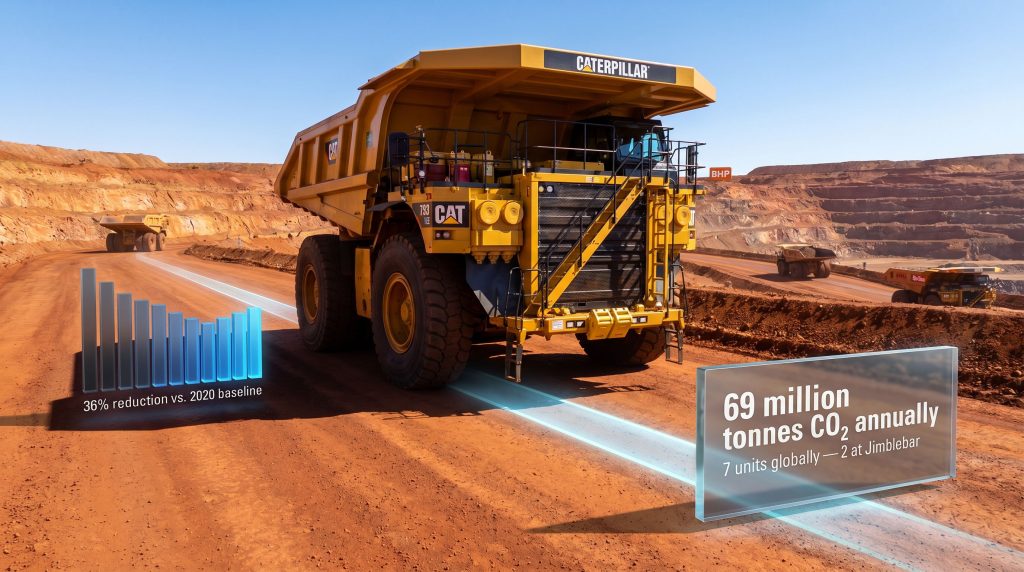
The International Council on Mining and Metals (ICMM) has catalogued the challenge in precise terms. Approximately 28,000 large haul trucks operate across mine sites worldwide. Together, these vehicles consume an estimated 25 billion litres of diesel fuel annually, producing more than 69 million tonnes of CO₂ in the process. To put that figure in context, it exceeds the total annual greenhouse gas output of many mid-sized industrialised nations.
ICMM has formally classified haul fleet electrification as a critical pathway to decarbonisation at the site level, yet progress has remained stubbornly slow at the ultra-class end of the market. The reason is not a lack of ambition. It is a set of genuinely difficult engineering and infrastructure problems that the industry has not yet solved. Furthermore, understanding the broader mining electrification trends helps contextualise why this particular trial carries such weight.
Why Large-Format Trucks Are an Entirely Different Engineering Problem
Most observers assume that electrifying a 240-tonne haul truck is simply a scaled-up version of electrifying a smaller vehicle. That assumption substantially underestimates the complexity involved.
To date, the majority of meaningful battery-electric deployments in mining have been concentrated in sub-120-tonne payload vehicles, predominantly operating in coal and quarry applications in China. These environments typically feature shorter haul cycles, more moderate grades, and lower ambient temperatures. Each of these factors is favourable to current battery technology. None of them describe the Pilbara.
Scaling battery-electric drivetrains to the 240-tonne payload class creates step-change increases in:
- Battery architecture complexity and energy density requirements
- Thermal management system demands under sustained high-load cycles
- Charging infrastructure power delivery requirements
- Integration requirements for safe fleet-level energy management
The engineering gap between a 100-tonne battery-electric truck and a 240-tonne equivalent is not linear. The power demands, thermal loads, and infrastructure requirements compound in ways that make direct comparison misleading.
Critically, the charging infrastructure needed to support ultra-class electric trucks at fleet scale is, according to BHP's own characterisation, still under active development by multiple suppliers globally. No commercially mature solution exists at this scale. That is precisely why the Jimblebar trial matters, and why the mining decarbonisation benefits of getting this right extend far beyond a single operation.
What the Cat 793 XE Early Learner Actually Is
The vehicle at the centre of the BHP and Rio Tinto battery-electric haul truck trial is the Cat 793 XE Early Learner, a purpose-built platform developed by Caterpillar to validate battery-electric technology in the 240-tonne class under real operational conditions.
The "Early Learner" designation carries deliberate meaning. These are not production-ready commercial units. They are pre-commercial research and development assets designed to generate the data needed to eventually build a commercially deployable platform. Only seven Cat 793 XE Early Learner trucks are currently being tested across all global deployment sites, making the concentration of two at Jimblebar particularly significant.
| Specification | Detail |
|---|---|
| Payload Class | Approximately 240 tonnes |
| Vehicle Classification | Battery-electric haul truck |
| Program Stage | Early Learner (pre-commercial validation) |
| Global Fleet Size | 7 units across all sites |
| Jimblebar Allocation | 2 units |
| Pre-deployment Testing Facility | Caterpillar Tucson Proving Ground, USA |
| Pre-deployment Milestones | 100+ operating hours, 200+ test laps |
Before arriving at Jimblebar late in 2025, both trucks completed a structured safety validation program at Caterpillar's proving ground facility in Tucson, Arizona. That controlled environment allowed engineers to stress-test the vehicles across more than 100 hours of operation and 200 test laps before exposing the platform to the extreme heat, dust, and gradient conditions of a live Pilbara iron ore operation.
Three Months In: What the Jimblebar Trial Has Established
After three months of on-site testing, the trial partners have characterised results as showing meaningful progress. That language is deliberate and worth interpreting carefully. It signals early-stage validation rather than commercial readiness, which is entirely appropriate for a pre-commercial technology program of this complexity.
The trial is structured around three interdependent data-generation objectives:
- Technical readiness: Assessing how the battery-electric drivetrain performs under continuous heavy-haul conditions in extreme ambient heat
- Infrastructure requirements: Mapping the physical and electrical infrastructure needed to support potential fleet-scale deployment across a Pilbara operation
- Commercial feasibility: Evaluating total cost of ownership, energy costs, and productivity benchmarks against the diesel baseline
The Jimblebar site creates testing conditions that no proving ground can fully replicate. Average summer temperatures in the Pilbara regularly exceed 45°C, placing battery thermal management systems under sustained stress that is qualitatively different from laboratory or controlled-track environments.
Operating a 240-tonne battery-electric truck in the Pilbara is not just a vehicle test. It is an infrastructure test, a logistics test, a maintenance test, and a thermal management test running simultaneously in one of the most demanding industrial environments on Earth.
Thad Litkenhus, Caterpillar's Vice President of Product Management for Resource Industries, has described working in the Pilbara's demanding environment as the ideal context for validating battery-electric trucks and charging infrastructure under the exact conditions that customers will ultimately face.
The Dynamic Charging Question: Mining's Next Frontier
The most technically interesting aspect of the BHP Rio Tinto Caterpillar battery-electric haul truck trial is not what has already been tested, but what comes next. The upcoming phase of the trial will introduce dynamic charging via an energy transfer system designed to recharge trucks while they are actively in motion.
This capability, if it can be validated at scale, fundamentally changes the economic equation for battery-electric haulage. The core problem with static charging in a continuous production environment is productivity loss. A 240-tonne truck that must park at a charging station is a truck that is not hauling ore. In an operation where haulage productivity directly determines throughput, that trade-off is commercially significant.
Dynamic charging addresses this by embedding energy transfer capability within the haul road infrastructure itself, whether through inductive surface systems or overhead contact systems, enabling continuous battery replenishment during normal operations. In addition, clean energy mine design principles increasingly favour this kind of integrated approach to energy management across the full site footprint.
| Factor | Static Charging | Dynamic Charging |
|---|---|---|
| Truck Availability | Reduced during charge windows | Continuous operation potential |
| Infrastructure Complexity | Moderate (fixed stations) | High (embedded road or overhead systems) |
| Energy Efficiency | Standard | Potentially higher via regenerative integration |
| Scalability to Fleet Level | Constrained by station capacity | Theoretically unlimited with sufficient road coverage |
| Commercial Readiness | Near-term | Medium-term (under active development) |
Dynamic charging technology remains under active development, and its validation in a live Pilbara environment would represent a meaningful step forward for the entire heavy haulage electrification sector, not just for BHP and Rio Tinto.
The next major ASX story will hit our subscribers first
The Kansanshi Precedent and What It Reveals About Retrofit vs. Greenfield Approaches
The global battery-electric haul truck landscape includes one other notable trial worth examining for context. At First Quantum Minerals' Kansanshi Copper Mine in Zambia, Hitachi Construction Machinery ran an extended trial of a Hitachi EH 4000 AC retrofitted to operate on battery power, utilising existing trolley overhead infrastructure already installed at the site.
Over the trial period running through to mid-2025, the Kansanshi truck covered 4,143 kilometres, hauled more than 30,000 tonnes of material, and recorded zero CO₂ emissions during active operation. The results were significant enough that Hitachi accelerated its commercialisation roadmap and brought hybrid technology forward as a near-term commercial option.
The comparison between Kansanshi and Jimblebar is instructive:
- Kansanshi leveraged existing trolley infrastructure in a copper mine environment with established overhead power systems, effectively reducing the greenfield infrastructure challenge
- Jimblebar is testing a purpose-built battery-electric platform in a greenfield charging infrastructure context, within one of the world's highest-throughput iron ore haulage environments
Neither approach is superior in isolation. Together, they represent the two primary pathways through which the industry is attempting to solve the same fundamental problem from different starting points. This also mirrors wider developments seen with hydrogen-powered mine trucks, where alternative zero-emission powertrains are advancing along parallel development tracks.
BHP and Rio Tinto's Decarbonisation Positions
Both BHP and Rio Tinto have publicly committed to net zero operational greenhouse gas emissions by 2050. The gap between that commitment and current trajectory is where the Jimblebar trial's strategic importance becomes most visible.
Diesel has become BHP's single largest source of operational greenhouse gas emissions, a position it reached after the company substantially reduced its electricity-related footprint by transitioning to renewable energy sources for its fixed facilities. BHP has reported achieving a 36% reduction in operational greenhouse gas emissions against its 2020 baseline, which represents genuine progress. However, trend analysis of scope 1 and 2 emissions across ten major Australian miners between FY2021 and FY2025 suggests the sector collectively is on track to reach net zero by approximately 2061, a full decade beyond stated targets.
| Metric | Status |
|---|---|
| BHP emissions reduction vs. 2020 baseline | 36% |
| Projected net zero year (current sector trajectory) | ~2061 |
| Stated net zero target (BHP and Rio Tinto) | 2050 |
| Gap between trajectory and target | ~11 years |
| Diesel's current role in BHP emissions | Single largest operational source |
BHP President Australia Geraldine Slattery has articulated that investing in battery-electric haul truck technology in the Pilbara is central to the company's decarbonisation strategy, with the trial intended to advance both the technology itself and the operational understanding of how to scale it across the broader fleet, spanning charging infrastructure, energy management, and safe production integration.
Rio Tinto Iron Ore Chief Executive Matthew Holcz has emphasised that decarbonising Pilbara haulage represents a complex challenge that requires collaboration across the industry to solve, and that real-world data from demanding operating conditions is essential to making that progress.
A Broader Electrification Program Beyond the Truck Trial
The Jimblebar haul truck trial does not exist in isolation. It is one component of a substantially larger electrification program BHP is executing across its Pilbara operations, which includes:
- Battery-electric locomotives: Two Wabtec battery-electric locomotives have been delivered to Port Hedland for rail trials, with two additional Progress Rail battery-electric locomotives expected to follow
- Electric excavators: BHP has separately trialled the Liebherr 9400E electric excavator at its Yandi operation
- Dynamic charging research: Dynamic charging system evaluation is running in parallel across both the truck and rail programmes
These parallel programmes are designed to generate data on how high-energy battery systems perform across different heavy mining and rail environments, and to identify the infrastructure and safety frameworks required to manage large electric fleets at scale.
Why Industry Collaboration Is the Only Viable Path Forward
The technical, infrastructure, and commercial challenges associated with electrifying ultra-class haul fleets at the scale of a major Pilbara iron ore operation are not solvable by any single organisation. The launch of this collaborative trial between BHP, Rio Tinto, and Caterpillar distributes the cost and risk of early-stage technology validation across three organisations with genuinely complementary capabilities.
Slattery has emphasised that industry collaboration accelerates progress across the technology itself, the operational requirements, and the supply chain simultaneously, rather than each organisation working in isolation toward the same destination.
WesTrac, as Caterpillar's authorised dealer for Western Australia, also plays a critical supporting role, providing on-the-ground maintenance, parts logistics, and technical support that is essential for maintaining operational continuity during a live mine site trial.
One dimension of this challenge that receives less attention than the vehicles themselves is the supply chain readiness problem. Even if the Cat 793 XE platform is ultimately validated as commercially viable, fleet-scale deployment would require a parallel build-out of battery component supply chains, charging infrastructure, and specialised maintenance capabilities. Current high-capacity battery production remains predominantly oriented towards automotive and grid storage markets. A transition from a two-truck trial to fleet-level deployment across a single Pilbara operation would consequently require infrastructure investment of an entirely different order of magnitude.
Frequently Asked Questions: BHP Rio Tinto Caterpillar Battery-Electric Haul Truck Trial
What Makes the Cat 793 XE Significant Compared to Other Battery-Electric Mining Trucks?
The Cat 793 XE operates in the 240-tonne payload class, which sits far beyond the sub-120-tonne range where most meaningful battery-electric mining deployments have occurred globally. Commercially viable battery-electric technology at this scale does not yet exist. The 793 XE Early Learner program is the industry's most advanced attempt to develop and validate it under real operational conditions.
How Many Cat 793 XE Trucks Exist Globally?
Only seven Cat 793 XE Early Learner trucks are currently deployed across all global trial sites. Two of these are operating at Jimblebar, representing a substantial concentration of the program's global testing capacity at a single location.
What Is Dynamic Charging and Why Does It Matter for Mining?
Dynamic charging refers to technology that replenishes a truck's battery while the vehicle remains in motion, using an embedded energy transfer system within haul road surfaces or overhead infrastructure. For a 240-tonne truck on a continuous production cycle, this could eliminate the productivity penalty associated with static charging windows, where the truck must stop hauling in order to recharge.
What Would the Emissions Impact Be if This Technology Reaches Fleet Scale?
Large haul trucks globally consume approximately 25 billion litres of diesel annually, generating over 69 million tonnes of CO₂. Successful electrification of this fleet segment would represent one of the largest single reductions in industrial greenhouse gas emissions achievable within the mining sector.
When Might Fleet-Scale Commercial Deployment Be Realistic?
No firm commercial timeline has been announced for the Cat 793 XE platform. Charging infrastructure development, battery supply chain capacity, and operational integration frameworks all require parallel advancement alongside the vehicle platform itself. Fleet-scale commercial deployment is best characterised as a medium-to-long-term prospect based on the current state of development.
This article contains forward-looking observations and technology assessments based on currently available information. Timelines, commercial outcomes, and technology performance referenced in trial contexts should not be interpreted as guarantees of future results. Readers should conduct independent research before drawing investment or commercial conclusions.
Want to Stay Ahead of the Next Major Mining Breakthrough?
Discovery Alert's proprietary Discovery IQ model scans ASX announcements in real time, instantly identifying significant mineral discoveries across the commodities driving the electrification revolution — from iron ore to copper — and delivering actionable alerts directly to subscribers. Explore how historic ASX mineral discoveries have generated extraordinary returns and begin your 14-day free trial today to secure a market-leading edge before the broader market moves.