June 26, 2026
The Engineering Ceiling That Bauxite Mining Has Been Quietly Approaching
Every extractive industry eventually confronts a version of the same problem: the easiest resources come out first, and what remains grows progressively harder and more expensive to reach. In bauxite mining, this dynamic has been playing out across mature operations for decades, largely invisible to markets focused on headline production volumes and aluminium price movements. The real story is not about supply shortages in the abstract. It is about a specific, structural inefficiency built into conventional open-pit methodology, and why that inefficiency has now produced the conditions for a genuine technical breakthrough.
Understanding what makes the world's first vertical bauxite mining project significant requires stepping back from the announcement itself and examining the geological and economic mechanics that made it necessary in the first place. For broader context on the sector, a bauxite production overview helps illustrate just how dominant conventional methods have been until now.
When big ASX news breaks, our subscribers know first
Why Open-Pit Bauxite Mining Has a Built-In Economic Ceiling
Bauxite is among the most geologically accessible of all commercially mined minerals. Deposits typically form through long-term tropical weathering of aluminium-rich parent rock, concentrating near-surface over millions of years. This geological profile is precisely what made bauxite so amenable to large-scale industrial extraction: shallow, soft, and requiring no drilling or blasting to liberate. The process is often described within the industry as free digging, where operators remove surface vegetation and topsoil before directly loading ore.
Conventional operations typically work a face height of around 8 metres, using heavy earthmoving equipment such as D11 dozers to push ore into stockpiles. The economics are compelling at shallow depths because the ratio of waste material removed to ore recovered remains manageable. However, this equation degrades sharply as depth increases.
The core problem is straightforward: to access ore sitting at progressively greater depths within a conventional open pit, operators must remove exponentially larger volumes of overburden from an ever-widening area. Beyond a certain depth threshold, the cost of that overburden removal exceeds the economic value of the ore it exposes. At that point, the deposit effectively becomes stranded. It is still physically present, measurable on a resource statement, and of known grade and quality. It simply cannot be recovered at a profit using the tools currently deployed above it.
This is not a geological limit. It is an engineering and cost-efficiency limit. The ore does not disappear. It becomes economically invisible under conventional extraction frameworks.
This distinction matters enormously for how the industry values mature assets. Operations that appear to be approaching end-of-life based on conventional reserve classifications may contain substantial volumes of bauxite that are, under the right technological conditions, entirely recoverable. Furthermore, understanding cut-off grade economics is essential to appreciating why these stranded deposits are so commercially significant.
What Vertical Bauxite Mining Actually Is: A Technical Explanation
The world's first vertical bauxite mining project has been commissioned at the Krasno-Oktyabrskoye Bauxite Mining Unit (KBRU), part of Aluminium of Kazakhstan within the Eurasian Resources Group (ERG). Specifically, the technology has been deployed at open pit No. 4 of the Vostochno-Ayatskoye mine, where both conventional and vertical extraction methods are now operating simultaneously.
The methodology applies rotary drilling technology to mineral extraction in a way that has never previously been attempted commercially in the bauxite sector. Rather than widening an open pit downward, vertical mining involves drilling directly into the base and walls of previously mined areas to access deep-seated ore that lies beyond the economic reach of conventional strip methods.
The BAUER BG 45: Construction Equipment Repurposed for a Mining World-First
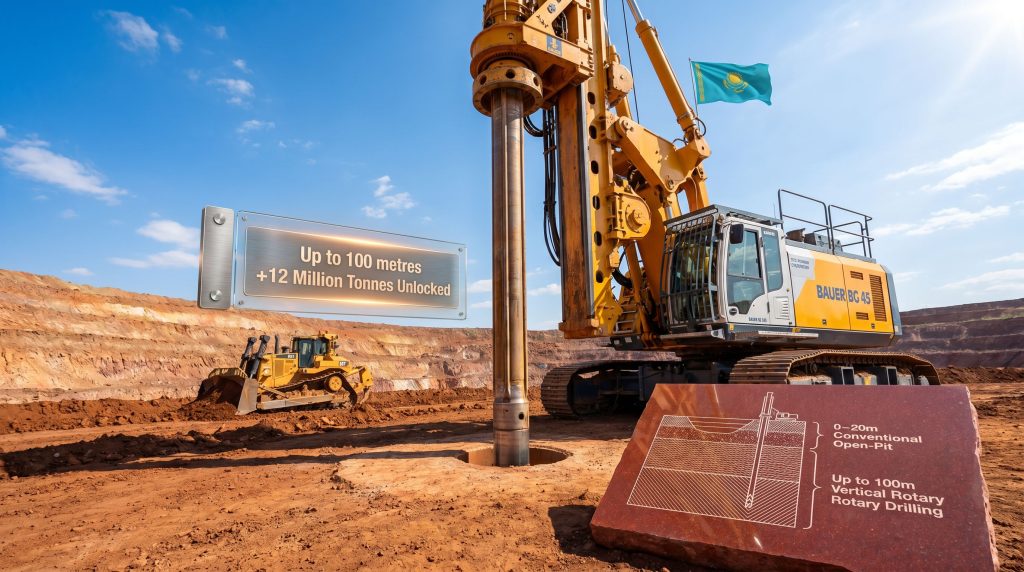
The centrepiece of the operation is a BAUER BG 45 heavy-duty hydraulic rotary drilling rig, a platform originally engineered for civil foundation construction and geotechnical investigation. Its adaptation for commercial bauxite extraction represents a cross-industry technology transfer with no direct precedent in global mining practice.
| Specification | Detail |
|---|---|
| Equipment Model | BAUER BG 45 Hydraulic Rotary Drilling Rig |
| Machine Weight | 133 tonnes |
| Engine Output | 580 hp |
| Key Attachments | Telescopic Kelly bar; bucket auger |
| Maximum Extraction Depth | Up to 100 metres |
| Original Design Purpose | Civil foundation piling and geotechnical work |
| Mining Application | First commercial adaptation for bauxite extraction globally |
Fitted with a telescopic Kelly bar and bucket auger, the rig extracts ore selectively by drilling vertical columns into the deposit. Ore is returned to surface through the auger mechanism, meaning operators can assess and manage the quality of material being extracted in real time. Critically, the entire process requires no explosives. There is no blasting cycle, no seismic disturbance, and no blast-induced fragmentation of surrounding geology.
The collaboration between Aluminium of Kazakhstan specialists and engineers from the German manufacturer BAUER was essential to making this adaptation work. The mechanical demands of extracting consolidated mineral ore differ substantially from the geotechnical conditions the equipment was designed for, and the engineering modifications required to make the transition viable were non-trivial.
Vertical Versus Conventional: A Direct Comparison
| Factor | Conventional Open-Pit Mining | Vertical Bauxite Mining |
|---|---|---|
| Depth Access | Limited by overburden economics | Up to 100 metres via rotary drilling |
| Overburden Removal | Large volumes required | Minimal within existing pit footprint |
| Blasting Required | Yes, in many operations | No |
| Ore Selectivity | Lower, bulk extraction approach | Higher, targeted vertical columns |
| Environmental Footprint | Larger land disturbance area | Confined to existing disturbed land |
| Seismic Impact | Present from blasting activity | Eliminated entirely |
| Primary Equipment | Dozers, excavators, blast rigs | Hydraulic rotary drilling rig |
The Kazakhstan Context: Why This Location and This Deposit
Kazakhstan's bauxite deposits are characterised by what KBRU operations director Ruslan Aslyamov has described as a complex geological structure, making deep-seated reserves increasingly costly to access through conventional means. This geological complexity is not simply a matter of depth. It reflects variability in ore body geometry, discontinuous mineralisation horizons, and the kind of structural irregularity that makes bulk open-pit extraction progressively less precise and less economical as operations mature.
The Pavlodar Aluminium Plant, which sits downstream in the supply chain and depends on KBRU for its bauxite feed, requires a stable and continuous raw material supply to maintain refinery throughput. Any reduction in KBRU's output rate translates directly into reduced alumina production capacity and, ultimately, constrained aluminium output. The pressure to extend the productive life of the KBRU operation is therefore not simply a mine-management issue. It is a supply chain continuity issue with consequences that cascade through the entire aluminium value chain.
Operating the vertical mining project within existing open-pit footprints at the Vostochno-Ayatskoye mine offers a significant practical advantage: the land is already disturbed, environmental baseline conditions have been established, and the regulatory complexity of opening new mining areas is avoided entirely.
The Reserve Extension Argument: What 12 Million Tonnes Actually Means
The vertical mining technology is projected to unlock an estimated additional 12 million tonnes of bauxite over the next decade from reserves previously classified as economically unrecoverable under conventional methods. To contextualise that figure, it is worth examining how it compares against leading global bauxite mines:
| Major Bauxite Operation | Location | Scale / Annual Capacity | Method |
|---|---|---|---|
| Guinea Alumina Corporation (GAC) | Boké Region, Guinea | ~12 million tonnes per annum | Open-pit / strip mining |
| Rio Tinto Queensland Operation | Queensland, Australia | ~50 million tonnes (full production) | Open-pit mining |
| Aurukun Bauxite Project (Glencore) | Queensland, Australia | ~8 million dry tonnes per year | Proposed open-cut |
| KBRU Vertical Mining Project | Kazakhstan | +12 million tonnes (decade projection) | Vertical rotary drilling |
Viewed through this lens, the volume being unlocked at KBRU through vertical extraction is equivalent to an entire year's output from one of the world's largest individual bauxite operations. At a mine that already has established infrastructure, downstream processing capacity, and trained workforce, recovering that volume through a new extraction method represents a materially different economic proposition compared to building a new mine from scratch.
Ivan Lobanov, chief mining engineer at Aluminium of Kazakhstan, has characterised the vertical mining project as an important strategic step for the company's Aluminium Division, noting that the technology enables cost reduction, significant decreases in overburden removal volumes, greater precision in ore extraction, more effective raw material quality management, and the development of sites that were previously uneconomical to work.
Ore Quality and Processing Efficiency
Beyond reserve volume, selective vertical extraction carries a less obvious but commercially significant benefit: improved ore grade consistency. Conventional bulk extraction at the margins of economic viability tends to incorporate increasing proportions of waste rock intermixed with bauxite ore. This dilution reduces the average grade of material delivered to the processing plant, increasing refinery costs per tonne of alumina produced and creating variability in feed quality that disrupts processing efficiency.
Vertical drilling extracts targeted columns of ore from within defined mineralised zones, physically separating them from surrounding waste material before they reach surface. The result is a higher-grade, more consistent feed to the Pavlodar Aluminium Plant, with direct implications for alumina recovery rates and refinery operating costs.
Environmental and Regulatory Dimensions
The environmental profile of vertical bauxite mining differs from conventional open-pit operations across several measurable dimensions:
- No blasting eliminates seismic disturbance to surrounding geology and any nearby infrastructure
- Reduced dust generation results from the absence of blast fragmentation and associated airborne particulate
- No new land clearing is required, as operations are confined entirely within existing disturbed open-pit footprints
- Lower heavy machinery intensity at surface reduces both noise pollution and the carbon footprint per tonne of ore extracted
- Real-time ore quality management reduces the volume of subeconomic material processed, cutting waste streams at the refinery
As mining jurisdictions globally continue tightening environmental permitting requirements, extraction technologies that demonstrably reduce land disturbance, eliminate blast-related impacts, and operate within existing disturbed footprints are likely to encounter lower regulatory friction in future project approvals. This represents a structural advantage that extends well beyond the immediate economics of any single operation.
In addition, discussions at the annual bauxite and alumina conference have increasingly centred on sustainability metrics, making the environmental credentials of vertical extraction particularly timely.
The next major ASX story will hit our subscribers first
The Limitations That Define Where This Technology Applies
Intellectual honesty requires acknowledging what vertical bauxite mining is not. The 100-metre maximum extraction depth of the BAUER BG 45 platform defines a specific operating window. It is neither a surface mining system nor an underground mining system. It occupies a depth range that sits between the economic ceiling of conventional open-pit methods and the threshold at which constructing underground infrastructure becomes justifiable.
This means the technology is not universally applicable. It is highly relevant at:
- Mature open-pit operations where near-surface reserves are substantially depleted
- Sites where confirmed deep-seated ore bodies sit within the 100-metre depth window
- Operations with existing downstream processing infrastructure that justifies reserve extension
- Locations where conventional overburden removal has become economically prohibitive
Where these conditions are not met simultaneously, the case for vertical extraction weakens considerably. Productivity rates for rotary drilling rigs are also inherently lower than bulk open-pit extraction at comparable ore grades. Vertical mining is designed to complement conventional operations, not replace them.
Additionally, KBRU employees are currently receiving hands-on training from BAUER engineers on-site, underscoring that the method requires a specialist skill set that does not yet exist within the broader mining workforce. Building that capability base will take time and structured investment in training infrastructure if the technology is to scale. For comparison, projects such as the Niagara bauxite project illustrate how diverse the technological and operational approaches to bauxite development have become across different jurisdictions.
What This Innovation Signals for the Broader Mining Industry
The more significant implication of the KBRU vertical bauxite mining project may not be operational but conceptual. It challenges a longstanding assumption embedded in how the industry classifies and values mineral reserves: that ore beyond the economic reach of conventional open-pit methods is effectively unrecoverable without transitioning to full underground operations.
If vertical extraction can be demonstrated to deliver consistent production data, predictable ore quality, and acceptable cost-per-tonne metrics at KBRU, it opens a question that reserve engineers and mine planners at mature operations globally will need to consider: how much previously stranded bauxite sits within the 100-metre depth window of existing open pits, and what is it now worth?
The cross-industry technology transfer model itself — adapting construction-grade geotechnical equipment for commercial mineral extraction through collaborative engineering between mining operators and original equipment manufacturers — may also provide a template applicable beyond bauxite. Other sedimentary ore bodies with similar depth profiles and conventional extraction cost challenges could potentially benefit from analogous approaches. However, demonstrating economic viability at KBRU is the prerequisite for any serious industry-wide conversation about broader adoption.
The BAUER BG platform's origins in civil foundation piling also point toward an underappreciated source of mining technology innovation: the construction and geotechnical engineering sectors. These industries operate at similar depth ranges and face comparable ground conditions but have developed distinct equipment traditions. Consequently, the boundary between these industries may prove more permeable than previously assumed, and operations such as the Metro Mining bauxite project in Queensland demonstrate how logistics and infrastructure innovation are equally transforming the sector.
Disclaimer: This article contains forward-looking projections, including the 12-million-tonne reserve recovery estimate, which are based on current technical assessments and operational assumptions. Actual outcomes may differ materially from projections depending on geological conditions, equipment performance, regulatory developments, and commodity market dynamics. Nothing in this article constitutes financial or investment advice.
Want to Know When the Next Major Mining Breakthrough Hits the ASX?
Discovery Alert's proprietary Discovery IQ model scans ASX announcements in real time, instantly identifying significant mineral discoveries and turning complex geological data into actionable investment insights — whether you're a short-term trader or a long-term investor seeking to capitalise on transformative opportunities like those that delivered exceptional returns for early investors in De Grey Mining and WA1 Resources. Start your 14-day free trial today and explore Discovery Alert's dedicated discoveries page to see how historic mineral discoveries have generated substantial market returns.