June 26, 2026
The Hidden Architecture of Value Destruction in Mining
Most conversations about mining productivity focus on what happens within functions. How fast can the drill operate? What is the cost per tonne at the crusher? How efficiently is the flotation circuit running? These are legitimate questions, but they share a structural limitation: they treat each stage of a mining operation as if it exists in isolation, accountable only to itself.
The reality is far more complex. Every decision made along the mining flowsheet sends signals downstream, and those signals can amplify, distort, or silently erode value in ways that never appear on a departmental scorecard. Understanding this interconnectivity is what a whole-of-value-chain perspective in mining is fundamentally about, and it represents one of the most underutilised levers in modern mining competitiveness.
When big ASX news breaks, our subscribers know first
What a Whole-of-Value-Chain Perspective Actually Means
Defining the End-to-End Mining System
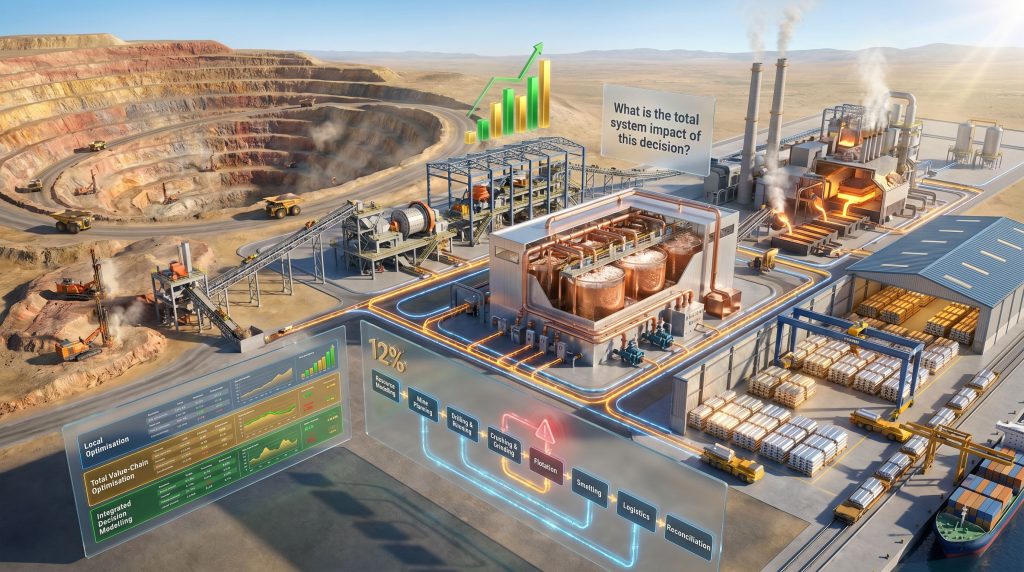
A whole-of-value-chain approach treats the mining operation not as a sequence of handoffs between departments, but as a single, interdependent system. Each stage contributes to, and depends upon, every other stage. Success is not measured at the function level; it is measured at the system level.
The key value chain stages and their interdependencies look like this:
| Value Chain Stage | Primary Function | Downstream Dependency |
|---|---|---|
| Resource Modelling | Ore quantity and quality estimation | Drives mine planning and scheduling |
| Extraction and Blasting | Ore removal and fragmentation | Shapes processing feed characteristics |
| Handling and Transport | Material movement | Affects throughput consistency |
| Processing and Flotation | Mineral separation and recovery | Determines concentrate quality |
| Smelting and Refining | Metal extraction and purification | Defines final product value |
| Environmental Management | Compliance and waste handling | Impacts long-term licence to operate |
| Reconciliation | Model-to-actual performance tracking | Identifies inefficiencies across all stages |
Reconciliation deserves particular attention here. It functions as the connective tissue of the value chain, revealing where the actual system performance diverges from what was planned. Without robust reconciliation across all stages, organisations are essentially navigating without feedback.
The Mindset Shift from Sequential to Systems Thinking
Traditional mine management thinking is sequential. Stage A completes its task and passes material to Stage B, which optimises its own performance, and so on. The problem is that optimising each stage independently does not produce an optimised system. In fact, it frequently produces the opposite.
Systems thinking reframes this entirely. A decision at Stage A is not evaluated purely on its local merit; it is evaluated on what it does to Stages B, C, D, and beyond. This is not a theoretical abstraction. It has direct, measurable consequences on margins, recovery rates, and operational costs.
The Organisational Complexity That Creates Blind Spots
When Functional Excellence Masks Systemic Failure
The mining sector has become genuinely skilled at building deep functional expertise. Procurement teams drive hard on cost. Metallurgists push recovery rates. Operations pursue productivity benchmarks. Each function has its own KPIs, its own reporting lines, and its own definition of success.
The structural problem this creates is that specialists are accountable for their area of responsibility without necessarily having visibility of what their decisions trigger downstream. A procurement decision may deliver a measurable cost reduction and register as a win on every internal metric. However, if that decision introduces a trace contaminant into the processing circuit, or shifts the fragmentation profile enough to alter grinding efficiency, the real cost of that saving will appear elsewhere — often in a different department's budget and attributed to a different cause.
A cost reduction achieved in one operational function does not constitute a genuine saving unless its net effect across the entire mining system remains positive. Upstream efficiencies that trigger downstream losses in recovery, reagent performance, or product quality can silently erode margins far in excess of the original saving.
The Procurement Paradox in Practice
Consider a simplified but illustrative example of how upstream savings can become downstream losses:
| Impact Stage | Observable Effect | Value Consequence |
|---|---|---|
| Blasting | Altered fragmentation profile | Marginal, within acceptable range |
| Crushing and Grinding | Increased energy consumption | Moderate cost increase |
| Flotation | Trace contaminant affects reagent efficiency | Significant recovery reduction |
| Smelting | Elevated impurity load increases processing complexity | Major cost and throughput impact |
| Final Product | Lower grade concentrate reduces sale price | Compounding revenue loss |
| Net System Outcome | Upstream saving eliminated; net loss realised | Negative total value impact |
Industry experience indicates that relatively modest savings achieved upstream can, under certain circumstances, be outweighed many times over by downstream losses when recovery, processing efficiency, environmental management, and product value are considered together. This is not an edge case. It is a structural risk embedded in organisations where functions are optimised independently. Furthermore, the mining industry evolution toward greater integration has made this risk increasingly visible and commercially significant.
Contaminants as a Case Study in Value-Chain Connectivity
How Trace Process-Borne Contaminants Travel Through a Flowsheet
One of the clearest illustrations of value-chain interdependency involves trace contaminants. When substances such as certain lead-bearing species enter a mining system at a single point, their effects rarely remain localised. As material moves through the flowsheet, these substances can accumulate, interact with processing reagents, and influence performance across multiple downstream stages in ways that are not immediately visible.
Documented downstream effects of unmanaged process-borne contaminants can include:
- Reduced flotation selectivity and concentrate grade
- Elevated reagent consumption across processing circuits
- Degraded metallurgical performance in smelting environments
- Increased complexity and cost of purification and refining stages
- Additional environmental monitoring and compliance obligations
- Suppressed final metal recovery rates
What makes this particularly challenging is a critical knowledge gap: published studies specifically investigating how certain contaminant species affect downstream metallurgical processes and reagent performance remain limited. For an industry that prides itself on technical rigour, this represents a meaningful blind spot. In addition, check sampling reliability plays a critical role in detecting contaminant pathways before they compound across the flowsheet.
The Accumulation Effect and Delayed Symptom Presentation
A mine may be aware that a contaminant is present in its system but not necessarily understand where it accumulates within the flowsheet, how it migrates between processing stages, or at what concentration threshold it begins to impair performance. By the time challenges become visible in a processing circuit, smelter, or refinery, the original source of introduction may no longer be part of the investigation.
The connection between cause and effect has been severed by time, distance, and departmental separation. This delayed symptom presentation is what makes siloed decision-making so commercially hazardous. The cost lands in a different period, in a different department, and is frequently attributed to a different cause than the one that actually generated it.
The Strategic and Financial Consequences of Siloed Decision-Making
Comparing Decision Frameworks by Risk Profile
| Decision Framework | Measurement Lens | Risk Profile |
|---|---|---|
| Local Optimisation | Departmental KPI: cost, productivity | High, downstream effects invisible |
| Total Value-Chain Optimisation | System-wide margin and recovery impact | Low, full consequence visibility |
| Integrated Decision Modelling | Cross-functional scenario analysis | Lowest, proactive bottleneck resolution |
The comparison above is not merely academic. Mining organisations operating under local optimisation frameworks are systematically blind to a category of risk that integrated frameworks would make visible. Different functions measuring success through different lenses, with different reporting cycles and different incentive structures, will reliably produce decisions that look correct locally and are damaging systemically.
The Compounding Effect of Small Disconnects
Value leakage in mining is rarely the result of a single catastrophic decision. It accumulates through dozens of small disconnects, each individually defensible, collectively destructive. A minor fragmentation variance here. A slightly elevated reagent demand there. A marginal reduction in flotation recovery. Individually, none of these registers as a crisis. Together, they can represent a significant and sustained drag on margin that never appears as a line item in any budget.
Why Integrated Value-Chain Thinking Is Now a Commercial Imperative
Margin Pressure, Sustainability Obligations, and Asset Productivity
Mining organisations face a convergence of pressures that make the status quo increasingly expensive to maintain. Commodity price volatility compresses margins. Environmental and sustainability obligations are intensifying. Ageing assets require more sophisticated management to sustain productivity. In this context, the hidden value destruction embedded in siloed decision-making is no longer an acceptable operational inefficiency.
Mining organisations that embed a whole-of-value-chain perspective into their decision-making gain measurable advantages across several dimensions:
- Bottleneck Detection — System-wide visibility enables early identification of throughput constraints before they escalate into production losses.
- Margin Optimisation — Scenario modelling across commodity price environments allows value-chain configuration for maximum returns under varying conditions.
- Resilience and Agility — End-to-end data transparency creates operational flexibility during disruption events, whether supply-side, environmental, or market-driven.
- Silo Dissolution — Cross-functional coordination replaces sequential departmental handoffs with concurrent, informed decision-making.
- Environmental Performance — Integrated management reduces compliance risk by tracking material flows and waste streams holistically rather than by functional area.
- Worker Safety — System-level hazard visibility reduces exposure risks that may not be apparent within a single functional area.
The Global Dimension: Local Decisions With International Consequences
As mining value chains extend across international borders, the implications of local production decisions have expanded significantly. A change in input materials at a mine site can affect the performance of a concentrator in a different region, the economics of a smelter on another continent, and the compliance posture of an end buyer operating under tightening supply chain legislation. The OECD's analysis of the mining global value chain provides valuable context on how these cross-border interdependencies are reshaping operational accountability.
As mining value chains extend across international borders, local production decisions increasingly carry global implications — including exposure to climate-related disruption, human rights compliance obligations, and the capacity constraints of local suppliers in developing economies.
This global dimension adds urgency to the case for integrated value-chain thinking. Consequently, the consequences of decisions are no longer bounded by geography or organisational structure.
The next major ASX story will hit our subscribers first
How Mining Operations Can Implement a Whole-of-Value-Chain Framework
Organisational Design Requirements
Transitioning to integrated value-chain management requires structural change across three core domains:
Organisational Design
- Establish dedicated cross-functional value-chain teams with shared performance metrics that span departmental boundaries
- Align KPIs across procurement, operations, processing, metallurgy, and environmental functions toward common system-level outcomes
- Build executive visibility into system-wide performance rather than aggregated departmental outputs
Data and Technology Architecture
- Deploy infrastructure capable of capturing, tracking, and cleaning operational data across all value-chain stages in near real time
- Integrate advanced analytics models to support cross-functional decision-making with downstream consequence modelling
- Enable simulation capabilities, including digital twins, to model the downstream effects of upstream operational changes before they are implemented
Process and Culture
- Adopt continuous improvement methodologies at the system level rather than at the functional level
- Create feedback loops that connect downstream performance outcomes back to the upstream decision-makers whose choices generated them
- Embed a cultural norm of asking: what is the total system impact of this decision?
Technology Enablers: From Digital Twins to Real-Time Flowsheet Monitoring
The technology infrastructure required to support whole-of-value-chain management has matured considerably. Data-driven mining operations now underpin this shift, providing the real-time sensor networks and analytics platforms needed to make cross-functional consequence modelling genuinely actionable.
Digital twin platforms can now simulate entire processing flowsheets, allowing operators to model the downstream consequences of upstream changes in a controlled environment before committing to implementation. Furthermore, 3D geological modelling has become a foundational capability that feeds directly into value-chain planning at the resource estimation stage.
The technology is not the barrier. The barrier is organisational willingness to invest in the integration architecture and cultural change required to make that technology actionable. McKinsey's analysis of the mine-to-market value chain reinforces this point, noting that the greatest untapped value in mining often lies in integration rather than extraction efficiency alone.
Frequently Asked Questions: Whole-of-Value-Chain Perspective in Mining
What does whole-of-value-chain mean in a mining context?
It refers to an operational and strategic framework that treats the entire mining process — from resource modelling to final product delivery — as a single interconnected system. Decisions are evaluated based on their impact on total system performance rather than departmental metrics alone.
How does this differ from traditional mine optimisation?
Traditional mine optimisation typically focuses on improving performance within individual functions. Whole-of-value-chain optimisation focuses on improving performance across the connections between functions, which is where the most significant and least visible value is often lost.
What types of decisions benefit most from this approach?
Procurement decisions involving input materials, changes to blasting or extraction practices, processing chemistry adjustments, and any operational change that touches a stage upstream of smelting or refining all carry significant downstream consequence potential. A definitive feasibility study conducted with full value-chain integration will, however, capture these interdependencies far more effectively than one conducted in functional silos.
How do contaminants introduced during blasting affect downstream performance?
Trace contaminants introduced during blasting or from initiating system materials can persist through crushing, grinding, and flotation circuits. They can impair reagent selectivity, reduce flotation recovery, elevate impurity loads in concentrate, and complicate smelting and refining operations. The full cost of their introduction is rarely visible at the point where they enter the system.
How should mining companies measure success under this framework?
Success metrics should shift from departmental cost and productivity targets toward system-level indicators: total metal recovery across the chain, cost per unit of final product, overall margin performance, environmental compliance track record, and long-term asset productivity. Reconciliation across all stages provides the measurement foundation.
The Future Competitive Frontier: Systems Thinking as a Strategic Differentiator
Why the Greatest Opportunities Exist Between Functions
The most consequential insight embedded in whole-of-value-chain thinking is also the most counterintuitive: the greatest risks and the greatest opportunities in a mining operation are rarely contained within any single department. They exist in the spaces between departments — in the handoffs, the assumptions, and the decisions made without full visibility of their downstream consequences.
Mining organisations that understand this will increasingly outperform those that do not. Not because they have better equipment or more talented specialists, but because they have better information about what their decisions actually cost and create across the full system.
Building the Integrated Mining Enterprise
The transition toward integrated value-chain management is not a technology project or a process redesign exercise. It is a fundamental shift in how mining leadership defines value, measures performance, and structures accountability. It requires executives to hold a system-wide view, functional leaders to operate with transparency about the downstream effects of their decisions, and organisations to build the data infrastructure that makes cross-functional consequence modelling possible.
The mining organisations best positioned for long-term competitiveness will not necessarily be those with the most efficient individual departments. They will be those that most consistently understand, measure, and optimise the connections between them. The question is no longer whether to adopt a whole-of-value-chain perspective in mining, but how quickly it can be embedded as a core decision-making discipline.
The industry has spent decades perfecting what happens within each stage of the mining process. The next competitive frontier is perfecting what happens between them.
Readers interested in exploring additional perspectives on integrated mining systems and value-chain management can find related industry commentary at Global Mining Review's article "Why Mining Needs a Whole-of-Value-Chain Perspective", which offers supplementary industry context from an operational standpoint.
Want to Identify the Next Major ASX Mining Discovery Before the Broader Market?
Discovery Alert's proprietary Discovery IQ model delivers real-time alerts on significant ASX mineral discoveries, instantly translating complex mineral data into actionable investment insights — giving both short-term traders and long-term investors a measurable edge the moment a discovery is announced. Explore how historic discoveries have generated substantial returns and begin your 14-day free trial today to position yourself ahead of the market.