June 26, 2026
Why the World's Mining Leaders Are Converging on Lima in 2026
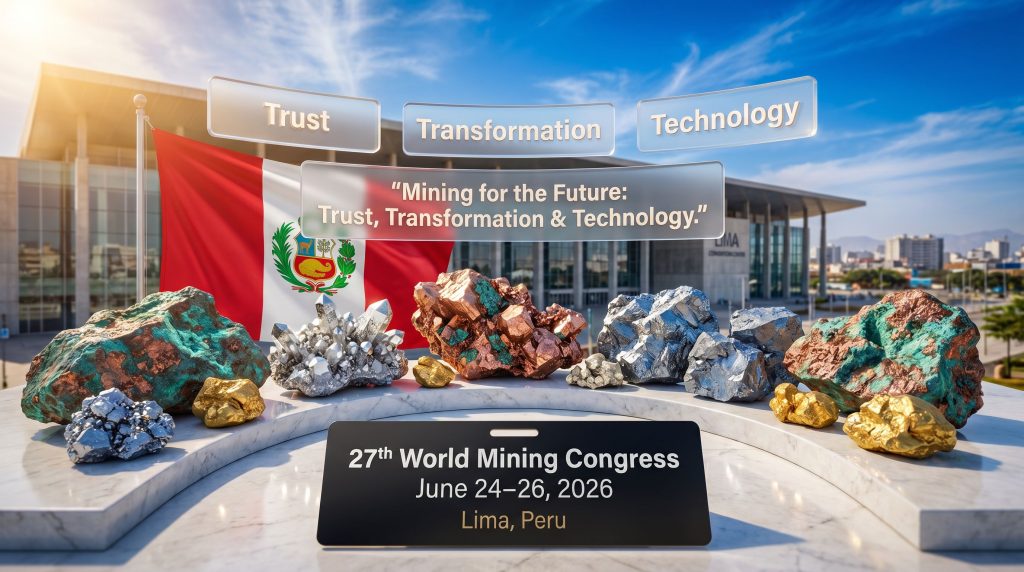
Every few decades, the centre of gravity in global mining shifts. Not in terms of where the ore lies underground, but in terms of where the decisions get made, where the relationships are forged, and where the standards of the future are quietly negotiated over conference tables. The World Mining Congress no Peru, unfolding in Lima across June 24 to 26, 2026, represents exactly one of those inflection points. For an industry navigating the dual pressures of the energy transition and intensifying geopolitical competition for mineral resources, a gathering of this scale carries consequences that extend well beyond a three-day event calendar.
When big ASX news breaks, our subscribers know first
Why Peru? Understanding Lima's Role as the 2026 Host
Peru is not a peripheral player in global mining. It consistently ranks among the world's top five producers of copper, zinc, silver, and gold, making it one of the most mineralogically diverse nations on earth. The decision to bring the World Mining Congress no Peru for its 27th edition reflects that status directly. Lima's Convention Center in San Borja (Calle del Comercio 192) provides a venue capable of hosting thousands of international delegates within a city that has grown into one of Latin America's most prominent diplomatic and commercial hubs.
The timing carries additional cultural resonance. The congress coincides with Peru's Inti Raymi, the Festival of the Sun, a celebration with roots in Inca tradition that honours the relationship between the land, natural resources, and human civilisation. For an industry increasingly pressed to articulate its social and cultural contract with host communities, this symbolic alignment is not incidental.
Here is a snapshot of the event's core parameters:
| Attribute | Detail |
|---|---|
| Edition | 27th World Mining Congress |
| Host City | Lima, Peru |
| Venue | Lima Convention Center, San Borja |
| Dates | June 24 to 26, 2026 |
| Theme | Mining for the Future: Trust, Transformation and Technology |
| Organizer | Institute of Mining Engineers of Peru (IIMP) |
| Expected Attendees | 3,000+ global mining professionals |
What Is the World Mining Congress and How Does It Actually Work?
The World Mining Congress is one of the few truly multilateral forums in the extractive industries sector. Unlike trade expos or commodity conferences, it operates as a structured dialogue platform connecting governments, private corporations, academic institutions, and multilateral development organisations under a single technical and policy framework.
Its mandate spans four interlocking domains:
- Innovation in extraction and processing technology
- Operational safety standards and international benchmarking
- Environmental stewardship and sustainable mineral development
- Knowledge transfer between developed and developing mining economies
The congress is governed by the International Organising Committee (IOC), which coordinates host-nation selection, agenda development, and the institutional participation of member countries between editions. Critically, on June 23, 2026, the day before the main event opened, the IOC convened a preparatory meeting in Lima attended by representatives from multiple nations. These pre-congress IOC sessions are where much of the substantive governance work happens, including the formal confirmation of future host nations.
The confirmed schedule of future editions reveals a great deal about where global mining influence is heading: China in 2028 and Canada in 2031. The sequencing of these selections reflects the IOC's awareness of who controls the dominant supply and demand nodes in the critical minerals economy.
Unpacking the 2026 Theme: Trust, Transformation and Technology
The thematic architecture of WMC 2026 was not assembled arbitrarily. Each of its three pillars maps onto a structural challenge the global mining industry is actively wrestling with.
Trust addresses what industry professionals call the social licence to operate, the informal but powerful mandate that mining companies must earn from local communities, indigenous groups, and civil society before, during, and after extraction. Across Latin America, community opposition has stalled or cancelled numerous major projects, making trust-building frameworks an urgent operational and financial priority.
Transformation speaks to the seismic structural shifts underway in mining business models. The energy transition is simultaneously the industry's greatest demand catalyst and its most complex reputational challenge. Furthermore, mining companies must supply the materials that enable decarbonisation while managing the environmental footprint of their own operations. This contradiction is reshaping capital allocation, project prioritisation, and corporate strategy across the sector. Mining's transformation in 2025 offers useful context on how electrification and decarbonisation are already reshaping the sector ahead of the WMC.
Technology encompasses the accelerating deployment of automation, artificial intelligence, remote sensing, and digital twin modelling in mine planning and operations. Digital twins, which create real-time virtual replicas of physical mine environments, are enabling operators to simulate production scenarios, optimise ore recovery, and reduce safety incidents before they occur in the physical world. These technologies are no longer experimental; they are becoming competitive necessities.
Critical Minerals and Latin America's Strategic Position
The WMC arrives at a moment when the minerals underpinning the global energy transition, particularly lithium, copper, cobalt, and rare earth elements, are the subject of intense geopolitical competition. Latin America sits at the centre of this dynamic in ways that are still not fully appreciated by mainstream investment audiences. In addition, the critical minerals demand surge already underway in 2025 is amplifying the strategic importance of this region considerably.
Peru, Chile, and Bolivia collectively form what analysts describe as the Lithium Triangle and the Andean copper belt, two of the most strategically significant mineral concentrations on the planet. Peru alone accounts for a substantial share of global copper production, a metal whose demand trajectory is directly tied to electric vehicle manufacturing, grid infrastructure, and renewable energy systems.
For WMC 2026, this translates into a policy agenda that goes beyond technical papers. The congress functions as a diplomatic forum where mineral-rich nations can engage directly with demand-side governments and corporate procurement teams seeking to diversify and secure supply chains that have become dangerously concentrated.
Who Sits in the Room? The WMC Stakeholder Ecosystem
Understanding who attends the World Mining Congress is essential for grasping its real-world significance. The participant mix is deliberately broad:
- Government delegations and regulators, including trade ministers, geological survey agencies, and policy architects shaping national mining frameworks
- Private sector representatives ranging from major diversified miners to mid-tier producers and junior exploration companies seeking capital and partnerships
- Academic and research institutions presenting technical papers, geological studies, and innovation research through the congress's formal scientific track
- Multilateral organisations such as the World Bank and the International Finance Corporation, which maintain active mining mandates tied to development finance
The presence of over 3,000 registered professionals from across multiple continents gives the congress a density of decision-making capacity that few other industry forums can match. For junior explorers and smaller operators, the WMC represents a rare opportunity to sit alongside institutional capital, government counterparts, and technical experts in a single venue. Consequently, the geopolitical landscape for metals and mining in 2025 makes participation at forums like this more strategically valuable than ever.
Brazil's Relationship With the WMC: More Than a Neighbouring Spectator
Brazil's engagement with the World Mining Congress carries its own institutional history. In 2016, Brazil hosted the 24th World Mining Congress in Rio de Janeiro, with the Brazilian Mining Institute, known as IBRAM, serving as the primary organiser. That event placed Brazil at the centre of global mining governance discourse and reinforced its identity as a major mining nation.
A decade on, Brazil's sustained engagement with the WMC's governing structure continues. Brazil participated in the IOC preparatory meeting held in Lima on June 23, 2026, maintaining its seat at the table where future congress agendas and hosting decisions are shaped.
The strategic rationale is clear. Brazil is one of the world's dominant producers of iron ore, niobium, bauxite, and lithium, and its presence within the IOC framework ensures that its policy positions and industry priorities remain visible to the international mining community between hosting cycles.
The contrast between Brazil and Peru as Latin American mining powers is instructive:
| Dimension | Brazil | Peru |
|---|---|---|
| Top Commodities | Iron ore, niobium, bauxite, lithium | Copper, zinc, silver, gold |
| WMC Hosting History | 2016 (24th edition, Rio de Janeiro) | 2026 (27th edition, Lima) |
| Regional Standing | Largest economy in Latin America | Top-5 global copper and zinc producer |
| Key ESG Challenges | Amazon deforestation, tailings dam safety | Community water rights, indigenous land access |
The next major ASX story will hit our subscribers first
The Long Game: What China 2028 and Canada 2031 Signal
The IOC's confirmation of China as the 2028 host and Canada as the 2031 host reveals a calculated sequencing. China is the world's largest consumer of virtually every major mined commodity and is aggressively positioning itself as a standard-setter in processing and refining technology. Hosting the WMC allows Beijing to shape the framing of critical mineral narratives within a multilateral technical forum rather than exclusively through bilateral trade channels.
Canada's 2031 hosting rights are equally significant. Canada occupies a unique position as both a major producer and a Western-aligned nation with deep institutional frameworks around environmental regulation and indigenous consultation. In a period when the United States and Canada are actively coordinating on critical mineral supply chain security, the 2031 congress will likely serve as a platform for advancing North American mineral cooperation frameworks to a global audience. The PDAC conference insights from 2025 illustrate how Canada-hosted gatherings already function as pivotal moments for shaping global industry direction.
For nations and companies planning multi-year engagement strategies, the WMC rotation calendar provides a useful map of where institutional momentum in global mining governance will be concentrated through the early 2030s.
Knowledge Exchange as a Long-Term Economic Asset
One dimension of the WMC that receives less attention than its networking and policy functions is its role as a knowledge diffusion mechanism. The congress maintains a rigorous academic and technical track, with peer-reviewed papers, geological research presentations, and technology demonstrations contributing to the global mining knowledge base in ways that persist long after the event closes.
For developing economies with significant mineral endowments, this knowledge transfer function is materially valuable. Access to international best practices in areas like tailings management, hydrogeological modelling, and ore processing efficiency can meaningfully improve project economics and reduce environmental risk profiles, outcomes that translate directly into financing terms and investor confidence.
The institutional relationships formed at WMC events, between geological institutes, university research departments, and corporate technical teams, frequently evolve into joint venture discussions, exploration partnerships, and bilateral cooperation agreements that generate economic value for years afterward. However, this downstream effect is rarely captured in headline coverage of the congress but represents one of its most durable contributions to the global industry. For instance, the copper supply crunch already emerging in 2025 underscores precisely why these long-term partnerships matter so much.
Frequently Asked Questions: World Mining Congress in Peru
What is the World Mining Congress?
The World Mining Congress is one of the most significant international forums in the global mining sector, convening governments, corporations, academic institutions, and multilateral organisations to advance knowledge sharing, debate policy, and establish best practices across mineral extraction, processing, and governance.
Where is the 2026 World Mining Congress being held?
The 27th edition is being held at the Lima Convention Center in San Borja, Lima, Peru, from June 24 to 26, 2026.
Who organises the World Mining Congress no Peru?
The Institute of Mining Engineers of Peru (IIMP) is the primary organiser, working in coordination with the International Organising Committee.
What is the theme of WMC 2026?
The official theme is Mining for the Future: Trust, Transformation and Technology, reflecting the industry's convergence of ESG accountability, structural business model change, and technological deployment.
Where will future World Mining Congresses be held?
The 2028 edition is confirmed for China and the 2031 edition will be hosted by Canada.
How many people attend the World Mining Congress?
WMC 2026 is expected to draw more than 3,000 professionals, including industry executives, government officials, researchers, and investors from across the globe.
Readers seeking further context on Brazil's role in international mining forums and the broader Latin American minerals sector can access sector data, event coverage, and policy positioning materials through the Brazilian Mining Institute (IBRAM) at ibram.org.br.
Want to Know When the Next Major Mineral Discovery Hits the ASX?
Discovery Alert's proprietary Discovery IQ model delivers real-time alerts on significant ASX mineral discoveries, instantly transforming complex geological data into actionable investment insights — ideal for investors looking to capitalise on the critical minerals driving the energy transition. Explore historic discoveries and their market returns, then begin your 14-day free trial to position yourself ahead of the broader market.