
June 26, 2026
When Courts Define the Boundaries of Environmental Law, Industry Moves Forward
Across the developed world, the gap between what environmental law requires and what environmental advocates want has become one of the most consequential fault lines in energy project development. Nowhere is this more visible than in Australia, where the Australia court dismisses action against Beetaloo gas ruling has drawn renewed attention to how courts interpret regulatory obligations for unconventional gas development. Consequently, the Beetaloo sub-basin has become a critical test case, with Federal Court and Northern Territory Supreme Court rulings progressively mapping the outer edges of regulatory obligation, without ever fully resolving the underlying policy debate.
The question at the centre of these disputes is deceptively simple: at what point does an exploratory gas activity trigger mandatory federal environmental scrutiny? The answer, as Australian courts have repeatedly demonstrated, depends almost entirely on how strictly statutory thresholds are interpreted, and not on the scale of community concern or the potential long-term consequences of the development pathway being opened.
Understanding what the June 2026 Federal Court dismissal actually decided, and perhaps more importantly what it left entirely untouched, requires a close reading of Australia's layered approval architecture and the specific legal provisions being tested.
When big ASX news breaks, our subscribers know first
Australia's Dual-Track Approval System for Onshore Gas Projects
Unconventional gas development in Australia's Northern Territory operates under two distinct and largely parallel regulatory frameworks. The NT government functions as the primary approving authority for exploration activities, including the assessment and approval of Environment Management Plans, or EMPs. These documents govern how a project manages environmental risks during the exploration phase, covering everything from well integrity to waste disposal.
Sitting alongside this territorial layer is the federal government's jurisdiction under the Environment Protection and Biodiversity Conservation Act 1999 (EPBC Act). Federal oversight is not automatic. It is triggered only when a proposed action meets specific statutory thresholds, the most relevant of which, for unconventional gas, is the water trigger introduced in 2013. Furthermore, the geopolitical landscape for mining adds additional pressure on governments to clarify how these frameworks apply to strategically significant energy resources.
How the EPBC Act Water Trigger Works
The water trigger requires mandatory federal environmental assessment for any coal seam gas or large coal mining project that is likely to have a significant impact on a water resource. The threshold concept of "significant impact" is not defined with mathematical precision in the legislation, which is precisely why it has become the battleground for Beetaloo litigation.
Regulatory Key Concept: The water trigger does not apply to all unconventional gas activity. It applies specifically where a significant impact on a water resource can be established. The evidentiary burden of demonstrating this threshold has, to date, proved difficult for environmental litigants to satisfy in the context of exploratory well programmes.
It is worth noting that the Beetaloo sub-basin's geology adds a layer of genuine scientific complexity to this question. The sub-basin sits within the McArthur Basin, an ancient geological formation containing the Beetaloo shale interval at depths of roughly 2,000 metres. Critically, the region also contains shallower freshwater aquifers that Indigenous communities and pastoral operations depend upon. The physical separation between these aquifer systems and the target shale formations is a central point of technical and legal dispute.
The Lock the Gate Alliance Case: What the Court Actually Found
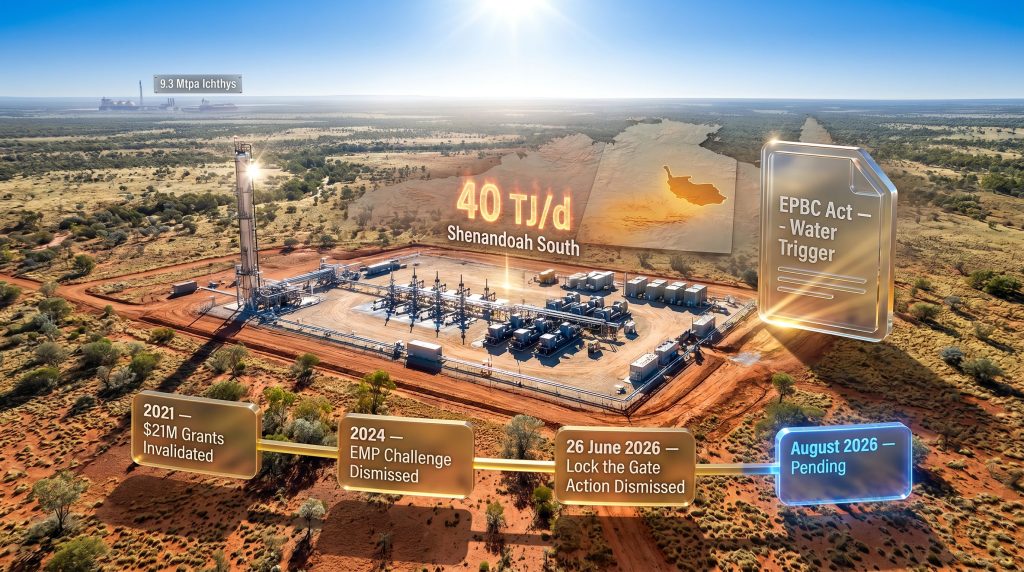
On 26 June 2026, Federal Court Justice Nicholas Owens dismissed the Lock the Gate Alliance's application to halt development at Tamboran Resources' 40 TJ/d Shenandoah South pilot project, located approximately 500 kilometres south-east of Darwin in the Northern Territory.
The Lock the Gate Alliance, a coalition that campaigns against fossil fuel expansion across Australia, had argued that the federal government was required to assess the Shenandoah South project under the EPBC Act before hydraulic fracturing could proceed. Justice Owens' ruling turned on a single evidentiary finding: the applicant had not established that the project would produce a significant impact on a water resource, the precise threshold that would have activated mandatory federal oversight.
What the Ruling Does Not Resolve
The dismissal of this particular case removes one near-term legal impediment to Tamboran's July to September 2026 first gas target, but it does not extinguish all active legal challenges to Beetaloo gas development.
Critical Distinction: A separate Federal Court proceeding specifically testing the water trigger's application to Beetaloo development remains active. Final submissions in that case are anticipated in August 2026. The outcome of this second proceeding could carry significantly greater national implications than the dismissed Lock the Gate action, as it directly contests the scope and application of federal water protections for unconventional gas projects across Australia's onshore basins.
The two cases differ in important ways. The Lock the Gate action targeted the Shenandoah South pilot project specifically. The pending water trigger case is understood to engage the water protection provisions more broadly, potentially redefining how the federal government's assessment obligations apply to unconventional gas exploration across multiple tenements.
A Litigation Landscape Built Case by Case
The June 2026 dismissal is the latest in a sequence of legal challenges that have collectively shaped, rather than resolved, the regulatory trajectory of Beetaloo gas development. Each ruling has added a data point to the emerging picture of where Australian courts draw the line between legitimate environmental scrutiny and impermissible regulatory expansion.
| Legal Action | Court | Plaintiff | Outcome | Key Finding |
|---|---|---|---|---|
| Gas Grants Invalidity Case (2021) | Federal Court | Environmental litigants | $21M in grants to Imperial Oil & Gas invalidated | Minister not required to assess climate risks for exploration-only grants |
| EMP Approval Challenge (2024) | NT Supreme Court | Central Australian Frack Free Alliance (CAFFA) | Dismissed on all four grounds | Ministers not required to assess long-term climate risks for exploratory EMP approvals |
| Shenandoah South EPBC Challenge (2026) | Federal Court | Lock the Gate Alliance | Dismissed | Significant water impact threshold not established |
| Federal Water Trigger Case (pending) | Federal Court | TBC | Pending, final submissions August 2026 | Could redefine national water protection obligations for unconventional gas |
The 2021 Federal Court ruling that invalidated $21 million in Beetaloo exploration grants to Imperial Oil & Gas is frequently cited in this context, but its significance is often misread. That case was decided on procedural and administrative law grounds, finding that the relevant minister had not properly assessed climate risks before approving the grants. It was not a finding on the environmental merits of Beetaloo development itself, and it did not permanently block any exploration activity.
The 2024 NT Supreme Court ruling in the CAFFA case is arguably more instructive for understanding how courts approach the scope of ministerial obligation. Chief Justice Michael Grant found that the NT government's assessment obligations when approving an EMP do not extend to anything that might conceivably occur in the future beyond the specific exploration activity being approved. This reasoning has since informed how subsequent challenges have been framed and, ultimately, dismissed.
The 2022 EMP Compliance Breach: An Underreported Regulatory Episode
One element of the Beetaloo regulatory record that has received comparatively little attention is a reported compliance breach by Imperial Oil & Gas in 2022 involving allegations that underground barriers between aquifer systems were not properly installed during well operations. The NT government's response was to issue a behaviour-change letter rather than pursue prosecution. This episode raises unresolved questions about the rigour of ongoing regulatory oversight, independent of the litigation process, and it illustrates the distinction between the legal architecture that governs approvals and the practical enforcement culture that governs operations.
The NT Government's Commercial Role: Regulator and Underwriter
A structural feature of the Beetaloo regulatory environment that distinguishes it from most comparable onshore gas jurisdictions is the NT government's simultaneous role as both the primary approving authority and a commercial stakeholder in the project's success. In this respect, government intervention in mining and energy development raises important questions about where regulatory independence ends and commercial interest begins.
In 2024, the NT government entered into a take-or-pay gas sales agreement with Tamboran Resources. Under this structure, the government assumes financial exposure if Tamboran fails to deliver contracted gas volumes. This is not a regulatory instrument. It is a commercial risk transfer mechanism that effectively makes the NT government a party to the project's commercial outcome, creating governance tensions that are not fully resolved by the approval and oversight processes designed to ensure regulatory independence.
Darwin LNG and the Strategic Infrastructure Context
The strategic rationale for the NT government's position is not difficult to understand when the regional infrastructure context is mapped out.
- Darwin is home to the 9.3 million tonne per annum Ichthys LNG facility and the 3.7 million tonne per annum Darwin LNG (DLNG) terminal
- DLNG holds export permits for up to 10 million tonnes per annum, well above its current throughput capacity
- Santos, as the domestic independent operating DLNG, has identified Beetaloo-sourced gas as a potential feedstock for a facility expansion that would bring throughput closer to the permitted ceiling
- Santos plans to drill three Beetaloo appraisal wells from July 2026, with a 9 to 12 month testing programme to determine whether a final investment decision on broader development is commercially justifiable
The proximity of the Beetaloo sub-basin to Darwin's existing LNG export infrastructure is a material factor in the basin's commercial attractiveness. Unlike many frontier shale gas plays that face significant greenfield infrastructure requirements, Beetaloo development can potentially leverage existing liquefaction capacity, permitted export volumes, and established shipping relationships with Asian LNG buyers.
The Deeper Policy Question: Should Exploration Approvals Require Lifecycle Assessment?
The pattern across the Beetaloo litigation record is consistent: courts have declined to impose on ministerial approval processes assessment obligations that extend beyond the specific activity being authorised. Environmental litigants have repeatedly argued that approving exploration is functionally inseparable from enabling production, and that the cumulative environmental impact of a full development pathway should be assessed before exploration commences.
Australian courts have not accepted this reasoning. Chief Justice Grant's 2024 formulation, that ministerial obligations do not extend to anything that might conceivably occur in the future, captures the judicial position succinctly. However, this approach continues to be challenged by those who view the critical raw materials transition as inseparable from robust oversight of fossil fuel expansion.
Policy Debate Snapshot: Environmental law scholars argue the water trigger's significant impact threshold is insufficiently precautionary for unconventional gas development in geologically complex basins where subsurface connectivity between aquifer systems cannot always be fully characterised at the exploration stage. Industry groups counter that applying production-phase assessment standards to exploratory activities would make commercially viable appraisal programmes legally unworkable, chilling investment in domestic gas supply at a time of projected shortfall.
Comparing Stakeholder Positions
| Stakeholder | Position | Key Argument |
|---|---|---|
| Tamboran Resources | Pro-development | Regulatory approvals are lawful; pilot project is essential for NT gas supply |
| Santos | Pro-development | Beetaloo appraisal critical to Darwin LNG expansion feasibility |
| NT Government | Pro-development | Take-or-pay agreement reflects energy security and economic development priorities |
| Lock the Gate Alliance | Anti-development | Federal water protections should apply; EPBC Act review required |
| CAFFA | Anti-development | EMP approvals should require long-term climate and production risk assessment |
| Federal Government | Neutral/regulatory | Reservation scheme and EPBC framework define the boundary of federal oversight |
Indigenous land and water rights remain an area of ongoing policy sensitivity in the Beetaloo region that the litigation process has not fully addressed. The sub-basin sits across land of deep cultural and practical importance to Aboriginal communities who rely on groundwater resources that sit above the target shale formations. This dimension of the regulatory debate operates somewhat separately from the statutory water trigger framework and is likely to remain a point of contention regardless of how the pending Federal Court case is resolved.
The next major ASX story will hit our subscribers first
Three Scenarios for Beetaloo's Development Trajectory Through 2027
The June 2026 court dismissal clears one pathway, but the development outlook for the Beetaloo sub-basin remains genuinely uncertain across three plausible scenarios.
Scenario 1: Unimpeded Development
The pending Federal Court water trigger case is dismissed or resolved in favour of developers. Santos' appraisal programme confirms commercial viability across the three-well programme. Tamboran achieves first gas in the July to September 2026 quarter as planned. Darwin LNG expansion proceeds toward a final investment decision, underpinned by Beetaloo supply projections.
Scenario 2: Regulatory Delay
The pending water trigger case produces an adverse ruling requiring federal environmental assessment before further hydraulic fracturing can proceed. Development pauses while Tamboran and Santos navigate a revised approval process. The NT government's take-or-pay obligations create fiscal pressure, and the Darwin LNG expansion timeline slips by at least 18 to 24 months.
Scenario 3: Structural Reform
The water trigger case triggers legislative reform of the EPBC Act, potentially introducing new federal standards specifically designed for unconventional gas exploration in water-sensitive geological settings. Beetaloo development ultimately proceeds but under a more stringent and better-defined regulatory framework, with greater certainty for all parties over the long term.
How Beetaloo Fits Into Australia's Broader Gas Supply Picture
The Beetaloo litigation is not occurring in isolation from the broader Australian gas market. The federal government's gas reservation scheme, which is scheduled to commence on 1 July 2027 and will require LNG exporters to reserve 20 per cent of shipped volumes for the domestic market, has introduced a new layer of commercial uncertainty for producers and LNG buyers alike. In addition, Australia's resource and energy exports face mounting pressure as domestic supply dynamics shift and new regulatory frameworks take hold.
Eastern Australia faces a projected gas supply shortfall later this decade as legacy conventional fields decline. Beetaloo's potential to contribute substantial new supply volumes, routed through Darwin LNG for export while also contributing to domestic reservation obligations, makes the basin's regulatory status a matter of national energy policy interest. Furthermore, the mining industry evolution underway across Australia means that how Beetaloo is ultimately developed will likely serve as a template for future unconventional energy projects nationwide.
The Australia court dismisses action against Beetaloo gas outcome removes a near-term legal obstacle to first gas production, but the broader regulatory architecture remains unsettled. The pending water trigger case, the evolving federal reservation scheme, and the unresolved questions around Indigenous water rights and enforcement culture collectively ensure that Beetaloo will remain one of the most closely watched unconventional gas developments in the Asia-Pacific region through 2027 and beyond.
This article is analytical and informational in nature. It does not constitute legal, financial, or investment advice. Projections, scenarios, and regulatory interpretations discussed herein involve uncertainty and should not be relied upon as definitive outcomes. Readers should seek independent advice appropriate to their circumstances.
Want to Stay Ahead of Significant ASX Mineral Discoveries in Real Time?
While regulatory battles shape the future of Australia's energy landscape, Discovery Alert's proprietary Discovery IQ model scans ASX announcements daily, delivering instant alerts on significant mineral discoveries across 30+ commodities — turning complex data into actionable investment insights for both short-term traders and long-term investors. Explore historic discoveries and their extraordinary returns, then begin your 14-day free trial at Discovery Alert to position yourself ahead of the broader market.