June 26, 2026
The Industrialisation Equation: Why Green Hydrogen Is South Africa's Most Complex Industrial Bet
Across the global energy transition, a familiar pattern has emerged: resource-rich nations with exceptional renewable endowments are discovering that the ability to produce clean energy molecules is far less valuable than the ability to transform them into finished industrial goods. This distinction sits at the heart of South Africa's green hydrogen ambition. The country's solar irradiation levels, wind resources, and platinum group metal (PGM) reserves create a theoretically compelling convergence of inputs. However, converting natural advantage into durable industrial capacity requires something far harder to engineer than a policy framework or a pilot project.
South Africa green hydrogen industrialisation is not simply an energy story. It is an industrial transformation thesis, and the conditions required to make it work are simultaneously technical, financial, logistical, and institutional.
When big ASX news breaks, our subscribers know first
Why South Africa's Renewable Geography Creates a Cost Structural Advantage
The Northern Cape sits at the intersection of some of the world's most intense solar irradiation and reliable wind corridors. These physical characteristics translate directly into the economics of green hydrogen production, where the cost of renewable electricity accounts for the majority of the final production cost per kilogram.
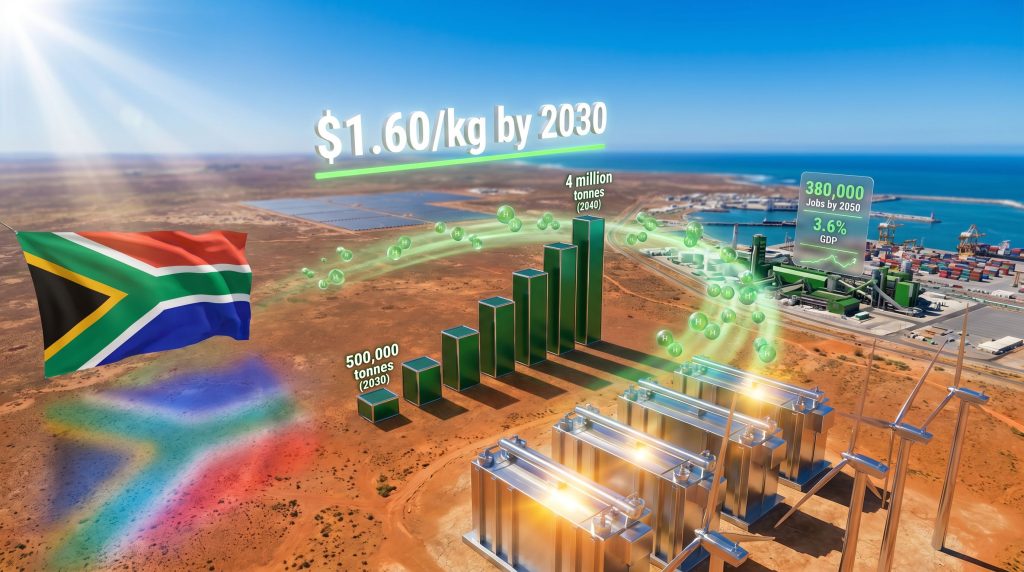
South Africa's projected green hydrogen production cost of approximately $1.60 per kilogram by 2030 places it among the most cost-competitive producers globally. By 2050, modelling suggests production costs could approach $1.00/kg, a threshold that would make South African green hydrogen genuinely competitive against fossil fuel-derived alternatives in international markets without subsidy support.
The Northern Cape's combination of solar intensity and wind reliability gives South Africa a rare physical foundation for low-cost electrolysis at scale, provided the surrounding infrastructure can be built to match.
The table below summarises the headline production and economic targets underpinning South Africa's hydrogen commercialisation strategy:
| Metric | 2030 Target | 2040 Target | 2050 Projection |
|---|---|---|---|
| Annual Production Volume | 500,000 tonnes | 4 million tonnes | Commercial scale |
| Electrolysis Capacity (Northern Cape) | 10 GW | 15 GW | 40 GW (provincial ambition) |
| Production Cost ($/kg) | ~$1.60 | Declining | ~$1.00 |
| GDP Contribution | Emerging | Scaling | 3.6% |
| Jobs Created | Foundational | Growing | 380,000 |
These figures should be understood as strategic targets rather than confirmed forecasts. Their realisation depends on factors that remain unresolved, including infrastructure funding, skills pipelines, and off-take agreement certainty.
The Policy Architecture Underpinning South Africa's Hydrogen Push
South Africa's hydrogen strategy rests on three sequential policy instruments that together form an evolving regulatory and commercial framework.
The Hydrogen Society Roadmap (2021) established four strategic outcomes focused on positioning hydrogen as a domestic energy carrier, an export commodity, a catalyst for industrial development, and a driver of social inclusion.
The Green Hydrogen Commercialisation Strategy (2023) translated that vision into six operational pillars:
- Prioritising export market development, targeting European and Asian off-take agreements
- Stimulating domestic industrial demand by incentivising the switch from fossil-based feedstocks to hydrogen
- Building localised manufacturing capacity across the supply chain
- De-risking capital deployment through structured financing and investment security mechanisms
- Embedding socio-economic development obligations within project structures
- Establishing technical standards, safety frameworks, and certification regimes to attract international capital
The South African Renewable Energy Masterplan (SAREM, 2025) added a further layer of industrial integration, linking renewable energy buildout to downstream manufacturing and localisation requirements.
A technically significant recent development is the establishment of a green hydrogen and power-to-X project development standard, which provides developers with the regulatory certainty required to structure international investment. This kind of standards infrastructure is often underestimated in its importance, yet without it, international capital providers and off-take partners have no common technical language for assessing project quality or risk.
Industrial Hubs: Where South Africa's Hydrogen Economy Will Be Built
South Africa's hydrogen geography is not uniform. Three registered industrial hubs, anchored in Johannesburg, Durban, and the Mogalakwena/Limpopo corridor, form the backbone of the domestic hydrogen value chain. Two additional mega-projects define the export ambition.
Boegoebaai, located in the Northern Cape, represents the most ambitious single development in South Africa's hydrogen pipeline. With a provincial ambition of up to 40 GW of electrolysis capacity, the project is designed to produce green hydrogen, green ammonia, and green methanol at a scale that would position South Africa as a credible global exporter. The Northern Cape's port access and renewable resource density make it the natural anchor for this vision.
Saldanha Bay offers a different proposition: the conversion of decommissioned steel infrastructure into a green iron production facility using direct reduced iron (DRI) technology. Furthermore, this is where South Africa's hydrogen story connects most directly to the global steel decarbonisation imperative.
Saldanha Bay: The Green Iron Gateway
- Site: Former Saldanha Steel plant, currently mothballed
- Technology: Green hydrogen-based direct reduced iron production
- Target Market: European steel producers seeking low-carbon feedstock
- Production Timeline: Green DRI output targeted from 2027
- Employment Potential: Over 8,000 jobs projected at full operation
The Hydrogen Valley corridor, stretching from Mokopane to Durban, connects South Africa's mining heartland to its primary export port, creating a logistics backbone for hydrogen movement across the country's industrial geography.
Beyond the Molecule: How Green Hydrogen Enables Industrial Transformation
The Southern African Institute of Mining and Metallurgy (SAIMM) has articulated a perspective that fundamentally reframes how South Africa's hydrogen potential should be understood. The SAIMM's position is that hydrogen's greatest value is not as an energy carrier but as an industrial catalyst. Its potential to trigger entirely new sectors in green iron projects, green steel, green chemicals, and broader beneficiation is what makes it strategically significant for a country seeking to move beyond raw mineral exports.
SAIMM president Gary Lane has publicly observed that the real prize in South Africa's hydrogen development is industrialisation itself, with the hydrogen molecule serving as the mechanism through which South Africa's renewable energy and mineral endowments are converted into finished industrial goods with far higher economic multipliers than raw commodity exports. (Source: Engineering News and Mining Weekly, June 2026)
This framing has important implications for how project pipelines should be evaluated. A project that produces hydrogen for export is valuable. A project that uses hydrogen to produce green steel, green ammonia, or sustainable aviation fuel (SAF) is, consequently, transformative.
Power-to-X: The High-Value Derivatives Layer
Power-to-X refers to the conversion of renewable electricity, via hydrogen as an intermediary, into storable and exportable energy carriers. South Africa's strategic interest in this space includes:
- Green ammonia: A storable hydrogen carrier with established global shipping infrastructure and strong demand as a fertiliser feedstock
- Green methanol: A chemical feedstock and potential marine fuel with growing international demand
- Sustainable aviation fuel (SAF): Producible via Fischer-Tropsch synthesis, a technology in which South Africa holds proprietary expertise developed through its legacy Sasol processes
The Fischer-Tropsch pathway to SAF is particularly noteworthy because it represents a case where South Africa's industrial history, developed during the apartheid-era fossil fuel sanctions period, has inadvertently created a technological foundation for a clean-energy export product.
The PGM Dimension: South Africa's Hidden Electrolyser Advantage
South Africa hosts the world's largest known reserves of platinum group metals, which are critical inputs in PEM electrolyser technology and hydrogen fuel cells. This creates a theoretically compelling localisation opportunity: South Africa could not only produce green hydrogen at low cost but also manufacture the equipment used to produce it.
The gap between this theoretical advantage and commercial reality is, however, significant. Currently, South Africa has no commercial-scale electrolyser or fuel cell manufacturing industry. PGMs are predominantly exported as refined metals, with value-addition occurring offshore.
| Supply Chain Component | Current Status | Strategic Target |
|---|---|---|
| Electrolyser Manufacturing | No commercial production | Domestic manufacturing at scale |
| Fuel Cell Production | No commercial production | Export-ready domestic industry |
| PGM Input Utilisation | Exported as refined metal | Integrated into local clean-tech manufacturing |
| Fischer-Tropsch SAF | Proprietary technology available | Commercial SAF export pipeline |
Closing this gap would require substantial international technology partnerships, patient capital, and a coordinated industrial policy that links PGM mining royalties and beneficiation obligations to hydrogen supply chain investment. In addition, the rising critical minerals demand globally adds further urgency to South Africa's need to build this localised capability. This is not currently in place at the scale required.
The next major ASX story will hit our subscribers first
The Coordination Problem: Why Infrastructure Must Be Built Concurrently
Perhaps the least discussed but most consequential challenge in South Africa's hydrogen industrialisation program is the coordination imperative. Chemical engineering specialists have consistently identified a fundamental sequencing risk: production infrastructure, transport networks, and end-use conversion must be developed in parallel rather than in sequence. Funding a single electrolysis plant represents only a fraction of the total capital required for a functioning hydrogen ecosystem.
Building hydrogen production capacity without simultaneously developing transport, storage, and end-use infrastructure creates stranded assets. The hydrogen molecule has no value without a complete value chain.
Key Infrastructure Risks
- Logistics gaps: Dedicated hydrogen pipelines, port liquefaction terminals, and ammonia conversion facilities are all required and none currently exist at commercial scale
- Industrial conversion costs: Existing heavy industry must retrofit equipment to accept hydrogen as a feedstock, a cost layer that often exceeds the cost of the hydrogen itself
- Grid independence requirement: Electrolysis at commercial scale must be powered by dedicated renewable generation, not grid-connected supply, to qualify for green certification under international standards
- Skills shortfall: South Africa currently lacks the volume of specialised hydrogen engineering, operations, and maintenance professionals required to staff commercial-scale facilities
How South Africa Compares to Global Competitors
South Africa is not the only nation pursuing low-cost green hydrogen for export. Australia, Chile, and Namibia are all targeting overlapping European and Asian demand pools. For instance, the EU-backed green hydrogen partnership with South Africa further intensifies international competitive dynamics by drawing European capital and standards into the local market.
| Country | Projected H₂ Cost (2030) | Key Advantage | Key Risk |
|---|---|---|---|
| South Africa | ~$1.60/kg | PGM supply chain, solar/wind convergence | Infrastructure gaps, coordination complexity |
| Australia | ~$1.80–$2.20/kg | Established LNG export infrastructure | Distance to European markets |
| Chile | ~$1.50–$1.80/kg | Atacama solar irradiation | Water scarcity, political risk |
| Namibia | ~$1.50/kg | Coastal wind resources | Limited industrial base, small domestic demand |
South Africa's cost position is competitive but not dominant. Its distinguishing advantage lies in the combination of PGM supply chain integration potential, industrial infrastructure, a skilled engineering workforce, and proximity to European shipping lanes. These systemic advantages are harder to replicate than raw renewable resource endowments.
What Successful Industrialisation Actually Requires
Translating South Africa green hydrogen industrialisation potential into commercial reality requires coordinated action across four institutional domains:
- Public sector: Policy certainty, regulatory standards, co-investment in shared infrastructure, and blended finance mechanisms that reduce the cost of capital for private developers
- Private sector: Technology deployment, off-take agreement development, localisation investment, and risk-sharing across project consortia
- Academic and professional institutions: Workforce pipeline development, applied research programs, and technology transfer agreements with international hydrogen leaders
- International partners: Long-term capital commitments, technology licensing, and guaranteed demand through binding purchase agreements with European and Asian industrial users
The window for South Africa to establish first-mover positioning in key segments of the global green hydrogen supply chain is finite. European hydrogen demand timelines, driven by the EU's Fit for 55 framework and the Carbon Border Adjustment Mechanism (CBAM), create a demand signal that peaks in the early 2030s. Projects that are not in construction by 2028 risk missing the first significant wave of international off-take demand.
Three Scenarios for South Africa's Hydrogen Industrialisation Trajectory
| Scenario | Key Conditions | Likely Outcome by 2035 |
|---|---|---|
| Accelerated Integration | Concurrent infrastructure build, strong policy execution, international capital inflow | 3–4 anchor industrial projects operational; meaningful export volumes beginning |
| Moderate Progress | Partial infrastructure development, selective project delivery, limited coordination | 1–2 projects operational; export scale limited |
| Structural Stagnation | Coordination failures, infrastructure gaps unresolved, skills shortfall persists | Pilot projects only; strategic objectives deferred beyond 2040 |
The difference between these scenarios is not primarily about policy design. South Africa's policy architecture is already reasonably well developed. The differentiating variable is execution: the ability to mobilise capital, build infrastructure, develop skills, and coordinate across public and private institutional boundaries simultaneously and at pace. According to the IDC's green hydrogen briefing, closing these execution gaps will determine whether South Africa green hydrogen industrialisation becomes a genuine economic transformation or remains a pipeline of unfulfilled ambitions.
Disclaimer: Production cost projections, GDP contribution estimates, employment figures, and project timelines referenced in this article are drawn from publicly available strategic frameworks and modelling exercises. They represent targets and scenarios rather than confirmed outcomes. Readers should not rely on these figures for investment decisions without independent verification.
Frequently Asked Questions: South Africa Green Hydrogen Industrialisation
What is green hydrogen and why is South Africa well-positioned to produce it?
Green hydrogen is produced by splitting water into hydrogen and oxygen using electrolysis powered entirely by renewable energy, resulting in zero direct carbon emissions. South Africa's Northern Cape region offers some of the world's highest solar irradiation levels alongside consistent wind resources, enabling low-cost renewable electricity generation, which is the dominant input cost in green hydrogen production.
When will South Africa begin commercial green hydrogen production?
South Africa's policy framework targets meaningful commercial-scale production by 2030. Anchor projects such as the Saldanha Bay green DRI facility are targeting output from 2027. Commercial production at full scale, however, depends on resolving infrastructure, financing, and skills development challenges concurrently rather than sequentially.
What is the Boegoebaai project?
Boegoebaai is a large-scale green hydrogen development planned for the Northern Cape coast, with provincial ambitions targeting up to 40 GW of electrolysis capacity. It is designed to produce green hydrogen, green ammonia, and green methanol for export, positioning South Africa as a major participant in global clean molecule trade.
What is power-to-X?
Power-to-X describes the conversion of renewable electricity into storable or exportable chemical energy carriers beyond pure hydrogen, including green ammonia, green methanol, and sustainable aviation fuel. South Africa's existing Fischer-Tropsch technology expertise provides a credible pathway to commercial SAF production as a high-value export.
How many jobs could the hydrogen economy create in South Africa?
Modelling by strategic planning bodies suggests the hydrogen economy could support approximately 380,000 jobs across South Africa by 2050, spanning production, logistics, manufacturing, and downstream industrial sectors. These projections assume full delivery of the strategic targets and are not guaranteed outcomes.
Readers seeking further coverage of South Africa's energy transition and green hydrogen developments can explore ongoing reporting through Mining Weekly and Engineering News, published by Creamer Media. Visit miningweekly.com for the latest project and policy updates across the southern African resources sector.
Want to Know Which ASX Companies Are Capitalising on the Green Hydrogen and Critical Minerals Boom?
Discovery Alert's proprietary Discovery IQ model delivers real-time alerts the moment significant ASX mineral discoveries are announced, turning complex data across 30-plus commodities into clear, actionable opportunities — including those tied to the PGMs and critical minerals driving the hydrogen economy. Explore historic discoveries and their extraordinary market returns, then begin your 14-day free trial to position yourself ahead of the broader market.