June 26, 2026
The Hidden Cost Buried Underground: Why Mining's Diesel Dependency Can No Longer Be Ignored
Every hour that a diesel-powered loader operates inside an underground mine, it releases a complex cocktail of particulate matter, nitrogen oxides, and carbon monoxide into a confined, poorly ventilated environment. Unlike surface operations where exhaust disperses into the open atmosphere, underground diesel combustion creates persistent exposure risks for workers who spend entire shifts breathing recirculated air. This is not a marginal safety concern. According to Health Canada and occupational health research across multiple mining jurisdictions, chronic exposure to diesel particulate matter (DPM) is classified as a Group 1 carcinogen by the International Agency for Research on Cancer. The underground mining sector has known this for decades, yet equipment replacement cycles, capital constraints, and the sheer weight of existing fleet investments have slowed the transition away from internal combustion.
That inertia is now meeting a countervailing force: a convergence of regulatory tightening, cost reductions in battery technology, and a federal funding apparatus that is actively seeding applied research to close the gap between knowing electrification is necessary and actually achieving it. The Cambrian College diesel loader conversion funding announcement, made on June 24, 2026, sits precisely at that intersection and offers a revealing case study in how Canada is trying to move the needle.
When big ASX news breaks, our subscribers know first
Understanding the Scale of the Underground Diesel Problem
To appreciate why the Cambrian College diesel loader conversion funding matters beyond its dollar value, it helps to understand the structural challenge that diesel presents in hard rock mining environments.
Underground mines are not simply dark tunnels. They are engineered atmospheric systems where ventilation infrastructure can account for 30 to 50 percent of a mine's total energy consumption, according to research published through the Canada Mining Innovation Council. A significant portion of that ventilation cost exists for one primary reason: diluting and extracting diesel exhaust. Battery-electric vehicles eliminate tailpipe emissions entirely at the point of use, which means less ventilation air is required to maintain safe working conditions.
This creates a cascading economic benefit that extends well beyond the fuel savings of switching from diesel to electricity. Furthermore, the broader mining electrification trend across Canada suggests that regulatory and economic pressures are only going to intensify in the years ahead.
The thermal load reduction is equally significant. Diesel engines convert only roughly 35 to 45 percent of fuel energy into mechanical work, with the remainder released as heat. In deep, hot underground environments, that waste heat compounds existing geothermal challenges and drives up cooling costs. Battery-electric drivetrains operate at efficiencies typically exceeding 85 to 90 percent, fundamentally changing the thermodynamic profile of underground operations.
These are the upstream economics that make projects like Cambrian's conversion initiative strategically important, not just symbolically green.
What the Cambrian College Diesel Loader Conversion Project Actually Involves
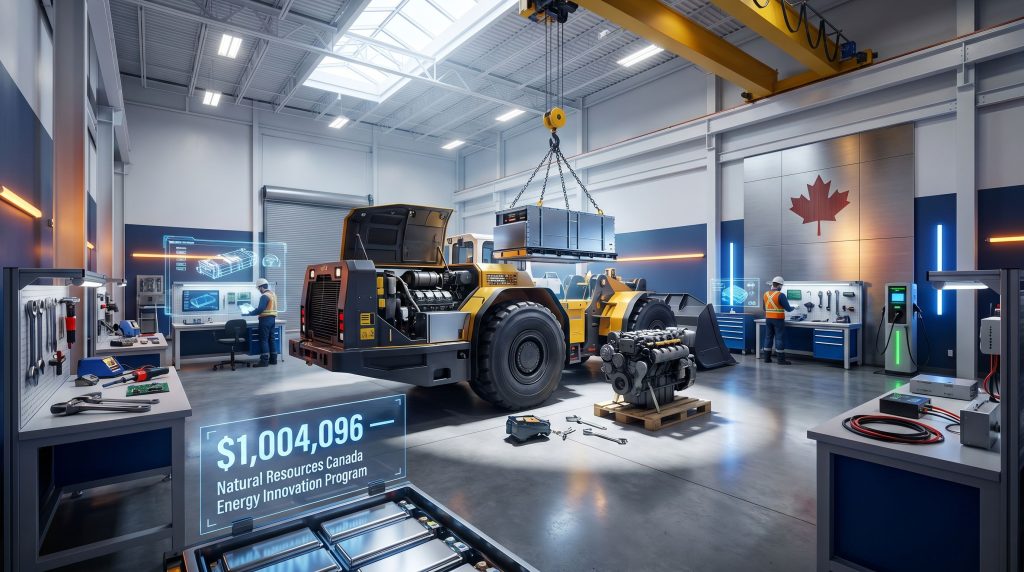
The project, administered through Cambrian College's R&D division at its Centre for Smart Mining in Sudbury, Ontario, received $1,004,096 via Natural Resources Canada's Energy Innovation Program. The announcement was made by Sudbury Member of Parliament Viviane Lapointe on June 24, 2026.
The core engineering objective is the conversion of a functional diesel-powered underground loader, donated by Walden Equipment (a subsidiary of the Walden Group), into a fully operational battery-electric vehicle. Critically, the project is designed to validate performance under actual operating conditions rather than laboratory simulations, which is a distinction that carries significant technical and commercial weight.
Why Real-World Validation Changes Everything
Simulated performance data and real-world underground performance frequently diverge in ways that matter enormously to fleet operators making capital allocation decisions. Underground mining equipment faces a specific combination of stresses that bench testing struggles to replicate:
- Continuous high-torque demand on steep declines (grades of 10 to 15 percent are common)
- Repetitive charge-discharge cycling under variable thermal conditions
- Vibration and shock loads from uneven tunnel floors and rock fragmentation debris
- Communication and telematics interference from geological rock mass
- Battery thermal management challenges in environments where ambient temperatures can swing significantly between deep hot headings and cooler decline access ways
By testing the converted loader under these real conditions, Cambrian's project generates data that equipment suppliers, mine operators, and future R&D programmes can actually use. This is what separates applied research from academic exercise, and it explains why industry partners like Walden Equipment view facility access at an institution like Cambrian R&D as genuinely strategic rather than purely philanthropic.
The Engineering Disciplines Behind the Conversion
The project is expected to create five student research positions across a range of technical specialisations, each addressing a distinct engineering challenge within the conversion process.
| Discipline | Primary Responsibilities |
|---|---|
| Heavy-Duty Mechanics | Drivetrain disassembly, mechanical interface preparation, component integration |
| Mechatronics Engineers | Control systems, sensor arrays, electromechanical interface design |
| Mechanical Engineers | Chassis adaptation, structural reinforcement, thermal management layout |
| Electrical Engineers | Battery management systems (BMS), power distribution, wiring architecture |
The battery management system deserves particular attention as a technically complex component. A BMS in a converted mining loader must manage cell balancing, state-of-charge estimation, temperature monitoring, fault detection, and communication with the vehicle's control architecture simultaneously. In a retrofit application, where the BMS is being integrated into a mechanical platform it was not originally designed for, the engineering challenge is substantially greater than in a purpose-built electric vehicle.
Students enrolled in programmes such as the heavy equipment technician diploma at Cambrian College are positioned to develop the exact skill sets this kind of conversion work demands. In addition, the motive power technician programme at Cambrian provides complementary training in drivetrain systems that directly supports applied research of this nature.
The Retrofit vs. Replace Question: A Framework That Matters
One of the less-discussed dimensions of underground fleet electrification is the economic divide between large-scale producers and mid-tier or junior operators. Major mining companies operating multiple large mines can justify the capital expenditure required to purchase purpose-built battery-electric loaders from original equipment manufacturers. These vehicles, produced by companies like Epiroc, Sandvik, and MacLean Engineering, carry premium price tags that reflect their engineered-from-the-ground-up electric architectures.
Smaller and mid-tier operators face a fundamentally different calculation. Their fleets often contain serviceable diesel equipment with years of mechanical life remaining. For these operators, the economic pathway to electrification may run through retrofit conversion rather than wholesale replacement. Cambrian's project is among the few publicly funded research initiatives in Canada that is actively generating empirical cost and performance data for this pathway.
Key insight: If the Cambrian conversion project demonstrates that a retrofitted diesel loader can achieve comparable productivity metrics to its original diesel configuration at a fraction of the cost of purchasing a new battery-electric equivalent, it could fundamentally reshape how smaller Canadian mining operators approach their electrification timelines.
A Multi-Stage Decarbonisation Roadmap for Underground Mining
The Cambrian project does not exist in isolation. It represents one node within a broader, multi-stage decarbonisation logic that applies across the underground hard rock sector.
| Stage | Action | Expected Outcome |
|---|---|---|
| Stage 1 | Diesel-to-electric retrofit of existing equipment | Immediate DPM and NOx reduction; cost data generation |
| Stage 2 | Real-conditions performance validation | Proof-of-concept for broader fleet conversion |
| Stage 3 | Replication across Northern Ontario operators | Regional decarbonisation of mobile equipment fleets |
| Stage 4 | Integration with renewable or low-carbon power supply | Full lifecycle carbon reduction across underground operations |
The fourth stage is worth examining carefully. Battery-electric mining equipment only delivers its full carbon reduction potential when the electricity powering it comes from low-carbon sources. Consequently, renewable mining power integration becomes a critical downstream consideration for any operator pursuing a genuine full-lifecycle emissions reduction strategy.
In Ontario, where the provincial grid is among the cleanest in North America due to nuclear baseload generation, this condition is already largely met. Mines operating in provinces with carbon-heavy grids face a more complex calculus, but Ontario-based operations like those surrounding Sudbury are positioned favourably for near-complete lifecycle emissions reduction.
Cambrian R&D's Centre for Smart Mining: More Than a Lab
The Centre for Smart Mining at Cambrian College serves as the institutional backbone of this project, and its capabilities extend well beyond a single conversion exercise. The centre brings together research competencies in artificial intelligence integration, automation systems, and electric vehicle technology under one facility, positioning it as a genuine applied research hub rather than a teaching laboratory with a rebranded name.
This matters because the mining sector's electrification challenge cannot be solved by battery swaps alone. The full vision of a smart mine encompasses:
- Autonomous or semi-autonomous electric mining transport operation integrated with mine planning systems
- Real-time battery state monitoring integrated with mine planning software
- Predictive maintenance systems that reduce unplanned downtime across electric fleets
- Remote operation capability that keeps human workers away from the highest-risk underground zones
Electric drivetrains are foundational to this vision because they are inherently more compatible with digital control systems than diesel engines. Furthermore, AI mining efficiency tools are increasingly being layered on top of electric vehicle platforms to optimise energy usage and operator decision-making in real time. A battery-electric loader can communicate its state of charge, thermal condition, and operational parameters to a central mine management system continuously — something a diesel machine cannot offer without significant additional instrumentation.
The next major ASX story will hit our subscribers first
Sudbury's Role in Canada's Mining Technology Future
Sudbury's identity as Canada's hard rock mining capital is well established, built on more than a century of nickel and copper extraction from the Sudbury Basin's extraordinary sulphide ore system. What is less frequently discussed is how that geological legacy created a dense concentration of mining expertise, supplier networks, and research infrastructure that is now being redirected toward technology leadership rather than purely extractive output.
Cambrian College and Laurentian University together form the academic spine of a regional innovation ecosystem that also includes private sector R&D operations and an unusually experienced local workforce. This concentration of capability makes Sudbury a logical location for projects like the diesel loader conversion.
The Cambrian College diesel loader conversion funding therefore serves a dual purpose. It advances a specific technology objective while simultaneously reinforcing Sudbury's position as a national node for mining innovation at a time when that positioning carries genuine economic development significance for Northern Ontario.
Workforce Implications: The Skills Gap Hiding Inside the Energy Transition
The mining sector's electrification challenge has a workforce dimension that is frequently underestimated. Converting a mine's mobile fleet from diesel to battery-electric does not simply swap one set of machines for another. It changes the maintenance requirements, the operational parameters, the diagnostic procedures, and the safety protocols that underground workers must understand and apply every day.
A diesel mechanic and a battery-electric systems technician are not interchangeable, and the training pathways that produce them are structurally different. The risk, unless addressed proactively, is that the physical equipment transitions faster than the human capital required to support it, creating operational gaps that undermine the productivity case for electrification.
Projects structured like Cambrian's, where students from multiple engineering disciplines work simultaneously on a single complex conversion challenge, are among the most effective responses to this skills gap. The learning environment forces mechatronics students to understand the mechanical constraints their electrical designs must accommodate, and forces mechanical engineers to understand the power electronics their structural work must physically house. That cross-disciplinary fluency is precisely what the electrified mining workforce of the next decade will require.
Frequently Asked Questions
What is the Cambrian College diesel loader conversion project?
A federally funded applied R&D initiative to convert a diesel-powered underground mining loader into a fully operational battery-electric vehicle, conducted by engineering students at Cambrian College's Centre for Smart Mining in Sudbury, Ontario.
How much federal funding did the project receive?
The project received $1,004,096 through Natural Resources Canada's Energy Innovation Program, announced on June 24, 2026.
Who donated the diesel loader?
Walden Equipment, a subsidiary of the Walden Group, donated the diesel loader to Cambrian College for the project.
How many student positions will be created?
The project anticipates creating five student research positions spanning heavy-duty mechanics, mechatronics, mechanical engineering, and electrical engineering.
Why is underground diesel equipment particularly problematic compared to surface diesel use?
Underground environments are enclosed atmospheric systems where diesel exhaust cannot disperse freely. Workers face prolonged exposure to diesel particulate matter, a classified carcinogen, and mine operators must invest heavily in ventilation infrastructure specifically to manage diesel exhaust. Battery-electric equipment eliminates these exhaust-related costs and health risks entirely at the point of use.
What is NRCan's Energy Innovation Program?
A federal funding mechanism administered by Natural Resources Canada designed to support applied research and development of clean energy technologies across Canadian industries, including mining. It is one of several funding instruments through which the federal government directs investment into industrial decarbonisation.
Could this project serve as a template for other Canadian mining operators?
That is precisely the intended outcome. By validating a diesel-to-electric conversion methodology under real underground operating conditions, the project aims to generate replicable technical and economic data that smaller mining operators across Northern Ontario and beyond could apply to their own fleet electrification decisions.
Key Takeaways
- Ventilation cost reduction is the hidden economic prize of underground electrification, often more financially significant than fuel savings alone
- The Cambrian College diesel loader conversion funding of $1,004,096 represents a targeted federal investment in applied methodology development, not just equipment demonstration
- Retrofit economics remain a largely underexplored pathway that could unlock electrification for capital-constrained mid-tier and junior mining operators who cannot afford purpose-built electric equipment
- Cross-disciplinary student training is as important as the technical outcome, addressing a workforce skills gap that will otherwise slow the real-world deployment of electric mining fleets
- Sudbury's existing concentration of mining expertise and research infrastructure makes it structurally well-positioned to translate this project's findings into broader regional industry adoption
- Ontario's low-carbon electricity grid means that battery-electric mining equipment operating in the Sudbury basin can deliver near-complete lifecycle emissions reductions, not just point-of-use benefits
Readers seeking broader context on Canadian mining electrification trends and federal clean energy investment programmes can find ongoing coverage at the Canadian Mining Journal, which tracks technology and sustainability developments across Canada's mining sector.
Want To Stay Ahead of the Next Major Mining Discovery?
Discovery Alert's proprietary Discovery IQ model scans ASX announcements in real time, instantly identifying significant mineral discoveries and turning complex data into actionable investment insights — explore historic discoveries and their returns to understand the opportunity, then begin your 14-day free trial at Discovery Alert and position yourself ahead of the broader market.