June 25, 2026
The Institutional Architecture Behind Mexico's Most Productive Mining State
Competitive advantage in mining rarely originates from geology alone. The states and jurisdictions that consistently attract capital, advance projects, and retain skilled workforces tend to share a common structural feature: a layered institutional ecosystem where professional associations, financial bodies, and regulatory frameworks operate in coordinated alignment. Understanding how AIMMGM support mining projects in Zacatecas translates into real outcomes is essential for anyone tracking the long-term trajectory of Mexico's mining sector.
Zacatecas sits at the centre of this analysis. As the country's foremost silver-producing state and a significant contributor to national gold, zinc, and lead output, it occupies a position that extends well beyond regional economic interest. The question confronting the industry in 2026 is not whether Zacatecas has the mineral endowment to sustain its leadership, but whether its institutional and regulatory environment can keep pace with the demands of a rapidly evolving global mining landscape.
When big ASX news breaks, our subscribers know first
Why Zacatecas Holds an Irreplaceable Position in Mexico's Mining Economy
Zacatecas's dominance in Mexican mining is geological in origin but institutional in its continuation. The state sits across a series of mineralised corridors, hosting both high-grade underground silver operations and large-tonnage open-pit gold-silver-zinc-lead deposits. This commodity diversity is strategically significant: it means Zacatecas's production profile is not entirely dependent on a single price cycle, offering a degree of natural revenue hedging that pure gold or pure silver jurisdictions cannot replicate.
Furthermore, commodity price impacts on mining economics mean that this multi-commodity exposure provides measurable protection during periods of single-metal price weakness. Mining's contribution to the state's GDP, formal employment base, and export revenues is substantial enough that disruptions to project pipelines generate measurable macroeconomic consequences at the community level.
Towns across the Mazapil, Chalchihuites, and Fresnillo districts are economically anchored to mine-generated wages and procurement activity. When projects stall in permitting, the downstream effects are felt well before a single tonne of ore is extracted.
Active and Advanced Projects Defining the Current Pipeline
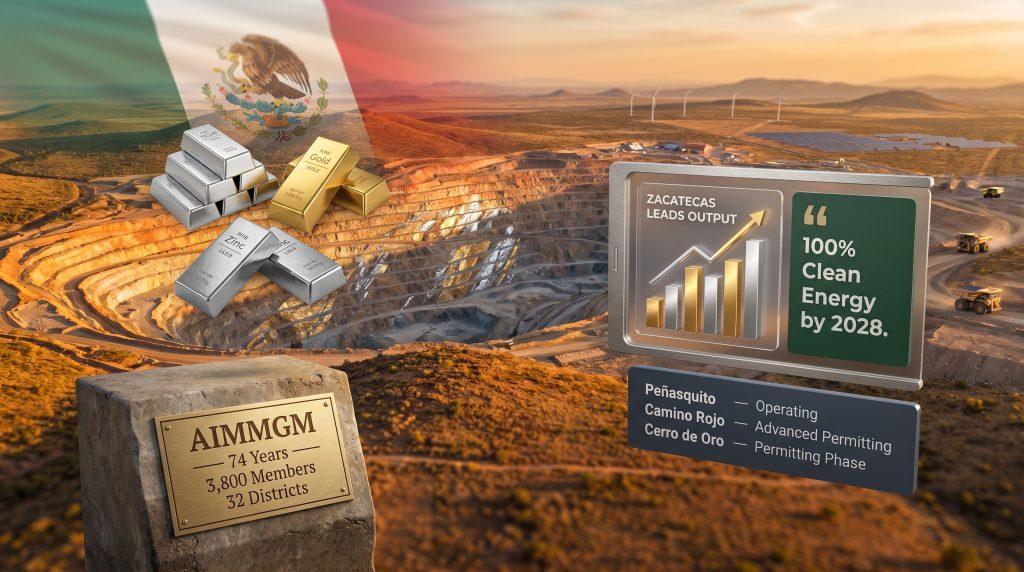
The following table illustrates the major operations and development-stage projects currently shaping Zacatecas's production outlook:
| Project | Operator | Commodity Focus | Development Stage | Mining Method |
|---|---|---|---|---|
| Peñasquito | Newmont | Gold, Silver, Zinc, Lead | Operating | Open-pit |
| Camino Rojo | Orla Mining | Gold, Silver | Advanced Permitting | Open-pit |
| Cerro de Oro | Minera Alamos | Gold | Permitting Phase | Open-pit |
Peñasquito, operated by Newmont, remains the flagship operation, functioning as one of the largest polymetallic open-pit mines globally by silver output. Its scale generates a gravitational pull on regional supply chains, infrastructure investment, and workforce development that smaller operations cannot independently sustain.
The advancement of projects like Camino Rojo through permitting therefore carries significance beyond their individual production profiles, as each new operating mine deepens the regional ecosystem that supports all existing producers.
What AIMMGM Does and Why Its Role Is Frequently Misunderstood
The Asociación de Ingenieros de Minas, Metalurgistas y Geólogos de México, known as AIMMGM, is a professional body representing mining engineers, metallurgists, and geologists across Mexico. With more than 74 years of operational history and a membership base exceeding 3,800 active professionals distributed across 32 mining districts nationwide, it is among the most structurally significant non-operator institutions in the Mexican mining sector.
A critical distinction frequently overlooked in industry commentary is that AIMMGM does not own, develop, permit, or finance mines. It neither deploys capital nor holds concessions. Its influence operates through an entirely different mechanism: the mobilisation of professional knowledge, technical standards, and collective advocacy across a network dense enough to carry weight in regulatory and legislative conversations.
"Professional associations like AIMMGM represent an underappreciated layer of competitive infrastructure. Their influence is not measured by balance sheet strength, but by the breadth and depth of the professional network they can mobilise when industry conditions require coordinated advocacy."
Understanding this distinction matters enormously for investors and policy analysts seeking to interpret how AIMMGM support mining projects in Zacatecas translates into tangible outcomes. The association shapes the conditions under which capital flows; it does not supply that capital itself.
AIMMGM's Three Core Pillars of Industry Engagement
The association's contribution to Zacatecas's competitiveness can be mapped across three interlocking pillars:
-
Knowledge Transfer and Professional Development: Structured certification pathways, technical forums, and training programmes that elevate operational standards across member companies, from major operators to small-scale extractors.
-
Sustainability Advocacy: Active promotion of clean energy adoption and environmental best practices at the mine-site level, including support for industry commitments such as Peñoles' stated target of achieving 100% clean energy usage by 2028, alongside advocacy for transitioning diesel-powered equipment to electric alternatives and implementing closed-loop wastewater reuse systems.
-
Regulatory and Policy Engagement: Direct participation in legislative processes and industry-government dialogue aimed at reducing structural permitting barriers that currently constrain project advancement timelines across the state.
Zacatecas represents one of AIMMGM's most strategically significant district clusters. The association's efforts to integrate professionals working at the state's major operations into its membership base translate directly into greater advocacy leverage at both the state and federal levels, since membership density in high-output jurisdictions strengthens the credibility of collective policy positions.
Collaboration with FIFOMI: Expanding the Support Network Below the Flagship Level
Beyond its engagement with large-scale operators, AIMMGM collaborates with FIFOMI (Fideicomiso de Fomento Minero), the federal institution responsible for providing financial and technical assistance to Mexico's small and medium mining sector. This partnership is more consequential than it might initially appear.
Zacatecas's mining economy is not exclusively composed of large open-pit polymetallic mines. A significant portion of the state's productive activity occurs across smaller, less capitalised operations that lack access to the technical resources available to companies like Newmont or Orla Mining.
By connecting FIFOMI's financial capacity with AIMMGM's technical knowledge network, the two institutions create a support pipeline that extends professional standards and operational capability downward through the production hierarchy, strengthening the breadth of Zacatecas's mining economy rather than concentrating institutional value at the flagship level.
Permitting Delays and Social Conflict: The Twin Constraints on Project Advancement
The most immediate threat to Zacatecas's continued mining leadership is not geological depletion or commodity price weakness. It is the compound effect of environmental permitting delays interacting with unresolved social conflicts at the community level. These two variables create a self-reinforcing dynamic that extends project timelines, inflates capital expenditure estimates, and ultimately signals jurisdictional risk to international capital allocators.
Understanding mining permitting basics is therefore essential context for any investor evaluating project advancement timelines in the state. The Camino Rojo project in Mazapil, operated by Orla Mining, illustrates the problem concretely. This advanced open-pit gold-silver development has demonstrated strong geological credentials, yet its path from advanced permitting to construction has been shaped by the complexity of Mexico's environmental authorisation process.
Permit delays at projects of this calibre send a signal that extends well beyond the individual asset, affecting investor appetite across the entire Zacatecas pipeline.
"When permitting bottlenecks affect advanced-stage projects with established geological and technical credentials, the chilling effect on earlier-stage exploration investment can be disproportionate, as junior companies reassess whether the jurisdictional risk-return profile justifies continued capital allocation."
AIMMGM's advocacy position on permitting reform calls for frameworks that preserve rigorous ecological oversight while reducing procedural delays that do not materially improve environmental outcomes. Social conflict compounds this dynamic. Where community relations are poorly managed before formal permitting processes begin, unresolved land access disputes and social licence challenges become additional variables that regulators must navigate, further extending decision timelines.
The association's promotion of proactive community engagement best practices is therefore not merely a social responsibility initiative. It functions as a mechanism for reducing the frequency and severity of conflict-driven disruptions that ultimately translate into capital expenditure uncertainty for project developers.
The Clean Energy Transition as a Competitive Variable, Not Just an ESG Obligation
Mexico's mining sector has historically operated with a heavy dependence on diesel-powered equipment, particularly in haulage and underground applications. This dependency creates a dual vulnerability: exposure to volatile fuel costs and increasing misalignment with global ESG expectations that now materially influence institutional capital allocation decisions.
The broader shift toward renewable energy in mining is reshaping cost structures and investor expectations simultaneously. AIMMGM's advocacy for accelerated electrification of mining equipment reflects an understanding that this transition carries economic logic beyond environmental optics. Practical applications already being evaluated or deployed across the sector include:
- Electric haul trucks reducing per-tonne haulage costs on high-cycle open-pit operations
- Battery-powered underground equipment eliminating ventilation costs associated with diesel exhaust management
- Grid-connected processing facilities reducing energy cost volatility against commodity price cycles
- Closed-loop water systems addressing the structural constraint of Zacatecas's semi-arid operating environment
Water management deserves particular emphasis in the Zacatecas context. The state's climate imposes real limits on freshwater availability for processing operations, making wastewater reuse systems not merely an environmental preference but an operational necessity for mines seeking to scale production without triggering community conflicts over resource competition.
Copper is also emerging as an increasingly significant commodity within Zacatecas's production mix, with copper cathode production gaining attention as electrification supply chains intensify demand. This positions the state favourably within not only traditional precious metals markets but also the critical minerals transition conversation that is reshaping how mining jurisdictions are evaluated by both governments and capital markets globally.
The Institutional Landscape: Who Does What in Zacatecas Mining
One of the most persistent sources of confusion in external analysis of Mexico's mining sector is the conflation of different institutional roles. The following table clarifies the distinct functions of the key organisations shaping Zacatecas's mining ecosystem:
| Organisation | Role | Scope |
|---|---|---|
| AIMMGM | Professional advocacy, training, sustainability promotion | Industry-wide, 32 districts |
| FIFOMI | Financial and technical support for small/medium mining | Small-medium operators |
| CLUSMIN | Regional industry coordination and competitiveness | State-level |
| Newmont (Peñasquito) | Mine operator and capital deployer | Single major operation |
| Orla Mining (Camino Rojo) | Project developer, permitting and construction | Single advanced project |
| Minera Alamos (Cerro de Oro) | Exploration and development operator | Single permitting-stage project |
Each institution occupies a distinct functional lane. Conflating AIMMGM's advocacy role with the capital deployment functions of operators like Newmont or developers like Orla Mining produces analytical distortions that misrepresent what outcomes are realistic to expect from each type of institutional actor.
The next major ASX story will hit our subscribers first
RIM Zacatecas 2026: Where Industry Convergence Becomes Competitive Intelligence
Taking place on June 24–26, 2026, the RIM Zacatecas regional mining forum functions as one of the sector's most important informal coordination mechanisms. Beyond its formal programming, events of this nature serve as environments where project developers, professional associations, regulators, and capital allocators interact outside the constraints of formal negotiation or regulatory processes.
AIMMGM's active participation positions the association as a connector across these constituencies. The forum's 2026 agenda reflects the core tensions currently shaping Zacatecas's competitive position:
- Permitting reform pathways and regulatory modernisation
- Clean energy integration frameworks for operating and development-stage mines
- Professional workforce development and technical capacity building
- Investment climate signals for both domestic and international capital
Five Conditions Required for Sustained Mining Leadership in Zacatecas
Looking across the structural variables shaping Zacatecas's trajectory, five conditions emerge as necessary for the state to defend and extend its position as Mexico's dominant mining jurisdiction:
-
Regulatory efficiency: Streamlined environmental permitting that reduces project advancement timelines without weakening ecological oversight standards.
-
Workforce depth: Expanded AIMMGM membership and FIFOMI-supported training programmes that build technical capability across all scales of mining activity.
-
Social licence infrastructure: Proactive community engagement frameworks that address land access and resource competition concerns before they enter formal regulatory processes.
-
Energy transition readiness: Accelerated adoption of electrified equipment and clean energy sources that reduce operating costs and align with institutional ESG requirements.
-
Investment climate clarity: Consistent and transparent policy signals that reduce the jurisdictional risk premium applied by international capital allocators when evaluating Zacatecas-based assets.
Silver's dual role as both a monetary reserve asset and a critical industrial input for photovoltaic panels and electronics gives Zacatecas's flagship commodity an unusually favourable demand profile over a multi-decade horizon. Gold's function as a portfolio hedge in periods of macroeconomic uncertainty sustains its appeal to institutional investors. Zinc and lead provide industrial demand diversification. Together, this commodity mix positions the state at the intersection of both traditional precious metals cycles and the accelerating critical minerals supply chain buildout driven by the global energy transition.
Frequently Asked Questions: AIMMGM and Mining in Zacatecas
What does AIMMGM actually do to support mining in Zacatecas?
AIMMGM support mining projects in Zacatecas through professional development programmes, sustainability advocacy, regulatory engagement, and knowledge-sharing events. It functions as an industry facilitator rather than a project operator or capital provider, shaping the conditions under which capital flows and projects advance without directly deploying financial resources.
How many members does AIMMGM have and where do they operate?
The association has more than 3,800 active members distributed across 32 mining districts throughout Mexico. Zacatecas represents one of the most strategically significant district clusters within this network given the state's scale of silver, gold, and zinc production.
What is the current status of the Camino Rojo project in Zacatecas?
Camino Rojo, operated by Orla Mining in the Mazapil municipality, is an advanced open-pit gold-silver project currently navigating Mexico's environmental permitting process. Permit delays have been identified as a material risk factor affecting its advancement timeline, and the project is frequently cited in discussions about the need for regulatory reform across the sector.
What is the difference between AIMMGM, FIFOMI, and CLUSMIN?
AIMMGM is a professional association for mining engineers, metallurgists, and geologists. FIFOMI is a federal financial institution that provides funding and technical assistance to small and medium mining operators. CLUSMIN is a regional industry cluster focused specifically on Zacatecas's mining competitiveness.
Each body plays a distinct and complementary role that, when functioning in alignment, strengthens the overall institutional architecture supporting the state's mining sector. Furthermore, understanding these distinctions allows investors and policy analysts to more accurately assess the Newmont Peñasquito operation and the broader ecosystem in which it operates.
This article is intended for informational purposes only and does not constitute financial or investment advice. Forward-looking statements regarding project timelines, production forecasts, and commodity demand are subject to material risks and uncertainties. Readers should conduct independent due diligence before making investment decisions based on information contained herein.
Want to Stay Ahead of the Next Major Mineral Discovery on the ASX?
Discovery Alert's proprietary Discovery IQ model delivers real-time alerts on significant ASX mineral discoveries, translating complex geological and commodity data into actionable insights for both short-term traders and long-term investors. Explore how historic discoveries have generated substantial returns and begin your 14-day free trial today to position yourself ahead of the broader market.