June 25, 2026
The Invisible Architecture Redefining What a Mine Actually Is
There is a quiet revolution unfolding beneath the surface of global resource extraction — one measured not in tonnes blasted or kilometres drilled, but in data packets transmitted, machine learning inferences made, and milliseconds of precision timing. The physical act of mining has not changed: rock must still be broken, moved, and processed. But the intelligence layer governing how those actions are sequenced, optimised, and reported has undergone a transformation so fundamental that the industry is approaching a definitional boundary. Connected AI-powered mining operations are not simply an upgrade on what came before. They represent an entirely different way of thinking about what a mine is.
Understanding this shift requires stepping back from the machinery and looking at the data architecture underneath it.
What Are Connected AI-Powered Mining Operations?
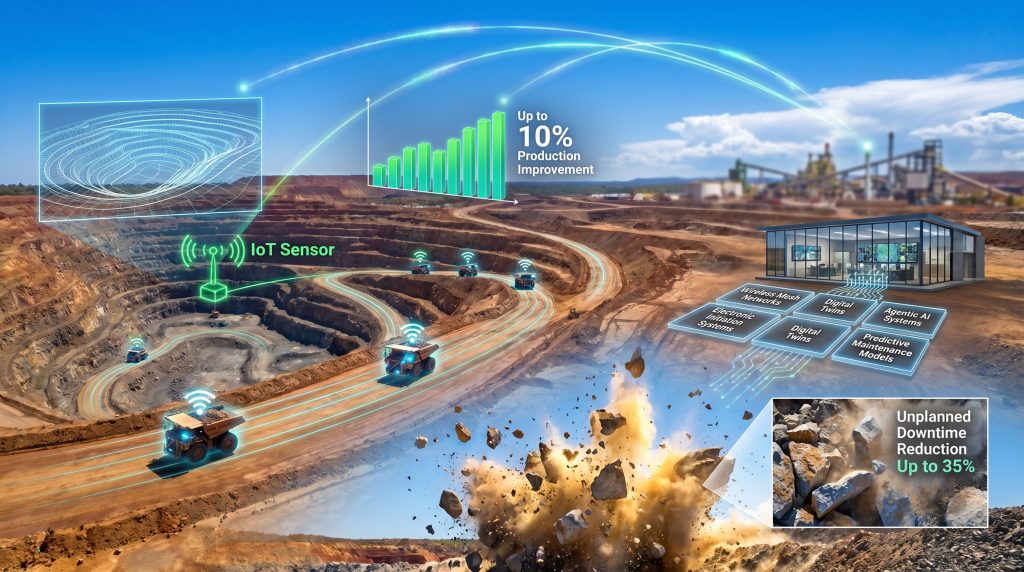
Connected AI-powered mining operations are fully integrated mine environments where IoT sensors, wireless mesh networks, machine learning models, autonomous systems, and cloud data infrastructure work in concert to enable real-time decision-making, predictive optimisation, and end-to-end operational visibility — from blast design through to final mill product.
The forces compelling this transformation are not discretionary. Declining ore grades mean miners must process substantially more material to extract the same quantity of metal. Global copper ore grades have fallen from an average of around 1.8% in the early 2000s to below 0.6% at many major operations today, according to industry research. Energy costs are rising across every jurisdiction where large-scale mining occurs. Skilled workforce shortages are structurally worsening as experienced personnel retire faster than the talent pipeline can replenish them. Furthermore, ESG investor mandates now require verifiable, real-time environmental performance data — not annual reports compiled after the fact. These pressures are converging to make intelligent connectivity a competitive necessity rather than an aspirational technology roadmap.
When big ASX news breaks, our subscribers know first
How Connected AI-Powered Mining Operations Actually Generate Value
Mapping the Data Flow From Rock Face to Final Product
The concept of a connected mining value chain rests on a single foundational principle: every operational stage must generate, transmit, and consume data in a continuous feedback loop. When that loop is intact, performance improvements compound across the chain. When it is broken — when data sits in isolated silos — only a fraction of the available value is captured. Data-driven mining operations are therefore not simply a technological upgrade but a structural reimagining of how mines function.
The operational stages where connected AI-powered mining operations deliver measurable impact include:
-
Blast design and fragmentation — AI-optimised initiation parameters reduce over-break, uncontrolled vibration, and variability in downstream crusher feed, producing more predictable fragmentation profiles from each blast event.
-
Excavation and loading — Real-time fragmentation data fed directly to excavation equipment improves shovel and loader cycle efficiency, reducing the time equipment spends repositioning or re-engaging oversized material.
-
Haulage and fleet coordination — Agentic AI systems manage autonomous vehicle routing dynamically, minimising idle time, reducing fuel consumption, and eliminating the fatigue-related safety risks associated with 24-hour human-operated haul cycles.
-
Crushing and milling — Predictive set-point optimisation adjusts process parameters in real time based on incoming ore type and fragmentation characteristics, improving throughput consistency and reducing energy consumption per tonne processed.
-
Tailings and environmental monitoring — AI systems track emissions, water usage, and waste output streams against ESG benchmarks continuously, enabling proactive compliance rather than retrospective reporting.
The Procurement Blind Spot: Why Blasting Technology Is Systematically Undervalued
One of the least-discussed structural inefficiencies in traditional mine cost accounting involves how blasting technology is evaluated at the procurement stage. The purchase decision for initiation systems is almost universally framed around unit cost per detonator or per tonne blasted. This is a logical starting point but a deeply incomplete framework.
The greatest financial return from precision blasting does not appear at the blast bench. It appears downstream — in crusher throughput consistency, mill energy consumption, maintenance scheduling accuracy, and final product quality. Consequently, when blasting is optimised using electronic initiation systems capable of millisecond-precision timing, the fragmentation profile becomes more predictable. That predictability enables:
-
Tighter crusher feed control, reducing peak energy loads and protecting equipment from impact damage
-
More consistent mill feed, which directly improves throughput and lowers kilowatt-hours consumed per tonne processed
-
Predictive maintenance models scheduling based on known wear patterns rather than reactive breakdowns
-
Lower diesel generator reliance through reduced processing variability
The procurement decision for blasting technology is evaluated at unit cost, yet the greatest financial and environmental return emerges far downstream of that decision. This structural blind spot causes mines to systematically underinvest in the first link of their entire value chain.
The Technology Stack Powering Connected AI Mining Ecosystems
Core Technology Layers: A Comparative Overview
| Technology Layer | Core Function | Operational Impact |
|---|---|---|
| Wireless Mesh Networks | Transmit real-time sensor data across pit and plant | Second-by-second performance monitoring of mobile and stationary equipment |
| IoT Sensors | Capture equipment health, ore quality, and environmental data at source | Feeds machine learning models with high-frequency, field-verified inputs |
| Electronic Initiation Systems | Precision blast timing with full traceability | Predictable fragmentation, reducing downstream variability across the value chain |
| AI-Enabled Blast Optimisation Platforms | Analyse blast design parameters against historical and live data | Generates traceable, auditable recommendations for engineers without replacing human judgement |
| Digital Twins | Virtual replicas of physical operations synced to live sensor data | Enables scenario modelling and configuration testing without disrupting live production |
| Agentic AI Systems | Self-directed decision engines coordinating workflows autonomously | Manages fleet routing, blast scheduling, and process adjustments with minimal human input |
| Cloud Data Warehouses | Centralise and process operational data at scale | Supports cross-site benchmarking, predictive analytics, and remote decision-making |
| Computer Vision Systems | Monitor hazardous zones, worker proximity, and equipment wear | Reduces safety incidents and enables autonomous hazard detection and response |
| Predictive Maintenance Models | Forecast equipment failure probability based on sensor trends | Reduces unplanned downtime by up to 35% in mature deployments |
What Integrity-First AI Means in Practice
Not all artificial intelligence architectures are equal, and in mining — where decisions directly affect pit wall stability, worker safety, and regulatory compliance — the design philosophy of the AI system matters as much as its computational capability. The concept of integrity-first AI refers to systems built with traceability, explainability, and human oversight as foundational design requirements rather than optional additions bolted on after deployment.
In practical terms, integrity-first AI in mining means:
-
Every recommendation generated by the system is traceable back to its verified source data inputs
-
Engineers retain full decision authority — the AI augments rather than overrides human judgement
-
All outputs are fully auditable for regulatory and operational review, creating a documented decision trail
-
The data feeding the system is independently verified before being consumed by models, ensuring recommendations are actionable rather than theoretically sound but practically misleading
This philosophy stands in direct contrast to black-box algorithmic systems, which generate outputs without disclosing the reasoning chain. In safety-critical environments, black-box AI creates unacceptable accountability gaps. An engineer cannot defend a pit wall configuration decision to a regulator by explaining that an algorithm recommended it without knowing why.
The integrity-first approach also aligns directly with the broader industry trajectory toward fully autonomous mine certification. As regulatory frameworks for autonomous operations mature across jurisdictions, the mines already operating with auditable AI decision trails will be structurally better positioned to achieve certification than those retrofitting accountability onto black-box systems. Mining automation transformation is, however, only realised fully when these governance principles are embedded from the outset.
What Connected AI Mining Deployments Actually Deliver
Validated Performance Benchmarks From Global Operations
The performance case for connected AI-powered mining operations is increasingly supported by documented outcomes from major global deployments rather than theoretical modelling.
| Outcome Metric | Reported Performance Range | Deployment Context |
|---|---|---|
| Overall production improvement | Up to 10% increase in output | Freeport-McMoRan cloud and mesh network deployment |
| Throughput gains | 2–5% improvement in mature AI applications | Global mining industry benchmarking |
| Operating margin improvement | 2–4 percentage point increase | Industry-wide AI adoption analysis |
| Unplanned downtime reduction | Up to 35% via predictive maintenance | Machine learning deployment in processing plants |
| Equivalent new capacity unlocked | Output equivalent to a new processing facility | Achieved without 8–10 year permitting and capital cycle |
The significance of the Freeport-McMoRan outcome warrants particular attention. A 10% production improvement achieved through data infrastructure investment rather than physical capital expenditure fundamentally reframes how the industry should think about capacity growth. Building a new processing facility typically involves 8 to 10 years of permitting, design, construction, and commissioning — and capital costs that can exceed several billion dollars for a large-scale copper operation. Achieving equivalent output gains through intelligent connectivity represents a radically faster and more capital-efficient growth pathway.
How Major Global Miners Are Scaling Connected Operations
BHP and Rio Tinto have deployed autonomous haul truck fleets at scale across their Pilbara iron ore operations, with Rio Tinto operating one of the world's largest autonomous haulage systems covering multiple mine sites from a single remote operations centre in Perth — thousands of kilometres from the physical operations. The key operational dimensions of these deployments include:
-
Autonomous haulage systems operating continuously across 24-hour production cycles without fatigue-related safety risks or shift change downtime
-
AI in drilling and blasting that improves ore recovery rates and reduces unnecessary waste rock movement, lowering both operational cost and environmental footprint per tonne extracted
-
Centralised remote operations centres consolidating real-time oversight of multiple geographically dispersed sites under a single unified data architecture
-
Ongoing integration challenges involving legacy equipment that lacks the sensor architecture required for full connectivity without costly retrofitting programmes
The Materials Intelligence System: What Comes After Automation
Mining as an Integrated Data Ecosystem
The trajectory of connected AI-powered mining operations points toward something more profound than automation of individual tasks. Industry practitioners are increasingly using the term materials intelligence system to describe the end state — operational ecosystems where data flows continuously and bidirectionally between algorithms, physical equipment, commodity markets, regulators, and environmental monitoring systems simultaneously.
Four relationship dimensions define this future architecture:
-
Human-machine interfaces where engineers manage AI systems and interpret machine-generated insights rather than directly operating equipment
-
Mine-to-market data loops where real-time commodity quality data feeds trading decisions and logistics scheduling without manual data translation
-
Regulatory-operational integration where compliance data is generated automatically as a by-product of continuous operational monitoring rather than compiled separately for reporting purposes
-
Primary-secondary resource coordination where AI systems manage both primary extraction and material recovery or recycling processes within a single unified intelligence framework
The gap between incremental automation and transformational connected intelligence is not primarily a technology problem. It is an ecosystem problem. Mines that consolidate data architectures, align technology partnerships, and build interoperable systems will capture disproportionate value compared to those deploying isolated point solutions.
The critical insight here is that pockets of AI innovation already exist across the industry — but they frequently operate in isolation. A blast optimisation system that cannot share its fragmentation data with a crusher control system captures only a fraction of its potential value. An autonomous haul system disconnected from a predictive maintenance platform cannot optimise its own servicing schedule. The compounding returns from connected intelligence require the connections to actually exist.
Workforce Transformation in the Age of Connected AI Mining
Beyond the Automation Displacement Narrative
The public conversation about AI and automation in mining tends to default to a displacement narrative — machines replacing human workers. This framing misunderstands both the current state of the technology and the structural workforce requirements of truly connected AI-powered mining operations.
Connected AI mining does not eliminate the human workforce. Instead, it restructures the skills required of that workforce fundamentally. The emerging high-value roles in AI-powered mine environments include:
-
Data analysts responsible for interpreting AI-generated operational insights and translating them into actionable decisions
-
System optimisation engineers managing autonomous equipment configurations and continuously improving process models
-
Remote operations specialists overseeing multiple geographically dispersed sites from centralised control environments
-
AI integrity auditors validating the traceability and accuracy of machine-generated recommendations against regulatory and safety standards
The talent pipeline challenge is equally significant. The mining industry has historically struggled to attract digitally-native professionals who might otherwise gravitate toward technology, aerospace, or advanced manufacturing careers. AI-powered mining efficiency creates a genuine repositioning opportunity — mining as a sophisticated digital domain where data science, systems engineering, and autonomous technology converge in one of the world's most consequential industrial settings.
There is also a direct social licence dimension to this workforce evolution. Real-time environmental monitoring data, shared transparently with regulators and communities, builds operational trust in ways that periodic compliance reports cannot replicate. Auditable AI decision trails demonstrate responsible governance. Precision blasting technology that measurably reduces ground vibration, dust, and noise directly addresses the community impact concerns that have historically complicated the relationship between mining operations and their host communities.
The next major ASX story will hit our subscribers first
Key Challenges in Deploying Connected AI Mining Systems
Barriers to Adoption: A Structured Assessment
The performance case for connected AI-powered mining operations is compelling, however adoption barriers are real and should not be underestimated by operators considering the transition.
-
Legacy infrastructure incompatibility — Equipment purchased before the connected mining era lacks the embedded sensor architecture required for real-time data capture. Retrofitting is technically complex and operationally disruptive.
-
Connectivity constraints in remote environments — Underground operations and deep open pits create wireless signal propagation challenges that limit mesh network reliability, requiring purpose-built communication architectures.
-
Data quality and integrity — Machine learning models are only as reliable as the data feeding them. Inconsistent or unverified sensor inputs produce unreliable recommendations that erode operator confidence in AI systems.
-
Organisational change resistance — Shifting from experience-based decision-making cultures to data-driven operational oversight requires genuine cultural transformation, not simply technology deployment.
-
Cybersecurity exposure — Fully connected mine systems present significantly expanded attack surfaces. Operational technology security frameworks must evolve in parallel with connectivity capability. The World Economic Forum's guidance on industrial cybersecurity provides a useful framework for understanding these risks at scale.
-
Regulatory uncertainty — Autonomous systems operating in safety-critical environments require clear certification frameworks that many jurisdictions have not yet established, creating compliance ambiguity for early movers.
-
Integration complexity — Connecting systems from multiple vendors across the full value chain requires substantial systems integration investment and ongoing cross-platform governance.
FAQ: Connected AI-Powered Mining Operations Explained
What is the difference between automated mining and connected AI-powered mining?
Automated mining describes machines performing specific tasks without direct human control — an autonomous haul truck following a pre-programmed route, for example. Connected AI-powered mining goes substantially further by integrating data from every operational stage into a unified intelligence system that learns from operational history, adapts to changing conditions, and optimises performance across the entire value chain simultaneously rather than at individual task level.
How does AI improve safety in mining operations?
Multiple mechanisms contribute: computer vision systems detect hazardous proximity events before incidents occur; predictive maintenance models identify equipment failure risk before breakdowns happen in safety-critical contexts; precision electronic initiation systems reduce uncontrolled ground movement during blasting; and autonomous systems physically remove workers from the most dangerous operational zones. The International Council on Mining and Metals has documented how digital safety systems are progressively transforming industry-wide incident rates.
What is a digital twin in mining?
A digital twin is a continuously updated virtual replica of a physical mining operation, synchronised with live sensor data from across the operation. Engineers use digital twins to simulate operational changes, test blast designs under different geological scenarios, model equipment configurations, and identify process bottlenecks — all without interrupting live production or exposing personnel to physical risk during testing.
Can smaller mining operations access connected AI systems?
While large-scale connected deployments have historically been the domain of major global miners, modular cloud-based platforms and sensor-as-a-service commercial models are progressively reducing the entry cost. The economic argument rests on operational expenditure reduction through energy savings, downtime reduction, and throughput improvement — returns that industry practitioners suggest can deliver positive ROI within 12 to 24 months of deployment in well-managed implementations.
Why does blasting technology matter so much in a connected system?
Blasting is the first data-generating event in the mining value chain. The fragmentation profile produced by a blast directly determines the load characteristics and processing demands of every subsequent stage — excavation efficiency, crusher throughput, mill energy consumption, and final product quality. When blasting is optimised using precision electronic initiation and AI-driven design platforms, performance improvements propagate forward through every downstream process, making it arguably the highest-leverage entry point for connected intelligence investment in the entire operational sequence.
The Future Trajectory of Connected AI Mining
Three Stages of Connected Mining Maturity
| Maturity Stage | Defining Characteristics | Value Unlocked |
|---|---|---|
| Stage 1: Connected Data | IoT sensors, wireless networks, and cloud warehouses operational; data captured across the value chain | Operational visibility and reactive decision support |
| Stage 2: Intelligent Optimisation | Machine learning models active; predictive maintenance and process optimisation running; digital twins deployed | Proactive decision-making; throughput and efficiency gains of 2–10% |
| Stage 3: Autonomous Materials Intelligence | Agentic AI coordinating cross-system workflows; mine-to-market data loops active; regulatory reporting automated; human roles focused on strategy and oversight | Transformational productivity; new capacity unlocked without physical capex; full ESG accountability |
The macro forces making connected AI mining adoption structurally inevitable extend well beyond any single operator's technology strategy. Declining ore grades require more intelligent processing to maintain economic viability at current commodity price levels. Energy cost pressures demand continuous optimisation at a frequency no human workforce can sustain. ESG investor mandates require verifiable, real-time environmental performance data as a condition of capital access. Critical mineral demand trajectories for copper, lithium, and cobalt require faster and more efficient extraction without proportional increases in environmental footprint. Furthermore, demographic workforce shifts mean the industry must extract more value from smaller experienced teams — a structural condition that makes AI augmentation not just attractive but necessary.
The mines that will define the next decade of resource extraction are not being built with bigger equipment. They are being built with better data architectures. The competitive advantage in mining is shifting from geological endowment alone to the intelligence infrastructure layered on top of it.
Disclaimer: Performance figures cited in this article, including production improvement percentages and downtime reduction estimates, reflect documented or reported industry outcomes from specific deployments and should not be interpreted as guaranteed results applicable to all operations. Mining investment decisions should be based on site-specific technical assessment and independent financial analysis.
Want to Identify ASX Mining Companies Leading the Connected Intelligence Revolution?
Discovery Alert's proprietary Discovery IQ model scans ASX announcements in real time, instantly alerting subscribers to significant mineral discoveries across the commodities driving the connected mining transformation — from copper to critical minerals — before the broader market reacts. Explore Discovery Alert's dedicated discoveries page to understand how historic ASX mineral discoveries have generated substantial returns, and begin a 14-day free trial to position yourself ahead of the next major find.