June 25, 2026
The Engineering Forces Reshaping How the World Extracts Its Resources
Every major industrial transition in history has been preceded by a period where the cost of doing nothing finally exceeded the cost of changing everything. The global mining sector has arrived at precisely that inflection point. Declining ore grades, tightening emissions frameworks, persistent skilled labour shortages, and an accelerating critical minerals supercycle have collectively made incremental improvement insufficient. The industry is not tweaking its processes; it is rebuilding them from the ground up.
What makes the current wave of top 10 mining innovations distinct from previous equipment cycles is its scope. These innovations do not cluster around a single technology category. They span autonomous surface operations, underground electrification, seabed resource extraction, sensor-based ore sorting, and GPS-free spatial mapping. Together they represent a structural redesign of the mining value chain rather than isolated efficiency gains at individual process steps.
Three forces are compressing the adoption timeline in ways that would have seemed unlikely a decade ago. ESG-linked capital allocation is making decarbonisation a prerequisite for institutional investment, not a voluntary aspiration. Regulatory frameworks governing both surface emissions and underground air quality are tightening across major mining jurisdictions. Furthermore, the demand signal from battery supply chains for nickel, cobalt, copper, and manganese is creating a commercial imperative to produce more from resources that conventional methods would classify as marginal or uneconomic.
The innovations profiled here were assessed across four dimensions: the operational scale of deployment, the measurable impact on productivity or safety outcomes, the contribution to decarbonisation targets, and whether the technology represents a genuine industry-first rather than a refinement of existing practice.
| Innovation | Primary Benefit | Deployment Stage |
|---|---|---|
| Komatsu FrontRunner AHS | Productivity and Safety | Commercial, 1,000+ trucks |
| Fortescue Battery-Electric Locomotives | Decarbonisation | Commercial, Pilbara fleet |
| Sandvik TH665iB | Emissions and Ventilation | Commercial, global |
| Epiroc SmartROC D65 | Labour Efficiency | Commercial, US debut 2025 |
| TOMRA XRT Ore Sorting | Resource Recovery | Commercial, 70+ sites |
| ABB Underground Trolley Assist | Energy Efficiency | Demonstrated, expansion planned |
| Emesent Hovermap | Safety and Survey Speed | Commercial, 200+ mines |
| The Metals Company NORI-D | New Resource Frontier | Pre-commercial |
| Hexagon HxGN MineProtect | Worker Safety | Commercial, multi-continent |
| Eriez HydroFloat | Metallurgical Recovery | Commercial, 70+ operations |
When big ASX news breaks, our subscribers know first
10. Eriez HydroFloat: Recovering the Value That Conventional Flotation Leaves Behind
Why Coarse Particles Have Always Been a Blind Spot
Conventional flotation technology was engineered around fine-ground particles. The physics of bubble attachment, which is the mechanism that carries mineralised material to the surface of a flotation cell, becomes progressively less effective as particle size increases. The practical consequence is that coarser mineralised material, often containing economically significant grades of copper, gold, or other target metals, bypasses recovery and reports directly to tailings. This represents a genuine value destruction problem at the process plant level, and one that worsens as mines process lower-grade ore requiring finer liberation.
The Fluidised Bed Principle and Its Economic Consequences
The Eriez HydroFloat addresses this limitation through a fundamentally different separation architecture. Rather than relying on fine-ground particles attaching to bubbles in a conventional cell, the system suspends particles in an upward-flowing water current within a fluidised bed environment. This allows recovery of material more than twice the particle size that conventional cells can process.
The secondary benefit is equally significant: by enabling coarser grind sizes, the HydroFloat reduces the energy demand of the upstream ball milling circuit by up to 50%, according to Eriez. Ball milling is one of the most energy-intensive processes in mineral processing, meaning this reduction has a material effect on both operating costs and carbon intensity per tonne of metal produced.
The technology received the Society for Mining, Metallurgy and Exploration's Murray Award for Innovation in 2025, and is now installed across more than 70 operations globally. BHP commissioned a HydroFloat plant at its Carrapateena copper operation in South Australia in August 2025, achieving performance targets ahead of schedule and lifting site throughput to approximately 20,000 tonnes per day.
Recovering value from material previously classified as process waste improves mine economics without expanding the extraction footprint, a combination that is structurally aligned with both financial performance and ESG reporting requirements.
9. Hexagon HxGN MineProtect: Building a Real-Time Safety Net Across Active Mine Environments
The Collision Problem That GPS Alone Cannot Solve
Vehicle-to-worker and vehicle-to-vehicle collisions remain among the leading causes of fatalities in both surface and underground mining globally. The complexity of active mine environments, where large-payload haul trucks, excavators, and light vehicles operate simultaneously across confined and often dusty spaces, creates collision risk that simple GPS-based awareness systems are poorly equipped to manage.
GPS signal degradation in pit walls, GPS blind spots near berms, and latency in position data all create gaps in coverage precisely where proximity events are most likely. Consequently, the industry has increasingly turned to multi-sensor platforms to address this challenge effectively.
Multi-Sensor Architecture and Fleet-Wide Integration
Hexagon's HxGN MineProtect uses a combination of radar, GPS, and onboard computing to track every vehicle and person on a mine site in real time. The multi-sensor approach compensates for the limitations of any single detection method, maintaining awareness even in environments where GPS performance is degraded. When a proximity threshold is breached, the system triggers automated alerts and responses calibrated to the severity of the approach trajectory.
Critically, the system operates across mixed fleets, covering haul trucks, excavators, and light vehicles within a unified platform, and integrates with Hexagon's broader fleet management infrastructure to provide consolidated operational visibility. Active deployments span major operations across Australia, Africa, and the Americas.
8. The Metals Company NORI-D: A New Resource Frontier on the Pacific Seabed
What Polymetallic Nodules Are and Why They Are Commercially Significant
Polymetallic nodules are naturally occurring formations found on the deep ocean floor, particularly across the Clarion-Clipperton Zone in the Pacific, a region stretching roughly between Hawaii and Mexico. These formations contain concentrations of nickel, cobalt, copper, and manganese accumulated over millions of years through slow accretion of minerals from seawater. The resource base has attracted intense commercial interest because the critical minerals contained within these nodules align directly with the input requirements of lithium-ion battery manufacturing and broader clean energy infrastructure.
What is less widely understood is the comparative resource density involved. The nodule fields of the Clarion-Clipperton Zone are estimated to contain quantities of nickel and cobalt that dwarf known terrestrial reserves, raising genuine questions about whether seabed extraction could eventually reshape the supply dynamics for these metals at a global level.
Commercial Progress, Technical Mechanics, and Unresolved Regulatory Risk
The Metals Company's NORI-D project uses a seafloor collector vehicle to gather nodules from the seabed and pump them via riser system to a surface vessel. Multiple collection trials have been completed. The company submitted a commercial exploitation licence application to the International Seabed Authority in 2024, with commercial operations targeted for the late 2020s.
The unresolved dimension is regulatory. The International Seabed Authority's decisions on commercial exploitation licences will establish precedent for an entirely new extractive sector, and the environmental debate around seafloor ecosystem disruption remains substantive. Sediment plumes, benthic habitat disturbance, and the long recovery timescales of deep-sea ecosystems are all factors that regulators are weighing without the benefit of long-term operational data.
The International Seabed Authority's licensing framework will determine whether polymetallic nodule extraction becomes a meaningful component of the critical minerals supply chain within this decade, or whether regulatory uncertainty delays commercial scale indefinitely.
7. Emesent Hovermap: Removing Humans From the Most Hazardous Measurement Task in Underground Mining
The Hidden Risk in Post-Blast Survey Operations
After a stope is blasted underground, the geometry of the void must be measured before mucking and ground support decisions can be made. Traditionally this required a surveyor to enter the freshly blasted space, which by definition is an environment of unknown structural stability, to collect geometric data using conventional survey equipment. The process was slow, introduced safety exposure, and the resulting data often arrived too late to influence the decisions it was intended to inform.
How Autonomous LiDAR Navigation Works Without GPS
Emesent's Hovermap mounts on a drone and navigates autonomously using simultaneous localisation and mapping, known as SLAM, a computational approach that builds a real-time 3D map of an environment using LiDAR returns without requiring any external positioning signal. Because the system generates its own spatial reference from the point cloud it is actively building, it can operate in environments where GPS is entirely absent.
A single surveyor can deploy Hovermap, collect detailed 3D point cloud data from a stope or void, and have results integrated into standard mine planning software within minutes of launch. The system has reached more than 200 mines globally and has been reported by Emesent to reduce stope reconciliation time by up to 75% compared to conventional methods. Applications now extend beyond stope surveys to decline mapping, void detection, and inspection of areas where human entry carries unacceptable risk.
6. ABB Underground Trolley Assist: Solving the Energy Equation on Steep Ramps
Why Battery-Electric Trucks Hit an Energy Wall Underground
Battery-electric underground trucks offer compelling advantages in terms of exhaust elimination and heat reduction, but they face a physics-driven constraint that diesel vehicles do not. Repeated heavy climbs up steep underground ramps at full payload drain battery packs at rates that can compromise operational continuity. However, if trucks must pause production for extended recharge cycles after every ramp transit, the productivity case for electrification weakens considerably.
The Catenary Power Delivery System and Its Energy Recovery Logic
ABB's approach uses an overhead catenary wire on the ramp section, delivering power directly to the truck via a roof-mounted pantograph during the climb. This preserves battery charge for the flat-haul segments of the cycle where the catenary is not available. On the loaded descent, the system recovers energy through regenerative braking, feeding it back into the battery rather than dissipating it as heat through the braking system.
In April 2024, ABB, Epiroc, and Boliden completed the world's first demonstration of a battery-electric underground truck trolley system on an 800-metre test track at Boliden's Kristineberg mine in Sweden, operating on a 13% gradient. Boliden has subsequently committed to four Epiroc trolley trucks for a planned 5-kilometre full system at its Rävliden mine, a deployment that will provide the first long-run operational data for the technology at production scale.
The next major ASX story will hit our subscribers first
5. TOMRA XRT Ore Sorting: Pre-Concentration as a Structural Answer to Declining Ore Grades
The Grade Decline Problem and Its Processing Cost Implications
Average ore grades across most major metal categories have declined significantly over the past several decades. As grades fall, the tonnage of rock that must be mined, crushed, ground, and processed per unit of recovered metal increases. This creates a compounding cost and energy burden across every stage of the processing circuit. Pre-concentration technologies that remove waste before it reaches the mill offer a structural response by improving the grade and reducing the tonnage delivered to energy-intensive downstream processes.
How X-Ray Transmission Sorting Works at the Particle Level
XRT ore sorting scans individual pieces of rock on a moving conveyor belt using X-ray transmission, detecting density differences between mineralised material and barren waste at the particle level. When a waste particle is identified, a precisely targeted air jet ejects it from the conveyor before it enters the mill feed. The system operates at throughput rates compatible with production-scale mining and can be integrated at multiple points in the crushing and screening circuit.
Two contrasting deployments illustrate the technology's versatility:
- At EQ Resources' Mt Carbine tungsten mine in Queensland, XRT sorting achieves separation clean enough that the rejected waste rock is sold as construction aggregate, converting a disposal cost into a revenue stream.
- At Eloro Resources' Iska Iska project in Bolivia, XRT testing demonstrated the potential to reject large volumes of sub-grade material, improving the head grade fed to the mill and unlocking ore blocks that would otherwise have been uneconomic to process.
TOMRA's technology is now deployed across more than 70 operations worldwide, and its application is expanding beyond hard-rock metals to industrial minerals and other bulk commodities. For a broader perspective on top mining technology companies, it is worth noting how sensor-based sorting has emerged as a defining capability across the sector.
X-ray transmission ore sorting uses density-based detection at the individual particle level to identify and eject waste rock from a conveyor belt before it enters the processing plant, reducing energy consumption and improving mill feed grade without increasing the extraction footprint.
4. Epiroc SmartROC D65: Taking the Operator Out of the Drill Cab Entirely
The Labour Constraint at the Heart of Drill-and-Blast Scheduling
Rotary blasthole drilling has historically been a one-to-one proposition: one operator per rig, per shift. In an era of skilled labour shortages across surface mining jurisdictions globally, this model creates both cost pressure and scheduling inflexibility. Furthermore, operator fatigue introduces variability in drill pattern execution that affects blast fragmentation outcomes, which in turn affects crusher throughput downstream.
Autonomous Drilling Architecture: GNSS, Rod Handling, and Remote Supervision
Epiroc's SmartROC D65 executes complete drill patterns autonomously using GNSS positioning for hole location accuracy across the full pattern. An onboard rod handling system adds and removes drill rods without human intervention, eliminating one of the most physically demanding manual tasks in surface drilling operations. A remote supervisor can monitor and manage multiple rigs simultaneously from a single control panel, shifting the operational model from operator-per-machine to supervisor-per-fleet.
In September 2025, Epiroc and Luck Stone deployed the first fully autonomous SmartROC D65 in the United States, also marking the first autonomous surface drill delivered to the quarry market anywhere in the world. Both companies committed to publishing performance data from the deployment, creating a public benchmark for the technology's productivity and accuracy outcomes in a quarry context. Automation transforming mining at the drill-and-blast stage represents one of the most consequential shifts in surface operations currently underway.
3. Sandvik TH665iB: Zero-Exhaust Haulage and the Ventilation Multiplier Effect
The Hidden Energy Cost That Diesel Imposes Underground
The energy cost of ventilating underground mines powered by diesel equipment is substantially underappreciated in discussions of mining decarbonisation. Diesel combustion generates not only exhaust gases but also significant heat, both of which must be diluted and removed through forced ventilation systems to maintain safe working conditions. In mines with significant diesel fleets operating on extended ramp systems, ventilation infrastructure can account for close to half of the mine's total energy consumption.
As mines go deeper, this cost grows because the thermodynamic challenge of cooling and ventilating longer airways intensifies. Consequently, the case for electrification underground extends well beyond simple emissions reduction.
What the TH665iB Delivers at the Face and on the Ramp
Sandvik's TH665iB is a 65-tonne payload battery-electric underground haul truck designed to eliminate these diesel penalties. It produces zero exhaust emissions, substantially lower heat output, and considerably less noise than a diesel equivalent, all of which directly reduce the ventilation load required to maintain a safe underground atmosphere. The battery system supports hot-swap capability, allowing depleted batteries to be exchanged for charged units without taking the truck out of the production cycle.
| Factor | Diesel Underground Truck | Battery-Electric TH665iB |
|---|---|---|
| Exhaust Emissions | High | Zero |
| Heat Generation | High | Low |
| Ventilation Load | High | Substantially Reduced |
| Noise Level | High | Considerably Lower |
| Operational Continuity | Continuous via refuelling | Hot-swap battery system |
| Decarbonisation Alignment | Poor | Strong |
South32 placed Sandvik's largest-ever battery-electric fleet order in Q2 2025, covering TH665iB trucks alongside battery-electric drills, bolters, and loaders, with deliveries scheduled from late 2026 through to 2030. Mining electrification at this scale, as seen at Eldorado Gold's Lamaque complex in Quebec, has already prompted fleet expansion decisions at the site level. For further context on the broader decarbonisation agenda, mining electrification represents one of the most consequential structural shifts in the industry's history.
2. Fortescue Battery-Electric Locomotives: The World's Largest Land-Mobile Batteries on Rails
Why Heavy-Haul Rail Electrification Presents a Unique Engineering Challenge
Electrifying underground trucks or short-haul equipment involves a manageable set of engineering variables. Electrifying heavy-haul long-distance rail in a remote region without grid access is a fundamentally different challenge. Fortescue's Pilbara iron ore operations involve hundreds of kilometres of track, extreme ambient temperatures, and no connection to a commercial electricity grid, making diesel displacement genuinely difficult.
Technical Specifications and the Regenerative Braking Energy Recovery Loop
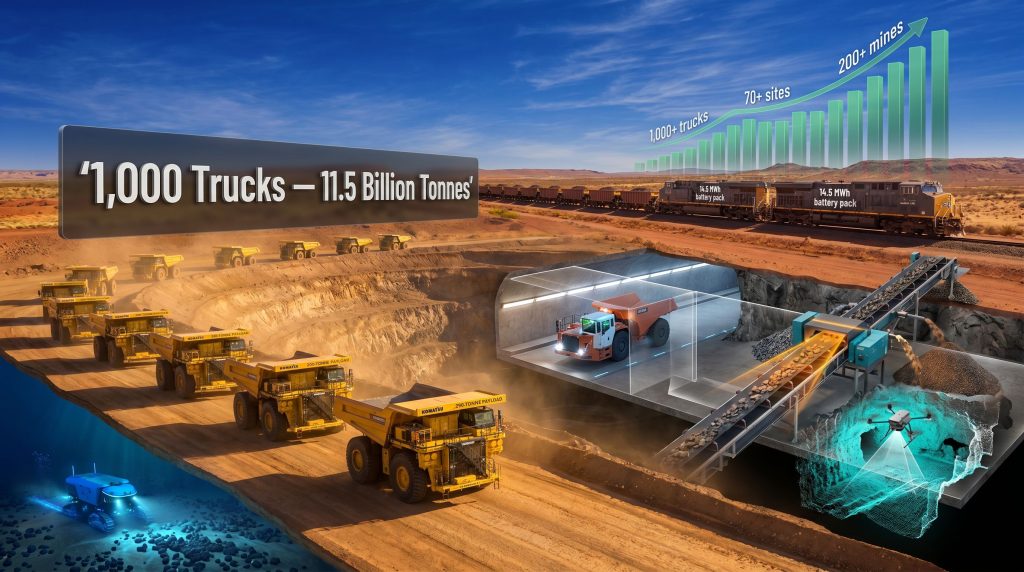
Fortescue added two battery-electric locomotives to its Pilbara fleet in 2025, built by Progress Rail, a subsidiary of Caterpillar. Each unit carries a 14.5 MWh battery pack, placing them among the largest land-mobile battery installations ever constructed. The trains haul loads of up to 40,000 tonnes per consist across the remote Western Australian terrain.
The energy recovery logic built into the system is particularly well-matched to the operational profile of iron ore haulage. On the loaded downhill run from mine to port, the locomotives recover between 40% and 60% of their battery charge through regenerative braking. The remaining charge is replenished at port using renewable energy from Fortescue's Pilbara Energy Connect grid, meaning the round trip energy economy benefits from the natural topography of the haul route.
Together the two units are expected to reduce diesel consumption by approximately one million litres annually. They are the first of 70 planned battery-electric locomotives targeted to replace Fortescue's entire Pilbara diesel locomotive fleet by 2030, representing one of the most ambitious heavy-haul rail electrification programmes undertaken by a single mining company.
Key Stat: A 70-locomotive battery-electric fleet by 2030, each carrying a 14.5 MWh battery pack, would constitute one of the largest aggregated land-mobile battery deployments in any industry sector globally.
1. Komatsu FrontRunner AHS: How 1,000 Autonomous Trucks Redefined the Economics of Surface Mining
A Commercial History That Stretches Back Further Than Most Realise
The narrative around autonomous vehicles in mining often frames the technology as emerging or recently proven. The commercial reality is different. Komatsu deployed the world's first autonomous truck system at Codelco's Gaby copper mine in Chile in 2008, making FrontRunner the longest-running commercially deployed autonomous haulage programme in the industry by a considerable margin. The 18 years of operational data accumulated since that first deployment represent an asset that newer entrants to the autonomous haulage market cannot replicate.
The April 2026 Milestone and the Performance Record Behind It
In April 2026, Komatsu commissioned its 1,000th autonomous ultra-class haul truck, a 930E-5AT with a 290-tonne payload capacity, at Barrick's Nevada Gold Mines. The cumulative material moved across the global FrontRunner fleet now exceeds 11.5 billion tonnes, at a daily throughput rate of more than six million tonnes across all active deployments.
The operational performance data behind these figures is equally instructive:
- Average tyre and brake life improvement of 40% across the fleet, driven by consistent, algorithmically optimised speed and braking profiles that human operators cannot replicate across every cycle of every shift.
- 13% reduction in overall maintenance costs, reflecting the reduction in shock loading and component stress that results from removing driver variability.
- An estimated US$2.4 billion in social and economic impact generated globally in 2024, based on Komatsu's own calculations.
- Current deployment span covers operations in North America, South America, Australia, and Europe.
FrontRunner integrates Komatsu's electric drive haul trucks with the DISPATCH fleet management platform, enabling round-the-clock route optimisation, queue management, and production scheduling without human intervention at the truck level. The broader case for AI mining efficiency is well illustrated by the compounding operational gains that FrontRunner's 18-year commercial record demonstrates.
The shift from operator-per-truck to supervisor-per-fleet is not simply a labour cost story. It is a fundamentally different relationship between human decision-making and machine execution in surface mining operations, and FrontRunner's 18-year commercial record demonstrates that the transition is both technically stable and economically durable.
Three Macro Themes Connecting All Ten Innovations
Theme One: Decarbonisation Across the Entire Haulage Chain
The battery-electric locomotive, the underground haul truck, the trolley assist system, and the autonomous surface fleet collectively address diesel dependency at every major haulage node in a mining operation, from the underground ramp to the surface pit to the long-haul rail corridor to port. The ventilation multiplier effect deserves particular attention: eliminating diesel underground does not simply reduce exhaust emissions. It reduces heat load, which reduces ventilation demand, which reduces the electricity required to run ventilation fans, creating a compounding energy saving that extends well beyond the trucks themselves.
Theme Two: The Transition From Operator-Per-Machine to Supervisor-Per-Fleet
Autonomous haulage, autonomous surface drilling, and autonomous underground mapping all represent points on the same trajectory. The operational model that positions a single human operator as the controlling intelligence for a single piece of equipment is being replaced by a model where a single supervisor oversees a fleet of machines making real-time decisions independently. This transition has implications for workforce composition, training requirements, mine design, and control room infrastructure that the industry is still working through.
Theme Three: Resource Efficiency as the Answer to Grade Decline
XRT ore sorting, coarse particle flotation, and polymetallic nodule collection all address the same underlying structural challenge: extracting more economic value from resource bases that conventional approaches would classify as marginal. As global average ore grades continue their long-run decline across copper, gold, nickel, and other major metals, the economics of resource efficiency technologies improve relative to conventional bulk processing. The trends shaping mining productivity consistently point to pre-concentration, improved metallurgical recovery, and new resource frontier strategies as the defining differentiators for operations that will remain viable through the next decade of grade decline.
Frequently Asked Questions: Top 10 Mining Innovations in 2026
What Is the Most Widely Deployed Autonomous Mining Technology in the World Right Now?
Komatsu's FrontRunner autonomous haulage system holds this position with more than 1,000 trucks commissioned and a cumulative material movement record exceeding 11.5 billion tonnes since commercial deployment began in 2008.
How Do Battery-Electric Vehicles Reduce Energy Consumption Beyond the Trucks Themselves?
By eliminating diesel combustion underground, battery-electric trucks reduce both exhaust gas load and heat generation. This directly reduces the ventilation airflow required to maintain safe underground working conditions. In addition, since ventilation can account for close to half of a mine's total energy consumption in diesel-intensive underground operations, the energy savings extend significantly beyond the trucks' own power consumption.
What Is XRT Ore Sorting and Why Is It Gaining Adoption Rapidly?
X-ray transmission ore sorting uses density-based detection at the individual particle level to identify mineralised material and waste rock on a moving conveyor belt, ejecting waste before it enters the processing plant. As global ore grades decline and the energy cost of processing low-grade bulk feed rises, pre-concentration technologies that improve mill feed grade without increasing extraction volumes are becoming structurally more attractive across a widening range of commodity types and deposit styles. This dynamic is central to why the top 10 mining innovations of this era place such strong emphasis on resource efficiency alongside electrification and autonomy.
Want to Know Which ASX Miners Are Developing the Next Generation of High-Impact Discoveries?
As the mining sector undergoes its most significant structural redesign in decades — driven by autonomous systems, underground electrification, and sensor-based ore sorting — the companies pioneering these technologies are creating compelling discovery opportunities on the ASX. Discovery Alert's proprietary Discovery IQ model delivers real-time alerts the moment significant mineral discoveries are announced, transforming complex data across more than 30 commodities into clear, actionable insights — explore historic discovery returns on Discovery Alert's discoveries page and begin your 14-day free trial to position yourself ahead of the market.