June 25, 2026
Why the Mining Industry's Most Valuable Asset Is No Longer the Equipment Itself
The most significant competitive battles in modern mining are no longer being fought at the equipment sales stage. They are being fought years later, deep inside the operational lifecycle of mineral processing plants, where uptime reliability, water management efficiency, and regulatory compliance increasingly determine whether a mine runs profitably or not. Across every major commodity corridor, from the copper belts of South America to the polymetallic processing hubs of Asia-Pacific, a fundamental restructuring of the supplier-operator relationship is underway.
This shift is not incidental. It reflects a calculated response by both mining companies and their equipment providers to the economics of capital-intensive extraction, where unplanned downtime can cost operators hundreds of thousands of dollars per hour. Furthermore, the margin difference between a well-maintained and poorly maintained processing circuit can exceed the value of the original equipment purchase many times over.
Metso secures contracts with key mining customers at an accelerating pace, and the latest filtration-focused life cycle services agreements announced in June 2026 offer a precise lens through which to understand how this structural realignment is playing out across the global mining services sector.
When big ASX news breaks, our subscribers know first
From Transactional Supply to Embedded Operational Partnership
For most of the twentieth century, the dominant model in mining equipment supply was straightforward: a manufacturer designed and sold capital equipment, the mine operator purchased it, and responsibility for maintaining performance transferred entirely to the buyer. Third-party maintenance contractors, in-house engineering teams, and opportunistic spare parts procurement filled the gaps.
That model served the industry adequately when commodity cycles were more predictable and operational complexity was lower. Today, however, it is increasingly inadequate. Processing circuits have become more sophisticated, environmental requirements more demanding, and the consequences of equipment failure more financially severe. The result has been a gradual but decisive migration toward what the industry now terms Life Cycle Services, or LCS.
An LCS framework is a structured, multi-year agreement between an original equipment manufacturer and a mine operator that integrates the following components:
- Preventive and predictive maintenance scheduling, including OEM-managed inspection cycles
- Genuine spare parts supply with guaranteed availability and lead time commitments
- Real-time and remote performance monitoring using embedded sensor technology
- Process optimisation support, where OEM engineers actively work to improve circuit throughput and recovery
- Reporting against contractual performance benchmarks, including availability and utilisation targets
Critically, LCS contracts differ from conventional maintenance agreements in how they allocate risk. Rather than the operator absorbing all performance variability, risk is shared with the supplier, who has a direct financial incentive to ensure the equipment performs to specification. This shared accountability model has proven commercially compelling for both parties.
For mining operators, the appeal is straightforward: outsourcing lifecycle management to the OEM that designed the equipment eliminates the knowledge gap inherent in third-party or in-house maintenance, while converting unpredictable capital expenditure spikes into manageable, recurring operational costs.
These dynamics align closely with the broader shift toward data-driven mining operations, where performance visibility across the entire asset lifecycle has become a core strategic priority for mine management teams.
Filtration as the Anchor Technology in Modern LCS Agreements
Among the processing technologies being drawn into long-term service frameworks, filtration has emerged as a particularly strategic category. The June 2026 LCS announcements involving a five-year agreement with a South American copper producer and a four-year agreement with an Asia-Pacific lead and zinc producer both centre on filtration systems, and this focus is deliberate.
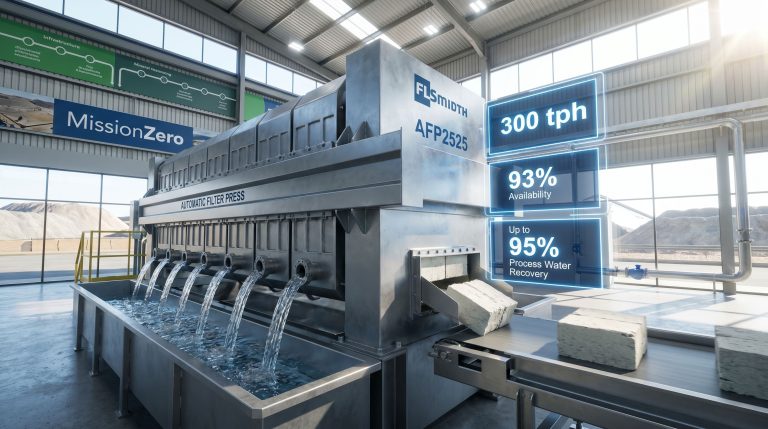
Filtration occupies a unique position in the mineral processing flowsheet. It is the stage at which concentrate dewatering occurs, where water is recovered for reuse, and where the physical characteristics of the final product are determined. In regions where water scarcity is a growing operational and regulatory constraint, filtration efficiency directly affects both production economics and licence-to-operate considerations.
The complexity of filtration requirements varies meaningfully across commodity types, as illustrated below:
| Commodity | Filtration Complexity | Primary Driver |
|---|---|---|
| Copper | High | Concentrate dewatering, water recycling |
| Lead and Zinc | Medium to High | Tailings management, concentrate purity |
| Gold | Medium | Cyanide circuit management |
| Iron Ore | Lower | Volume throughput, slurry handling |
Copper processing demands particularly sophisticated filtration because the concentrate must meet strict moisture specifications for smelter acceptance, typically below 9% moisture content for most international smelting contracts. Achieving consistent results across varying ore types and feed grades requires ongoing optimisation, making it an ideal candidate for OEM-managed service agreements.
For lead and zinc operations, filtration complexity is driven by the need to produce clean, separable concentrates from polymetallic ore bodies, where the mineralogy can shift significantly across ore zones. Managing that variability within a fixed environmental compliance framework creates sustained demand for specialist technical support.
Why ESG Integration Is Accelerating LCS Adoption
Beyond operational economics, the integration of environmental, social, and governance criteria into mining procurement is reshaping how service agreements are structured and evaluated. Filtration LCS contracts now frequently embed environmental KPIs alongside operational performance targets. In addition, the push toward renewable energy in mining is reinforcing the case for service models that actively manage energy consumption at the equipment level.
A typical filtration LCS contract delivers environmental value through a sequential process:
- Initial baseline assessment of water consumption rates, tailings moisture content, and energy use per tonne processed
- System configuration optimisation based on OEM engineering analysis of the specific ore characteristics and circuit design
- Continuous real-time monitoring with OEM-managed adjustments to filter press pressure cycles, cake thickness parameters, and cycle times
- Formal reporting against contractual environmental benchmarks, including water recovery rates and tailings moisture targets
- Continuous improvement cycles linked to contract renewal incentives, ensuring sustained rather than one-time performance gains
This five-step model transforms filtration from a static process step into a dynamic, managed function, which is precisely why sophisticated mining operators are prepared to commit to multi-year agreements rather than managing it in-house.
Scaling the Numbers: Metso's LCS Contract Portfolio in Context
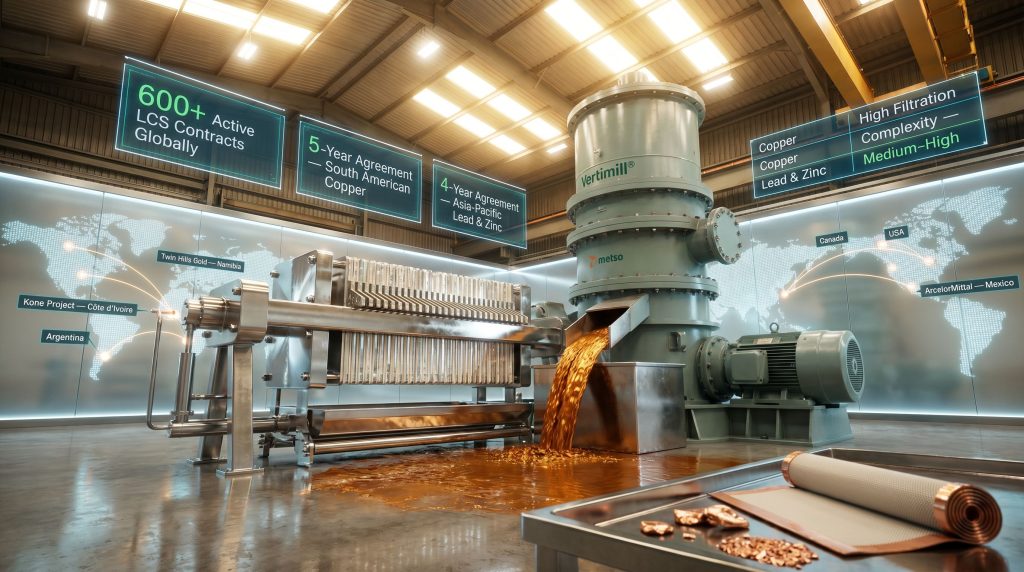
The filtration agreements announced in June 2026 are not isolated wins. They extend a commercial pattern that has been building consistently over the preceding two years. Metso secures contracts with key mining customers across both the minerals and aggregates segments, with Metso's global LCS portfolio now encompassing more than 600 active agreements worldwide.
| Period | New LCS Agreements | Dominant Segment |
|---|---|---|
| 2024 | 100+ new contracts secured | Minerals (more than 66% of total) |
| 2025 | 100+ new contracts secured | Minerals (more than 66% of total) |
| 2026 (ongoing) | Filtration-focused multi-year wins | Copper, Lead and Zinc |
| Total Active (2025) | 600+ contracts globally | Average duration approximately 3 years |
Sustaining more than 100 new agreements annually signals something beyond strong sales execution. It reflects a customer base that is actively choosing to renew and expand service relationships rather than revert to transactional procurement. When the Minerals segment consistently accounts for more than two-thirds of all new LCS bookings, it also suggests that the operational complexity of minerals processing, relative to aggregates or other segments, is the primary demand driver.
A portfolio of more than 600 active contracts across diverse geographies generates a compounding informational advantage that is difficult for competitors to replicate. Each active contract produces performance data, process insights, and equipment wear patterns that feed back into future optimisation recommendations, creating a proprietary knowledge base that deepens the value of the service relationship over time.
In capital equipment markets tied to commodity price cycles, recurring service revenue provides a structural buffer against demand compression. This dynamic has become increasingly relevant to institutional investors evaluating the risk-adjusted return profile of mining services companies, where revenue predictability is as important as growth trajectory.
Disclaimer: The above perspective reflects general industry analysis and does not constitute financial advice. Investors should conduct independent due diligence before making investment decisions.
Regional Expansion: Reading the Geographic Strategy
The two filtration LCS agreements represent one dimension of a broader geographic diversification strategy. Across Africa and the Americas, separate contract wins and equipment deliveries reveal the full scope of recent commercial activity:
| Region | Project or Customer Type | Technology or Service |
|---|---|---|
| Namibia | Gold (Twin Hills, Osino Resources) | Process equipment supply |
| Côte d'Ivoire | Gold (Kone project) | Feeder equipment |
| Argentina (San Juan) | Copper and Gold operations | Operational support services |
| USA and Canada | Iron Ore | Vertimill® grinding mill delivery |
| Mexico | Steel-adjacent mining | Processing equipment supply |
Africa: Emerging Gold Production Geography
The contract at Osino Resources' Twin Hills gold project in Namibia and the feeder equipment selection for the Kone gold project in Côte d'Ivoire both reflect a deliberate positioning in African gold development. These are not mature, brownfield operations with established supplier relationships. They are developing projects where early equipment supply can anchor long-term service dependencies, establishing a foundation for LCS agreements once operations reach steady-state production.
The Americas: Technology Differentiation Through Proprietary Equipment
The Vertimill® grinding mill delivery to a Canadian iron ore producer operating in the United States illustrates a distinct competitive dynamic. The Vertimill® is a vertically oriented stirred grinding mill that delivers significantly lower energy consumption compared with conventional horizontal ball mills, typically achieving 30 to 35 percent energy savings in fine and ultra-fine grinding applications.
Once installed, the operational and maintenance characteristics of this technology are sufficiently specialised that OEM-managed servicing becomes the practical default, creating a natural pathway into multi-year LCS arrangements. The deepening presence in San Juan, Argentina, supporting copper and gold production, further reinforces South American market positioning at a time when copper demand fundamentals remain structurally supportive of sustained exploration and processing investment.
The Competitive Architecture Behind Long-Term Service Contracts
There is a strategic dimension to multi-year LCS agreements that extends beyond revenue predictability. Each contract creates switching costs that are genuinely substantial. Transitioning a mineral processing circuit from one OEM's service framework to another's involves retraining maintenance personnel, rebuilding spare parts inventories, recalibrating monitoring systems, and accepting a period of performance uncertainty during the transition.
For a high-throughput copper or zinc operation, the risk-adjusted cost of switching providers typically far exceeds any potential price saving. This dynamic is well understood by procurement teams at major mining companies, which is precisely why the negotiation leverage in LCS contract renewals tends to favour the incumbent supplier.
Proprietary technologies such as the Vertimill® grinding system and advanced pressure filtration equipment embed this advantage further, because optimal performance of these systems requires OEM-level knowledge of wear patterns, process chemistry interactions, and equipment-specific calibration protocols. Consequently, third-party maintenance providers, regardless of general engineering capability, structurally lack access to this depth of equipment-specific intelligence.
Digital Monitoring as the New Frontier in LCS Value Creation
The role of remote diagnostics and predictive maintenance technology in making LCS contracts commercially viable at scale cannot be overstated. Modern mineral processing equipment increasingly incorporates embedded sensors that transmit operational data in real time, allowing OEM engineers to identify wear trends, process inefficiencies, and impending failures before they manifest as unplanned downtime. This capability directly underpins AI-powered mining efficiency advances that are reshaping service delivery across the sector.
This capability fundamentally changes the economics of service agreements. Predictive maintenance, as distinct from scheduled preventive maintenance, allows service interventions to be timed precisely to equipment need rather than calendar intervals, reducing both maintenance frequency and the risk of over-maintaining equipment. The result is lower total cost of ownership for the operator and higher-margin service delivery for the provider, a genuine alignment of commercial interests across the contract term.
The next major ASX story will hit our subscribers first
Frequently Asked Questions: Metso LCS Contracts and Mining Services Strategy
What is a Life Cycle Services contract in mining?
An LCS contract is a multi-year agreement between a mine operator and an equipment supplier covering ongoing maintenance, parts availability, technical optimisation, and performance monitoring. It replaces transactional equipment purchases with a sustained operational partnership where both parties share responsibility for performance outcomes.
Why is filtration a priority for LCS expansion?
Filtration is critical to concentrate dewatering, water recovery, and tailings management. As water scarcity intensifies across key mining regions and environmental regulations tighten, filtration efficiency has become both an operational and compliance imperative, making it a natural anchor for long-term service commitments. These pressures are directly linked to mining decarbonisation benefits that operators are increasingly required to demonstrate to regulators and investors alike.
How significant is a portfolio of 600+ active LCS contracts?
A portfolio of this scale generates compounding operational intelligence that competitors cannot easily replicate. Each active contract produces process data and equipment performance insights that improve the quality of future service recommendations, deepening the value delivered to customers over successive contract cycles. You can explore a detailed LCS case study on Metso's own platform for a granular view of how this model operates in practice.
Are the financial values of the June 2026 filtration contracts disclosed?
No. The financial terms of the agreements have not been publicly disclosed, which is consistent with standard commercial practice for multi-year service contracts of this nature in the mining sector.
What commodities does Metso's recent LCS activity cover?
The June 2026 announcements specifically cover copper in South America and lead and zinc in Asia-Pacific, extending an existing portfolio that spans gold, iron ore, and aggregates operations across multiple continents.
The Industry Inflection Point: Services-Led Growth Becomes the Default Model
The trajectory visible in Metso's contract activity mirrors a broader transition occurring across aerospace, energy, and heavy manufacturing, where original equipment manufacturers have progressively repositioned themselves as long-term operational partners rather than discrete product suppliers. In aerospace, engine manufacturers now routinely derive more than half of their total revenue from aftermarket services rather than new engine sales.
The mining equipment sector is following the same trajectory, albeit from a different starting point and at a different pace. For mining operators, the implication is a procurement environment where the quality and depth of a supplier's service capability is weighted as heavily as equipment purchase price. For equipment suppliers, the initial equipment sale is increasingly understood as the entry point to a multi-year revenue relationship rather than a stand-alone transaction.
The acceleration of LCS adoption across filtration and grinding technologies, combined with the geographic diversification evident in recent contract activity spanning Namibia, Côte d'Ivoire, Argentina, the United States, and Mexico, suggests that this structural shift is moving from early adoption into mainstream practice. Furthermore, the broader mining automation trends reshaping operational models globally are reinforcing the case for services-led partnerships that can adapt dynamically to technological change. Metso secures contracts with key mining customers across an ever-wider geographic and commodity footprint, reflecting the maturation of this commercial model at scale.
Key Takeaways for Mining Industry Stakeholders:
- Multi-year filtration LCS contracts reflect the convergence of tightening environmental compliance requirements and genuine operational efficiency demand
- A portfolio exceeding 600 active global contracts demonstrates the scalability of the services-led model and the strength of customer retention dynamics
- Proprietary technologies such as Vertimill® grinding systems create embedded switching costs that structurally protect market share across contract renewal cycles
- Regional diversification across Africa, the Americas, and Asia-Pacific distributes geographic revenue concentration risk across different commodity and regulatory environments
- Digital monitoring and predictive maintenance capabilities are transforming LCS contracts from scheduled service arrangements into real-time performance management partnerships
Readers seeking further context on global mining services trends, equipment lifecycle management, and procurement strategy can explore ongoing industry coverage at australianminingreview.com.au, which regularly reports on supplier developments and operational news across the Australian and international mining sectors.
Want to Spot the Next Major ASX Mineral Discovery Before the Broader Market Does?
Discovery Alert's proprietary Discovery IQ model delivers real-time alerts on significant ASX mineral discoveries — instantly transforming complex data across more than 30 commodities into clear, actionable insights for both short-term traders and long-term investors. Explore historic discoveries and their extraordinary returns, then begin your 14-day free trial to position yourself ahead of the market.