June 25, 2026
The Dewatering Imperative: Why Filter Press Technology Is Reshaping Mining's Water Future
Across the global mining industry, the relationship between ore extraction and water management has never been under greater scrutiny. Freshwater is becoming a finite, contested resource in many of the world's most productive mining regions, from the Atacama Desert in northern Chile to the arid interiors of Western Australia and the water-stressed basins of southern Africa. At the same time, the catastrophic failures of wet tailings storage facilities in Brazil at Mariana in 2015 and Brumadinho in 2019 fundamentally altered how regulators, investors, and communities assess the risk profile of mining operations. Together, these forces have elevated dewatering technology from a back-of-plant afterthought to a front-of-mind strategic priority.
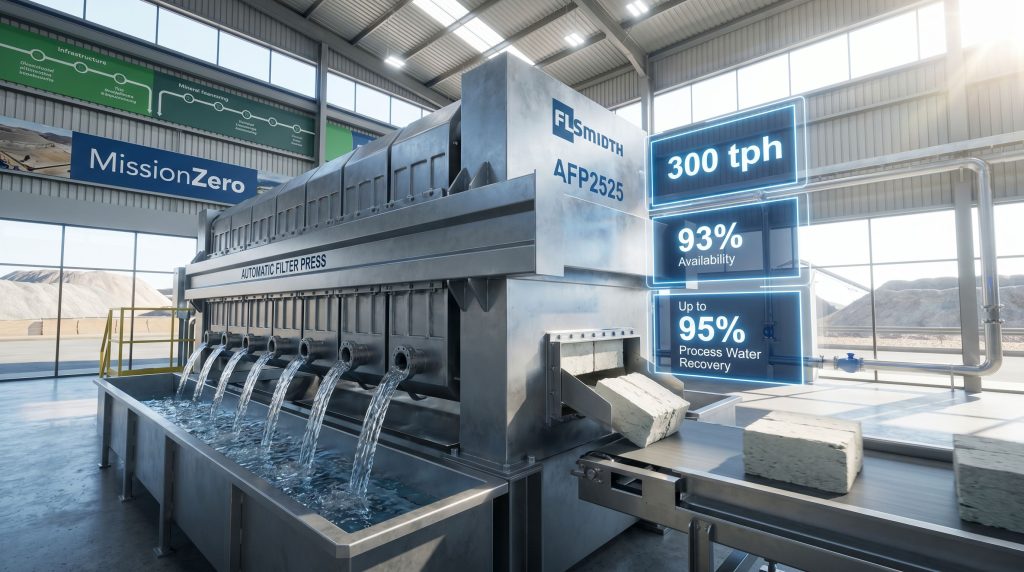
It is within this context that the FLSmidth AFP2525 automatic filter press represents a genuinely significant engineering development. Rather than offering incremental improvement over existing systems, the AFP2525 was designed to address the full spectrum of modern mining's dewatering challenges simultaneously: throughput, water recovery, availability, cost efficiency, and long-term durability.
When big ASX news breaks, our subscribers know first
How Dewatering Technology Arrived at This Moment
The evolution of solid-liquid separation in mineral processing reflects broader shifts in how the industry conceptualises environmental liability. For decades, wet tailings storage facilities (TSFs) were the default solution. Slurry was piped to large retention dams, water was partially recovered through decanting and evaporation, and the residual solids were left to consolidate over time. This approach was cost-effective in the short term but carried substantial long-term risks: dam structural failure, acid mine drainage, heavy metal leaching, and ongoing regulatory monitoring costs.
Thickeners and cyclones improved matters by increasing the density of tailings before storage, but the output remained wet enough to require conventional dam infrastructure. Vacuum belt filters represented a further step forward, producing semi-dry cakes in some applications, but struggled to achieve the throughput volumes required by large-scale operations. Furthermore, mine reclamation innovation has accelerated pressure on operations to adopt more sophisticated solid-liquid separation approaches from the outset.
High-pressure automatic filter presses represent the current technological frontier. By applying mechanical pressure across a series of filter plates, these systems extract water from tailings slurry to produce a dry, stackable filter cake that can be placed directly into engineered dry-stack facilities without standing water, without dam construction, and without the seismic and hydrological failure modes that make wet TSFs such a persistent liability.
The shift to dry-stack filtration is not merely a technical preference. In Brazil, following the Brumadinho disaster, regulators moved aggressively to restrict new upstream-constructed wet tailings facilities above certain risk classifications. Other jurisdictions are tracking similar regulatory trajectories, making filtered dry-stack tailings an increasingly necessary, rather than optional, operational choice.
FLSmidth AFP2525 Automatic Filter Press: Technical Specifications and Performance Benchmarks
Core Performance Metrics at a Glance
The AFP2525's performance parameters set a high bar relative to other single-unit filter press solutions currently available to the mining sector. The following table summarises its key operational characteristics:
| Performance Parameter | AFP2525 Specification |
|---|---|
| Throughput Capacity | 300 tonnes per hour (single unit) |
| Daily Processing Volume | 7,200 tonnes per day |
| Average Equipment Availability | 93% |
| Process Water Recovery Rate | Up to 95% |
| Cake Moisture Output | Industry-leading low moisture levels |
| Operational Lifespan | Designed for the full life of mine and beyond |
| Cost Efficiency | Lowest cost per tonne in its equipment class |
Achieving 300 tonnes per hour from a single filter unit is a meaningful engineering milestone. At that throughput rate, a single AFP2525 can process the equivalent of a significant large-scale copper or gold operation's daily tailings output without requiring parallel unit trains, simplifying both the plant layout and the maintenance schedule.
How the AFP2525 Achieves 93% Availability: The Maintenance Architecture
Availability is the metric that separates filter press performance promises from operational reality. Many high-capacity filter presses struggle with unplanned downtime during cloth changes, plate inspections, and hydraulic system servicing. The AFP2525 addresses this through a fundamentally different maintenance philosophy:
-
External plate and cloth servicing: Cloth changes and plate maintenance are conducted outside the active filter body, meaning the press does not need to enter a full shutdown state for routine servicing tasks. This is a structural departure from conventional designs where internal access is required.
-
Rapid plate-pack removal system: The unit is engineered for minimal transition time between maintenance intervals and full operational resumption, compressing the window during which throughput capacity is reduced.
-
Dual cycle optimisation: Fast filtration rates are combined with shortened mechanical transition times, reducing the total filter cycle duration without sacrificing cake moisture quality or throughput consistency.
-
Robust structural design: The chassis is engineered to absorb the mechanical stresses associated with continuous, high-volume tailings processing over multi-decade operational periods, reducing the frequency of structural maintenance events.
At 300 tonnes per hour throughput, every unplanned hour of downtime creates a direct processing bottleneck across the entire tailings circuit. The 93% average availability target is designed to contain unplanned downtime to approximately 620 hours per year across continuous operations, a figure that compares favourably against lower-availability alternatives where downtime can exceed twice that level.
The FLSmidth Closure System: Engineering for Maximum Plate Density
One of the less-discussed but commercially significant design features of the AFP2525 is its proprietary closure mechanism. Conventional filter press configurations are constrained in the number of filter plates that can be fitted within a given unit footprint when using standard plate dimensions. FLSmidth's closure system overcomes this constraint by enabling a greater plate density per unit than comparable configurations from competing manufacturers.
The practical implications of this are substantial:
-
Fewer individual filter press units are required to achieve a given total throughput target at a large mine site
-
Reduced unit count means lower capital expenditure on procurement, civil foundations, and ancillary infrastructure
-
A smaller equipment footprint simplifies plant layout, reduces the land area required for the processing facility, and lowers ongoing maintenance labour requirements
Comparing the AFP2525 Against Conventional Dewatering Approaches
The following comparison illustrates how the AFP2525 positions relative to alternative dewatering methodologies across the key performance dimensions that matter most to mining operations:
| Dewatering Method | Water Recovery Rate | Throughput Scalability | Tailings Output | Infrastructure Risk |
|---|---|---|---|---|
| Wet Tailings Dams | Low (passive evaporation) | High volume, low control | Liquid slurry | High (dam failure risk) |
| Thickeners + Cyclones | Moderate | Moderate | Thickened slurry | Moderate |
| Vacuum Belt Filters | Moderate to High | Limited per unit | Semi-dry cake | Low |
| High-Pressure Filter Press (AFP2525) | Up to 95% | 300 tph per unit | Dry-stack cake | Very Low |
The performance gap between wet tailings infrastructure and high-pressure filter press technology is not marginal. It is the difference between passive water recovery through evaporation and active recovery of up to 95% of process water that can be recycled directly back into the mineral processing circuit.
Operational Scenarios Where the AFP2525 Delivers the Greatest Value
Scenario 1: High-Volume Operations in Water-Stressed Regions
A large open-pit copper mine processing more than 7,000 tonnes of tailings per day in an arid climate can redeploy the majority of its process water back into the circuit, eliminating freshwater sourcing infrastructure and removing the capital and ongoing liability costs associated with wet tailings dam construction, lining, and monitoring programmes.
Scenario 2: Operations Transitioning Away from Wet TSFs
Mines facing regulatory pressure or closure orders on existing tailings storage facilities can retrofit AFP2525 units into existing processing circuits to achieve dry-stack compliance without rebuilding the entire mineral processing flowsheet from scratch.
Scenario 3: Greenfield Projects in Environmentally Sensitive Jurisdictions
New mine developments in regions with stringent environmental licensing requirements can incorporate the FLSmidth AFP2525 automatic filter press as a core component of a zero-liquid-discharge tailings strategy, directly supporting both regulatory approval processes and ongoing community social licence obligations.
What Are the Key Cost Drivers Behind the Lowest-Cost-Per-Tonne Claim?
Breaking Down the Total Cost of Ownership
The AFP2525's cost efficiency argument operates across multiple dimensions simultaneously, which is what distinguishes it from equipment that may excel on one metric while underperforming on another.
Capital Cost Efficiency
The high plate density enabled by the proprietary closure system means fewer individual units are needed to meet a given throughput target. This reduces total capital expenditure on equipment procurement and installation. A simplified structural footprint also reduces civil engineering and foundation costs compared to equivalent-capacity multi-unit configurations that require additional structural supports, piping networks, and control systems.
Operating Cost Reduction Levers
-
Water cost savings: Recovering up to 95% of process water eliminates or significantly reduces freshwater purchase, pumping, and treatment costs across the mine's water management budget.
-
Wet tailings liability elimination: Removing the need for tailings dam construction, lining, geotechnical monitoring, and eventual closure planning dramatically reduces the long-term financial liability carried on the mine's balance sheet.
-
Maintenance cost control: External servicing capability and rapid plate-pack removal reduce both labour hours and lost production time during maintenance windows, lowering the per-tonne operating cost of the dewatering circuit.
-
Extended asset life: The mine-life durability orientation of the AFP2525's design reduces the frequency and capital cost of major equipment replacement events over the project's operational life.
The AFP2525 Within FLSmidth's MissionZero Sustainability Framework
FLSmidth's MissionZero programme establishes a target of enabling mining operations to achieve zero water waste and zero emissions by 2030. The AFP2525 sits at the centre of the water waste dimension of this ambition, providing the mechanical means by which operations can transition from water-intensive wet tailings infrastructure to fully closed-loop water management systems. Consequently, natural capital in mining has become an increasingly prominent framework for evaluating how equipment investments such as this translate into measurable environmental balance sheet improvements.
The environmental and social licence implications of this are substantial. Wet tailings storage facilities represent one of the most significant categories of environmental liability in mining globally. Catastrophic TSF failures have generated multi-billion-dollar remediation costs and produced irreversible ecological damage in affected river systems and communities. Dry-stack filtration eliminates the standing water volume from the tailings facility, reducing the principal failure mode that makes wet TSFs so consequential when they fail.
Communities located near mining operations are increasingly sophisticated in their scrutiny of tailings management practices as part of broader ESG assessments. Dry-stack filtration offers a measurable, auditable improvement in environmental performance that can be directly incorporated into sustainability reporting frameworks, including the Global Industry Standard on Tailings Management (GISTM), which major mining companies and institutional investors have adopted following the industry's reckoning with TSF failure risks.
The next major ASX story will hit our subscribers first
Industry Context: Why High-Capacity Filter Press Technology Is a Strategic Imperative
The Scale of the Global Tailings Challenge
The global mining industry generates an estimated 14 billion tonnes of tailings annually, with wet storage facilities representing the largest single category of environmental liability on most major miners' balance sheets. Institutional investors and ESG rating agencies have elevated tailings management to a board-level governance issue, and the adoption of the GISTM has created formal expectations around dry-stack filtration consideration for operations where it is technically and economically feasible.
What is less commonly understood is the compounding financial logic behind filter press investment at scale. Beyond the direct operating cost savings from water recovery, mines that eliminate wet TSF requirements also remove a contingent liability from their balance sheets that can dwarf the capital cost of the filter press installation itself. TSF closure and rehabilitation costs for large facilities can run into hundreds of millions of dollars, representing an obligation that institutional investors are increasingly demanding be provisioned and disclosed transparently.
Water Stewardship as a Competitive Differentiator in Permitting
Access to water is a binding constraint on new mine development in an increasing number of jurisdictions. Regulators in Chile, Peru, South Africa, and parts of Australia now require detailed water balance modelling and closed-loop water management plans as part of environmental impact assessment processes. Demonstrating a 90%+ process water recovery rate enabled by high-capacity filter press technology provides a quantifiable, credible commitment to water stewardship that carries weight in permitting negotiations.
Mines that can demonstrate closed-loop water management capability also benefit from reduced political and community opposition risk. This is increasingly material to project timelines and the cost of capital in the ESG-conscious investment environment that now dominates institutional allocation decisions. In addition, broader mining sustainability transformation trends are reinforcing the commercial logic of adopting dry-stack filtration as a standard rather than a premium operational choice.
Frequently Asked Questions: FLSmidth AFP2525 Automatic Filter Press
What is the maximum throughput of the AFP2525 filter press?
The FLSmidth AFP2525 automatic filter press can process up to 300 tonnes per hour from a single unit, equating to approximately 7,200 tonnes per day. This positions it among the highest-capacity single-unit filter press solutions available to the mining industry.
What level of process water recovery does the AFP2525 achieve?
The unit is engineered to recover up to 95% of process water from tailings slurry, enabling mines to recycle the vast majority of water used in mineral processing back into their operational circuits.
How does the AFP2525 minimise maintenance downtime?
Cloth changes and plate maintenance are conducted outside the filter body, meaning the press does not require a full shutdown for routine servicing. Combined with rapid plate-pack removal, this architecture supports an average availability rating of 93%.
Is the AFP2525 suitable for dry-stack tailings operations?
Yes. The AFP2525 produces low-moisture filter cake suitable for dry-stack disposal, eliminating the need for conventional wet tailings storage infrastructure and its associated environmental and regulatory risks.
How does the AFP2525 support ESG and sustainability reporting?
By enabling near-complete process water recycling and supporting the elimination of wet tailings dams, the AFP2525 provides mines with quantifiable improvements across water stewardship, environmental risk reduction, and community relations metrics that are directly relevant to leading ESG reporting frameworks. Furthermore, mining electrification and decarbonisation initiatives are increasingly paired with water stewardship programmes to present a cohesive sustainability narrative to investors and regulators.
What applications beyond tailings management can benefit from the AFP2525?
While designed for high-volume mining tailings applications, the underlying high-pressure automatic filtration technology has applicability across any industrial process requiring large-scale solid-liquid separation. This includes mineral sands processing, industrial wastewater treatment, and certain chemical manufacturing streams. Moreover, the growing demand for critical raw materials transition minerals means that efficient processing of lower-grade ores — which generate proportionally more tailings — is making high-capacity filter press technology even more strategically relevant.
Key Takeaways: FLSmidth AFP2525 Automatic Filter Press
-
The AFP2525 delivers 300 tph throughput and 7,200 tpd capacity from a single filter unit, among the highest in its equipment class
-
93% average availability is achieved through an external maintenance architecture that eliminates the need for full shutdowns during routine servicing
-
Up to 95% process water recovery enables near-complete closed-loop water management, directly reducing freshwater dependency and wet tailings infrastructure costs
-
The proprietary FLSmidth closure system enables greater plate density per unit, supporting the lowest-cost-per-tonne claim through both capital and operational efficiency gains
-
Dry-stack filter cake output eliminates the structural failure risk, regulatory exposure, and long-term closure liability associated with conventional wet tailings storage facilities
-
The AFP2525 is a central technology within FLSmidth's MissionZero 2030 framework, targeting zero water waste across the global mining sector
-
A design philosophy oriented toward mine-life durability reduces total cost of ownership across extended operational periods, strengthening the investment case relative to lower-availability alternatives
Disclaimer: This article is intended for informational purposes only and does not constitute financial, investment, or professional engineering advice. Performance specifications and operational benchmarks referenced in this article are based on manufacturer disclosures and publicly available industry information. Actual equipment performance will vary depending on ore characteristics, operational conditions, and site-specific factors. Readers should conduct independent due diligence before making capital investment decisions.
Want to Know Which ASX Mining Companies Are Adopting Game-Changing Technologies Like This?
Discovery Alert's proprietary Discovery IQ model scans ASX announcements in real time, instantly identifying significant mineral discoveries and the companies embracing transformative operational technologies — turning complex data across 30+ commodities into clear, actionable insights for investors at every level. Explore how historic discoveries have delivered extraordinary returns on Discovery Alert's dedicated discoveries page, then begin your 14-day free trial to position yourself ahead of the broader market.