August 6, 2026
The Deepwater Frontier: Why National Oil Companies Are Betting on Collaboration Over Competition
Across the global offshore industry, a quiet but consequential shift is underway. The era in which international oil majors dominated frontier deepwater development is giving way to a new model, one where national oil companies are increasingly turning to each other to unlock technically demanding reserves that neither could efficiently pursue alone. This dynamic is nowhere more visible than in Latin America, where shared geology, overlapping maritime boundaries, and complementary technical capabilities are reshaping how state-owned energy giants approach the next generation of hydrocarbon development.
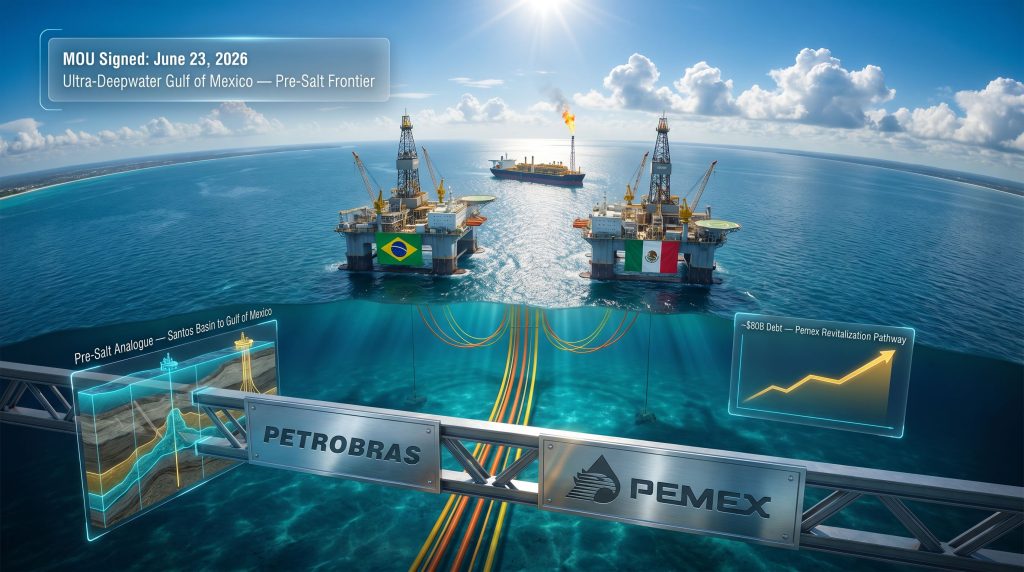
The Petrobras and Pemex deepwater Gulf of Mexico MOU, signed on June 23, 2026, is the latest and perhaps most strategically significant expression of this trend. Understanding what it means requires looking beyond the headline announcement and into the structural forces, geological realities, and institutional constraints that will ultimately determine whether this agreement evolves into something transformative or remains a framework in search of execution.
When big ASX news breaks, our subscribers know first
Why These Two Companies Need Each Other
The partnership did not emerge from a vacuum. Both Petrobras and Pemex face structural pressures that make intra-regional collaboration an attractive strategic response, though their challenges differ considerably in nature and severity.
Petrobras has spent decades becoming one of the world's most capable deepwater operators. Its pre-salt discoveries in the Santos and Campos basins off the Brazilian coast placed the company at the frontier of ultra-deepwater technology, operating routinely in water depths exceeding 3,000 metres and developing subsurface plays buried beneath thick salt layers that once made reliable seismic imaging nearly impossible.
The company's mastery of sub-salt imaging, floating production storage and offloading systems, and long-distance subsea tiebacks represents a technical capability set that few operators anywhere in the world can match. Furthermore, crude oil price volatility has only intensified the pressure on both companies to maximise returns from frontier acreage.
Pemex, by contrast, is navigating a far more difficult operational environment. The company carries an estimated debt burden of approximately USD $80 billion, and its production profile has been declining for years as legacy fields like Cantarell mature and output from shallow-water Gulf of Mexico acreage diminishes. Critically, Pemex lacks the deepwater and ultra-deepwater operational expertise needed to independently develop the Gulf of Mexico's frontier zones, where pre-salt geological analogues to Brazil's prolific Santos Basin have been identified but remain largely undrilled.
This creates a natural complementarity. Petrobras brings world-class technical capability but limited geographic exposure to the Gulf of Mexico. Pemex holds sovereign access to Mexican deepwater acreage but lacks the operational toolkit to develop it efficiently. The Petrobras and Pemex deepwater Gulf of Mexico MOU is, at its core, an attempt to close that gap.
The Diplomatic Dimension
What distinguishes this agreement from a purely commercial arrangement is its origin at the highest levels of government. The initiative was proposed directly by Brazilian President Luiz Inácio Lula da Silva in communication with Mexican President Claudia Sheinbaum, elevating the MOU into the domain of state diplomacy as much as corporate strategy.
This political framing carries both advantages and complications. It signals genuine commitment from both governments, but it also means the partnership's trajectory will be influenced by broader bilateral relations and domestic political considerations in each country. In addition, the broader geopolitical landscape for energy partnerships has grown considerably more complex in recent years, adding another layer of strategic consideration to such agreements.
What the MOU Actually Covers
According to reports from Upstream Online, the agreement spans a broader scope than a simple exploration partnership. Its provisions fall into two main categories: upstream exploration and production activities, and industrial and processing cooperation.
Upstream: Deepwater, Pre-Salt, and Mature Field Revitalization
On the exploration and production side, the MOU covers:
- Joint evaluation of deepwater and ultra-deepwater exploration opportunities across Gulf of Mexico acreage
- Collaborative assessment of pre-salt frontier potential, the geological play where Petrobras holds the deepest operational experience globally
- Mature field revitalization programmes, applying enhanced oil recovery techniques and seismic reprocessing to extend the productive life of declining Mexican assets
- Structured knowledge transfer encompassing subsurface data interpretation, technical methodologies, and operational best practices
The pre-salt dimension deserves particular attention. Pre-salt reservoirs are hydrocarbon accumulations trapped beneath ancient salt layers, often at depths requiring the most advanced seismic processing technologies available. In Brazil's Santos Basin, pre-salt fields have proven to be among the highest-quality reservoirs ever discovered, with light crude, high flow rates, and recovery factors that routinely exceed those of conventional reservoirs.
Industrial Cooperation: From Refining to Carbon Capture
Beyond the wellhead, the MOU extends into industrial processing, covering:
- Refining capacity optimisation and petrochemical integration
- Cooperation in fertiliser production, gas processing, and natural gas liquids recovery
- Energy efficiency programmes and operational reliability benchmarking
- Carbon capture and storage technology sharing
- Production of lower-carbon fuels and emissions reduction protocols
The inclusion of carbon capture and lower-carbon fuel cooperation reflects the broader integration of energy transition pressures into NOC partnership frameworks, a trend that is becoming standard practice as state energy companies face growing pressure to demonstrate decarbonisation pathways.
MOU Parameters at a Glance
| Parameter | Detail |
|---|---|
| Agreement Type | Non-binding Memorandum of Understanding |
| Signing Date | June 23, 2026 |
| Duration | 2 years, renewable |
| Legal Status | Does not constitute a joint venture, consortium, or binding investment commitment |
| Future Projects | Subject to separate negotiations, feasibility studies, and regulatory approvals |
| Governance | Each party subject to its own applicable governance rules |
Three Scenarios for Where This Partnership Goes Next
The non-binding nature of the MOU means its ultimate value depends entirely on what follows. Three plausible scenarios frame the range of outcomes.
Scenario 1: Limited Near-Term Impact (Base Case)
No capital has been committed and no operational mandate exists under the current agreement. Deepwater development in the Gulf of Mexico, whether on the Mexican or US side, typically requires multi-year lead times, complex regulatory approval processes, and capital commitments running into the billions of dollars per project.
Pemex's ~$80 billion debt load represents a genuine constraint on its capacity to fund large-scale deepwater programmes, even with a technically superior partner. In this base case, the MOU creates strategic optionality without near-term production impact.
Scenario 2: Phased Technical Collaboration Gains Traction (Upside Case)
Notably, technical missions from both companies have already conducted preliminary geological viability and regulatory assessments prior to the MOU's signing. This suggests the groundwork is more advanced than a typical early-stage framework agreement.
If joint seismic reprocessing campaigns identify commercially attractive deepwater targets, the partnership could accelerate toward binding project instruments within the two-year window. Mature field revitalization, which carries lower capital intensity than greenfield deepwater development, may represent the fastest pathway to tangible output gains for Pemex.
Scenario 3: Full Deepwater Development Alliance (Long-Term Potential)
A successful pre-salt discovery in the Gulf of Mexico, modelled conceptually on Petrobras' Santos Basin experience, could fundamentally alter the strategic calculus for both companies. A formalised joint venture or consortium structure could emerge post-MOU if regulatory conditions and capital availability align.
Over a 10 to 15 year horizon, combined deepwater output from two major NOCs operating in the Gulf of Mexico could meaningfully reshape regional supply dynamics. However, ongoing trade war impact on energy markets and capital flows could influence the pace at which binding commitments materialise.
The Technical Knowledge Gap and Why It Matters
One of the least-discussed aspects of this partnership is just how significant Petrobras' technical advantage actually is in the specific context of Gulf of Mexico pre-salt exploration.
Sub-salt seismic imaging remains one of the most technically demanding challenges in modern exploration geophysics. Salt bodies distort acoustic wave propagation in ways that can make underlying reservoirs appear structurally different from reality, leading to dry holes and misallocated capital. Petrobras developed and refined proprietary approaches to this challenge through necessity, as its pre-salt discoveries in Brazil would have been impossible without advances in wide-azimuth seismic acquisition and full-waveform inversion processing.
These techniques are directly applicable to the Gulf of Mexico, where allochthonous salt sheets — salt bodies that have moved laterally from their original position — create similar imaging challenges over potentially prospective deepwater acreage. The transfer of Petrobras' sub-salt interpretation methodology to Pemex's technical teams could substantially improve the quality of exploration decisions over Mexican deepwater blocks.
Beyond exploration technology, Pemex also stands to gain:
- Access to proven deepwater well construction and completion frameworks developed for high-pressure, high-temperature environments
- Operational frameworks for subsea production system management and intervention
- Safety management system architecture drawing on Petrobras' offshore safety experience
- Potential connections to Petrobras' supply chain networks and specialised deepwater engineering contractors
Regulatory Architecture: The Institutional Hurdles Ahead
Translating an MOU into operating reality requires navigating two distinct and complex regulatory environments.
In Mexico, any deepwater development project requires approval from the Comisión Nacional de Hidrocarburos (CNH), compliance with the country's hydrocarbons law, and navigation of Pemex's layers of federal oversight, budget authorisation, and congressional scrutiny. Mexico's energy sector has experienced significant policy shifts in recent years, including periods of restricted foreign and private participation in upstream activities.
In Brazil, Petrobras operates as a publicly listed company on both the NYSE and Brazil's B3 exchange, which means any binding international partnership must align with corporate governance standards, board approval processes, and shareholder obligations. Brazil's National Petroleum Agency, the ANP, may also play a role in shaping how Petrobras structures future joint arrangements. Consequently, OPEC's market influence over regional production decisions adds yet another variable to the regulatory calculus both companies must navigate.
The MOU's explicit acknowledgment that future opportunities are contingent on the execution of specific contractual instruments, feasibility validation, and approvals from relevant authorities is standard language for agreements of this type, but it also reflects the genuine institutional complexity that lies between intent and operation.
The next major ASX story will hit our subscribers first
NOC-to-NOC Cooperation: A Comparison of Partnership Models
The Petrobras and Pemex deepwater Gulf of Mexico MOU fits within a broader and growing pattern of Latin American state energy companies pursuing intra-regional partnerships. Understanding the typical progression of NOC cooperation structures helps frame where this MOU sits in its potential lifecycle.
| Partnership Model | Key Characteristics | Relevance to This Agreement |
|---|---|---|
| Technical Assistance Agreement | Knowledge transfer, no equity sharing | Most likely immediate pathway |
| Joint Study Agreement | Shared geological and feasibility analysis | Already underway via technical missions |
| Production Sharing Contract | Revenue and cost sharing on specific blocks | Plausible medium-term structure |
| Incorporated Joint Venture | Shared equity company for field operations | Long-term possibility post-MOU renewal |
As reported by Brazil Energy Insight, the involvement of heads of state in initiating this agreement underscores how deepwater energy development has become a dimension of regional geopolitical strategy, not merely a commercial calculation. The pattern of South-South energy diplomacy, where resource-rich developing economies seek partnerships that reduce dependence on international majors, is accelerating across multiple regions globally.
What Analysts and Investors Should Monitor
For those tracking this partnership's progression, several indicators will provide early signals of whether the MOU is evolving into something substantive.
- Seismic reprocessing outcomes: Shared campaigns over Gulf of Mexico deepwater acreage represent the most likely near-term deliverable. Commercially meaningful results would be the clearest early indicator of forward momentum.
- Pemex financial trajectory: The company's ability to commit capital to deepwater programmes is directly constrained by its debt position. Any material improvement in its fiscal situation would change the partnership's execution potential considerably.
- Mexican regulatory signals: Policy developments under President Sheinbaum's administration regarding inter-NOC and foreign participation in upstream activities will shape what legal structures are available for future binding agreements.
- Technical mission reports: Whether the preliminary geological and regulatory assessments already completed result in publicly disclosed findings will indicate how seriously both parties are advancing the partnership's substantive work.
- The 2028 renewal decision: Whether both parties choose to renew or upgrade the agreement to a more formal structure at the two-year mark will serve as a defining signal of the partnership's long-term trajectory.
Frequently Asked Questions
Is the Petrobras-Pemex MOU legally binding?
No. The agreement signed on June 23, 2026 is explicitly non-binding. It creates no joint venture, consortium, or investment obligation. Future projects arising from the partnership will require separate contractual instruments and regulatory approvals in both countries.
What deepwater areas does the agreement focus on?
The MOU covers deepwater and ultra-deepwater zones within the Gulf of Mexico, with emphasis on exploration and development opportunities including pre-salt geological plays and mature field revitalisation programmes.
How long does the agreement remain active?
The MOU has an initial two-year duration from the date of signing, with provisions allowing for renewal by mutual agreement.
What makes Petrobras uniquely qualified for pre-salt deepwater work?
Petrobras developed world-leading expertise in sub-salt seismic imaging, ultra-deepwater well construction, and floating production systems through decades of operating in Brazilian offshore basins at depths exceeding 3,000 metres. This experience is directly applicable to Gulf of Mexico pre-salt exploration challenges.
Does the MOU include energy transition components?
Yes. The agreement incorporates provisions for carbon capture and storage cooperation, lower-carbon fuel production, energy efficiency programmes, and emissions reduction frameworks.
Disclaimer: This article is intended for informational purposes only and does not constitute financial or investment advice. Forward-looking assessments regarding project timelines, production potential, and partnership outcomes are speculative in nature and subject to material uncertainty. Readers should conduct independent research before making investment decisions.
Want to Stay Ahead of the Next Major Resource Discovery?
Discovery Alert's proprietary Discovery IQ model scans ASX announcements in real time, instantly identifying significant mineral discoveries across more than 30 commodities and converting complex geological data into actionable investment insights — explore the historic returns major discoveries have generated and begin your 14-day free trial to position yourself ahead of the broader market.