June 25, 2026
The Engineering Logic That Nature Already Solved
Across billions of years of evolutionary pressure, insects developed navigation systems of extraordinary precision using nothing more than ambient light, internal motion sensing, and distributed group behaviour. No satellites. No centralised controllers. No power-hungry processors. The honeybee, in particular, solved a problem that continues to frustrate robotics engineers working in some of the most hostile environments on earth: how to navigate accurately when no external positioning signal is available.
This is not a trivial engineering challenge. It sits at the core of one of mining's most persistent operational constraints, and it is precisely why researchers at institutions across Australia and Europe are now looking to insect biology for answers that conventional technology has struggled to provide. Bee-inspired robotic ore collection represents a genuinely novel response to this challenge.
When big ASX news breaks, our subscribers know first
The Navigation Problem at the Heart of Underground Mining
Modern autonomous mining equipment overwhelmingly depends on GPS for spatial positioning. The moment a machine descends below the surface, that dependency becomes a liability. Underground environments strip away GPS signal entirely, forcing current autonomous systems to rely on a patchwork of LiDAR-based mapping, inertial measurement units, and pre-loaded mine geometry data. These workarounds are expensive, computationally intensive, and brittle in dynamic environments where tunnel layouts shift, rock falls alter passageways, and dust disrupts sensor accuracy.
This is where bee-inspired robotic ore collection enters the conversation not as a novelty, but as a structurally rational response to a genuine engineering gap. Furthermore, automation in mining has already demonstrated that removing human operators from dangerous underground environments is both technically feasible and commercially desirable.
Honeybees navigate using two independent biological mechanisms that function entirely without external signal input:
-
Celestial polarisation sensing: Bees detect the polarisation pattern of scattered sunlight across the sky dome, which remains readable even under cloud cover. This provides directional orientation analogous to a compass, but derived entirely from ambient light physics.
-
Optic flow measurement: As a bee moves through space, the rate at which surrounding visual textures shift across its retina encodes information about velocity and distance travelled. This mechanism, known as optic flow, allows bees to estimate how far they have moved without any external reference point.
Together, these two systems form a self-contained positioning architecture. For underground robots operating beyond GPS range, this biological model offers something that no current commercial technology fully replicates: reliable, low-power, signal-independent navigation.
Key Insight: The dual-mechanism approach bees use, combining light polarisation orientation with motion-based distance estimation, produces navigation accuracy that is robust to signal interference and requires minimal onboard power. Both properties are critically valuable in deep underground mine environments.
From Hive Behaviour to Swarm Architecture
The navigation mechanism is only one dimension of what makes bee-inspired design relevant to mining. The broader structural logic of how bee colonies organise collective tasks offers an equally important engineering blueprint.
Honeybee colonies divide labour between scout bees, which explore and assess resources, and retriever bees, which collect and transport based on scout intelligence communicated through the waggle dance. This separation of exploration and retrieval functions, coordinated without any central command, produces highly efficient resource acquisition across large and variable territories.
Mapped onto an underground mining context, this biological logic translates into a multi-robot architecture where:
-
A subset of robots performs autonomous ore body mapping and grade assessment across unknown or dynamic sections of a mine.
-
A second subset executes targeted sample collection or retrieval based on intelligence generated by the first group.
-
The entire system self-coordinates without requiring centralised software control, meaning individual unit failures do not collapse the broader operation.
Ant colonies contribute a complementary principle. Ant trail behaviour optimises transport paths through iterative reinforcement, where the most efficient routes are progressively strengthened through collective use. This mechanism, formalised in computer science as ant colony optimisation (ACO), is directly applicable to ore haulage path planning in complex underground environments. Research published on bio-inspired swarm robotics design further validates the structural logic of applying these principles to mine automation.
How Bio-Inspired Swarm Robotics Compares to Conventional Mining Automation
The differences between swarm-based systems and current autonomous mining equipment are not merely technical, they reflect fundamentally different design philosophies.
| Capability Dimension | Conventional Autonomous Equipment | Bio-Inspired Swarm Robots |
|---|---|---|
| Navigation Dependency | GPS + LiDAR + centralised mapping | Onboard sensing, decentralised |
| Unit Cost | High (single large-scale machine) | Low (many small-scale units) |
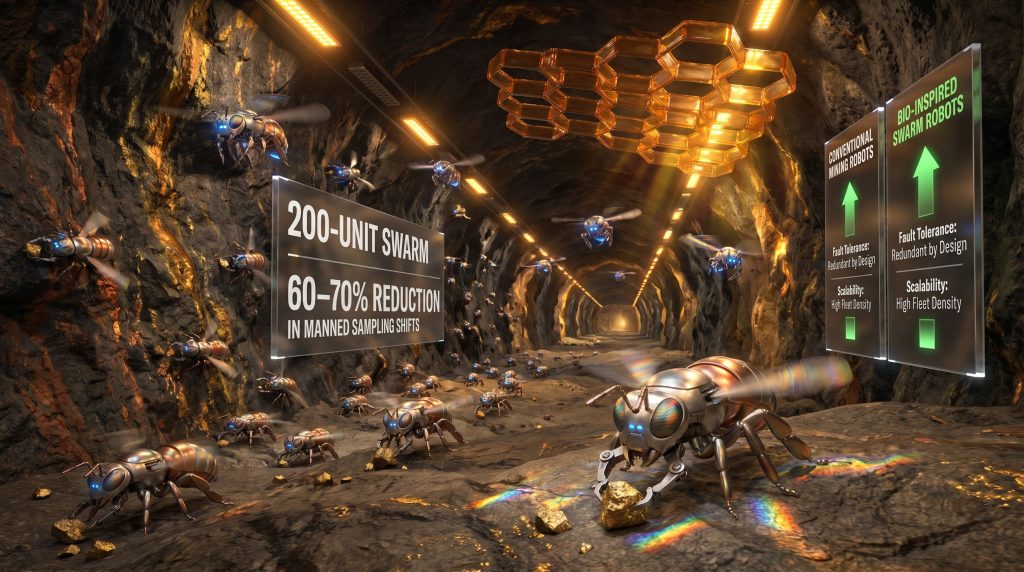
| Fault Tolerance | Single point of failure risk | Redundant by design |
| Terrain Adaptability | Optimised for known environments | Adaptive to dynamic conditions |
| Scalability | Limited by capital cost per unit | Scalable through unit replication |
| Communication Architecture | Centralised command structure | Distributed, emergent coordination |
| Energy Footprint | High power draw per unit | Low power draw across fleet |
The decentralised architecture of swarm systems produces a property that single-unit autonomous machines cannot replicate at equivalent cost: fault tolerance through redundancy. When one unit in a swarm fails, the collective continues to function. When a single large autonomous vehicle fails underground, the operational and recovery cost is substantial.
This structural advantage becomes more pronounced as mine depth increases. Operations extending beyond 1,000 metres face exponentially greater challenges for human access, equipment retrieval, and real-time remote operation. A swarm of insect-scale robots designed for these conditions offers a different risk profile entirely. In addition, data-driven mining operations are increasingly being integrated alongside these emerging swarm architectures to optimise decision-making at every level.
The Research Programs Advancing This Technology
Who Is Leading the Research?
The University of Adelaide has positioned itself as a meaningful contributor to swarm robotics research for mining applications, with work focused on how multi-robot coordination can enhance both safety outcomes and operational efficiency in underground environments. This research sits within a broader global network of institutions pursuing bio-inspired autonomous systems.
In Europe, the InsectNeuroNano initiative, funded through the EU research framework, is developing navigation chips that replicate bee-style positioning using integrated light polarisation sensing and motion detection hardware. These chips are designed to operate at insect scale, making them compatible with miniaturised robotic platforms intended for complex, signal-denied environments. The program's development timeline extends to September 2026, after which hardware validation in applied settings is expected to follow.
At Harvard University, the Wyss Institute's RoboBee program has demonstrated centimetre-scale flying robots capable of operating in controlled environments, with ongoing work addressing power supply constraints and outdoor applicability. While current RoboBee systems are not mining-ready, the underlying manufacturing and control architecture contributes directly to the knowledge base from which underground-capable micro-robots will eventually be developed.
Technical Context: Navigation chip miniaturisation is currently the most critical hardware bottleneck in bio-inspired mining robotics. Chips capable of processing polarised light orientation and optic flow data at sufficiently low power draw to enable continuous underground operation are still in advanced research phases, not yet at commercial production scale.
Practical Mining Applications Being Targeted
What Can Swarm Robots Actually Do Underground?
The range of underground applications that bee-inspired robotic ore collection could address is broader than the headline use case suggests. Furthermore, the role of AI in mining operations suggests that integrating intelligent decision-making with swarm coordination could significantly amplify these capabilities. Current research trajectories point toward the following operational roles:
-
Autonomous ore grade mapping: Swarms of sensor-equipped robots traversing ore bodies to generate high-frequency, spatially dense grade data, replacing or augmenting conventional manned sampling programmes.
-
Blasthole and chip sample collection: Targeted retrieval of ore samples from blastholes and development headings, reducing the need for personnel to enter freshly blasted areas before atmospheric and structural conditions are verified safe.
-
Structural hazard monitoring: Continuous passive monitoring of ground movement, gas accumulation, and structural stress indicators across mine workings, with swarm architecture enabling coverage that fixed sensor networks cannot economically provide.
-
Search and rescue in inaccessible zones: Deployment into collapsed or otherwise inaccessible sections of underground mines to locate personnel, assess conditions, and relay information to surface operators.
-
Mapping of unknown or geologically complex ore bodies: Autonomous reconnaissance of mine extensions where the geometry and rock conditions are insufficiently characterised for safe human or large-machine entry.
The next major ASX story will hit our subscribers first
Space Mining as an Unexpected Accelerator
One of the less widely recognised dynamics shaping the pace of bio-inspired mining robotics development is the acceleration effect of space mining research programmes. Asteroid mining advances and lunar initiatives, pursued by space agencies and private operators globally, are generating hardware investment in robotic ore collection systems under constraints that closely mirror deep underground mining: no GPS, extreme terrain variability, communication latency, energy limitation, and zero tolerance for mission-critical failures.
The engineering outputs of in-situ resource utilisation (ISRU) programmes, which focus on extracting and processing materials at their source location rather than returning them to a central facility, are producing robotic drilling, scooping, and sample transfer capabilities with direct terrestrial application potential. Consequently, lunar resource extraction technologies validated against the demands of lunar regolith collection are likely candidates for adaptation to underground ore environments on earth.
Strategic Note: Space mining programmes currently represent the most heavily capitalised development environment for autonomous ore collection robotics worldwide. The technology transfer pathway from space to terrestrial underground mining is not speculative. It is already an active consideration in academic and industry research planning.
Safety, Sustainability, and ESG Implications for Australian Mining
Beyond the operational efficiency case, bee-inspired swarm robotics carries significant implications for the safety and sustainability performance of Australian mining operations, both of which are increasingly material to investor and regulatory relationships.
The safety case is direct: reducing human presence in the most hazardous underground environments, including freshly blasted headings, structurally compromised areas, and zones with elevated atmospheric risk, is an unconditional improvement in worker safety outcomes. Swarm robots can operate continuously in conditions that would require mandatory evacuation of human workers.
On the sustainability side, the energy arithmetic is compelling. A fleet of insect-scale robots drawing milliwatts of power per unit across a swarm of hundreds represents a fundamentally different energy profile than a fleet of diesel-powered autonomous loaders or underground haul trucks. As Australian mining companies face increasing ESG reporting obligations and investor scrutiny on operational emissions, the energy efficiency characteristics of micro-robotic systems become financially relevant, not just operationally interesting.
Precision swarm collection also carries the potential to reduce ground disturbance relative to conventional bulk mining approaches in certain deposit types, which has implications for environmental approvals and rehabilitation liability.
Key Barriers to Commercial Deployment
The technology is not without significant development hurdles. Several barriers stand between current research capability and commercial underground deployment:
-
Navigation chip performance in industrial conditions: Lab-validated navigation chips must demonstrate equivalent accuracy in environments characterised by dust, vibration, variable humidity, and irregular rock surface textures.
-
Power supply at scale: Providing sustained, reliable power to swarms of hundreds of micro-robots in underground environments without recharging infrastructure poses a genuine engineering challenge.
-
Inter-robot communication without wireless infrastructure: Underground mines have limited wireless network coverage, and swarm coordination protocols must function with intermittent or low-bandwidth connectivity.
-
Regulatory accommodation: Australian mining regulations were developed around human and large-machine operations. Formal frameworks for licensing, monitoring, and managing autonomous swarm systems in active underground mines do not yet exist in any jurisdiction.
-
Industry adoption psychology: The mining industry has historically moved cautiously on automation transitions. The shift from conventional equipment to large-scale autonomous haulage took more than a decade to achieve mainstream adoption. Insect-scale swarm robotics represents a more radical departure and is likely to face comparable inertia.
A Scenario Projection: 2026 to 2035
Based on current research timelines and hardware development trajectories, a plausible deployment pathway for bee-inspired robotic ore collection in Australian mining looks as follows:
| Phase | Period | Key Milestone |
|---|---|---|
| Phase 1: Hardware Validation | 2026–2028 | Navigation chip testing in controlled underground environments post-InsectNeuroNano |
| Phase 2: Multi-Robot Trials | 2029–2031 | Coordinated swarm testing in active mine sections under supervised conditions |
| Phase 3: Commercial Deployment | 2032–2035 | First commercial swarm deployments for ore mapping, sampling, and hazard monitoring |
Hypothetical Scenario: A mid-tier Australian gold producer operating at depths exceeding 1,200 metres deploys a 200-unit insect-scale swarm for continuous ore grade mapping and automated sample retrieval. Operating on low-power navigation chips across multiple shifts without human accompaniment, the system reduces manned underground sampling requirements by an estimated 60 to 70 percent, while generating ore body data at a frequency and spatial density that conventional sampling schedules cannot economically replicate. The capital cost of the swarm fleet is lower than a single conventional autonomous loader.
Disclaimer: This scenario is illustrative and speculative. Actual deployment timelines, performance characteristics, and economic outcomes will depend on research outcomes, regulatory development, and commercial decisions that cannot be predicted with certainty at this stage.
Frequently Asked Questions: Bee-Inspired Robotic Ore Collection
What exactly does bee-inspired mean in the context of mining robots?
It refers to robotic systems that replicate the navigation mechanisms and collective behaviour strategies used by honeybees and other social insects, specifically polarised light orientation, optic flow distance estimation, and decentralised swarm coordination, and apply these principles to autonomous underground mining operations.
Are there any bee-inspired mining robots currently operating in commercial mines?
No. All current development is at the research and prototype stage. Commercial deployment is not expected before the early 2030s at the earliest, contingent on navigation hardware validation and regulatory framework development.
How do swarm robots communicate underground without wireless infrastructure?
Current research is exploring local peer-to-peer communication protocols that function over short ranges between adjacent units, reducing dependency on mine-wide wireless networks. Some approaches draw on ant-inspired trail marking analogues using physical or chemical markers in the environment.
What types of ore or minerals are most suited to swarm robotic collection?
High-value, lower-volume deposits where precision sampling is operationally significant, such as gold, copper, and critical mineral deposits in complex underground settings, represent the most economically logical initial applications. Bulk commodity operations are less likely to be the first adoption environment.
Is bee-inspired robotics the same as artificial intelligence in mining?
Not precisely. Swarm robotics draws on biologically inspired algorithms and hardware architectures rather than machine learning in the conventional sense. Some implementations will incorporate AI for pattern recognition and decision-making, but the foundational navigation and coordination logic is derived from biological systems rather than trained neural networks. A detailed overview of bio-inspired autonomous systems from the University of Colorado further clarifies this distinction.
Key Takeaways
-
Navigation without GPS is the foundational problem that bee-inspired polarisation sensing chips are specifically designed to solve for underground mining environments.
-
Swarm architecture delivers fault tolerance and scalability that single-unit autonomous systems cannot match at equivalent capital cost.
-
Space mining programmes are currently the most active development environment for ore collection robotics globally, with meaningful technology transfer potential for terrestrial underground applications.
-
The University of Adelaide and the EU-funded InsectNeuroNano programme represent the most concrete near-term research milestones for mining-applicable bio-inspired navigation hardware.
-
Commercial deployment remains approximately five to ten years away for most practical underground applications, with navigation chip validation in industrial conditions being the critical near-term gate.
-
Regulatory and safety frameworks will need to develop in parallel with the technology itself before swarm systems can be deployed in active Australian mine environments.
Readers interested in the broader landscape of autonomous mining technology and bio-inspired robotics research can explore related reporting through The Australian Mining Review's Technology and Innovation section at australianminingreview.com.au, which covers emerging developments across the Australian resources sector.
Want to Capitalise on the Next Wave of Mining Technology Discoveries?
Discovery Alert's proprietary Discovery IQ model scans the ASX in real time, instantly alerting subscribers to significant mineral discoveries — from the gold and copper deposits most suited to next-generation autonomous collection systems, to transformative finds like those made by De Grey Mining and WA1 Resources — so both traders and long-term investors can act before the broader market. Explore Discovery Alert's discoveries page to understand the historic returns major mineral discoveries have generated, and start your 14-day free trial today to secure your market-leading edge.