June 25, 2026
The Rising Dominance of Outcome-Based Service Models in Mineral Processing
Across the global mining industry, a quiet but consequential structural shift is underway. The era of break-fix maintenance, characterised by reactive procurement, unplanned shutdowns, and fragmented service relationships, is giving way to something fundamentally different: long-term, performance-anchored partnerships between equipment manufacturers and the mining operations that depend on their technology.
Nowhere is this transition more visible than in filtration, a discipline that sits at the heart of concentrate dewatering and plays a direct role in determining cost-per-tonne efficiency across copper, lead, and zinc processing circuits. As miners face intensifying pressure on operational margins, the appeal of predictable, structured service frameworks has grown substantially, and original equipment manufacturers (OEMs) with deep installed base expertise are increasingly well positioned to capitalise.
When big ASX news breaks, our subscribers know first
Understanding Why Filtration Is a Strategic Asset Class
The Role of Dewatering in Processing Economics
Pressure filtration is not a peripheral function in mineral processing. In concentrate production, dewatering performance directly governs moisture content in the final product, which has downstream implications for smelting efficiency, transport costs, and commercial terms in concentrate sales agreements.
When filtration equipment underperforms or suffers unplanned downtime, the cascading effects ripple across the entire processing flowsheet. Throughput targets slip. Product quality becomes inconsistent. Emergency maintenance procurement inflates operating costs. For high-throughput copper and base metals operations, even modest improvements in filter availability can translate into meaningful gains in annualised output and unit economics.
This is the commercial logic underpinning the growing adoption of Metso filtration Life Cycle Services contracts: structured, multi-year agreements that replace reactive maintenance cycles with proactive, OEM-led asset management programs built around shared performance objectives.
What Metso's Life Cycle Services Model Actually Delivers
From Spare Parts Supply to Full Asset Management
The Metso Life Cycle Services (LCS) framework is not a conventional service-level agreement. Rather than guaranteeing response times or parts availability in isolation, it integrates the full spectrum of aftermarket requirements into a single contractual structure aligned around measurable performance outcomes.
The architecture of an LCS agreement typically encompasses:
- Programmed spare parts supply and plate pack provisioning
- Scheduled maintenance and planned overhaul events
- Component repairs, exchanges, and filter upgrades
- On-site technical support and service installation
- Digital condition monitoring and performance optimisation tools
- Local workshop capabilities and field service infrastructure
This integration matters because it eliminates the coordination friction that plagues conventional aftermarket procurement, where parts, labour, and technical expertise are sourced from multiple suppliers under separate commercial arrangements, creating gaps in accountability and performance visibility. Furthermore, data-driven mining operations are increasingly central to how these frameworks deliver measurable results.
The Three Tiers of Partnership Depth
Metso's LCS model is structured across three distinct service levels, each designed to match a different operational profile and capital allocation strategy:
| Service Level | Core Scope | Primary Outcome |
|---|---|---|
| Stability | Parts supply, OEM repairs, basic maintenance | Operational continuity and reduced unplanned downtime |
| Optimisation | Planned maintenance, upgrades, digital monitoring | Improved availability and cost predictability |
| Growth | Full flowsheet asset management and process optimisation | Long-term performance improvement and sustainability gains |
The tiered structure gives mining operators the flexibility to calibrate their service partnership to match the criticality of filtration within their specific processing environment, rather than accepting a standardised bundle that may over-serve or under-serve their needs.
Contract durations are similarly flexible. While the average term runs approximately three years, agreements span from 12-month arrangements through to multi-year commitments of four to five years for operations with substantial installed base requirements.
Scale and Recent Contract Milestones
A Global Footprint With Accelerating Momentum
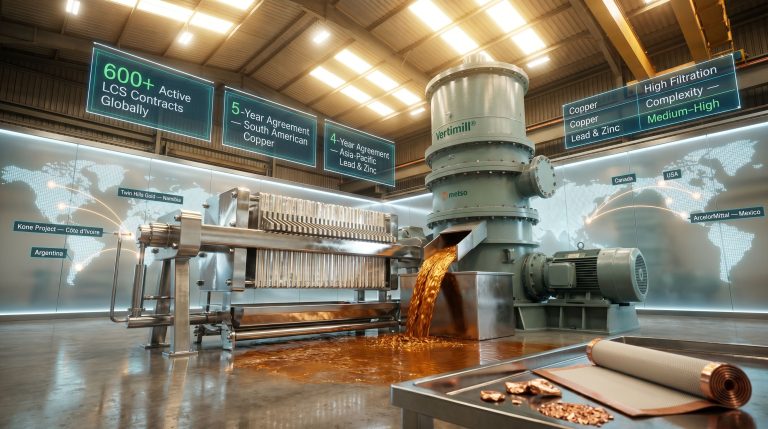
The scale of Metso's LCS presence in filtration is considerable. The company currently manages more than 600 active LCS contracts across its global customer base, spanning the full breadth of its aftermarket and equipment portfolio. In 2025 alone, Metso secured more than 100 new filtration-specific LCS contracts, reflecting both the growing appetite for structured service partnerships and the competitive strength of the company's installed base in pressure filtration.
Two landmark agreements signed with major mining customers illustrate the scale now achievable within this model:
- A five-year contract with a major copper producer in South America, supporting an extensive installed base of Larox® PF pressure filters across multiple processing sites.
- A four-year contract with a major lead and zinc producer in the Asia Pacific region, addressing dewatering performance and asset reliability across beneficiation operations.
The combined value of these two agreements is approximately €60 million, with order components being recorded on a phased basis, beginning with the Minerals segment's first quarter 2026 order intake. One of these agreements ranks among the largest single filtration LCS orders in Metso's history, signalling a step change in the scale of individual service commitments that major mining operators are now willing to make.
Why South America and Asia Pacific Are Key Growth Regions
These two geographic corridors are not arbitrary choices. South America hosts some of the world's largest copper processing operations, many of which have built substantial installed bases of Larox® pressure filtration equipment over decades of investment. The long asset cycles typical of large-scale copper processing create natural demand for structured lifecycle management services that protect and extend the performance of existing capital assets.
Asia Pacific's lead and zinc processing sector presents a complementary growth dynamic. As environmental regulations around tailings management and water efficiency tighten across key jurisdictions, consistent dewatering performance becomes increasingly important for regulatory compliance as well as operational efficiency. In addition, the copper leaching benefits associated with advanced processing technologies are reinforcing demand for high-performance dewatering solutions across these regions.
The Technical Core: Larox® PF Plate Pack Management Service
How PPMS Works in Practice
The technical foundation of these LCS agreements is Metso's Larox® PF Plate Pack Management Service (PPMS), which operates as part of the broader Metso Plus service offering. Plate packs are among the most wear-intensive components in pressure filtration systems, and their condition has a direct bearing on filter throughput, cycle times, and cake moisture content.
Under the PPMS model, maintenance is structured around annual planning cycles with built-in loops for continuous improvement and renewal. Rather than waiting for component degradation to manifest as a production disruption, planned intervention schedules are built into the contract from inception, with OEM repair warranties providing performance guarantees across the overhaul cycle.
The service delivery scope under PPMS includes:
- Plate pack supply and programmed spare parts management
- Plate pack repairs and structured component exchange programs
- Service installation and on-site technical support
- Filter upgrades and asset management integration
- Digital condition monitoring and performance optimisation tools
- Local workshop infrastructure and field service capabilities
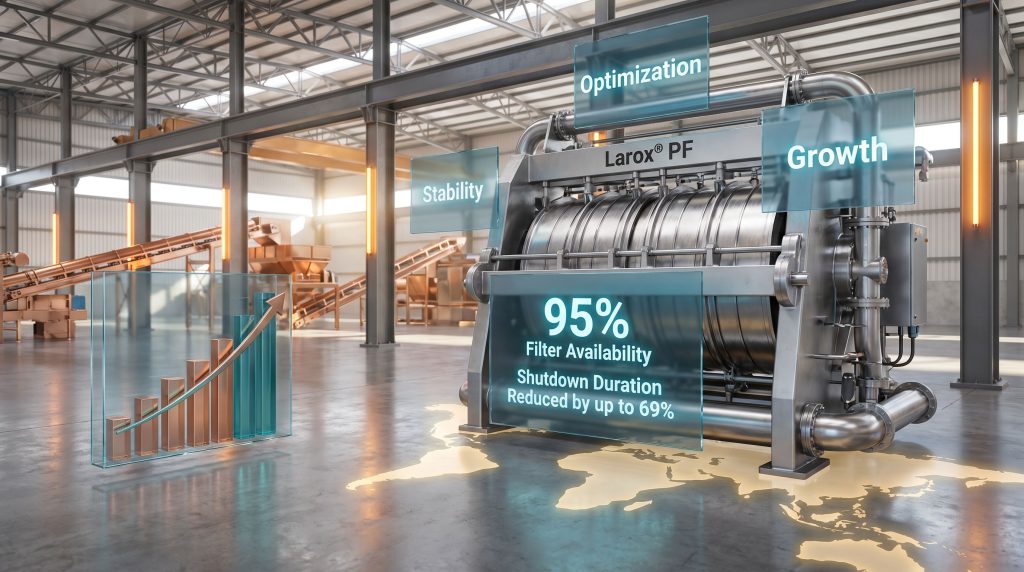
Technical Note: Under optimised LCS programs, filter availability targets can reach 95%, while planned maintenance structures have demonstrated the potential to reduce shutdown durations by as much as 69% compared to reactive, unplanned maintenance approaches. For a high-throughput processing plant, this represents a substantial improvement in annualised production reliability.
The Shift From Reactive to Proactive Maintenance Logic
The distinction between reactive and proactive maintenance is not merely semantic. In reactive models, maintenance events are triggered by failure or observed degradation, meaning that by the time intervention occurs, production has already been disrupted and the component may have operated outside its optimal performance envelope for an extended period.
Proactive, data-informed maintenance under PPMS reframes the intervention logic entirely. Digital condition monitoring tools track wear progression and operating parameters in near real-time, enabling service teams to schedule interventions at optimal points in the production calendar rather than responding to failures after the fact.
Quantifying the Operational and Financial Value
What Mining Operations Actually Gain
The value proposition of Metso filtration Life Cycle Services contracts operates across several interconnected dimensions:
| Performance Metric | Reactive Maintenance Model | LCS Partnership Model |
|---|---|---|
| Filter availability | Variable and event-driven | Targeted at 95%+ |
| Shutdown duration | Unplanned and often extended | Reduced by up to 69% |
| Cost predictability | Low, with reactive expenditure spikes | High, with agreed cost transparency |
| Asset lifecycle | Shortened by deferred maintenance | Extended through proactive care |
| Carbon footprint | Higher due to new parts consumption | Lower through component reconditioning |
Beyond availability and shutdown metrics, the LCS model delivers value through:
- Cost-per-tonne optimisation: Predictable service expenditure allows operations teams to model processing economics with meaningful accuracy across multi-year planning horizons.
- Asset life extension: Component reconditioning and programmed upgrades defer capital expenditure on new equipment, improving the return profile of existing assets.
- End-product quality consistency: Reliable dewatering performance maintains moisture content specifications critical for downstream smelting economics and concentrate sales terms.
- Operational visibility: Digital monitoring tools provide management with real-time insight into filtration circuit performance, enabling faster and more informed decisions.
The next major ASX story will hit our subscribers first
Sustainability as a Structural Advantage of LCS Models
The Environmental Case for Long-Term Service Agreements
As mining operators face growing pressure to reduce the carbon intensity of their operations, the sustainability credentials of the LCS model deserve attention. The key mechanism is component reconditioning: by repairing and refurbishing plate packs and filter components rather than replacing them with newly manufactured equivalents, LCS agreements reduce the volume of embedded carbon associated with the maintenance lifecycle. The mining decarbonisation benefits of this approach are increasingly being recognised as a strategic priority across the sector.
Reconditioned filter components carry substantially lower embedded carbon than newly manufactured replacements, making LCS procurement a measurable contributor to Scope 3 emissions reduction for mining operators with declared climate commitments.
Beyond carbon, the circular economy logic of the PPMS model reduces raw material consumption across the asset lifecycle, aligning with the resource efficiency principles increasingly embedded in mining ESG frameworks and reporting standards.
Digital monitoring tools add another layer of sustainability value by enabling energy efficiency optimisation within filtration circuits, reducing power consumption per tonne of filtered material processed.
Why OEM-Led Service Models Are Outcompeting Independent Providers
The Knowledge and Connectivity Advantage
The competitive edge that OEM providers hold in long-term service agreements is rooted in information asymmetry. Metso holds proprietary design data, wear pattern analytics, performance benchmarks, and failure mode libraries accumulated across hundreds of installed Larox® PF filter systems globally. This depth of product knowledge is structurally unavailable to independent maintenance contractors, regardless of their general engineering competence.
When this knowledge is combined with digital connectivity between OEM service platforms and the installed equipment itself, a closed-loop performance improvement cycle becomes achievable. Condition data collected from individual filter units feeds back into maintenance planning algorithms and OEM engineering teams, enabling continuous refinement of service schedules and component specifications.
Key considerations for mining operators evaluating filtration LCS agreements include:
- Alignment between contract scope and the criticality of filtration within the processing flowsheet
- Flexibility of phased booking structures, which allow capital commitment to be staged over the contract duration rather than front-loaded
- Mutual performance measurement frameworks built around agreed KPIs and continuous improvement accountability
- Transition planning to migrate from ad hoc procurement to structured LCS without disrupting ongoing production
What the LCS Growth Signal Tells Investors and Operators About Broader Market Dynamics
Structural Trends Reshaping the Mining Equipment Services Sector
The acceleration in Metso filtration Life Cycle Services contract signings is not simply a company-specific commercial story. It reflects broader structural forces reshaping how the mining industry allocates capital and manages operational risk. Consequently, understanding the underlying copper market trends and supply dynamics is essential context for evaluating why filtration reliability has become so commercially significant.
The transition from capital expenditure-heavy equipment ownership models toward operating expenditure-based service partnerships is being driven by several converging pressures:
- Capital discipline: Mining companies operating in a cost-conscious environment are increasingly reluctant to absorb the full financial risk of major equipment failures on their own balance sheets.
- Digital enablement: The maturation of condition monitoring and predictive analytics technologies has made performance-guarantee service models commercially viable at scale for the first time.
- Copper supply dynamics: As structural tightness in copper supply elevates the commercial value of processing reliability, any technology or service model that reduces throughput volatility becomes strategically important.
- ESG integration: Sustainability commitments are increasingly influencing procurement decisions, with component reconditioning programs offering a measurable and auditable pathway to lower maintenance carbon intensity.
For filtration specifically, the combination of high asset criticality, wear-intensive component cycles, and the technical complexity of optimising dewatering performance across varying ore types makes it an asset class particularly well suited to OEM-led, outcome-based service partnerships. The copper growth drivers underpinning long-term demand trajectories further reinforce why major operators are committing to multi-year service frameworks at this scale.
The growth of long-term filtration LCS agreements suggests that mining operators are not simply purchasing maintenance convenience. They are making a strategic decision to convert operational risk into predictable cost, and to leverage OEM knowledge assets that cannot be replicated through conventional procurement channels.
As copper demand trajectories remain elevated and base metals processing intensity increases, the structural case for Metso filtration Life Cycle Services contracts as a cornerstone of operational strategy for major mineral processors appears durable, and is likely to strengthen further as digital monitoring capabilities continue to mature.
This article contains forward-looking statements and industry observations based on publicly available information. It does not constitute financial or investment advice. Readers should conduct their own due diligence before making any investment or procurement decisions.
Want to Track the Next Major Mineral Discovery Before the Market Does?
Discovery Alert's proprietary Discovery IQ model delivers real-time ASX alerts the moment significant mineral discoveries are announced, transforming complex geological data into clear, actionable investment insights across copper, base metals, and beyond — begin your 14-day free trial today, or explore Discovery Alert's dedicated discoveries page to understand how historic mineral finds have generated exceptional market returns.