June 25, 2026
The Governance Gap That Could Define the Energy Transition
The global push toward decarbonisation has redirected enormous capital toward clean energy infrastructure, electric vehicles, and grid-scale battery storage. Yet beneath this technological ambition lies a quieter, more complex challenge: the territories that produce the raw materials underpinning this transition are frequently among the least institutionally prepared to manage the pressures that come with it. Whether a region faces coal contraction or rapid copper expansion, the central variable in determining outcomes is not geological or financial. It is territorial.
This is the lens through which responsible mining is increasingly being evaluated, and it is the analytical foundation that organisations like Insuco and the Insuco Center for Social Innovation (ICSI) have spent 15 years developing in the field. Their participation at the World Mining Congress (WMC) brings a body of applied knowledge that reframes how the industry thinks about social performance, mine reclamation, and the relationship between extraction and lasting territorial value. The concept of Insuco and ICSI at WMC territorial opportunities in mining is no longer aspirational language. It is a measurable, operational framework.
When big ASX news breaks, our subscribers know first
Why Social Performance Has Become a Strategic Imperative
From Compliance Function to Competitive Variable
For decades, social performance in mining was treated as a risk-containment function: manage community relations well enough to avoid disruption, satisfy permitting requirements, and move on. That model is structurally obsolete. Research across mining jurisdictions consistently shows that social conflict is one of the most costly variables in project economics, with studies suggesting that a large-scale mine experiencing even moderate community opposition can lose value at a rate exceeding US$20 million per week in delayed production alone.
The shift underway is from viewing social performance as a cost centre to recognising it as a value driver. Territories characterised by institutional stability, diversified economies, and constructive multi-actor relationships consistently attract sustained investment more effectively than those defined by recurrent conflict, fragmented governance, and transactional community engagement.
Key reasons social performance has become strategically central include:
- Institutional investors are embedding social licence metrics into ESG screening frameworks, making community conflict a capital markets risk, not just an operational one
- Supply chain transparency obligations in major consumer markets are increasing scrutiny of upstream social conditions
- Insurance markets are beginning to price social risk more explicitly into project finance structures
- Regulatory environments in many mining jurisdictions are tightening requirements around community consultation and free, prior, and informed consent
The Concept of Territorial Interdependency
A mine does not simply occupy land. Over its operational lifecycle, it restructures labour markets, reconfigures local supplier ecosystems, redirects fiscal flows through royalties and taxes, shapes infrastructure investment priorities, and recalibrates the expectations of communities whose futures become intertwined with the mine's productive life. This web of relationships is what researchers and practitioners refer to as territorial interdependency.
Furthermore, understanding this interdependency early is foundational to anticipatory social strategy. As one field-based framework describes it:
Territorial interdependency means that the social and economic footprint of a mine extends far beyond its physical boundary, and that understanding this footprint before it generates friction is the foundational premise of anticipatory social strategy.
Mapping these dependencies early allows mining operators to identify which relationships carry the greatest operational risk, which community institutions have the capacity to engage constructively, and where economic diversification is most urgently needed before closure becomes the dominant dynamic.
What Territorial Value Creation Actually Means in Practice
Moving the Analytical Frame Beyond Impact Mitigation
Impact mitigation asks: what harm are we causing, and how do we reduce it? Territorial value creation asks a structurally different question: what systems are we building that will function independently after we leave? The distinction is not semantic. It has direct implications for how mine planning is structured, how community investment is allocated, and how closure is integrated into operational strategy from the earliest feasibility stages.
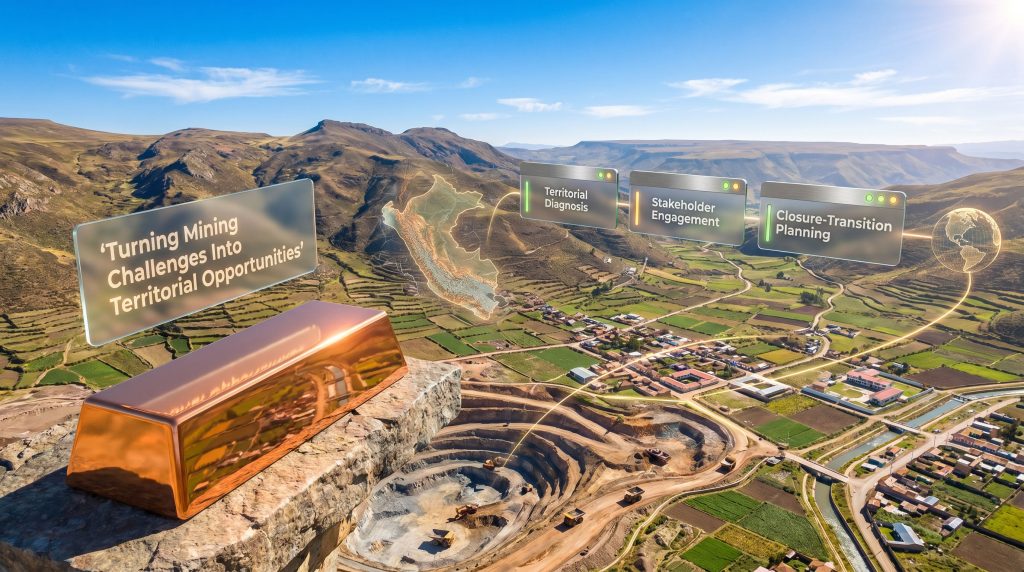
Applied territorial methodology combines several interlocking components that together create a decision-support architecture capable of guiding mining actors across the full project lifecycle:
| Methodology Component | Core Function | Why It Matters Operationally |
|---|---|---|
| Territorial Diagnosis | Maps socioeconomic dependencies and institutional capacity | Reveals vulnerabilities before they become conflict triggers |
| Stakeholder Engagement Frameworks | Structures multi-actor dialogue across divergent interests | Improves agreement durability and reduces renegotiation frequency |
| Social Data Systems | Builds an evidence base from field intelligence | Converts community dynamics into actionable strategy |
| Participatory Planning | Co-designs development pathways with affected populations | Builds legitimacy and shared ownership of outcomes |
| Conflict Analysis Tools | Diagnoses root causes of social tension | Enables intervention before escalation reaches operational thresholds |
| Closure-Transition Planning | Embeds post-operational transition in early project design | Reduces legacy liability and builds territorial resilience |
Why Legacy Architecture Outperforms Closure Compliance
The global mining industry has an uneven track record on mine closure. A significant proportion of the world's estimated 500,000 abandoned mines represent closures that were managed as terminal compliance exercises rather than territorial transitions. The economic and social costs of this approach are concentrated in the communities and local governments left managing the aftermath.
Legacy-oriented mine planning inverts this logic. Rather than asking what obligations must be fulfilled at closure, it asks what institutional, economic, and social systems should be operational by the time production ends. Consequently, this requires:
- Integrating closure planning into feasibility and environmental impact assessments, not post-operational phases
- Investing in local supplier development that builds firms capable of diversifying beyond mining contracts
- Supporting local government institutional capacity so municipalities can manage fiscal transitions when royalty revenues decline
- Co-designing economic diversification pathways with communities during the operational phase, while resources and goodwill exist to make them viable
In addition, mining waste management practices must be embedded in this legacy framework, as environmental liabilities at closure can undermine even the most carefully designed social transition strategies.
The Colombia Case: Coal Territory Transition as a Governance Test
What El Cesar Reveals About Energy Transition Complexity
Colombia's El Cesar department is one of Latin America's most instructive examples of the territorial complexity embedded in energy transition. The region has historically been among the most coal-productive in South America, and the structural decline of that industry does not affect employment alone. It cascades through local supplier networks, compresses municipal royalty revenues, disrupts social expectations shaped by decades of resource dependence, and strains the institutional capacity of local governments unequipped for economic restructuring.
Research on resource-dependent territories documents a consistent pattern: when a dominant extractive industry contracts without structured transition support, the accumulated dependencies it created transfer as concentrated vulnerabilities. Communities absorb employment shocks. Municipalities absorb fiscal shocks. Local suppliers absorb demand shocks. The institutional systems calibrated to serve a mining economy are suddenly expected to manage its absence.
The critical variable in territorial transition is not whether decline occurs, but whether adequate lead time and institutional investment exist to reshape economic and governance systems before the fiscal and employment floor collapses.
From Closure Protocol to Economic Diversification Strategy
When transition is anticipated through participatory processes and integrated territorial planning, the outcomes differ measurably. Economic diversification becomes viable when it begins during the operational phase, funded in part by mining revenues and supported by companies with reputational and commercial incentives to build durable territorial relationships.
Agricultural value chains, tourism infrastructure, renewable energy development, and local service industries have all been documented as viable diversification pathways in post-coal territories globally, from the Appalachian coalfields in the United States to the Ruhr Valley in Germany. According to research from the IISD, renewable energy infrastructure can play a particularly significant role in supporting community resilience during these transitions.
The lesson from El Cesar and comparable territories is that the energy transition is simultaneously a technical, financial, and territorial governance challenge. Coal-dependent regions require structured economic diversification strategies, institutional capacity building programmes, and long-term engagement frameworks — not merely mine closure protocols.
Peru's Critical Mineral Corridors and the Governance Deficit
Why Copper Production Depends on Territorial Legitimacy
Peru consistently ranks among the world's top two copper producers, generating approximately 10–12% of global copper supply annually — a figure that makes its territorial governance conditions directly relevant to global decarbonisation timelines. The role of critical minerals and energy transition pathways is increasingly central to how investors and policymakers assess these corridors. Copper is foundational to electric vehicle motors, grid infrastructure, and renewable energy systems, meaning that production disruptions in Peruvian mining corridors propagate into global clean energy supply chains.
Yet Peru also has one of the highest rates of active social conflicts associated with mining of any major producing nation. The country's Ombudsman office has consistently tracked over 60–70 active socio-environmental conflicts at any given time, with the majority involving mining operations. These conflicts reflect not simply opposition to mining, but the accumulated consequences of fragmented information environments, transactional engagement patterns, and governance systems that have failed to build credible shared rules between mining companies, communities, and state institutions.
The Dual Pressure of the Global Energy Transition on Mining Territories
The energy transition creates structurally opposite challenges for different mining territory types, yet both demand sophisticated territorial management:
| Territory Type | Primary Dynamic | Core Governance Challenge | Strategy Required |
|---|---|---|---|
| Coal-Dependent Regions (e.g. El Cesar, Colombia) | Economic contraction | Managing decline without transferring vulnerabilities | Diversification, fiscal transition planning, capacity building |
| Critical Mineral Corridors (e.g. Peru copper belt) | Rapid expansion pressure | Building governance legitimacy under production urgency | Shared information systems, multi-actor dialogue, long-term agreements |
| Mixed-Commodity Regions | Simultaneous contraction and expansion | Coordinating divergent territorial dynamics | Integrated planning across commodity cycles |
Downstream manufacturers in the electric vehicle and clean energy sectors are increasingly aware that supply chain risk begins in the territory, not at the port. Institutional investors and procurement officers are scrutinising the social and governance conditions of mineral supply chains with growing rigour, elevating territorial governance from a local social performance concern to a global supply chain reliability variable.
Local Supplier Development and the Commercial Case for Community Integration
Beyond Social Licence: The Competitiveness Argument
Local procurement and supplier development in mining have traditionally been framed through a social licence lens. However, the argument is evolving. Major mining operators have documented the commercial logic of strategic local supplier investment programmes, with some of the world's largest mining companies committing billions of dollars to local procurement strategies that reduce logistics dependencies, improve supply chain resilience during disruptions, and build institutional goodwill with local governments and communities.
For mid-tier and smaller operators, local supplier development represents a high-leverage mechanism for building territorial legitimacy without the capital intensity of large-scale philanthropic programmes. When local firms grow to serve mining operations, they also develop capabilities that reduce their dependence on mining contracts over time, creating the kind of economic diversification that supports territorial resilience at closure.
Building the Professional Infrastructure for Territorial Dialogue
One of the least visible but highest-leverage interventions in mining territories is the development of professional capacity to manage the complexity of multi-actor engagement. Partnerships between mining-focused social consulting organisations and academic institutions have produced structured training programmes in social management, conflict analysis, and territorial development. These programmes equip local government officials, community organisation leaders, and civil society actors with the analytical tools and negotiation frameworks needed to engage constructively with mining operations.
The effect is systemic: when both mining company social teams and community-facing government officials share a common analytical language and methodological toolkit, the quality of territorial dialogue improves measurably. Agreement durability increases. Conflict escalation frequency decreases. Furthermore, the institutional fabric of the territory strengthens in ways that persist beyond the mine's operational life.
The next major ASX story will hit our subscribers first
Anticipatory Strategy, Data Systems, and the Future of Territorial Mining
Why Reactive Risk Management Is Structurally Inadequate
The reactive model of community relations — responding to grievances as they surface, managing conflict events as they escalate, and treating closure as a terminal compliance phase — is not calibrated for the complexity of modern mining territories. By the time a conflict event becomes visible to operational management, the underlying tensions have typically been accumulating for months or years through unresolved grievances, deteriorating institutional trust, and unaddressed economic anxieties.
Anticipatory social strategy requires structured territorial intelligence: systematic tracking of employment dependencies, supplier network health, community sentiment trends, institutional capacity indicators, and fiscal flow dynamics across the full operational lifecycle of a mining project. Organisations operating across more than 50 countries develop the comparative dataset needed to identify early warning patterns that single-jurisdiction operators cannot recognise.
The Role of Territorial Observatories in Adaptive Management
Territorial observatories represent an emerging best practice in mining social performance: structured monitoring systems that aggregate field data, stakeholder feedback, economic indicators, and institutional health metrics into an adaptive management framework. These systems enable mining operators to track territorial transformations in near-real-time, identify emerging tensions before they crystallise into operational disruptions, and demonstrate to host communities and governments that monitoring commitments are being honoured with genuine rigour.
The intelligence generated by these observatories also serves a broader function: it creates the evidence base for post-mining territorial planning, documenting the economic and social systems built during operations so that communities and governments can manage their continuation after closure. In this context, understanding natural capital in mining operations becomes an integral component of long-term territorial planning, ensuring that environmental assets are accounted for alongside economic and social indicators.
Frequently Asked Questions: Territorial Opportunities in Mining
What does territorial opportunity mean in a mining context?
Territorial opportunity refers to the potential for a mining operation to generate durable economic, institutional, and social value for its host region — value that persists beyond the productive life of the mine. It includes developing local supplier ecosystems, building institutional capacity in local government, supporting economic diversification, and co-designing post-mining development pathways with communities during the operational phase.
How does social performance connect to mine closure planning?
Social performance and closure planning are inseparable in a territorial development framework. The economic dependencies, institutional relationships, and community expectations created during a mine's operational life directly determine the complexity and cost of its closure transition. Early integration of closure considerations into social strategy, rather than treating closure as a terminal phase, is the defining characteristic of legacy-oriented mine management.
Why is territorial governance critical to the global energy transition?
The decarbonisation transition depends on reliable supplies of copper, lithium, cobalt, and other critical minerals concentrated in specific territories. The social and governance conditions of those territories determine production continuity and supply chain reliability. Chronic conflict, weak institutions, and unresolved community grievances represent supply chain risk for the entire clean energy sector — not just individual mining operators.
What distinguishes anticipatory social strategy from reactive risk management?
Reactive risk management responds to community grievances and conflict events as they arise. Anticipatory social strategy, by contrast, identifies dependencies, vulnerabilities, and emerging tensions before they generate operational disruption, using territorial diagnostics, stakeholder mapping, and real-time data systems to build a proactive intelligence base for decision-making at every stage of the project lifecycle.
Key Takeaways
- Social performance is a core operational condition for mining continuity, not a peripheral compliance function
- Coal territory decline and critical mineral expansion represent structurally different territorial governance challenges, both requiring sophisticated anticipatory strategies
- Legacy-oriented closure planning, integrated from the earliest project stages, consistently reduces long-term liability and strengthens territorial resilience
- Local supplier development serves both commercial competitiveness and territorial legitimacy objectives simultaneously
- Territorial governance conditions in critical mineral corridors are now a measurable variable in global clean energy supply chain reliability
- Mining sustainability transformation is most effective when embedded within a broader territorial governance framework, rather than implemented as a standalone ESG initiative
- Organisations with field experience across more than 50 countries possess comparative pattern-recognition capabilities that are structurally unavailable to single-jurisdiction operators
Disclaimer: This article draws on publicly available research, industry reports, and analytical frameworks for informational and educational purposes. References to specific statistics, country-level data, and cost estimates reflect publicly documented figures from industry and policy sources and are subject to change. Nothing in this article constitutes investment advice or project-specific endorsement.
Ready to Identify the Next Major Mineral Discovery Before the Market Does?
Discovery Alert's proprietary Discovery IQ model delivers real-time alerts on significant ASX mineral discoveries, transforming complex geological and commodity data into actionable investment insights for both short-term traders and long-term investors. Explore Discovery Alert's discoveries page to understand how historic finds have generated substantial returns, and begin your 14-day free trial today to secure a market-leading advantage.