June 26, 2026
The Biological Algorithm Underground: Why Mining's Next Automation Leap Looks Nothing Like Its Last
The history of industrial automation follows a recognisable pattern. Each wave replaces human labour with machines that replicate human actions more reliably and at greater scale. Conveyor belts replaced manual handling. Programmable logic controllers replaced human operators. Autonomous haul trucks replaced drivers. Yet every generation of this progression has shared one fundamental architectural assumption: a central intelligence directs the system, and individual components execute instructions.
That assumption is now reaching the edge of its usefulness underground. The geological environments that mining companies must increasingly enter to secure the critical minerals underpinning modern technology are precisely the environments where centralised control architectures are most vulnerable. What is emerging as the credible successor is not a more powerful version of existing automation. It is something structurally different, and its design template was not conceived in an engineering department. It evolved over hundreds of millions of years in insect colonies.
Swarm robotics in mining represents one of the most consequential architectural shifts in industrial automation since the introduction of programmable machinery, and new physical laboratory evidence from the University of Adelaide is beginning to quantify what that shift could actually mean in practice.
When big ASX news breaks, our subscribers know first
Why Conventional Mining Automation Has Hit a Structural Ceiling
The deployment of autonomous mining equipment has accelerated significantly over the past decade. Komatsu's FrontRunner system recently recorded its 1,000th autonomous haul truck deployment, a milestone reflecting genuine industry-wide momentum. Rio Tinto, BHP, and Fortescue operate large fleets of driverless vehicles across surface operations in Western Australia. The broader mining automation transformation narrative, at face value, appears to be succeeding.
The problem is that this success is heavily concentrated in a specific operational context: high-volume, open-cut surface environments with well-mapped, predictable terrain. Transfer the same centralised architecture underground, into narrow-vein hard rock operations, deep high-temperature workings, or geologically complex deposits, and the model degrades rapidly.
Centralised command systems carry an inherent structural weakness. Every autonomous unit in the fleet depends on continuous communication with a control centre. A GPS signal lost underground, a communications relay knocked out, or a network interruption does not just affect one machine. It can cascade through an entire operation. Single points of failure become operational events.
There is also a deeper problem. Centralised systems are, by design, pre-programmed for anticipated conditions. Underground mining confronts operators with constantly evolving geological realities: unexpected fault zones, water ingress, gas accumulations, and variable rock strength that no surface model predicted. A robot that requires instruction from a central controller before adapting to these conditions is not truly autonomous. It is a remote-controlled machine with a very long cable.
The productivity ceiling this creates is becoming commercially significant as the industry moves into lower-grade, deeper, and more structurally complex deposits. Incremental improvements to existing centralised systems cannot solve a problem that is architectural in nature.
What Swarm Robotics Actually Is: Beyond the Buzzword
The term swarm robotics is frequently used loosely to describe any multi-robot system, which obscures a critically important technical distinction. True swarm architecture does not simply involve multiple robots operating simultaneously. It involves decentralised, emergent coordination where system-level intelligent behaviour arises from local interactions between individual agents, none of which has visibility of the full operational picture.
Each robot in a swarm makes decisions based on its immediate environment and the signals it receives from nearby units. No single robot directs the others. No central computer mediates their behaviour. The collective intelligence of the system is an emergent property, produced by the interaction rules governing individual units rather than by any overarching supervisory logic.
This distinction has profound engineering implications, best understood through three operational pillars:
| Pillar | Core Mechanism | Mining-Specific Advantage |
|---|---|---|
| Robustness | No single point of failure; units operate independently | System continues functioning if individual robots are disabled, damaged, or lost underground |
| Flexibility | Each unit adapts to immediate environmental conditions | Responds in real time to dynamic geological changes without waiting for external instruction |
| Self-Organisation | Roles emerge and shift based on collective need | Eliminates dependence on surface control centres in deep or communication-degraded environments |
Navigation within swarm systems for underground applications relies primarily on SLAM (Simultaneous Localization and Mapping), a technology that allows robots to build spatial models of their environment in real time while simultaneously tracking their own position within it. When combined with radar imaging capable of detecting subsurface metal concentrations, SLAM-equipped swarm units can map ore distribution, identify extraction priorities, and share that spatial intelligence across the collective, all without human input.
Nature's 50-Million-Year Head Start on Collective Intelligence
The biological inspiration for swarm robotics is not a metaphor. It is an engineering principle derived from systems that have been optimised through evolutionary pressure for far longer than human civilisation has existed.
Ant and honeybee colonies function as what biologists term superorganisms, unified decision-making entities composed of thousands of individuals, none of which possesses the cognitive capacity to direct the collective. The coordination mechanism they rely on is called stigmergy, a process of indirect communication mediated through the environment itself. An ant deposits a pheromone trail. Another ant follows it and strengthens it. A third reinforces the strongest paths and abandons the weaker ones. No ant designs the foraging network. The network designs itself through the cumulative effect of simple, local decisions.
Honeybee colonies employ a complementary mechanism. Scout bees conduct exploratory flights, then return to the hive and communicate resource location and quality through the now-famous waggle dance, a directional signal encoding both bearing and distance relative to the sun's position. Harvesting bees deploy with pre-loaded spatial intelligence derived from these scout reports, eliminating the energetic cost of independent exploration.
The engineering insight these systems offer is not merely conceptual. They represent tested, validated solutions to the exact operational challenges that underground mining automation faces: how to coordinate large numbers of agents across a complex, dynamic environment without centralised oversight, while maintaining system resilience against the loss of individual units. Furthermore, research into swarm robotics in extreme environments confirms that these biological principles translate meaningfully into real-world engineering performance.
The University of Adelaide Experiments: Physical Validation of a Bio-Inspired Hypothesis
What distinguishes the University of Adelaide research programme from earlier work in this field is precisely this: it moved beyond computational simulation into physical laboratory validation using real robots in a purpose-built test environment. Prior academic work on bio-inspired robotic mining strategies had largely relied on software models, which, however sophisticated, cannot replicate the friction, communication latency, mechanical failure modes, and spatial ambiguity of real physical operation.
The research, led by Professor Noune Melkoumian at Adelaide's School of Chemical Engineering with PhD researcher Joven Tan conducting the experimental programme, used Zumo 2040 microrobots as the experimental platform. These are compact, capable units measuring under four inches (approximately 10 centimetres) per side, weighing roughly nine ounces (approximately 255 grams), and built on Raspberry Pi RP2040 microcontrollers. Their designed capabilities in line-following and maze-solving made them well-suited to navigating a laboratory environment engineered to replicate the constrained spatial structure of an underground mine.
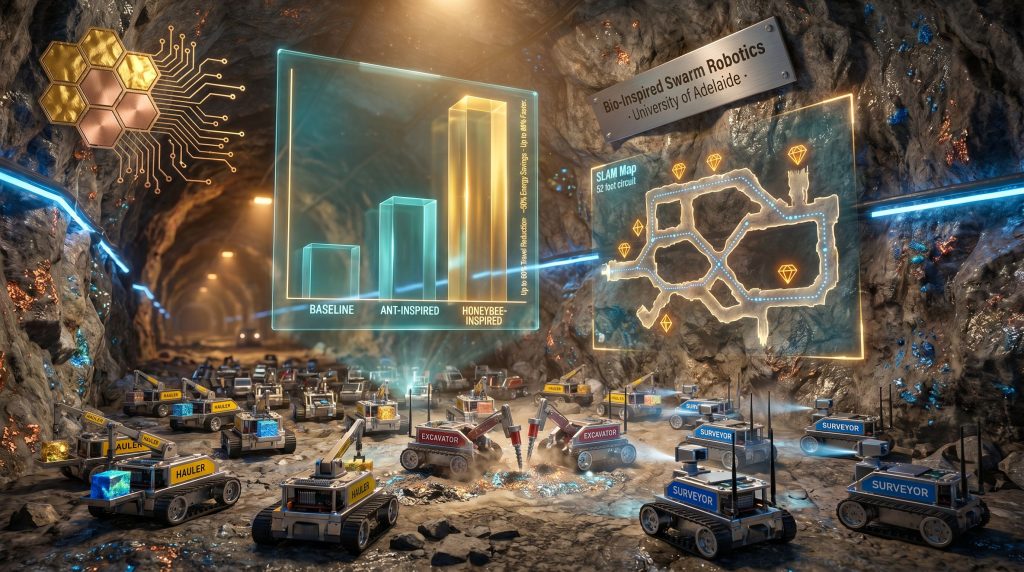
The test circuit extended 52 feet (approximately 16 metres) and contained eight discrete ore blocks distributed along the route. Three distinct autonomous collection strategies were tested against this environment:
- Baseline direct collection: robots identify ore and return immediately to the deposit point, mirroring conventional autonomous mining equipment logic.
- Ant-inspired division of labour: distinct robot classes handle separate functions, with one group dedicated to resource location and a separate group performing physical transport, replicating the task specialisation observed in ant foraging colonies.
- Honeybee-inspired scout-harvest architecture: dedicated scout robots conduct comprehensive environmental mapping in a first phase, with harvesting robots deploying in a second phase equipped with the spatial intelligence the scouts accumulated.
Critically, none of the robots in any of the three strategies operated under centralised control. Each unit made independent decisions while contributing to collective outcomes. This meant the swarm could continue functioning even if individual robots failed or dropped out mid-task, a resilience property that centralised systems structurally cannot replicate.
What the Performance Data Actually Shows
The results of the Adelaide experiments provide the most concrete quantitative evidence yet for the operational superiority of bio-inspired swarm architectures over conventional autonomous collection models. The honeybee-inspired strategy produced performance gains that were not marginal. They were substantial enough to represent a qualitative shift in operational capability.
| Strategy | Travel Distance vs. Baseline | Energy Consumption vs. Baseline | Task Completion Speed vs. Baseline |
|---|---|---|---|
| Baseline Direct Collection | Reference | Reference | Reference |
| Ant-Inspired Division of Labour | Moderate reduction | Moderate reduction | Faster |
| Honeybee-Inspired Scout-Harvest | Up to 80% reduction | ~50% reduction | Up to 60% faster |
*"The honeybee-inspired swarm robotic strategy reduced travel distance by up to 80%, cut energy consumption by approximately 50%, and completed ore delivery tasks up to 60% faster than conventional autonomous collection methods in University of Adelaide laboratory testing."* (Source: Natural Sciences, Wiley Online Library, Bio-Inspired Swarm Robotics Design for Mine Automation)
The mechanism behind the honeybee strategy's outperformance is not complex, but its implications are significant. When harvesting robots are deployed with pre-existing spatial knowledge of where ore is located, they never travel blind. Every movement is purposeful. The compound effect of eliminating redundant exploratory movement reduces both distance and energy expenditure simultaneously, creating efficiency gains that scale with the size and complexity of the operating environment.
In a real underground mine, where ore bodies can extend for kilometres through three-dimensional space, the advantage of spatial pre-knowledge compounds dramatically compared with a laboratory circuit of 52 feet. The ant-inspired strategy's performance advantage over the baseline also carries important practical implications. By decoupling discovery from transport and running these functions in parallel, it eliminates the bottleneck that afflicts single-function autonomous units.
The next major ASX story will hit our subscribers first
A Taxonomy of Swarm Mining Robots and Their Operating Roles
Understanding how swarm systems would function at commercial scale requires clarity about the distinct role categories that individual units would occupy. Unlike conventional mining fleets where machines are purpose-built for a single function and rarely deviate from it, swarm architectures are designed around role fluidity, the capacity for individual units to adapt their function based on collective need.
Three primary functional categories define a mining swarm:
Excavators carry specialised tool configurations for rock fragmentation, ranging from chisel attachments for softer formations to saw-type implements for higher-resistance rock. In particularly hard formations, the swarm model allows multiple excavator units to coordinate on a single target, applying force collectively in ways that individual machines cannot achieve. These units must be engineered for the extreme conditions of deep underground environments: high ambient pressure, elevated temperatures, chemically corrosive atmospheres, and high humidity.
Collectors and Haulers are optimised for ore transport, with payload-to-weight ratios designed for energy-efficient underground movement. A key capability of well-designed swarm haulers is role-switching: when transport queues are clear and excavation is the system bottleneck, hauler units can reassign themselves to assist excavation without human instruction. This dynamic reallocation of capacity is something centralised fleet management systems can only approximate through complex pre-programming. In addition, developments in autonomous mining trucks are helping to inform the energy and payload design requirements for next-generation swarm haulers.
Surveyors function as the intelligence-gathering layer of the swarm. Their primary outputs are environmental maps and mineral deposit location data, fed continuously into the collective's shared operational intelligence. Their movement decisions are governed by proximity algorithms that prioritise areas of low scan coverage frequency, ensuring systematic spatial intelligence rather than redundant mapping of already-known terrain.
Materials and Engineering Challenges for Hostile Underground Environments
Commercial deployment of swarm mining robots will require engineering advances that go beyond the microrobot platforms used in laboratory validation. Key requirements include:
- Ruggedised electronics with chemical erosion resistance and high-humidity tolerances
- Autonomous damage detection systems with adaptive operational responses
- Thermal management architectures suited to deep, high-temperature working environments
- Power-sharing algorithms enabling energy redistribution across the swarm during extended operations where individual unit battery levels become variable
The Safety and Environmental Case for Swarm Deployment
The operational efficiency argument for swarm robotics in mining is compelling, but the safety and environmental cases may prove more immediately persuasive to regulators, insurers, and investors.
Underground mining remains one of the most hazardous occupational environments on earth. Fatality statistics, even in jurisdictions with sophisticated safety regimes like Australia, Canada, and the United States, continue to reflect the fundamental danger of placing humans in proximity to heavy machinery, unstable rock masses, explosive atmospheres, and post-blast environments. Swarm systems offer a structural rather than procedural response to this hazard: they remove the humans from the danger zone entirely.
The immediate near-term application for swarm units in safety contexts does not even require commercial-grade excavation capability. A small swarm of surveyor-class robots equipped with gas detection, thermal imaging, and structural assessment tools could be deployed into an underground environment within minutes of a collapse, blast, or ventilation failure. The information they return could inform rescue decisions that currently depend on sending additional workers into unassessed hazard zones.
On environmental performance, fully electric swarm fleets address one of underground mining's most persistent and underappreciated pollution challenges: diesel particulate matter (DPM). Underground diesel equipment generates fine particulate emissions in enclosed spaces, creating chronic occupational health risks and requiring massive ventilation infrastructure to manage. Replacing diesel-powered fleets with electric swarms eliminates DPM at source and dramatically reduces the ventilation requirements that represent a major capital and operating cost in deep underground mines.
Precision extraction, guided by SLAM-enabled spatial intelligence, also reduces ore dilution by minimising the volume of waste rock included in mill feed. This improvement in feed quality reduces energy consumption and reagent use in processing, reducing the environmental footprint of each tonne of final product.
Where Swarm Robotics Research Stands Today and What Comes Next
The Adelaide programme represents the current frontier of physical validation for swarm robotics in mining. The significance of this stage cannot be overstated. Computer simulations of swarm behaviour are mathematically tractable, but they cannot model the full complexity of real physical systems, including sensor noise, communication interference, mechanical wear, and the unpredictable micro-geometry of real terrain. Physical validation in a controlled but real environment is the essential bridge between theoretical promise and commercial credibility.
An important and often overlooked context for the development trajectory of swarm mining robotics is the space mining research programme being pursued by NASA and other space agencies. The requirements of space resource extraction, specifically the absolute impossibility of human presence and the communication latency that makes centralised Earth-based control impractical, make swarm robotics not merely preferable but architecturally necessary. Investment and research driven by space mining applications is accelerating the maturation of swarm technology on a compressed timeline, with direct technology transfer potential to terrestrial underground mining.
Looking forward, the development pathway has three reasonably distinct phases:
- Near-term (2026-2030): Controlled pilot programmes at operating mines, prioritising narrow-vein underground operations, post-blast inspection tasks, and geotechnical monitoring applications where the operational risk of early-stage deployment is manageable.
- Medium-term (2030-2040): Integration of swarm systems with digital twin mine models and AI-driven collective behaviour optimisation, feeding real-time spatial and geotechnical data into broader Industry 4.0 management platforms.
- Long-term (post-2040): Fully autonomous mine sites operating without permanent human presence underground, and swarm-based extraterrestrial resource extraction becoming operational.
Four Critical Development Gaps That Must Be Closed
The Adelaide researchers are explicit that laboratory validation, however encouraging, does not constitute commercial readiness. Four specific development gaps must be addressed before swarm systems can operate in real mines.
1. Sensor capability at operational scale: The sensors used in microrobot laboratory platforms lack the range, resolution, and durability required in full-scale underground mines. Priority advances include longer-range LiDAR systems, multi-spectrum subsurface imaging capable of detecting mineral concentrations through rock, and integrated real-time gas detection. Consequently, advances in AI in drilling and blasting are providing important parallel sensor development insights that swarm robotics researchers are beginning to draw upon.
2. Energy storage and operational endurance: Current battery technology constrains operational range in deep underground environments where surface charging access is impossible. Solid-state battery development, wireless underground charging infrastructure, and swarm-level power sharing algorithms represent the key research priorities in this area.
3. AI adaptability to geological variability: Laboratory environments are controlled by design. Real underground mines present continuous geological surprises. Swarm AI systems must be trained on the full distribution of underground geological scenarios, not just the anticipated ones, and must demonstrate adaptive responses to conditions outside their training data. Furthermore, AI-led exploration success in surface applications is generating training datasets that could meaningfully accelerate this underground AI development process.
4. Mechanical robustness for rock fragmentation: Current swarm platforms excel at navigation, mapping, and transport. Miniaturised high-torque drilling systems and coordinated multi-robot rock fragmentation at commercially relevant scales remain engineering challenges requiring dedicated research investment. University of Adelaide researchers have highlighted these mechanical challenges as a primary focus area for the next phase of experimental work.
An additional, often underappreciated barrier is regulatory certification. No existing mining safety regulatory framework in Australia, the United States, or Canada was designed with decentralised autonomous swarm systems in mind. The certification of systems that make collective decisions without any individual unit having full operational awareness represents a conceptually new challenge for regulators accustomed to evaluating discrete machines with defined operational parameters.
Frequently Asked Questions: Swarm Robotics in Mining
What is swarm robotics in mining?
Swarm robotics in mining refers to the deployment of coordinated networks of autonomous robots that operate without central control, making individual decisions based on local environmental inputs while collectively executing complex mining tasks including exploration, excavation, ore transport, and environmental monitoring.
How much more efficient are swarm robots compared to standard autonomous systems?
Physical laboratory testing at the University of Adelaide demonstrated that a honeybee-inspired swarm strategy reduced travel distance by up to 80%, cut energy consumption by approximately 50%, and completed ore delivery tasks up to 60% faster than baseline autonomous collection systems operating on the same circuit.
Are swarm mining robots commercially available today?
No. Swarm mining robotics is currently at the laboratory validation stage. Commercial deployment will require advances in sensor technology, battery endurance, AI adaptability, and regulatory certification frameworks, with initial pilot programmes in controlled mining environments the most likely near-term step.
What minerals and mining environments are best suited to swarm robotics?
Underground hard-rock mines, narrow-vein deposits, deep mines with limited ventilation, and geologically complex environments are the highest-priority application contexts. Critical mineral targets including lithium, rare earth elements, copper, and cobalt in structurally challenging geological settings represent the most commercially significant use cases.
How does swarm robotics improve mine safety?
By operating without requiring human presence in active mining zones, swarm systems structurally eliminate the primary exposure pathway for underground mining fatalities and injuries. Near-term safety applications also include post-incident inspection and emergency response in environments too hazardous for immediate human entry.
Can swarm robots operate in space mining environments?
Space mining represents one of the strongest near-term drivers of swarm robotics development. The combination of absolute human absence requirements and communication latency that makes Earth-based centralised control impractical makes swarm architecture the only viable operational model for extraterrestrial resource extraction, creating a research investment pipeline with direct terrestrial mining applications.
Disclaimer: This article is intended for informational and educational purposes only. It does not constitute financial or investment advice. References to timelines, commercial readiness, and future applications involve forward-looking assessments subject to significant technological, regulatory, and commercial uncertainties. Readers should conduct their own independent research before making any investment or business decisions related to technologies discussed herein.
Want to Invest in the Companies Pioneering Tomorrow's Mining Technologies?
Discovery Alert's proprietary Discovery IQ model delivers real-time alerts on significant ASX mineral discoveries — instantly identifying the exploration and mining companies pushing the boundaries of what's possible underground, from autonomous systems to critical mineral extraction. Explore Discovery Alert's dedicated discoveries page to see how historic ASX discoveries have generated substantial returns, and begin your 14-day free trial today to position yourself ahead of the market.