June 26, 2026
Australia's Energy Grid Faces a Structural Reckoning: Why Gas Demand Is Set to Double by 2050
The physics of electricity grids have not changed, even as the fuels powering them are being rapidly transformed. Variable renewable energy sources, by their nature, produce output in alignment with weather patterns rather than consumer demand cycles. Bridging that gap, particularly during multi-day periods of low solar irradiance and wind lulls, requires dispatchable generation that can respond on command and sustain output for extended durations. This technical reality forms the backbone of Australia's 2026 AEMO gas grid reliability report, and it carries significant implications for every stakeholder in the country's energy future.
When big ASX news breaks, our subscribers know first
Gas as a System Anchor, Not a Transitional Footnote
There is a common misconception in public energy discourse that natural gas represents a bridge technology, one that will be progressively retired as renewable capacity scales up. The Australian Energy Market Operator's 2026 Integrated System Plan (ISP) challenges this framing directly. Rather than projecting a decline in gas's role, the ISP identifies it as a foundational component of the least-cost pathway to net zero.
Furthermore, it sits alongside transmission infrastructure, storage assets, and renewable generation as a structural pillar of the National Electricity Market (NEM). The ISP's language is precise on this point. Its modelling concludes that the lowest-cost route to decarbonisation involves a system built around renewable energy, connected through network infrastructure, firmed with storage technologies, and critically, backed by gas.
This is not a concession to fossil fuel interests but a reflection of what system modelling consistently reveals: that storage technologies available today cannot economically cover extended periods of suppressed renewable output. Considerations around energy transition and energy security reinforce why gas cannot simply be removed from the equation without consequence.
The Coal Retirement Gap and What It Creates
The retirement of coal-fired power stations across Australia's east coast is accelerating faster than replacement dispatchable capacity is being built. This creates what engineers and planners refer to as a dispatchability gap, a growing shortfall in firm, controllable generation that can be called upon regardless of weather conditions.
Key projections from the 2026 ISP quantify this challenge clearly:
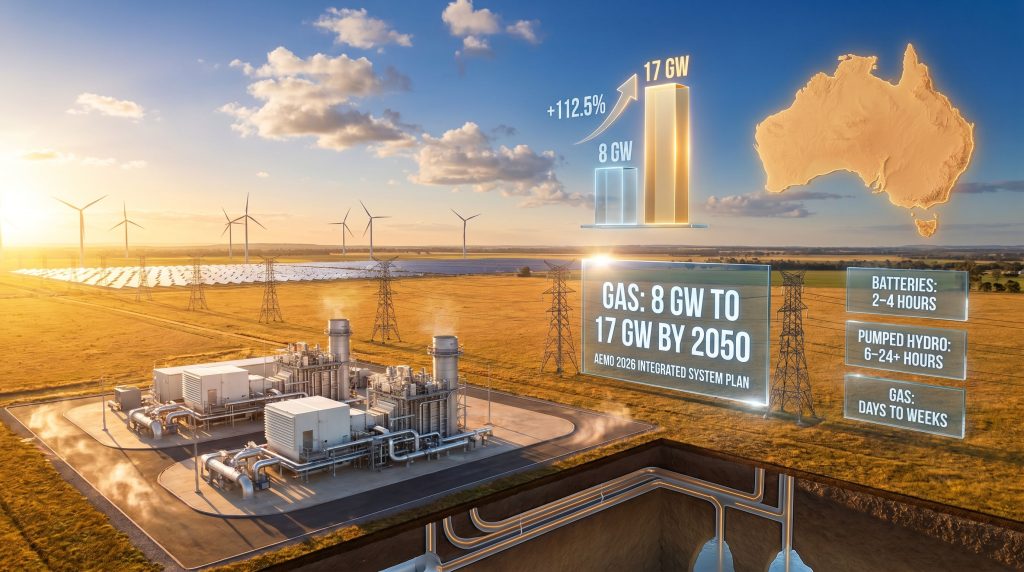
- NEM gas-powered generation capacity currently sits at approximately 8 gigawatts (GW)
- The ISP projects this must grow to 17 GW by 2050, representing an increase of 9 GW or 112.5% over 25 years
- This expansion requires concurrent investment in upstream gas supply, pipeline and transport infrastructure, and flexible storage facilities
- The primary operational role of gas is shifting from baseload and peaking functions toward system firming and extended backup as coal exits the market
| Metric | 2026 (Current) | 2050 (Projected) | Change Required |
|---|---|---|---|
| Gas-powered generation capacity | ~8 GW | ~17 GW | +9 GW (+112.5%) |
| Primary function | Baseload and peaking | Firming and extended backup | Flexibility-first transition |
| Key co-technologies | Coal (retiring), hydro | Batteries, pumped hydro, transmission | Storage integration essential |
Understanding AEMO's East Coast Gas System Reliability Function
A lesser-known dimension of Australia's energy governance is the structural asymmetry between electricity and gas reliability frameworks. Most Australians are familiar with the concept that electricity has a formal reliability standard, currently requiring 99.998% demand fulfillment across the NEM. What is far less understood is that the gas market has no equivalent codified benchmark.
AEMO's East Coast Gas System (ECGS) reliability and supply adequacy function covers all Australian states and territories except Western Australia. It operates under Part 27 of the National Gas Rules (NGR), which mandates AEMO to publish reports and notices following gas supply adequacy conferences. These reports fall into several categories:
- Supply adequacy assessment reports: forward-looking evaluations of whether projected gas supply can meet forecast demand across the east coast network
- Risk or threat notices: formal signals issued when supply adequacy thresholds are at risk, governed under NGR Part 27, Division 4
- Direction and trading notices: operational tools used to manage acute reliability events in real time
- Annual system security reports: published each December, covering gas-electricity interdependencies and identifying required investment for maintaining power system security
| Feature | Electricity Reliability | Gas Reliability (ECGS) |
|---|---|---|
| Formal reliability standard | Yes, 99.998% demand fulfillment | No formal standard currently set |
| Governing framework | National Electricity Rules | National Gas Rules (NGR), Part 27 |
| Reporting obligation | Yes | Yes, post-conference reports required |
| Risk signalling mechanism | Established | Proposed tiered system under review |
Proposals to extend AEMO's ECGS functions have been submitted to the Department of Climate Change, Energy, the Environment and Water (DCCEEW), signalling that the existing framework is widely considered insufficient for the complexity of the transition underway. Industry bodies including the Australian Pipelines and Gas Association (APGA) have advocated for a tiered risk-signalling mechanism for gas that would mirror the communication architecture used in electricity reliability planning.
This would enable earlier market response to supply constraints and clearer investment signals for infrastructure developers. In addition, natural gas price trends are increasingly influencing how urgently these reforms are being pursued across the sector.
The Three Infrastructure Pillars the ISP Identifies as Non-Negotiable
Meeting the ISP's projected 17 GW gas generation requirement is not simply a matter of drilling more wells. AEMO's assessment draws a direct line between system reliability and investment across three distinct but interconnected infrastructure categories.
1. New Gas Supply Development
Upstream resource expansion is the foundation. Without new field development and production growth, pipeline and storage upgrades become redundant. The ISP is unambiguous in stating that timely and efficient investment in new gas resources and infrastructure is critical to ensuring the operability, reliability, and security of the power system, while also maintaining supply to residential, commercial, and industrial consumers.
2. Transport Infrastructure
Pipeline capacity upgrades and new interconnections are needed to physically move gas from production regions to demand centres. Eastern Australia's pipeline network faces capacity constraints during peak demand periods. The geographic distribution of new gas developments may, consequently, require entirely new pipeline corridors rather than simple capacity expansions of existing infrastructure.
3. Flexible Storage Facilities
Underground gas storage assets play a role that is often underappreciated in public energy discussions. Unlike batteries that store electricity, gas storage facilities can hold volumes capable of sustaining generation output for days or weeks. This duration capability is what makes gas uniquely suited to covering extended low-renewable periods, a system need that batteries and pumped hydro cannot yet economically address.
The broader push toward renewable energy solutions in Australia underscores why these storage investments must be pursued in parallel rather than treated as competing priorities.
The East Coast Gas Reservation Scheme: Policy Design Under the Microscope
Against the backdrop of the ISP's investment requirements, the federal government's proposed east coast gas reservation scheme has emerged as a flashpoint. The concept of domestic gas reservation is straightforward: ensure sufficient gas volumes remain available for Australian consumers rather than being exported as liquefied natural gas (LNG). The policy intent is to protect domestic price competitiveness and supply security.
The execution, however, is where the complexity lies. The LNG supply outlook for Australia is directly shaped by how reservation rules are ultimately structured, making careful policy design essential.
Australian Energy Producers Chief Executive Samantha McCulloch stated that the ISP underscored the importance of getting the design of the reservation scheme right, with the current draft design framework identified as carrying risks that could destroy investment signals, crowd out domestic-focused gas producers, and ultimately contribute to higher energy prices and future supply shortfalls.
The investment signal problem deserves particular attention. Gas infrastructure projects typically carry development timelines of five to ten years from final investment decision to first production. This means that policy uncertainty in 2026 does not create supply gaps today; it creates them in the early to mid-2030s, precisely when the NEM's coal retirement timeline will be placing maximum pressure on dispatchable capacity.
Key Design Risks Identified by Industry
- Crowding out domestic-focused producers: smaller operators targeting Australian markets may face disproportionate reservation obligations compared to large LNG exporters, reducing their commercial viability
- Price distortion: poorly calibrated reservation volumes can create artificial market conditions that paradoxically push consumer prices higher rather than lower
- Investment certainty erosion: without stable, predictable policy settings, the long-lead-time projects the ISP identifies as essential may not attract capital
- Timeline misalignment: decisions deferred or abandoned now translate directly into generation capacity shortfalls in the 2030s
A well-designed reservation framework must satisfy competing objectives simultaneously: providing long-term supply certainty for domestic buyers while preserving the upstream investment incentives that bring new gas volumes to market in the first place.
A balanced scheme should ideally differentiate between LNG exporters and domestic-focused producers, align reservation trigger mechanisms with AEMO's own supply adequacy assessments, and include review clauses tied to NEM reliability outcomes rather than arbitrary volume thresholds. Australia's resource energy exports face growing scrutiny within this policy context, adding further pressure on scheme designers to strike the right balance.
How Gas and Storage Technologies Divide Reliability Responsibilities
Understanding why gas capacity must grow even as renewable penetration reaches record levels requires clarity about how different technologies divide system responsibility. The 2026 ISP describes a complementary rather than competitive relationship between gas generation and storage technologies.
| Technology | Response Time | Output Duration | Primary System Role |
|---|---|---|---|
| Utility-scale batteries | Seconds to minutes | 2 to 4 hours | Frequency regulation, short-duration firming |
| Pumped hydro | Minutes to hours | 6 to 24+ hours | Intraday balancing, overnight storage |
| Gas-powered generation | Minutes | Days to weeks | Extended low-renewable periods, seasonal gaps |
The concept of dark doldrums deserves specific attention here. These are multi-day weather events characterised by simultaneously low wind speeds and reduced solar irradiance, conditions that can persist for three to seven days across large geographic areas. In southern Australia, these events are particularly prevalent during winter months when solar generation is already reduced by shorter daylight hours.
No commercially viable battery storage technology currently deployed at grid scale can cover a seven-day dark doldrum event. Pumped hydro can extend coverage further, but reservoir capacity and refill rates impose practical limits. Gas-powered generation, drawing from pipeline-connected fuel reserves, faces no equivalent duration constraint. This is precisely why the ISP's modelling returns a result where gas capacity must grow rather than contract as renewable penetration increases.
The next major ASX story will hit our subscribers first
Scenario Analysis: What Happens If Investment Stalls
AEMO's modelling presents a conditional risk picture that policymakers cannot afford to dismiss as industry advocacy. The ISP's analysis of underinvestment scenarios reveals materially elevated reliability risks as the energy transition accelerates without adequate gas infrastructure backing.
| Scenario | Gas Capacity by 2050 | Reliability Outcome | Consumer Price Impact |
|---|---|---|---|
| Adequate investment pathway | ~17 GW | System operability maintained | Competitive pricing preserved |
| Underinvestment scenario | Below 17 GW | Elevated reliability risk periods | Upward price pressure likely |
| Policy uncertainty scenario | Delayed final investment decisions | Supply gaps in early 2030s | Short-term price volatility |
The narrow policy window this creates is arguably the most underappreciated dimension of the entire debate. Governments have a finite period in which to finalise reservation scheme design settings, infrastructure investment frameworks, and regulatory structures before the long-lead-time development pipeline closes off options for the early 2030s. Once that window passes, the consequences manifest as reliability events rather than policy debates.
Australian Energy Producers has called on federal and state governments to work collaboratively with industry to develop a reservation framework that balances domestic supply objectives with the investment certainty required to bring new gas projects online within the ISP's required timeframe. The AEMC's electricity reliability framework offers a useful structural reference point for how an equivalent gas standard might be designed and enforced.
Frequently Asked Questions: AEMO Gas Grid Reliability and the 2026 ISP
Why does gas capacity need to more than double if Australia is building more renewables?
Renewable energy sources generate output when weather conditions allow, not necessarily when the grid requires power. As coal-fired stations retire, the buffer of dispatchable generation they provided disappears. Gas-powered generation fills this role during extended periods when wind and solar output falls short of demand, a function that storage technologies cannot yet cover economically for multi-day durations.
Does Australia have a formal gas reliability standard equivalent to electricity?
No. The electricity market operates under a standard requiring 99.998% demand fulfillment. The gas market under the ECGS framework has no equivalent codified benchmark. Industry stakeholders and infrastructure groups have submitted proposals to DCCEEW for extended AEMO functions and a tiered risk-signalling mechanism to address this gap.
What is the key risk with the proposed east coast gas reservation scheme?
The design of the scheme carries the risk of deterring investment in precisely the new gas supply and infrastructure the ISP identifies as essential. Because gas projects have development lead times of five to ten years, investment decisions made or deferred in 2026 directly determine whether sufficient capacity is available when the NEM needs it most in the 2030s.
What are dark doldrums and why do they matter for energy planning?
Dark doldrums are multi-day weather events where both wind and solar generation fall simultaneously across large geographic areas. They represent the most demanding reliability test for a grid dominated by variable renewables. Consequently, they can only be managed economically through dispatchable generation with extended duration capability, a role currently filled exclusively by gas in the Australian context.
Key Takeaways: What the 2026 ISP Means for Australia's Energy Future
The 2026 AEMO gas grid reliability report delivers conclusions that cut against simplified narratives about the energy transition from multiple directions. For those who view gas as a legacy fuel to be phased out rapidly, the ISP's 17 GW capacity projection by 2050 presents an inconvenient structural reality. For those who resist the transition entirely, the ISP's placement of gas within a renewables-and-storage architecture makes equally clear that the direction of travel is not in doubt.
The critical synthesis is this: the energy transition requires more gas infrastructure investment, not less, precisely because renewable penetration is accelerating. The systems must work together, and the policy settings that govern gas investment certainty will determine whether Australia's reliability outcomes in the 2030s reflect the ISP's optimistic scenario or its risk scenario.
- The ISP confirms gas as a structural long-term necessity within the least-cost net-zero pathway, not a transitional holdover
- Gas capacity must grow from 8 GW to 17 GW by 2050, requiring upstream, transport, and storage investment across all three pillars simultaneously
- Australia's gas reliability framework lacks a formal standard equivalent to electricity, with proposals for reform under active consideration
- The east coast gas reservation scheme carries significant design risk, and poorly calibrated rules could undermine the ISP's investment requirements
- Policy decisions made in 2026 will determine supply availability in the early 2030s due to infrastructure development lead times of five to ten years
Readers seeking detailed assessments of Australia's gas supply adequacy can access AEMO's East Coast Gas System reports and notices directly through the AEMO website. Ongoing coverage of Australia's energy transition and gas sector developments is available through Petroleum Australia at petroleumaustralia.com.au.
This article reflects publicly available information from AEMO's 2026 Integrated System Plan and industry commentary as of June 2026. Projections and scenario analyses are forward-looking in nature and subject to change based on market, policy, and technology developments. This article does not constitute financial or investment advice.
Want to Identify ASX Energy and Resources Opportunities Before the Broader Market Does?
Discovery Alert's proprietary Discovery IQ model scans ASX announcements in real time, delivering instant alerts on significant mineral and energy-related discoveries so subscribers can act on actionable opportunities as soon as they emerge — explore historic discoveries and their returns to see what early positioning can look like, then begin a 14-day free trial at Discovery Alert to gain a market-leading edge.