June 26, 2026
Why Africa's Mineral Wealth Has Long Stopped Short of the Factory Gate
For decades, the story of African mineral resources has followed a familiar and frustrating arc: vast geological endowments extracted at scale, exported as raw or semi-processed materials, and transformed into high-value industrial products elsewhere in the world. The economic gap between mining a tonne of ilmenite and selling a tonne of finished titanium dioxide pigment represents one of the most stark illustrations of this dynamic. That value gap, measured in multiples rather than percentages, is precisely what the Richards Bay ilmenite beneficiation project is designed to close.
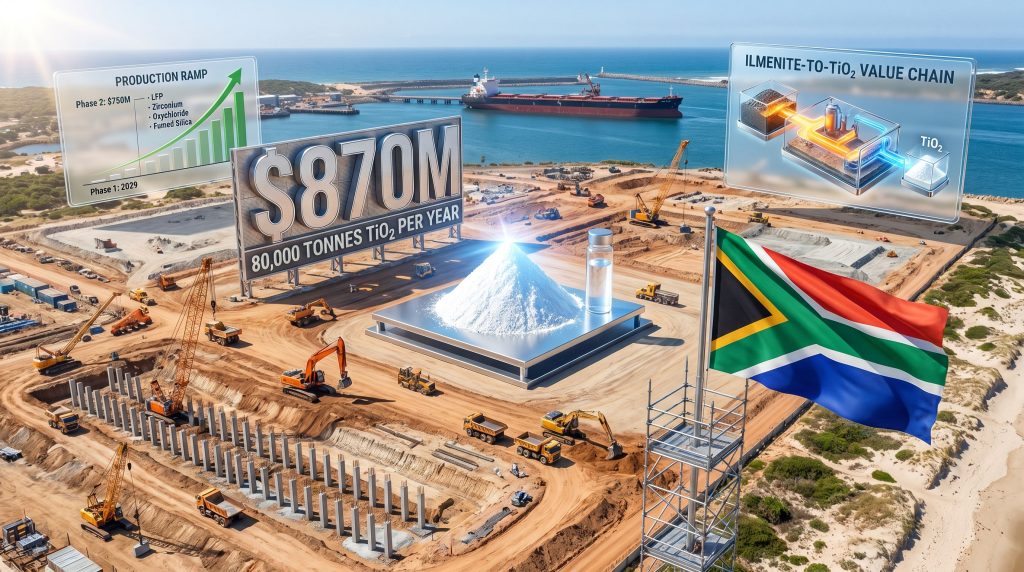
The Nyanza Light Metals industrial platform, now entering active construction at the Richards Bay Industrial Development Zone (RBIDZ) in KwaZulu-Natal, South Africa, represents a structural departure from that historical pattern. With a combined two-phase investment footprint approaching $1.62 billion, this is not an incremental upgrade to existing infrastructure. It is a ground-up industrial transformation.
When big ASX news breaks, our subscribers know first
Understanding the Ilmenite-to-TiO₂ Value Chain
What Ilmenite Actually Is and Why It Matters
Ilmenite is a titanium-iron oxide mineral found in heavy mineral sands (HMS) deposits, typically occurring alongside zircon, rutile, and other economically significant minerals in coastal and ancient beach deposit formations. South Africa's KwaZulu-Natal coastline hosts substantial HMS resources, and Richards Bay has long served as a hub for the mining and primary processing of these materials.
In its raw mined form, ilmenite functions primarily as a feedstock. Its commercial value is realised not at the point of extraction but through chemical transformation into titanium dioxide, the world's most widely consumed white pigment. The price differential between raw ilmenite and refined TiO₂ pigment is substantial, with finished pigment commanding many times the value of its feedstock on global markets. Furthermore, the critical minerals demand driving this sector continues to intensify as industrial and energy transition applications multiply globally.
"Ilmenite's true economic potential is unlocked not in the ground or even at the mine gate, but inside a chemical processing plant. The beneficiation step is where raw geology becomes industrial value."
The Sulphate Process Route: A Technical Note for Informed Readers
Nyanza Light Metals has selected the sulphate process route for TiO₂ production, a method particularly well-suited to lower-grade ilmenite feedstocks. Unlike the chloride process, which requires higher-grade rutile or synthetic rutile feedstocks, the sulphate route dissolves ilmenite in sulphuric acid, generating an iron sulphate by-product alongside titanium-bearing liquor that is subsequently purified and calcined to produce finished pigment.
This process choice has important strategic implications:
- It allows Nyanza to utilise regionally available ilmenite feedstock without requiring costly upgrading steps
- Iron sulphate produced as a by-product becomes a saleable product in its own right, with applications in water treatment and fertiliser production
- The sulphate process generates sulphuric acid as an input requirement, which can itself be produced on-site as part of a closed-loop materials design
- This chemistry directly informs the Phase 2 expansion logic, where process by-products become feedstocks for battery materials and specialty chemicals
The Nyanza Platform at a Glance: Phase 1 and Phase 2 Parameters
Phase 1 Capital and Production Profile
| Project Parameter | Detail |
|---|---|
| Total Phase 1 Investment | $870 million |
| Peak Funding Requirement | $860-$900 million |
| Annual TiO₂ Output | 80,000 tonnes per year |
| Export Orientation | Approximately 85% of production |
| Primary Process Route | Sulphate ilmenite-to-TiO₂ pigment |
| Site Area | 69 hectares within the RBIDZ |
| Construction Commencement | 2026 (foundation piling underway) |
| Targeted First Production | End of 2029 |
Phase 2 Downstream Expansion
| Phase 2 Parameter | Detail |
|---|---|
| Planned Investment | $750 million |
| Bankable Feasibility Study Completion | Expected 2028 |
| Primary Output Products | Lithium iron phosphate (LFP), zirconium oxychloride, fumed silica |
| Additional Co-products | Iron sulphate, sulphuric acid |
| Design Philosophy | Closed-loop platform consuming Phase 1 process by-products |
The integrated architecture linking Phase 1 chemistry with Phase 2 feedstock requirements is one of the project's most distinctive structural features. By engineering Phase 2 to consume what Phase 1 produces as by-products, Nyanza creates a cost structure that standalone chemical plants cannot easily replicate. This closed-loop design reduces both input costs and waste streams, conferring a durable competitive advantage. In addition, the battery raw materials market is increasingly rewarding this kind of integrated production model with stronger offtake interest.
Construction Progress and Development Timeline
As of June 2026, the Richards Bay ilmenite beneficiation project has progressed through several key milestones, with foundation piling works actively underway at the 69-hectare RBIDZ site. The development sequence reflects the complexity of executing an $870 million industrial facility in an emerging market context.
Current milestone status:
- ✅ Geotechnical studies and bulk earthworks: Completed
- ✅ Product testing and development centre: Operational, actively supplying samples to prospective customers
- ✅ Firm offtake agreements: Secured prior to construction commencement
- 🔄 Foundation piling works: In progress as of June 2026
- ⏳ Plant erection and equipment installation: Scheduled
- ⏳ First TiO₂ production: Targeted end of 2029
The fact that a product testing centre is already operational and generating customer samples before Phase 1 construction is complete is a detail worth noting. It indicates that Nyanza is building commercial relationships and validating product quality in parallel with civil construction, a strategy that de-risks the revenue ramp-up phase considerably.
The engineering, procurement, construction, and operations management (EPCM) contract is held by East China Engineering Science and Technology Company, a subsidiary of China National Chemical Engineering Group Company, one of the world's largest chemical engineering contractors. The same EPCM partner is expected to advance the Phase 2 expansion, providing design continuity across both phases.
Ownership, Financing, and Development Partners
Who Owns and Operates the Project
Nyanza Light Metals is the project development vehicle, with ownership interests held by Arkein Industrial Holdings and DBF Capital Partners. The project is co-developed alongside Afreximbank, the African Finance Corporation (AFC), and South Africa's state-owned Industrial Development Corporation (IDC), with institutional engagement from the Department of Trade, Industry and Competition and the RBIDZ authority.
A Development Finance Institution-Led Financing Model
The financing structure deserves particular analytical attention. Rather than relying on commercial bank syndicates as primary capital providers, the project is anchored by Afreximbank and the AFC as co-mandated lead arrangers, with a broader consortium of pan-African and local development finance institutions (DFIs) participating alongside them.
"DFI participation as lead arrangers rather than commercial co-lenders signals a fundamentally different risk and return framework. These institutions are mandated to finance African industrial development, not to maximise short-term returns on deployed capital. That structural alignment matters enormously for a project of this scale and complexity."
This financing architecture is significant for several reasons:
- DFIs typically accept longer tenor debt structures than commercial banks, which suits a project with a 2029 first-production target
- Afreximbank's mandate specifically encompasses export-oriented African manufacturing, directly aligned with Phase 1's 85% export orientation
- DFI involvement typically brings enhanced credibility for subsequent commercial financing rounds or bond issuances
- The IDC's co-development role connects the project to South Africa's domestic industrial policy framework without creating dependency on any single capital source
Employment and Economic Development Projections
| Employment Category | Phase 1 | Phase 2 |
|---|---|---|
| Peak Construction Jobs | 3,000 | 2,000 |
| Permanent Operational Roles | 850 | 600 |
Beyond direct employment, the project carries significant multiplier potential for the broader KwaZulu-Natal economy. Richards Bay has historically functioned as a raw material export terminal, shipping mineral sands, coal, and other commodities offshore in unprocessed or minimally processed form. The Nyanza platform represents a structural shift toward value-added manufacturing, which generates qualitatively different economic linkages: technical skills development, supplier ecosystems, logistics service demand, and hard-currency export revenues.
An 80,000 tpa TiO₂ output at prevailing global pigment prices represents a meaningful contribution to South Africa's manufactured goods export base, with implications for foreign exchange earnings and the country's industrial trade balance. However, the broader opportunity extends further still, as renewable energy in mining and industrial processing increasingly shapes the long-term cost competitiveness of facilities like this one.
The next major ASX story will hit our subscribers first
How Nyanza Fits Into the Global TiO₂ Market
Market Structure and Supply Geography
Global TiO₂ demand is driven by construction coatings, automotive finishes, consumer packaging, and paper manufacturing, with the pigment's exceptional opacity and UV resistance making it functionally irreplaceable across these applications. Current production capacity is heavily concentrated in China, Europe, and North America, leaving a pronounced geographic mismatch between where titanium mineral resources are located and where chemical processing actually occurs.
Africa holds significant ilmenite and rutile endowments but contributes negligibly to global TiO₂ pigment production. Nyanza's 80,000 tpa Phase 1 capacity would represent a genuinely new supply source in a market where feedstock security and geographic supply diversification are increasingly prioritised by downstream manufacturers following years of supply chain disruption.
Nyanza vs. Richards Bay Minerals: A Critical Distinction
A common point of confusion in market commentary conflates the Nyanza Light Metals facility with Richards Bay Minerals (RBM), the established HMS mining and smelting operation majority-owned by Rio Tinto. These are fundamentally different operations at different points in the value chain.
| Dimension | Nyanza Light Metals | Richards Bay Minerals (RBM) |
|---|---|---|
| Primary Activity | Ilmenite-to-TiO₂ chemical beneficiation | Heavy mineral sands mining and primary smelting |
| Key Output | TiO₂ pigment (finished chemical) | Titanium slag, zircon, rutile |
| Value Chain Position | Downstream chemical processing | Upstream mining and smelting |
| Ownership | Arkein Industrial Holdings / DBF Capital Partners | Rio Tinto (majority) |
| Development Status | Phase 1 construction commenced 2026 | Zulti South extension ($473M) targeting mine life to 2050 |
RBM produces the types of primary smelted titanium materials that serve as feedstocks for chemical processors. Nyanza operates at the next stage, converting those feedstocks into finished pigment. The two operations are consequently complementary from a regional supply chain perspective, not competing.
The Phase 2 Battery Materials Dimension: Energy Transition Meets Industrial Chemistry
Lithium Iron Phosphate and Its Growing Role in Energy Storage
Lithium iron phosphate (LFP) battery chemistry has emerged as the dominant cathode technology for stationary energy storage applications and is gaining market share in electric vehicles, particularly in cost-sensitive segments. LFP's advantages over nickel-manganese-cobalt (NMC) chemistries include greater thermal stability, longer cycle life, and lower raw material cost. Furthermore, the battery storage expansion now driving global energy investment is accelerating demand for precisely the kind of LFP precursor materials Nyanza's Phase 2 is designed to produce.
South Africa producing LFP precursor materials using by-products from its own mineral processing chemistry would represent a meaningful repositioning within global battery supply chains, adding manufactured value to a country already endowed with relevant mineral inputs.
Specialty Chemicals with Premium Pricing Potential
Phase 2 also encompasses zirconium oxychloride and fumed silica, both of which command premium pricing in specialty chemical markets:
- Zirconium oxychloride serves as a precursor to zirconia, used in advanced ceramics, catalysts, and solid oxide fuel cell components
- Fumed silica is a critical additive in adhesives, sealants, electronic encapsulants, and semiconductor manufacturing processes
- Both products serve industries with structurally strong long-term demand profiles independent of commodity cycle volatility
The connection between fumed silica and semiconductor manufacturing introduces a supply chain dimension that extends the project's strategic relevance beyond energy transition narratives into advanced electronics and computing infrastructure, sectors experiencing sustained demand growth globally. In addition, green transition materials produced from integrated platforms such as this are increasingly viewed as strategically significant by both industrial buyers and policymakers.
Frequently Asked Questions
What is the Richards Bay ilmenite beneficiation project?
It is the Nyanza Light Metals industrial platform, a two-phase development at the Richards Bay Industrial Development Zone in KwaZulu-Natal, South Africa. Phase 1 will chemically convert ilmenite from heavy mineral sands into 80,000 tonnes per year of titanium dioxide pigment. Phase 2 will add lithium iron phosphate, zirconium oxychloride, fumed silica, iron sulphate, and sulphuric acid.
When will TiO₂ production begin at Richards Bay?
Phase 1 construction commenced in 2026 with foundation piling works underway. First TiO₂ production is targeted for the end of 2029.
What is the total investment in the Nyanza project?
Phase 1 carries a capital cost of $870 million (peak funding requirement of $860-$900 million). Phase 2 represents an additional $750 million, bringing the combined platform investment to approximately $1.62 billion.
Who is financing the project?
Afreximbank and the African Finance Corporation act as co-mandated lead arrangers, supported by a consortium of pan-African and local development finance institutions. South Africa's Industrial Development Corporation is a co-developer.
How many jobs will the project create?
Phase 1 is expected to generate approximately 3,000 construction jobs at peak and 850 permanent operational positions. Phase 2 adds a further 2,000 construction jobs and 600 permanent roles.
Key Takeaways
The Nyanza Light Metals platform is significant not merely as a large capital project but as a structural inflection point in how South Africa and Africa more broadly engage with their own mineral endowments. Several dimensions stand out:
- Value chain transformation at scale: Moving from raw ilmenite export to finished TiO₂ pigment manufacture captures multiples of value that have historically left the continent
- Closed-loop industrial design: The integration of Phase 1 chemistry with Phase 2 feedstock requirements creates cost structures and efficiency advantages unavailable to standalone processors
- DFI-anchored financing: The development finance institution-led capital structure demonstrates the viability of African institutional capital for complex industrial projects at this scale
- Multi-sector demand exposure: From architectural coatings to battery storage, advanced ceramics, and semiconductor materials, the platform's product suite spans several high-growth global markets
- Export manufacturing orientation: With approximately 85% of Phase 1 output destined for international markets, the project materially strengthens South Africa's manufactured export base and foreign exchange generation capacity
Disclaimer: This article is intended for informational purposes only and does not constitute financial or investment advice. Projections relating to production targets, employment figures, capital costs, and timelines are forward-looking in nature and subject to change. Readers should conduct their own due diligence before making any investment decisions. All financial figures are sourced from publicly available project disclosures as reported by Mining Weekly.
Want to Stay Ahead of the Next Major Mineral Discovery on the ASX?
Discovery Alert's proprietary Discovery IQ model delivers real-time alerts the moment significant ASX mineral discoveries are announced, turning complex geological and commodity data into actionable investment insights for both short-term traders and long-term investors — explore the historic returns major discoveries have generated and begin your 14-day free trial today to position yourself ahead of the broader market.