June 27, 2026
India's Hydrocarbon Dependency and the Industrial Logic Behind Coal Gasification Valleys
Few structural economic challenges carry as much long-term consequence for an emerging superpower as energy import dependency. For India, this dependency is not a marginal concern but a foundational vulnerability that compounds with every global supply shock. The country consumes nearly 5 million barrels per day (bpd) of oil while producing approximately 0.5 million bpd domestically, a tenfold production-to-consumption gap that places enormous pressure on foreign exchange reserves. The natural gas import structure is similarly lopsided: domestic production of roughly 35 billion cubic metres (BCM) per year serves a national consumption base approaching 70 BCM, creating a structural supply deficit of nearly 50%.
These numbers are not abstract. Each percentage point of import dependency translates into sovereign exposure to geopolitical disruption, price volatility, and currency risk. The COVID-19 pandemic, followed by the Russia-Ukraine conflict and persistent instability across West Asia, demonstrated precisely how quickly import-reliant economies can find themselves on the wrong side of a global energy shock. It is within this context that coal gasification valleys in India have emerged as one of the most strategically significant industrial concepts of the current decade.
When big ASX news breaks, our subscribers know first
Understanding What a Coal Gasification Valley Actually Means
The term itself requires unpacking, because it describes an industrial concept rather than a geological formation. India's coal-bearing regions, including the IB Valley in Odisha, the Damodar Valley spanning Jharkhand and West Bengal, and the Talcher coalfields, are geological features that serve as feedstock reservoirs. A coal gasification valley, by contrast, refers to an integrated industrial ecosystem that grows up around these coal-rich zones, where multiple processing units, chemical clusters, and energy facilities co-locate to form an interconnected value chain.
The industrial logic mirrors that of large-scale integrated refinery complexes, where co-producing multiple outputs from a single feedstock base strengthens overall project economics. In a gasification valley model, coal is converted to syngas (a mixture of carbon monoxide and hydrogen), which then serves as a feedstock for producing ammonia, urea, methanol, dimethyl ether, hydrogen, ethanol, synthetic gas for power generation, and steel inputs such as direct reduced iron (DRI). The pit-head clustering strategy, placing processing facilities directly adjacent to coal mines, minimises logistics costs and enables the kind of coal blending that optimises gasifier performance across variable seam qualities.
As of 2026, India operates one commercial-scale coal gasification facility, located at Talcher in Odisha, with a capacity of approximately 2 million tonnes. This site functions as the blueprint for what gasification valley development could look like at scale.
The Eastern Coal Arc: India's Primary Gasification Geography
The four eastern states of Jharkhand, Odisha, Chhattisgarh, and West Bengal collectively hold approximately 54% of India's total coal and lignite reserves, making the eastern belt the natural geography for coal gasification valleys in India. Site selection under the National Coal Gasification Mission prioritises lower-ash coal seams to improve conversion efficiency and reduce downstream processing complexity.
| Region | State | Strategic Role |
|---|---|---|
| Talcher Coalfield | Odisha | India's first commercial gasification plant |
| IB Valley (Lakhanpur, Rampur, Samaleswari) | Odisha | Listed in National Coal Gasification Mission documents |
| Damodar Valley | Jharkhand / West Bengal | High coal density; UCG pilot potential |
| Angul Industrial Corridor | Odisha | Emerging downstream chemical manufacturing zone |
| Jharkhand UCG Sites | Jharkhand | 21 mines identified for Underground Coal Gasification |
A parallel technological pathway is also emerging through Underground Coal Gasification (UCG), which converts coal to syngas directly within the underground seam, bypassing surface mining entirely. India launched its first UCG pilot in Jharkhand in 2024, with 21 mines identified as having viable UCG potential across the eastern belt. UCG distributes gasification activity more broadly rather than concentrating it at single anchor sites, suggesting that India's eventual gasification geography will resemble a distributed eastern industrial arc more than a single concentrated valley.
The National Coal Gasification Mission: Targets, Funding, and Realistic Timelines
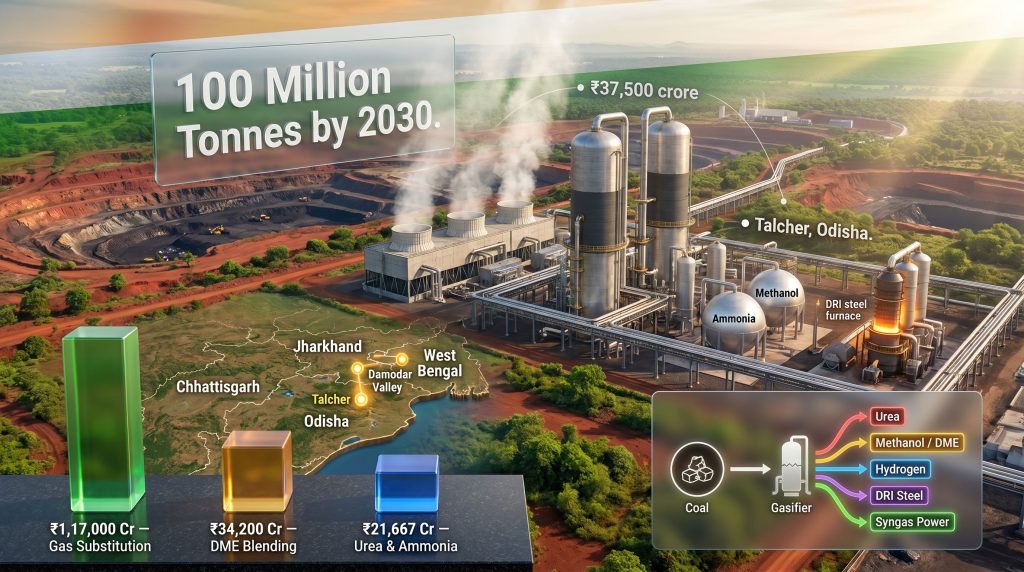
India's formal policy framework for coal gasification sets a target of gasifying 100 million tonnes of coal by 2030, with a longer-term ambition of 250 million tonnes by 2047. The financial architecture supporting this mission includes an initial incentive allocation of ₹8,500 crore covering eight projects with a combined capacity of approximately 12 million tonnes, followed by an expanded scheme of ₹37,500 crore (approximately USD $890 million).
| Mission Parameter | Detail |
|---|---|
| 2030 Coal Gasification Target | 100 million tonnes |
| 2047 Long-Term Opportunity | ~250 million tonnes |
| Phase 1 Incentive Scheme | ₹8,500 crore (8 projects, ~12 MT capacity) |
| Phase 2 Incentive Scheme | ₹37,500 crore (~USD $890 million) |
| Estimated Import Substitution by 2047 | ₹5,000 crore to ₹7,000 crore |
The honest assessment of the 2030 target is that it describes a development trajectory rather than a completion date. With no operational commercial capacity at scale currently available beyond the Talcher pilot, the more credible interpretation is that multiple projects will be at varying stages of development, financing, construction, or commissioning by 2030. This is consistent with how China's coal gasification sector evolved: beginning its journey in 1995, it now processes approximately 350 million tonnes per annum, a scale built over three decades of sustained policy commitment and infrastructure investment.
China's parallel achievement in urea production provides the most instructive benchmark. The country produces approximately 70 million tonnes of coal-based urea annually, making coal-to-fertiliser conversion its most commercially mature gasification application. India's path to replicating even a fraction of this capacity depends on solving a dual dependency problem that sits at the heart of the gasification mission.
The Urea Problem: India's Most Urgent Gasification Rationale
India's urea challenge is uniquely compounding. The country imported nearly 11 million tonnes of urea in FY2026, representing a substantial recurring foreign exchange outflow. However, even domestically produced urea carries an embedded import dependency, because most Indian fertiliser plants rely on imported natural gas as their primary feedstock. The result is a two-layer vulnerability: imported finished product on one side, imported feedstock for domestic production on the other.
Fertiliser subsidies have responded accordingly, escalating from ₹1.5 lakh crore to ₹2.5 lakh crore in 2022, with further increases projected as import volumes persist. The Ministry of Coal estimates that routing ammonia and urea production through the syngas pathway could reduce India's urea import bill by ₹21,667 crore by 2030, simultaneously severing both the finished product and feedstock dependencies.
This dual decoupling effect makes urea production the single highest-priority commercial anchor for early gasification valley development, providing the predictable revenue stream that high-capital infrastructure projects require to attract institutional financing.
The Syngas Value Chain: From Coal to Industrial Outputs
The breadth of products derivable from coal gasification is one of its most underappreciated strategic attributes. Furthermore, a single gasification facility can feed multiple downstream chemical pathways simultaneously, as outlined in research on coal gasification opportunities in India:
- Ammonia and urea for agricultural fertilisers with assured government offtake
- Methanol and DME for LPG blending and marine fuel applications
- Hydrogen for green chemistry and steel sector decarbonisation
- Ethanol for fuel blending programmes
- Syngas for retrofitting existing gas-fired power generation
- Ammonium nitrate for industrial explosives and mining applications
- Direct Reduced Iron (DRI) as a steelmaking raw material
The DME pathway deserves particular attention. Di-methyl-ether, produced through the methanol route during gasification, can be blended into LPG at up to 20% by BIS standards. India currently imports 22 million metric tonnes of LPG per year, making DME blending one of the most quantifiably impactful near-term applications. A phased approach modelled on India's ethanol blending programme, starting at 5 to 8% and scaling toward the 20% ceiling, could generate annual savings of ₹34,200 crore. The ethanol precedent is important: it demonstrates that India has already built the regulatory architecture and logistical infrastructure to execute blending mandates at national scale.
| Import Substitution Pathway | Estimated Annual Value |
|---|---|
| Chemical imports via syngas pathways | ₹3,65,354 crore reduction by 2030 |
| Urea and ammonia production | ₹21,667 crore import bill reduction by 2030 |
| DME blending in LPG (20% blend rate) | ₹34,200 crore per year |
| Natural gas substitution via syngas for power | ₹99,000 crore to ₹1,17,000 crore per year |
| Downstream products (ammonium nitrate, ethanol, DRI, hydrogen) | ₹15,900 crore via ongoing projects |
The next major ASX story will hit our subscribers first
What Makes These Projects Bankable and What Has Historically Stopped Them
The 2008 joint venture between Sasol and Tata Steel to develop India's first coal-to-liquids project provides the most instructive cautionary case. The project collapsed due to unresolved coal supply guarantees, prohibitive capital requirements, and structural policy constraints that made commercial viability unachievable. It was only after 2020 policy reforms opening coal mining to private and international operators that investor interest in coal gasification meaningfully recovered.
Five foundational conditions determine whether a gasification project reaches financial close:
- Assured coal feedstock through long-term mine linkages with guaranteed supply volumes
- Land acquisition and environmental clearances, historically the most time-consuming regulatory constraint
- Technology selection appropriate for India's characteristically high-ash coal, which requires adapted gasifier designs not optimised for lower-ash international feedstocks
- Offtake guarantees providing predictable revenue streams to justify high upfront capital deployment
- Capital access at viable interest rates, where infrastructure-sector classification becomes a critical financing enabler
The high-ash content of Indian coal is a technical challenge that is frequently underestimated in project development discussions. Conventional gasifier designs calibrated for international coal specifications require substantial engineering adaptation for Indian feedstock conditions, making technology due diligence a non-negotiable prerequisite for any developer entering this sector.
The DRI pathway currently represents the most naturally bankable offtake structure. Companies such as JSPL are establishing 2 MMTPA DRI capacity for captive steel production consumption, eliminating third-party offtake risk entirely. This captive demand model is precisely the kind of structural offtake certainty that makes gasification projects financeable at scale.
The Gasification-Green Hydrogen Integration Opportunity
One of the least widely understood dimensions of coal gasification valleys is their potential to function as demand anchors for green hydrogen, addressing one of the sector's most persistent commercialisation challenges. Large-scale green hydrogen production has struggled to attract investment without assured industrial offtake. Co-locating coal gasification and green hydrogen facilities creates the integration logic needed to solve this problem.
The chemical rationale is straightforward: coal gasification produces carbon monoxide (CO) as a primary output, while green hydrogen electrolysers produce pure hydrogen. Combining both yields methanol and a range of downstream chemicals, creating a circular feedstock relationship between the two technologies. This integration also aligns naturally with broader energy security transition goals that India is actively pursuing across multiple industrial sectors.
The oxygen economy within this integration is particularly compelling and largely overlooked in mainstream analysis. For every 1 kg of green hydrogen produced by an electrolyser, approximately 8 kg of pure oxygen emerges as a co-product. Conventional air separation units, which are standard oxygen supply infrastructure for coal gasification facilities, consume 200 to 250 kWh of electricity per tonne of industrial-grade oxygen produced. Sourcing that oxygen instead from a co-located electrolyser eliminates air separation unit capital and operating costs simultaneously, improving the economics of both the gasification and hydrogen facilities within the same integrated complex.
This oxygen co-product relationship transforms what would otherwise be two separate capital-intensive facilities into a mutually reinforcing system where each technology improves the cost structure of the other.
Integrated Carbon Capture and Utilisation (CCU) within gasification valleys further extends this potential. In addition, hydrogen-based iron reduction pathways are increasingly being explored alongside gasification clusters, positioning coal-based industrial chemistry within India's broader Green Hydrogen Mission framework and creating a pathway toward low-carbon industrial production consistent with India's 2070 net-zero commitment.
How Does This Compare to Green Iron Initiatives?
Globally, green iron production models offer a complementary perspective on how industrial decarbonisation can be structured around co-located clean energy and mineral processing assets. India's gasification valleys can draw on these precedents, adapting the integrated cluster logic to its own coal-rich geography and policy environment. Furthermore, renewable industrial decarbonisation strategies increasingly recognise the role that transitional fossil-based chemistry, such as coal gasification, can play in bridging toward fully zero-carbon industrial systems.
The Interministerial Coordination Imperative
Perhaps the most underappreciated structural challenge facing coal gasification valleys in India is not technological or financial but governmental. Gasification cuts across the jurisdictions of at least eleven separate ministries and departments, each with distinct regulatory authority over a different segment of the value chain.
| Ministry or Department | Role in the Gasification Ecosystem |
|---|---|
| Ministry of Coal | Primary mission driver and policy anchor |
| Ministry of Chemicals and Fertilisers | Offtake frameworks for ammonia, urea, and methanol |
| Ministry of Petroleum and Natural Gas | LPG blending policy and DME integration |
| Ministry of Steel | DRI offtake and captive consumption linkages |
| Ministry of Power | Syngas retrofitting for gas-based power plants |
| DPIIT | Industrial cluster facilitation and regulatory streamlining |
| Department of Science and Technology | R&D for high-ash coal gasification adaptation |
| Ministry of Environment, Forest and Climate Change | Environmental clearances and marine decarbonisation |
| Ministry of External Affairs | International technology transfer facilitation |
| Ministry of Civil Aviation | e-SAF integration for sustainable aviation fuel |
| Department of Economic Affairs | Infrastructure-sector classification for concessional financing |
The infrastructure classification question warrants particular attention. Classifying coal gasification projects within the infrastructure sector would enable developers to access concessional financing at materially lower interest rates, a mechanism that China adopted during its own gasification scale-up phase and that analysts identify as a critical accelerant in building sector scale. Without this classification, the capital intensity of gasification projects creates a financing gap that most private developers cannot bridge at commercially viable returns on equity.
India also operates approximately 20 GW of gas-based power generation capacity, capable of producing around 105 TWh per year. Retrofitting these plants with syngas combustors could substitute approximately 25 BCM per year of natural gas imports, with equivalent annual import savings estimated between ₹99,000 crore and ₹1,17,000 crore, potentially the largest single import substitution opportunity in the entire gasification value chain. According to policy pathway analysis from CRF India, achieving this scale will require coordinated policy reform across precisely these ministerial boundaries.
Frequently Asked Questions About Coal Gasification Valleys in India
What is a coal gasification valley in India?
A coal gasification valley is an integrated industrial cluster built around coal-rich geological zones in India, particularly in the eastern states, where coal is converted to syngas and processed into fertilisers, fuels, chemicals, and steel inputs. The concept describes a planned industrial geography rather than an existing facility type.
Where is India's first coal gasification plant located?
India's only commercial-scale coal gasification facility as of 2026 is located at Talcher in Odisha, within the broader IB Valley coalfield region. It has an approximate capacity of 2 million tonnes and serves as the developmental model for future gasification valley projects.
What is India's coal gasification target for 2030?
The National Coal Gasification Mission targets gasification of 100 million tonnes of coal by 2030, supported by government incentive funding of ₹37,500 crore. The longer-term vision targets 250 million tonnes by 2047.
Which Indian states are most important for coal gasification development?
Odisha, Jharkhand, Chhattisgarh, and West Bengal are the primary states, collectively holding approximately 54% of India's coal and lignite reserves. Odisha's Talcher and IB Valley sites, along with Jharkhand's UCG pilot locations, represent the most advanced nodes in the emerging network.
How does coal gasification reduce India's import bill?
By enabling domestic production of urea, methanol, DME, hydrogen, and synthetic gas, coal gasification addresses products India currently imports at significant recurring cost. Estimates span from ₹21,667 crore in annual urea savings to over ₹1 lakh crore per year in natural gas substitution for power generation.
What is Underground Coal Gasification and where is it being tested in India?
UCG converts coal to syngas within the underground seam without requiring surface mining. India launched its first UCG pilot in Jharkhand in 2024, with 21 mines identified as having UCG potential across the eastern coal belt. Consequently, this technology represents a significant expansion of the gasification geography beyond traditional surface-based processing sites.
Disclaimer: All financial projections, import substitution estimates, and mission targets referenced in this article are drawn from publicly available government documents, ministry reports, and industry analyses. These figures represent estimates and forward-looking projections subject to policy changes, technology development timelines, and market conditions. This article does not constitute financial or investment advice.
Want to Track the ASX Stocks Positioned to Benefit From the Global Energy Transition?
Discovery Alert's proprietary Discovery IQ model delivers real-time alerts on significant ASX mineral discoveries — including the critical commodities underpinning industrial transitions like coal gasification, green hydrogen, and DRI steelmaking — instantly equipping subscribers with actionable insights ahead of the broader market. Explore historic discoveries and their market returns to understand the scale of opportunity, then begin your 14-day free trial at Discovery Alert to position yourself ahead of the next major find.