
June 29, 2026
The Hidden Risk Architecture of Industrial Helicopter Operations at Critical Energy Infrastructure
Rotary-wing aviation in the oil and gas sector occupies a peculiar position within industrial risk management: it is simultaneously indispensable and statistically dangerous. Unlike commercial passenger aviation, where decades of regulatory pressure and technological investment have driven accident rates to historically low levels, helicopter operations across large-scale energy facilities continue to carry a fatality profile that commands serious attention. The International Association of Oil & Gas Producers (IOGP) has consistently documented that fatal accident rates per flight hour in the oil and gas helicopter sector remain significantly elevated compared to commercial aviation benchmarks. This reflects the genuinely hostile operating environments, compressed maintenance windows, and mission profiles that characterise industrial rotary-wing use at scale.
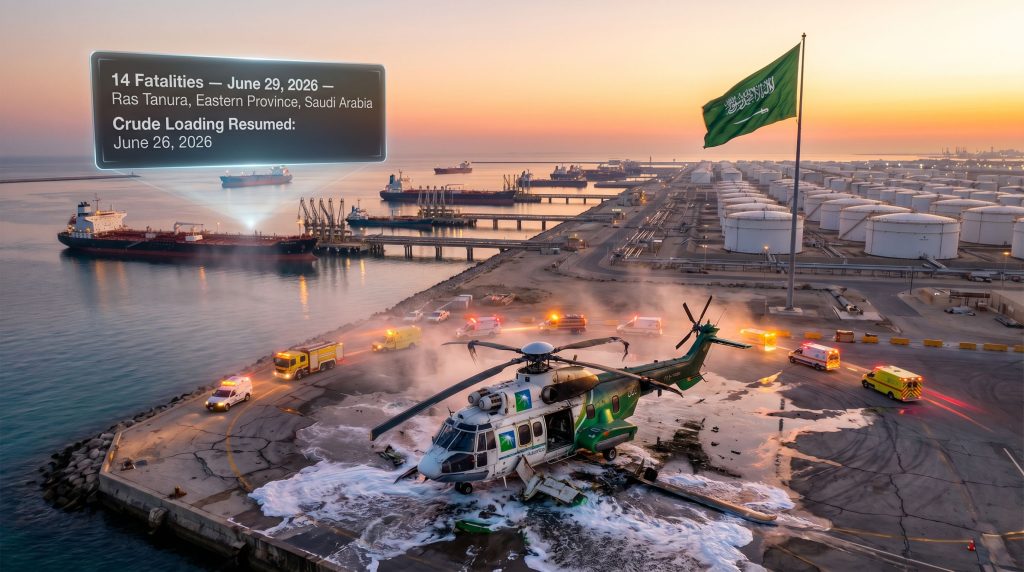
Against this backdrop, the Saudi Aramco helicopter crash in Ras Tanura on June 29, 2026, is not merely a tragic workplace fatality event. It is a case study in the layered operational vulnerabilities that persist even within the most resource-rich energy organisations in the world.
When big ASX news breaks, our subscribers know first
Ras Tanura: Why This Terminal Carries Disproportionate Strategic Weight
Ras Tanura sits on Saudi Arabia's eastern Gulf coastline, positioned west of the Strait of Hormuz, the narrow maritime passage through which roughly 20% of the world's oil supply transits on any given day. The terminal is one of the largest crude oil export facilities on the planet, and its operational continuity is directly tied to Saudi Arabia's global impact as the world's largest crude exporter.
The terminal's significance extends beyond raw throughput volume. It functions as a barometer for Gulf energy stability, with any disruption — whether technical, security-related, or otherwise — capable of generating immediate ripple effects across global oil pricing and shipping insurance markets. Furthermore, understanding oil's global importance helps contextualise why even a single incident at this facility commands worldwide attention.
What makes the timing of the Saudi Aramco helicopter crash in Ras Tanura particularly noteworthy from an operational standpoint is the context in which it occurred. The terminal had only resumed crude oil loading on June 26, 2026, following an extraordinary suspension of nearly four months. That hiatus was connected to broader regional instability stemming from the US-Iran-Israel conflict, which had generated serious security concerns across Gulf energy infrastructure.
Saudi Arabia, along with other Middle East producers, had been accelerating export volumes ahead of an interim arrangement to pause hostilities between the United States and Iran. The resumption of operations at Ras Tanura was being watched closely by oil traders, sovereign energy buyers, and freight markets globally. The crash occurring just 72 hours after that resumption was always going to attract intense scrutiny, even in the absence of any confirmed causal relationship to geopolitical events.
Confirmed Facts: What Is Known About the Incident
Saudi state news authorities confirmed the following details regarding the crash:
| Detail | Confirmed Information |
|---|---|
| Date | Sunday, June 29, 2026 |
| Time | Approximately 6:00 a.m. local time (03:00 GMT) |
| Location | Ras Tanura, Eastern Province, Saudi Arabia |
| Aircraft Operator | Saudi Aramco |
| Fatalities | 14 individuals |
| Nationality of Victims | All Saudi nationals |
| Cause | Unknown, under active investigation |
| Investigative Status | Full inquiry launched by relevant Saudi authorities |
Saudi Aramco did not issue an immediate public response to media inquiries. Saudi authorities confirmed that the relevant investigative bodies had been activated, and the Saudi Ministry of Energy publicly extended condolences to the families of the 14 victims. According to reporting from The Independent, the crash represents one of the most severe single-incident aviation fatalities in the Saudi energy sector in recent memory.
Editorial Note: Significant details remain unconfirmed as of the time of writing, including the specific make and model of the helicopter, the precise mission being conducted, whether the crash site was onshore or offshore, and any preliminary technical findings from investigators. No official or credible link to hostile action has been established.
How Helicopters Function Within Large-Scale Oil Terminal Operations
To understand the significance of this incident, it helps to appreciate how deeply rotary-wing aviation is embedded in the operational fabric of major energy terminals. At a facility the scale of Ras Tanura, helicopters serve multiple critical functions simultaneously:
- Personnel movement between onshore facilities, offshore platforms, and support vessels operating in adjacent waters
- Infrastructure inspection including aerial surveys of pipelines, loading arms, marine berths, and tank farms that are impractical to survey on foot
- Emergency response encompassing rapid medical evacuation and deployment of emergency personnel to incidents within the facility perimeter
- Security surveillance of the facility's extensive perimeter, which for a terminal of Ras Tanura's scale covers a substantial coastal footprint
- Logistics support for time-critical equipment delivery to areas of the terminal not easily accessible by ground
What is less widely understood is the degree to which helicopter missions at energy terminals often occur during unsociable hours, under time pressure, and without the same procedural buffer that commercial aviation schedules permit. An early morning departure at 6:00 a.m. local time, as was the case in this incident, is entirely typical for operational missions at large terminals.
Why Industrial Helicopter Risk Differs From Commercial Aviation
The elevated risk profile of oil and gas helicopter operations relative to commercial aviation is driven by several compounding factors that are not always visible to outside observers:
- Short-sector flying in industrial contexts involves frequent takeoffs and landings, which statistically represent the highest-risk phases of any helicopter flight
- Coastal and offshore environments expose aircraft to rapidly changing meteorological conditions, including sea fog, salt corrosion of instrument systems, and variable wind patterns near water surfaces
- Mission diversity means pilots at energy facilities frequently transition between very different task types, demanding broad competency maintenance
- Maintenance intensity for helicopters operating in salt-air coastal environments accelerates component wear at rates that exceed standard service interval assumptions
- Organisational pressure at major operational facilities can, in practice, create subtle incentives to proceed with flights in marginal conditions rather than invoke no-go protocols
According to IOGP aviation safety data, the oil and gas sector has historically recorded fatal helicopter accident rates significantly higher per million flight hours than scheduled commercial operations, reflecting the compounding effect of these environmental and operational factors.
The Investigation Framework: How Saudi Arabia Will Examine This Crash
Aviation accident investigations in Saudi Arabia fall under the primary jurisdiction of the General Authority of Civil Aviation (GACA), which operates in accordance with International Civil Aviation Organization (ICAO) Annex 13 standards. ICAO Annex 13 establishes the internationally recognised framework for accident investigation, prioritising safety learning over liability determination.
The investigation process will typically proceed through the following stages:
- Immediate scene security to preserve physical evidence and prevent contamination of the wreckage site
- Flight recorder retrieval, if the aircraft was equipped with a flight data recorder or cockpit voice recorder
- Witness testimony collection from personnel at or near the facility at the time of the incident
- Aircraft maintenance record audit covering the full service history of the helicopter involved
- Meteorological reconstruction to establish atmospheric conditions at the time of the crash
- Forensic wreckage analysis to identify the initiating failure point, whether structural, mechanical, or systems-related
- Preliminary report release within approximately 30 days, consistent with ICAO expectations
- Final comprehensive report, typically published within 12 months of the incident date
Alongside GACA's official inquiry, Saudi Aramco's internal Health, Safety, and Environment (HSE) division will conduct a parallel corporate review. Depending on the nationality of manufacture of the helicopter involved, the relevant national aviation authority — such as the European Union Aviation Safety Agency (EASA) for European-built aircraft — may participate as an accredited investigative representative.
The Black Box Gap: An Under-Appreciated Risk in Industrial Aviation
One detail worth examining more closely is the question of flight recorder coverage. Commercial fixed-wing aircraft and larger turbine-powered helicopters operating in commercial air transport are generally required to carry full flight data and voice recording systems. However, helicopters operating in industrial or corporate contexts, particularly older airframes, may carry limited or no recording instrumentation.
This creates an investigative information gap that can substantially extend the time required to determine causation and, in some cases, leaves root cause permanently uncertain. This gap is not unique to Saudi Arabia — it is a recognised limitation across the global oil and gas aviation sector, and regulatory discussions about extending mandatory recorder requirements to a broader category of industrial helicopter operations have been ongoing in multiple jurisdictions for years.
Operational Continuity and Workforce Safety Implications
From a terminal operations standpoint, the Saudi Aramco helicopter crash in Ras Tanura is not expected to directly disrupt crude oil loading, which proceeds through marine terminal infrastructure that operates independently of aviation assets. The resumption of export activity that began on June 26 was understood to be continuing. However, analysts monitoring oil market disruption risks in the Gulf region will nonetheless be tracking any secondary developments closely.
The loss of 14 Saudi nationals in a single event represents a profound human cost. Saudi Aramco employs hundreds of thousands of workers across its upstream, downstream, and logistics operations, and aviation safety — particularly helicopter personnel transport — is a core pillar of its occupational health and safety framework.
Industry practice following a fatality event of this scale typically includes:
- A temporary stand-down of non-essential helicopter operations pending preliminary investigation findings
- An immediate internal safety review of all helicopter contracts, maintenance records, and operational procedures
- Enhanced crew briefing requirements for any flights that do proceed under operational necessity
- Formal communication to the workforce on the incident and the company's investigative response
Operational Note: Whether Aramco implemented a formal flight stand-down following the crash has not been publicly confirmed. This is a standard precautionary measure, but its application is at the discretion of the operator's safety management system.
The next major ASX story will hit our subscribers first
What This Incident Reveals About Multi-Dimensional Risk at Energy Infrastructure Sites
This incident illustrates a principle that risk professionals in the energy sector frequently discuss but that broader public discourse often overlooks: critical infrastructure faces simultaneous threat vectors that do not always announce themselves through geopolitical channels. Consequently, analytical frameworks that focus exclusively on security risks can miss the operational vulnerabilities that are statistically more likely to cause harm on any given day.
In the weeks preceding this incident, most analytical attention directed at Ras Tanura was focused on the oil geopolitics analysis surrounding the US-Iran-Israel conflict and the implications of resumed loading for global oil supply. That framing, while entirely legitimate, can inadvertently crowd out attention to workplace safety risks. Furthermore, the broader oil price shock environment has already placed energy infrastructure under heightened scrutiny from investors and market participants globally.
Key analytical takeaways from this incident include:
- Industrial aviation risk is structural, not incidental. The elevated fatality rate in oil and gas helicopter operations compared to commercial aviation is a persistent feature of the sector, not an anomaly
- The timing of an incident does not imply causation. The proximity of this crash to resumed export operations should not be read as evidence of any connection absent official investigation findings
- Transparency speed matters institutionally. The credibility of both Saudi Aramco and the Saudi investigative framework will be assessed against how promptly and completely official findings are communicated
- Recorder coverage gaps in industrial aviation represent a systemic vulnerability that extends well beyond this single incident and deserves renewed regulatory attention globally
- Energy market sensitivity to Gulf infrastructure incidents remains acute, with analysts and traders monitoring any development at Ras Tanura against the backdrop of still-fragile regional stability
Disclaimer: This article is based on confirmed reports from Saudi state news authorities and independent industry sources available at the time of writing. Cause of the crash has not been officially determined. Readers should not draw conclusions about causation, liability, or operational responsibility pending the outcome of the formal investigation conducted by the General Authority of Civil Aviation (GACA). Nothing in this article constitutes investment advice.
Frequently Asked Questions
How many people were killed in the Saudi Aramco helicopter crash at Ras Tanura?
All 14 people aboard the helicopter lost their lives. Saudi state authorities confirmed all victims were Saudi nationals. CNN's coverage of the incident provides further detail on the official confirmation of fatalities.
What caused the Saudi Aramco helicopter crash in Ras Tanura?
The cause has not been determined. Saudi authorities launched a full investigation immediately following the incident, and no official findings have been released.
When did the crash occur?
The incident took place on Sunday, June 29, 2026, at approximately 6:00 a.m. local time, which corresponds to 03:00 GMT.
Has the crash affected oil exports from Ras Tanura?
No confirmed disruption to crude oil loading operations has been reported. The terminal had resumed loading on June 26, 2026, after a near four-month suspension.
Is there any confirmed link to regional security threats?
No. Saudi authorities have not indicated any hostile cause. The investigation is being treated as an aviation safety matter.
Which authority is leading the investigation?
Saudi Arabia's General Authority of Civil Aviation (GACA) holds primary investigative jurisdiction, with Saudi Aramco's internal HSE division conducting a parallel corporate review.
Want to Stay Ahead of Major Developments in the Energy and Resources Sector?
Discovery Alert's proprietary Discovery IQ model delivers real-time alerts on significant ASX mineral discoveries, instantly transforming complex data into actionable investment insights — explore historic discoveries and their remarkable returns to understand the scale of opportunity, and begin your 14-day free trial at Discovery Alert to position yourself ahead of the broader market.