
May 10, 2026
When Energy Ownership Becomes the New Frontier of Indigenous Economic Power
The global mining industry has spent decades refining its approach to community relations, land access, and benefit-sharing arrangements. For much of that history, the financial relationship between resource companies and Indigenous communities followed a familiar pattern: negotiate access, pay royalties, and move on. What has emerged in Australia's northwest is something fundamentally different. Rather than receiving a percentage of someone else's profits, the Yindjibarndi people of the Pilbara are positioning themselves as the energy supplier, infrastructure owner, and long-term commercial counterparty to one of the world's largest mining companies.
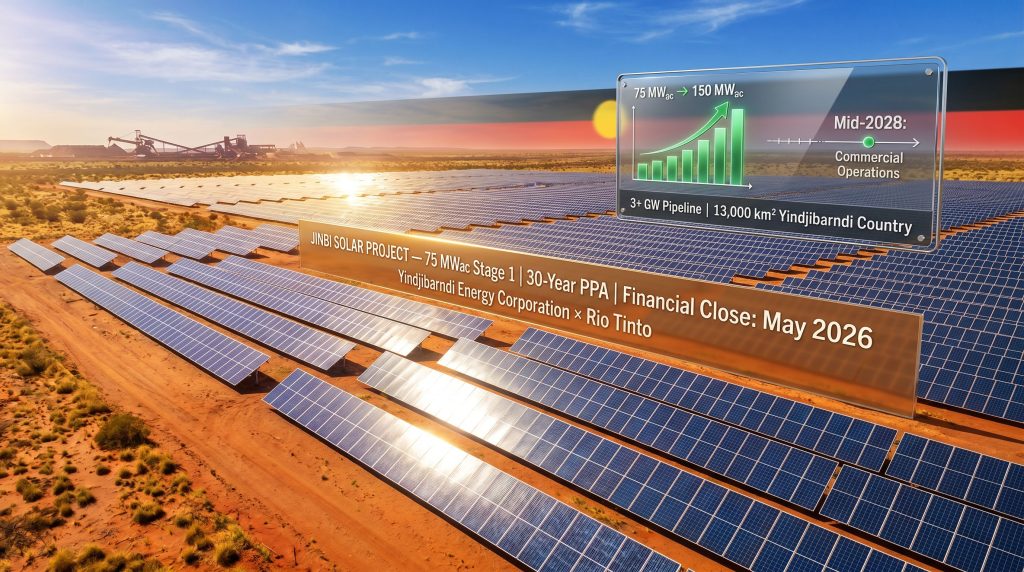
The Yindjibarndi Rio Tinto power purchase agreement, struck through the newly structured Yindjibarndi Energy Corporation (YEC), represents a shift in the economic logic of Indigenous participation in Australia's resources sector. It is not a compensation arrangement. It is a revenue-generating infrastructure business with a 30-year contracted income stream and a development pipeline that, if fully realised, could exceed 3 gigawatts of generation capacity across approximately 13,000 square kilometres of Yindjibarndi Country.
When big ASX news breaks, our subscribers know first
Understanding the Jinbi Solar Project: Specifications and Commercial Structure
The Jinbi Solar Project sits approximately 55 kilometres south of Karratha in Western Australia's iron ore heartland. Stage 1 is designed to deliver 75 megawatts (MWac) of solar generation capacity, with the entire output contracted to Rio Tinto's Pilbara iron ore operations under the terms of the PPA. The project has secured financial close as of May 2026, a critical milestone that formally unlocks construction financing and triggers notices to proceed for contractors.
Key project parameters are summarised below:
| Parameter | Detail |
|---|---|
| Location | ~55 km south of Karratha, Western Australia |
| Stage 1 Capacity | 75 MWac solar |
| Stage 2 Potential | Up to 150 MWac |
| Energy Storage | BESS under consideration (subject to approvals) |
| PPA Duration | 30 years |
| Offtaker | Rio Tinto |
| Financial Close | May 2026 |
| Target Commercial Operations | Mid-2028 |
| EPC Contractor | DT Infrastructure |
| Accommodation Provider | Rapid Camps |
DT Infrastructure has been engaged as the engineering, procurement, and construction contractor, while Rapid Camps will manage workforce accommodation logistics for a site located in one of Australia's most remote industrial corridors. With commercial operations targeted for mid-2028, the project operates on a construction window of approximately two years from financial close.
What Financial Close Actually Means for Project Delivery
In large-scale infrastructure development, financial close is not merely an accounting milestone. It represents the convergence of multiple complex financing conditions across debt providers, equity investors, regulatory approvals, and contractual frameworks. Before this point is reached, no construction dollars can be deployed and no binding contractor obligations can be enforced.
For the Jinbi project, achieving financial close required satisfying the following categories of conditions simultaneously:
- Debt financing commitments from project lenders willing to underwrite construction and operational risk
- Equity contributions from YEC's joint venture partners
- Execution of the PPA with Rio Tinto as the bankable offtake agreement
- Regulatory and environmental approvals to commence construction
- Contractor readiness, including the finalisation of EPC and accommodation agreements
The fact that YEC navigated all of these requirements simultaneously, as a newly established entity in a complex governance environment, speaks to the institutional sophistication of the partnership structure underpinning the project.
Who Is Yindjibarndi Energy Corporation and How Was It Structured?
YEC is a joint venture between Yindjibarndi Aboriginal Corporation (YAC), the peak representative body for the Yindjibarndi people who hold native title over a substantial portion of the western Pilbara, and ACEN Corporation, an international renewable energy developer headquartered in the Philippines with a growing footprint across the Asia-Pacific region.
The partnership was established roughly three years prior to the Jinbi project reaching financial close, meaning YEC was formed around 2023. This lead time reflects the genuine complexity of structuring Indigenous-led infrastructure in a regulated project finance environment. It is not unusual for renewable energy projects of this scale to require two to four years of pre-development work before reaching financial close, and projects involving native title land tenure add additional layers of legal and governance process.
Why the ACEN Partnership Brings Strategic Depth
ACEN Corporation brings several critical capabilities to the YEC structure that would be difficult for a community-based entity to assemble independently:
- International project finance expertise from developing utility-scale renewable projects across Southeast Asia and the Pacific
- Established relationships with infrastructure lenders and institutional equity providers
- Technical engineering and procurement capabilities relevant to large-scale solar development
- Experience navigating complex regulatory environments across multiple jurisdictions
This is a deliberate joint venture architecture. YAC contributes land tenure, community consent, and the sovereign legitimacy that makes Yindjibarndi Country a viable development platform. ACEN contributes the commercial and technical infrastructure required to convert that platform into a financeable, bankable energy business. Furthermore, renewable energy solutions in mining are increasingly being structured through exactly this kind of partnership model.
The transition from passive stakeholder to active energy producer is not merely symbolic. It restructures the economic relationship between a mining company and a Traditional Owner community at a fundamental level, shifting the Yindjibarndi people from recipients of land access payments to counterparties in a long-duration infrastructure contract.
How the 30-Year Yindjibarndi Rio Tinto Power Purchase Agreement Works
A power purchase agreement of this duration is structurally uncommon in Australian commercial energy markets, where most corporate PPAs span 10 to 15 years. A 30-year term is characteristic of infrastructure-grade agreements and serves specific commercial purposes for both parties.
For YEC as the seller, the extended term provides the long-dated revenue certainty that project finance lenders require before committing debt capital to a greenfield infrastructure project. Without a contracted revenue stream of sufficient duration, the risk profile of the project would not be financeable at commercially viable interest rates.
For Rio Tinto as the buyer, the agreement locks in a fixed or indexed cost of renewable energy over a period that encompasses multiple capital expenditure cycles for its Pilbara iron ore operations. This provides budget predictability and contributes directly to its Scope 1 and Scope 2 emissions reduction objectives by replacing fossil fuel-sourced power with contracted solar generation. Rio Tinto's green steelmaking ambitions, in addition, are closely aligned with procurement strategies of precisely this kind.
The Decarbonisation Imperative Driving Rio Tinto's Renewable Procurement Strategy
Rio Tinto's Pilbara iron ore operations represent one of Australia's most energy-intensive industrial clusters. For decades, power generation across the Pilbara relied heavily on natural gas-fired facilities, a legacy infrastructure approach increasingly incompatible with the emissions intensity reduction targets that major miners now face from institutional investors, ESG rating agencies, and their own board-level commitments.
Procuring renewable power through a third-party PPA rather than developing generation assets directly allows Rio Tinto to achieve several strategic objectives at once:
- Transfer construction and development risk to a specialist renewable energy developer
- Avoid significant upfront capital allocation to non-core energy infrastructure
- Demonstrate measurable progress on Pilbara decarbonisation commitments with contracted renewable volumes
- Achieve verifiable Scope 2 emissions reductions consistent with corporate sustainability reporting frameworks
This outsourced procurement model is increasingly standard among major miners globally, where decarbonisation in mining commitments are accelerating faster than in-house development capacity.
The Pilbara's Renewable Energy Transition: Scale and Context
The Pilbara's historical dependence on gas-fired power generation reflects the region's isolation from Australia's main electricity grids and the dominance of natural gas infrastructure developed to serve the LNG export sector. However, the economics of utility-scale solar in the Pilbara are now highly compelling. The region's solar irradiance levels rank among the highest in Australia, reducing the levelised cost of energy (LCOE) for photovoltaic generation to a point where it can competitively displace gas-fired power for large industrial consumers.
At 75 MWac in Stage 1, the Jinbi project is a meaningful but not outsized addition to the Pilbara's renewable energy mix. Its significance lies not in its immediate scale but in what it represents as a template. The project demonstrates that utility-scale solar can be developed, financed, and contracted in the Pilbara under an Indigenous ownership model, with a tier-one mining company as the offtaker. According to Renew Economy, the deal is already being recognised as a landmark moment for Indigenous-led renewable energy in Australia.
Stage 2 and Battery Energy Storage Systems: The Path to Firm Power
The potential expansion to 150 MWac under Stage 2 would double the project's generation footprint, subject to regulatory approvals that remain pending at this stage. More significant in commercial terms, however, is the consideration of Battery Energy Storage Systems (BESS) integration.
Solar generation is inherently intermittent. It produces power when the sun shines and nothing at night. For an industrial offtaker like Rio Tinto, which requires continuous power for processing, pumping, and operational systems, intermittency represents a material limitation of solar-only supply. BESS integration addresses this by storing excess generation during peak solar hours and dispatching it during periods of low or zero solar output.
The commercial logic of BESS integration in Pilbara solar projects can be summarised as follows:
| Challenge | Solar-Only | Solar + BESS |
|---|---|---|
| Nighttime supply | None | Dispatched from storage |
| Peak demand alignment | Partial | Programmable dispatch |
| Baseload equivalence | No | Partial to full, depending on storage duration |
| Lender bankability | Moderate | Higher (firmer revenue profile) |
| Emissions reduction scope | Daytime only | Extended operational hours |
A New Model for Indigenous Participation in Australia's Clean Energy Economy
The YEC structure inverts decades of conventional practice in the relationship between Indigenous communities and Australian resource companies. The traditional model centred on land access agreements, royalty distributions, and employment targets, each of which positioned communities as recipients of value generated by others. The Jinbi project's commercial architecture positions YEC as a long-term infrastructure operator, not a benefit-sharing participant.
This distinction carries profound implications for how Indigenous economic development is structured in future resource and energy projects. The comparison below illustrates the structural difference:
| Dimension | Conventional Arrangement | YEC / Jinbi Model |
|---|---|---|
| Community Role | Passive stakeholder | Active energy producer and PPA counterparty |
| Revenue Type | Land access payments or royalties | 30-year contracted energy revenue |
| Asset Ownership | None | Equity stake in energy infrastructure |
| Duration of Economic Benefit | Project-dependent | Multi-decade revenue stream |
| Scalability | Limited | 3+ GW pipeline, 13,000 km² development footprint |
| Commercial Counterparties | Mining company | Major miner as long-term offtaker |
The replicability of this model is one of its most consequential characteristics. The joint venture structure pairing an Indigenous land holder with an experienced international renewable developer offers a commercially viable template that other communities and developers could adapt. It requires neither government grants nor policy mandates to function; it requires a bankable land tenure, a willing development partner, and an industrial offtaker with a decarbonisation mandate. Consequently, Australia's green metals leadership ambitions are increasingly tied to whether models like this one can be replicated at scale.
Governance, Free Prior Informed Consent, and Dual Accountability
YEC operates under a dual accountability framework that distinguishes it from a standard commercial entity. On one side, it is accountable to Yindjibarndi community members as the ultimate beneficial stakeholders in the enterprise. On the other, it is accountable to ACEN Corporation as its commercial joint venture partner and to project finance lenders who require orthodox governance standards as a condition of debt deployment.
Maintaining Free, Prior, and Informed Consent (FPIC) principles throughout the construction and operational phases is both a legal obligation under Australian native title law and a reputational requirement for the long-term integrity of the project. Community consultation processes cannot be front-loaded to the development phase and then abandoned during construction. For projects of this duration and scale, they must be embedded as ongoing governance practices.
The next major ASX story will hit our subscribers first
Key Risks and Execution Challenges for the Jinbi Project
Despite the commercial and structural achievements represented by financial close, the Jinbi project faces execution risks that are material and worth understanding clearly.
Construction and Logistics Complexity
- Remote site logistics: A location 55 km south of Karratha introduces non-trivial supply chain, equipment transport, and workforce management complexity. Solar panels, inverters, transformers, and civil construction materials must travel through a limited road network to a remote site. Rapid Camps' engagement as accommodation provider directly addresses the workforce housing challenge.
- Construction timeline pressure: A mid-2028 commercial operations target gives the project approximately two years from financial close. For a 75 MWac facility in a remote environment, this is achievable but carries limited float. Any material delays in procurement, approvals, or construction sequencing could push commercial operations beyond the target date.
- Grid integration: Connecting utility-scale solar into the Pilbara's power network requires coordination with existing transmission infrastructure and network operators. This is a technical and regulatory process that can introduce schedule risk if not managed proactively from the outset.
Regulatory and Approval Dependencies
Stage 2 expansion to 150 MWac and the potential BESS integration remain subject to further regulatory approvals. This means the full commercial vision for Jinbi cannot be treated as a confirmed outcome. Investors and observers should distinguish clearly between Stage 1 (which has reached financial close and is under construction) and Stage 2 (which remains a development-phase initiative contingent on future regulatory outcomes). The growing demand for critical minerals and clean energy assets, however, is likely to support continued regulatory engagement as the energy transition accelerates.
Disclaimer: This article contains forward-looking statements and projections based on publicly available information. References to future capacity expansion, BESS integration, and commercial timelines are subject to regulatory approvals, financing conditions, and execution outcomes that cannot be guaranteed. This content does not constitute financial advice.
Frequently Asked Questions: Yindjibarndi Rio Tinto Power Purchase Agreement
What is the Yindjibarndi Rio Tinto power purchase agreement?
It is a 30-year agreement under which Yindjibarndi Energy Corporation will supply renewable solar energy to Rio Tinto's Pilbara iron ore operations. The deal underpins construction of the Jinbi Solar Project, located approximately 55 km south of Karratha in Western Australia, with Stage 1 delivering 75 MWac of solar generation capacity. Rio Tinto's official announcement provides further detail on the terms and strategic rationale behind the agreement.
When did the Jinbi Solar Project reach financial close?
Financial close was achieved in May 2026, at which point construction notices were issued to EPC contractor DT Infrastructure and accommodation provider Rapid Camps.
Who owns Yindjibarndi Energy Corporation?
YEC is a joint venture between Yindjibarndi Aboriginal Corporation, representing the Yindjibarndi people as Traditional Custodians of the land, and ACEN Corporation, an international renewable energy developer.
When will the Jinbi Solar Project begin generating power?
Commercial operations for Stage 1 are targeted for mid-2028.
What is the broader YEC energy pipeline?
YEC has outlined plans for more than 3 GW of solar, wind, and storage capacity across approximately 13,000 km² of Yindjibarndi Country in Western Australia's Pilbara region.
What the Yindjibarndi-Rio Tinto PPA Signals for Mining's Energy Future
The Jinbi Solar Project is commercially significant on multiple levels simultaneously. It validates Indigenous energy ownership as a viable infrastructure model at utility scale. It demonstrates that long-duration PPAs can serve as the foundational financing instrument for remote renewable projects serving major industrial consumers. Furthermore, it provides Rio Tinto with a contracted pathway to measurable Pilbara decarbonisation that avoids the capital intensity and development risk of building its own generation assets.
The strategic signals embedded in this single agreement extend well beyond one project:
- Indigenous communities can function as infrastructure operators with sovereign-grade corporate offtakers, not merely as passive recipients of resource revenues
- 30-year PPAs are becoming the preferred financing mechanism for remote renewable projects in Australia's mining regions, where energy certainty commands a premium
- The YEC development pipeline of 3+ GW positions Yindjibarndi Country as a potentially significant node in Australia's long-term renewable energy geography
- BESS integration will determine whether Pilbara solar assets can transition from intermittent generation to near-baseload supply, which will be the defining technical question for Stage 2 and beyond
- The joint venture model pairing Indigenous land tenure with an experienced international developer offers a commercially replicable structure that other communities and renewable developers may seek to adopt
The Pilbara has long been defined by what comes out of the ground. The Jinbi project introduces a new dimension: what can be harvested from above it.
Want to Identify the Next Major ASX Resource Discovery Before the Market Does?
Discovery Alert's proprietary Discovery IQ model scans ASX announcements in real time, delivering instant alerts on significant mineral discoveries across more than 30 commodities — giving investors a crucial edge in Australia's fast-moving resources sector, from iron ore to emerging clean energy minerals. Explore historic discoveries and their remarkable returns, then start your 14-day free trial at Discovery Alert to position yourself ahead of the market.