
June 15, 2026
When Global Supply Chains Break Down, Domestic Alternatives Become Strategic Necessities
Fertilizer markets rarely capture mainstream attention until something goes wrong. When global shipping corridors function smoothly, phosphate moves from mine to port to farm with little friction, and the structural vulnerabilities embedded in long-haul supply chains remain invisible. But when those corridors close, as has happened with the Strait of Hormuz in 2026, the fragility of import-dependent agricultural systems becomes impossible to ignore. Nowhere is this tension more apparent right now than in southern Brazil, where a confluence of geopolitical disruption, constrained port access, and seasonal planting urgency has transformed a regional phosphate development project from a long-term ambition into an immediate operational priority.
The Aguia Tres Estradas phosphate mine approval in Brazil has moved to the centre of that story.
When big ASX news breaks, our subscribers know first
The Supply Shock That Changed the Calculus
Brazil occupies a paradoxical position in global agriculture. As one of the world's largest exporters of soybeans, maize, and sugar, the country's agricultural productivity underpins global food supply in ways that few other nations can match. Yet Brazil has historically sourced a substantial portion of its phosphate fertilizer requirements from overseas, a pattern of fertilizer import dependence that leaves its farming sector exposed to exactly the kind of geopolitical disruption that has materialised in 2026.
The closure of the Strait of Hormuz has severed key phosphate import routes that previously connected Brazilian ports with Middle Eastern supply sources. For the Port of Rio Grande, the primary entry point for phosphate into southern Brazil, the practical consequences have been severe. Limited access to imported phosphate has created a supply gap arriving at the worst possible moment: precisely when farmers across Rio Grande do Sul are preparing their soils ahead of the summer planting season.
Southern Brazil is particularly exposed to these disruptions relative to other Brazilian regions. Its agricultural zones sit furthest from alternative domestic supply sources, making freight substitution complex, and its farming calendar leaves little room for extended procurement delays. When phosphate availability narrows, the cascading effects move quickly through the agricultural value chain, compressing soil preparation windows and threatening crop establishment timelines.
What makes this moment distinctive is that the supply shock has not created the demand for domestic phosphate alternatives so much as it has revealed a demand that was structurally latent all along. Projects positioned to fill that gap are now operating in a fundamentally different commercial environment than they were eighteen months ago.
What the Tres Estradas Project Actually Represents
Located within Rio Grande do Sul state, the Tres Estradas project sits in close geographic proximity to Brazil's primary southern agricultural zones. This positioning is not incidental. The project was conceived specifically to address southern Brazil's structural dependence on imported phosphate, and its mineral endowment provides a credible foundation for that ambition. Furthermore, the phosphate project development pathway at Tres Estradas offers a useful reference point for understanding how comparable projects navigate regulatory and commercial complexity.
The JORC-compliant resource base at Tres Estradas comprises the following:
| Resource Category | Tonnage | Grade (P₂O₅) |
|---|---|---|
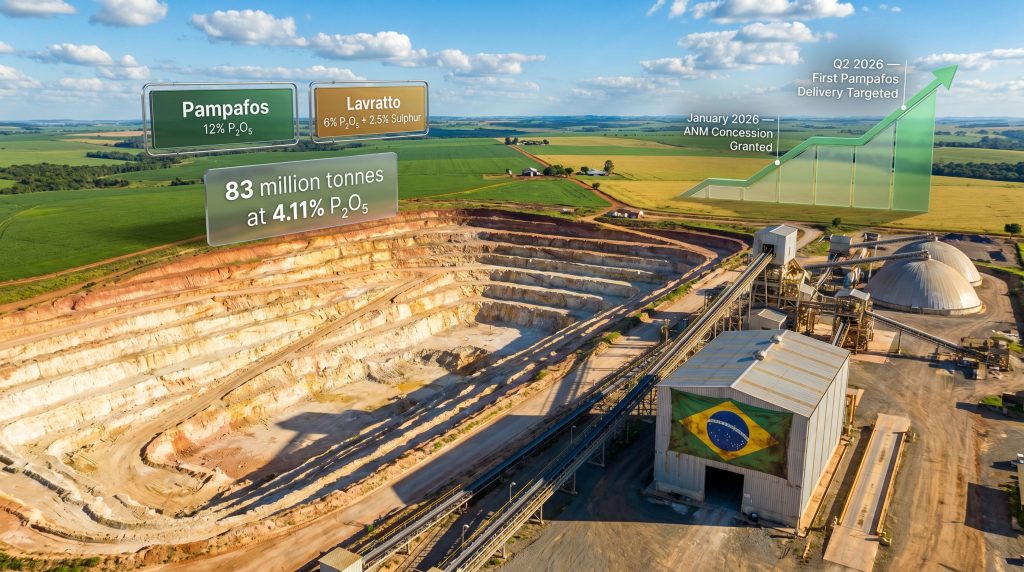
| Measured + Indicated | 83 million tonnes | 4.11% |
| Inferred | 21.8 million tonnes | 3.6% |
One characteristic of the Tres Estradas resource that carries significance beyond the tonnage figures is its low-cadmium phosphate classification. Cadmium is a toxic heavy metal that occurs naturally as a trace contaminant in many phosphate ores, and its presence has become an increasingly important regulatory and market consideration. The European Union has progressively tightened cadmium limits in phosphate fertilizers, and environmental scrutiny of cadmium-bearing products is intensifying globally. A low-cadmium resource not only reduces regulatory compliance risk but also positions the project favourably for any future export-oriented product strategy.
The Two-Product Commercial Architecture
Aguia Resources has structured the project around two distinct phosphate products, each targeting different segments of the southern Brazilian fertilizer market:
- Pampafos (12% P₂O₅): A higher-concentration phosphate product designed for immediate commercial deployment, with first deliveries targeted during the 2026 summer planting season
- Lavratto (6% P₂O₅ + 2.5% sulphur): A lower-concentration product incorporating sulphur as a secondary nutrient, designed to address specific soil chemistry requirements across the region's diverse farming areas, with commercial rollout planned for 2027
The inclusion of sulphur in Lavratto reflects a nuanced understanding of southern Brazilian soil profiles. Sulphur deficiency has been identified as an increasingly common constraint on crop productivity in Brazilian agricultural soils, particularly where long-term cropping systems have depleted native sulphur reserves. A combined phosphorus-sulphur product addresses two nutrient deficiencies simultaneously, which has practical appeal for farmers managing complex soil fertility programs.
The cost economics of local sourcing represent an additional structural advantage. Timothy Hosking, MD and CEO of Aguia Resources, has stated that farmers in the region stand to benefit not only from improved product availability but also from materially lower input costs, given that expensive international transport charges are eliminated when sourcing domestically (Mining Weekly, May 11, 2026). Imported phosphate arriving at Port of Rio Grande carries embedded freight costs, currency risk tied to USD-denominated contracts, and supply chain uncertainty. Domestically produced alternatives can structurally undercut that cost base regardless of where commodity prices sit in the cycle.
How Brazilian Mining Licensing Actually Works
Understanding the regulatory pathway for a project like Tres Estradas requires distinguishing between two parallel but distinct licensing frameworks that govern mining operations in Brazil. In addition, the broader mining permitting process involves navigating both federal and state-level requirements that must be satisfied sequentially.
The ANM Concession: Brazil's National Mining Agency, the Agência Nacional de Mineração (ANM), is the federal body responsible for granting mining concession licences. The ANM concession authorises the right to extract and commercialise mineral resources, but it does not, by itself, permit operations to commence. The Tres Estradas project received its ANM mining concession in January 2026, representing a significant regulatory milestone in the project's development history.
The FEPAM Operational Licence: Operating alongside the federal ANM framework, the Fundação Estadual de Proteção Ambiental Henrique Luís Roessler (FEPAM) is the state-level environmental protection authority for Rio Grande do Sul. FEPAM administers a multi-stage environmental licensing process that includes a preliminary licence, an installation licence, and finally an operational licence. All three stages must be completed before production can legally commence. The operational licence represents the final gating requirement before mining activities can begin.
This dual-layer regulatory structure means that federal and state approvals are sequential dependencies rather than parallel processes. Holding an ANM concession without a FEPAM operational licence does not enable production. As of early May 2026, Aguia holds the former and is in the final stages of obtaining the latter.
What FEPAM's Information Request Actually Signals
In the lead-up to issuing the operational licence, FEPAM requested supplementary documentation from Aguia. The specific items requested included:
- Updates to the project infrastructure schedule
- Changes to the land registry and environmental cadastre records
- Revised cartographic data and site layout information
- Alignment of environmental monitoring protocols with current requirements
- Minor additions to previously submitted documentation packages
Aguia submitted comprehensive responses to all of these requests on May 4, 2026, and the company anticipates receiving the operational licence within approximately three weeks of that submission (Mining Weekly, May 11, 2026).
Supplementary information requests of this nature are a standard procedural step in final-stage environmental licence reviews across Brazilian jurisdictions. They reflect an agency completing its due diligence checklist prior to issuing formal approval rather than signalling regulatory resistance or material project risk.
It is also worth noting that the project has navigated prior regulatory complexity. A legal challenge raised by a Federal Public Prosecutor in 2021, relating to the preliminary licence granted in 2019, has since been resolved, clearing the path for the current licensing stage to proceed.
The Regulatory Milestone Timeline
The sequencing of key milestones at Tres Estradas illustrates how systematically the project has progressed through its regulatory pathway:
| Milestone | Date | Status |
|---|---|---|
| Site declared operationally ready (infrastructure completion) | December 2025 | Completed |
| ANM mining concession granted | January 2026 | Completed |
| Environmental monitoring data submitted to FEPAM | January 2026 | Completed |
| Supplementary documentation submitted to FEPAM | May 4, 2026 | Completed |
| FEPAM operational licence (projected) | ~May 25, 2026 | Pending |
| First Pampafos product delivery targeted | Q2 2026 | Pending |
| Lavratto commercial rollout | 2027 | Planned |
Processing Infrastructure: Current Capacity and Expansion Pathway
The processing facility underpinning initial production is a leased plant sourced from Dagoberto Barcellos, currently operating at a capacity of 100,000 tonnes per year. Commissioning was targeted for late April to early May 2026, with minor outstanding items including weighbridge installation and ore storage extensions remaining to be completed at the time of the May 2026 reporting.
Critically, the facility has a documented upgrade pathway to 300,000 tonnes per year or more, providing a scalable production platform that can grow alongside market demand without requiring a full replacement of existing infrastructure. This phased capacity architecture reduces upfront capital risk while preserving the operational optionality to expand as offtake volumes increase.
Financing Structure and Development Backing
The project's financing structure offers a window into the institutional confidence that has developed around Tres Estradas. Brazil's Southern Development Bank, the Banco Regional de Desenvolvimento do Extremo Sul (BRDE), committed approximately A$4 million to the project in June 2025, structured as a 20-year term loan secured against the project's surface rights.
The BRDE is a Brazilian public development bank operating across the southern states of Rio Grande do Sul, Santa Catarina, and Paraná. Its mandate focuses on financing projects that generate regional economic development. A 20-year term commitment at project level reflects the bank's assessment of long-term commercial viability and is consistent with the type of patient capital that development bank frameworks are designed to deploy.
Complementing the debt financing, Aguia has secured offtake letters of intent from prospective customers in the southern Brazilian agricultural sector, indicating pre-committed commercial demand ahead of first production. The combination of secured development financing and offtake interest reduces the project's commercial risk profile meaningfully as it approaches the final regulatory approval stage.
The next major ASX story will hit our subscribers first
The Broader Import Substitution Economics
The economic case for domestic phosphate production in southern Brazil extends well beyond the individual farm gate. Phosphate imported through Port of Rio Grande carries a cost structure that includes ocean freight, port handling charges, inland transport to farm-level, and currency exposure embedded in USD-denominated purchase contracts. Each of these components adds cost that disappears when a locally produced alternative is available.
For farmers already managing thin operating margins in an environment of elevated input costs, a structurally cheaper and more reliably available phosphate source creates meaningful competitive advantage. This is particularly true during periods of global supply disruption, when import-dependent competitors face both higher costs and constrained access simultaneously. Consequently, the phosphate project economics of import substitution become increasingly compelling as geopolitical risk to supply chains persists.
From a national food security perspective, Brazil's reliance on imported fertilizer inputs to sustain one of the world's most productive agricultural export sectors has long represented a strategic vulnerability. Domestically produced phosphate reduces that vulnerability in a way that is geographically targeted to the regions most exposed to import disruption.
The agronomic dimension adds further complexity. Southern Brazilian soils present varying phosphorus status across different farming regions, and the two-product strategy at Tres Estradas reflects an awareness that a single product formulation cannot optimally address the full spectrum of soil chemistry conditions encountered across the state. The 12% P₂O₅ concentration in Pampafos suits soils requiring a more concentrated phosphorus application, while the 6% P₂O₅ plus sulphur formulation in Lavratto targets soils where multi-nutrient deficiency is the constraining factor on productivity.
Project Snapshot: Key Parameters at a Glance
| Parameter | Detail |
|---|---|
| Project Location | Rio Grande do Sul, Brazil |
| Operator | Aguia Resources (ASX: AGR) |
| JORC Resource (Measured + Indicated) | 83 million tonnes at 4.11% P₂O₅ |
| JORC Resource (Inferred) | 21.8 million tonnes at 3.6% P₂O₅ |
| Phosphate Classification | Low-cadmium |
| ANM Mining Concession | Granted January 2026 |
| FEPAM Licence Status | Pending; response submitted May 4, 2026 |
| Expected Approval Window | Approximately 3 weeks from May 4, 2026 |
| First Product (Pampafos) | Targeted Q2 2026 |
| Second Product (Lavratto) | Targeted 2027 |
| Processing Capacity (Initial) | 100,000 tonnes per year |
| Processing Capacity (Post-Upgrade) | 300,000+ tonnes per year |
| Development Finance | ~A$4 million BRDE loan (20-year term) |
Frequently Asked Questions
What is the current approval status of the Tres Estradas mine?
As of May 2026, Aguia Resources has submitted all supplementary documentation requested by FEPAM and anticipates receiving the operational licence within approximately three weeks of the May 4 submission date. The ANM federal mining concession was already granted in January 2026. A definitive feasibility study underpins the project's technical and commercial foundations, providing the analytical rigour that major licensing bodies and financiers typically require before committing to project approval.
What phosphate products will Tres Estradas produce?
Two products are planned. Pampafos, containing 12% P₂O₅, is targeted for delivery during 2026. Lavratto, containing 6% P₂O₅ combined with 2.5% sulphur to address multi-nutrient deficiencies, is scheduled for commercial launch in 2027.
Why is southern Brazil facing a phosphate shortage right now?
A combination of restricted access through the Strait of Hormuz, which has cut off key Middle Eastern phosphate supply routes, and constrained operational conditions at the Port of Rio Grande has created a significant phosphate supply gap across the region precisely as the summer planting season approaches. However, Brazilian phosphate demand continues to build, reinforcing the urgency of domestic production alternatives like the Aguia Tres Estradas phosphate mine approval in Brazil.
Has the project encountered historical regulatory obstacles?
A legal challenge from a Federal Public Prosecutor in 2021, relating to the 2019 preliminary licence, was raised but has since been resolved. The project has continued advancing through the subsequent licensing stages, culminating in the current final-stage FEPAM operational licence review.
What does the low-cadmium classification mean for the project?
Phosphate ores frequently contain cadmium as a trace contaminant, and international regulatory frameworks are progressively tightening permissible cadmium levels in phosphate fertilizer products. A low-cadmium resource reduces future regulatory compliance risk and may enhance the project's positioning for any export-oriented product development.
This article contains forward-looking statements and projections based on publicly available information as of May 2026. Regulatory timelines, product launch dates, production capacity figures, and financial details are subject to change and should not be relied upon as investment advice. Readers should conduct independent due diligence and consult qualified financial advisers before making any investment decisions related to ASX-listed entities or the broader phosphate sector.
Want to Stay Ahead of Significant ASX Mineral Discoveries Before the Broader Market?
Discovery Alert's proprietary Discovery IQ model delivers real-time alerts on significant ASX mineral discoveries — including resource developments across the fertiliser and agricultural minerals sector — instantly transforming complex data into actionable investment insights for both traders and long-term investors. Explore historic examples of major discoveries and their returns, then begin your 14-day free trial to position yourself ahead of the market.