June 8, 2026
The Skills Gap Threatening Heavy Industry's Technology Revolution
The most sophisticated autonomous mining equipment ever built is only as effective as the workers tasked with operating, maintaining, and troubleshooting it. Across the global mining, construction, and energy sectors, a quiet crisis has been building for years: the accelerating pace of industrial technology adoption has fundamentally outrun the workforce development systems designed to support it. Automation in mining, electrification, AI-driven diagnostics, and connected equipment ecosystems are no longer emerging concepts — they are operational realities on mine sites around the world. Yet the human infrastructure needed to sustain them remains critically underdeveloped.
This structural mismatch between technology deployment and workforce readiness is the problem that the Caterpillar Building the Future Workforce Challenge is specifically designed to address — and the scale of the company's financial commitment signals just how seriously the sector's most influential equipment manufacturer views this challenge.
When big ASX news breaks, our subscribers know first
What Is the Caterpillar Building the Future Workforce Challenge?
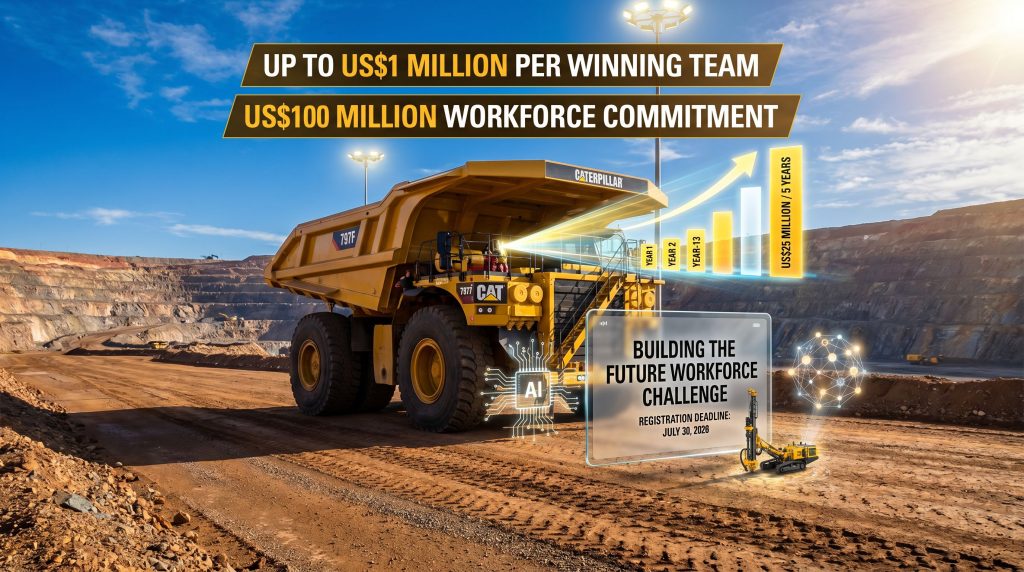
Launched in May 2026, the Caterpillar Building the Future Workforce Challenge is a global open innovation competition offering up to US$1 million per winning organisation to teams that can develop, propose, and pilot scalable solutions for attracting, retaining, and upskilling workers in advanced manufacturing and technician roles. The competition is open to both nonprofit and for-profit organisations worldwide, making it one of the most accessible large-scale workforce innovation challenges in the industrial sector.
The initiative was first previewed at the CES 2026 keynote by Caterpillar Chairman and CEO Joe Creed, and forms a central pillar of the company's previously announced five-year, US$100 million workforce development commitment. The challenge itself draws on US$25 million of that broader pledge across its full five-year lifecycle, with up to US$5 million available to distribute among winning teams in year one alone.
The competition is administered by CARROT, a platform specialising in open innovation and social impact challenges, and operates through a structured application process with defined eligibility criteria, milestone dates, and pilot testing requirements.
Competition Structure at a Glance
| Feature | Detail |
|---|---|
| Year-One Prize Pool | Up to US$5 million |
| Maximum Award Per Team | Up to US$1 million |
| Maximum Winning Teams (Year One) | Up to 5 |
| Pilot Implementation Period | Maximum 2 years |
| Five-Year Challenge Allocation | US$25 million |
| Parent Workforce Commitment | US$100 million over 5 years |
| Registration Opened | May 7, 2026 |
| Registration Deadline | July 30, 2026 (5:00 PM US Eastern Time) |
| Finalist Announcement | Expected early 2027 |
| Competition Operator | CARROT |
| Eligible Applicants | Global nonprofit and for-profit organisations |
Why Heavy Industry Is Facing a Human Capital Crisis
Understanding why a company of Caterpillar's scale is investing this heavily in external workforce innovation requires an appreciation of what has changed across mining, construction, and energy operations over the past decade — and how fast that change is accelerating.
The traditional model of industrial workforce development was built around relatively stable technology platforms. Apprenticeship programmes, trade certificates, and vocational curricula were designed for environments where the core mechanical competencies of a role changed slowly over years or decades. That model is now structurally misaligned with reality.
The Technology Vectors Driving the Skills Gap
Four distinct technology transitions are simultaneously creating new competency requirements across the heavy equipment workforce:
- The electrification of mining fleets is demanding knowledge of high-voltage battery systems, charging infrastructure, and fundamentally different drivetrain architectures that bear little resemblance to diesel-mechanical systems
- Autonomous and remote operations are shifting the role of frontline workers from direct mechanical interaction with equipment to digitally mediated supervision, fault diagnosis, and systems monitoring functions
- Predictive maintenance in mining platforms powered by AI require workers to interpret sensor data, understand algorithm-driven maintenance recommendations, and make decisions based on analytical outputs rather than physical inspection alone
- Connected equipment ecosystems introduce baseline requirements around data interpretation, network awareness, and increasingly, cybersecurity fundamentals — competencies that have historically sat outside the trade training domain entirely
The compounding effect of these transitions is that the skills profile of an equipment technician in 2026 looks fundamentally different from that role as recently as 2018. Traditional apprenticeship and vocational education frameworks were not designed for an environment where the technological foundation of a role transforms this rapidly.
Geography as a Structural Barrier
The challenge is further amplified by a geographic mismatch that is unique to the mining sector. Mining operations are disproportionately concentrated in remote or economically underserved regions, precisely the communities least likely to have access to high-quality technical training infrastructure. A mine deploying autonomous haulage systems in a remote location cannot rely on a nearby community college offering courses calibrated to that technology.
At the same time, the sector is experiencing accelerating attrition as experienced tradespeople reach retirement age, compressing the knowledge transfer window and removing the institutional memory that has historically compensated for formal training gaps.
Industry groups and equipment manufacturers have increasingly identified workforce readiness as a tier-one strategic constraint — one with the potential to limit technology adoption timelines and project delivery performance across the resource sector in ways comparable to permitting delays or commodity price volatility.
How the Challenge Works: Eligibility, Requirements, and Process
The Caterpillar Building the Future Workforce Challenge is structured as a competitive pilot-funding programme rather than a grant or donation mechanism. This distinction matters: Caterpillar is not simply funding workforce programmes that already exist; it is seeking to identify, test, and scale new approaches that have not yet been proven at the operational level.
Who Can Apply?
The eligibility framework is deliberately broad:
- Both nonprofit and for-profit organisations from anywhere in the world are eligible to participate
- Applicants must designate a Lead Organisation responsible for managing awarded funds and maintaining programme accountability throughout the pilot period
- Proposed solutions must be capable of being piloted and tested within select Caterpillar facilities and partner communities — a requirement that prioritises operational feasibility over theoretical design
- A readiness quiz and supporting application resources are available through the CARROT platform at buildingthefuture.carrot.net, with general programme information at caterpillarbuildingthefuture.org
The Lead Organisation requirement is worth examining more closely. It creates a clear governance structure and implies that winning proposals must demonstrate institutional capacity — not just innovative ideas. Organisations applying need to be able to manage multi-year programme administration, financial reporting, and multi-stakeholder coordination over the maximum two-year pilot period.
What Solutions Are Being Sought?
Caterpillar has identified two primary domains for qualifying proposals:
1. Upskilling and Reskilling Existing Workers
- Technical skill pathways aligned specifically to advanced manufacturing and equipment technician roles in technology-intensive environments
- Leadership and career mobility frameworks that enable workers to transition into higher-complexity supervisory or technical roles as operational technology evolves
- Modular, portable, or digitally delivered training formats capable of reaching workers in geographically dispersed or remote locations
2. Attracting and Retaining New Talent Pipelines
- Innovative recruitment strategies with demonstrated reach into underrepresented and underserved communities
- Retention frameworks that go beyond wage competitiveness to address career progression visibility, workplace culture, and community connection
- Durable partnerships between industry, educators, and community organisations capable of sustaining talent development ecosystems beyond the pilot period
A consistent requirement across both categories is sustainability and adaptability. Caterpillar has made clear that it is not seeking one-time training events or static curriculum updates. Solutions must be architecturally designed to evolve alongside successive generations of industrial technology — a requirement that reflects the understanding that today's skills gaps will be replaced by tomorrow's, and solutions need to be built to address that ongoing dynamic.
Caterpillar's Broader Workforce Investment: Context and Scale
The Caterpillar Building the Future Workforce Challenge does not exist in isolation. It is one component of a five-year, US$100 million workforce development commitment announced by Caterpillar in 2025 — a commitment that positions the company as one of the most financially engaged original equipment manufacturers in the industrial sector on the question of human capital development.
Of that US$100 million total, US$25 million is specifically designated for the challenge across its five-year lifecycle. The year-one distribution of up to US$5 million across a maximum of five winning teams represents a deliberate approach: rather than concentrating funding in a single flagship initiative or building a proprietary internal training programme, Caterpillar is using competitive funding to generate a diversified portfolio of real-world pilot programmes that can be evaluated, compared, and potentially scaled.
Caterpillar's existing infrastructure matters here. The company's established STEM education partnerships in underserved communities and regional university collaborations provide deployment networks through which winning proposals can be tested. This means the challenge is not asking winners to build implementation infrastructure from scratch — it is connecting innovative approaches to an existing, partially-built ecosystem.
Caterpillar's Chief Human Resources Officer, Christy Pambianchi, has described the initiative as reflecting a shared responsibility across industry, educators, and innovators to ensure that workers are prepared for the future of work. The challenge is presented not as a unilateral corporate intervention but as an open invitation for external innovation to address a problem that no single organisation can solve independently.
Why This Matters Specifically for the Mining Sector
Mining occupies a unique position within the landscape of industries affected by this workforce challenge. Unlike urban-centric sectors where skilled labour pools and training infrastructure are relatively accessible, mining operations face a convergence of pressures that amplifies the skills gap problem in sector-specific ways.
The Two-Tier Workforce Risk in Mining
Mining's accelerating deployment of autonomous haulage, AI in mining operations such as AI-assisted drill optimisation, remote operations centres, and real-time equipment health monitoring is creating what can be described as a two-tier workforce risk:
- Experienced workers who built careers around mechanical and electrical competencies face displacement risk if reskilling pathways are not developed alongside technology adoption timelines
- New entrants to the sector face an entry barrier that grows higher with each technology cycle, as foundational competency requirements expand to include digital, analytical, and data-oriented skills alongside traditional trade knowledge
Neither tier can be addressed effectively through conventional recruitment or standard trade training. This is precisely why Caterpillar's model of funding external innovation rather than attempting to solve the problem internally is strategically significant. Equipment manufacturers operate the machinery at the centre of this challenge, and their certification and training ecosystems directly shape which competencies become industry standards. When an OEM of Caterpillar's scale signals that existing approaches are insufficient and invites the broader innovation ecosystem to propose alternatives, it carries substantial weight across the sector.
Open Innovation as Industry Signal
The choice to operate the challenge through CARROT — an external open innovation platform — rather than through Caterpillar's internal training and development function is itself a meaningful signal. It communicates that the most effective solutions to this problem are likely to come from unexpected sources: community organisations, educational technology companies, social enterprises, or cross-sector partnerships that have not traditionally operated within the heavy equipment training ecosystem.
Furthermore, this openness reflects a broader shift in how industrial companies are approaching structural challenges that exceed their internal capacity to solve. Consequently, the workforce crisis in mining and heavy industry is not a problem that any single operator, OEM, training provider, or government programme can address in isolation. It requires the kind of collaborative, multi-stakeholder innovation architecture that competitive challenges are specifically designed to generate. Indeed, data-driven mining operations increasingly underscore just how urgent this human capital challenge has become.
The next major ASX story will hit our subscribers first
Key Dates and How to Apply
Organisations interested in competing for the Caterpillar Building the Future Workforce Challenge should note the following critical timeline:
- Competition first announced: CES 2026 keynote by Caterpillar Chairman and CEO Joe Creed
- Registration opened: May 7, 2026
- Registration deadline: July 30, 2026 at 5:00 PM US Eastern Time
- Finalist announcements: Expected early 2027
- Pilot implementation: Maximum two-year period for winning teams
Applications and supporting resources are available through the CARROT platform at buildingthefuture.carrot.net. General programme information is accessible at caterpillarbuildingthefuture.org.
Disclaimer: This article is intended for informational purposes only and does not constitute financial or investment advice. Information relating to competition structure, prize amounts, and timelines is sourced from publicly available reporting by the Canadian Mining Journal (May 11, 2026) and Caterpillar's official communications. Readers are encouraged to verify all application details through Caterpillar's official programme resources before making decisions based on the content of this article.
Want to Know Which ASX Mining Companies Are Leading the Technology Revolution?
As the mining sector races to close the skills gap and deploy next-generation autonomous, electrified, and AI-driven equipment, the companies successfully navigating this transition often represent compelling investment opportunities — and Discovery Alert's proprietary Discovery IQ model delivers real-time alerts the moment significant ASX mineral discoveries are announced, ensuring subscribers can act on actionable insights ahead of the broader market. Explore historic discoveries and their remarkable returns on Discovery Alert's dedicated discoveries page, or start your 14-day free trial today to secure a market-leading edge.