May 12, 2026
When a Single Facility Holds an Entire Industry's Nerve
There are moments in industrial history when the fate of one facility reveals something far larger about the structural fragility of a nation's manufacturing base. The search for a Liberty Bell Bay smelter buyer is one of those moments. Tasmania's Bell Bay precinct hosts the only manganese smelting operation on the Australian continent, and its administration process has exposed a convergence of private credit risk, workforce vulnerability, and strategic supply chain dependence that extends well beyond the island state's borders.
Understanding why this situation matters requires stepping back from the day-to-day drama of wage packages and offer deadlines, and examining the deeper industrial architecture that makes ferromanganese production irreplaceable within Australian steelmaking supply chains.
When big ASX news breaks, our subscribers know first
What Liberty Bell Bay Actually Produces and Why It Cannot Simply Be Replaced
Ferromanganese is not a niche commodity. It is a fundamental input in steel production, functioning as both a deoxidising agent and a structural strengthener in the steelmaking process. Every tonne of steel produced requires manganese in some form, and the high-carbon ferromanganese variant produced at Bell Bay represents the most commonly used grade in blast furnace and electric arc furnace operations alike.
What makes Australia's dependence on Liberty Bell Bay particularly acute is the absence of any alternative domestic smelting capacity. If the facility closes permanently, Australian steel producers face a binary choice: absorb higher costs through imported ferromanganese, primarily sourced from South Africa, China, and Norway, or restructure procurement relationships with longer lead times and greater currency exposure. Furthermore, South African ferroalloys supply represents one of the dominant alternatives, making any disruption to domestic production a matter of serious strategic concern.
The ore feedstock for ferromanganese production is manganese ore, typically graded at 35% to 48% Mn content for standard smelting grades, with higher-purity sources commanding premium positioning in global markets. Australia's Groote Eylandt deposit in the Northern Territory, operated by South32, represents one of the highest-grade manganese ore resources globally, with ore grades regularly exceeding 48% Mn. The geographic irony of Australia exporting premium manganese ore offshore while its only domestic smelter struggles for survival illustrates the disconnect between upstream resource wealth and downstream processing capability. Indeed, this challenge is reflected in broader steel market trends that continue to shape investment decisions across the sector.
The Ore Delivery Paradox: What Deeper Structural Issues the Collapse Revealed
The chronology of Liberty Bell Bay's deterioration contains a detail that industry specialists find particularly revealing. When GFG Alliance cited raw material supply constraints as the reason for halted production in early 2025, the Tasmanian government responded by approving a $20 million loan to facilitate ore procurement. The rationale was straightforward: if supply is the problem, fund the supply.
The ore arrived. Production did not resume.
Professor Jason Harris, a corporate and insolvency law specialist at the University of Sydney, observed that this sequence pointed to operational challenges well beyond feedstock availability. His analysis suggested the facility faced systemic problems that the ore financing decision could not address, meaning the structural issues predated and outweighed the supply constraint narrative that had been publicly presented.
This distinction matters enormously for prospective buyers. A facility that failed to restart despite ore delivery is not simply a business that needed working capital. It is potentially a business requiring significant capital expenditure on equipment rehabilitation, environmental compliance upgrades, or workforce restructuring before commercial production can resume. Each of these factors directly affects the acquisition price any rational buyer would offer and the timeline before any return on invested capital becomes achievable.
A Timeline of Decline: From Caretaker Mode to Administration
The progression from functional operation to voluntary administration followed a pattern that insolvency specialists would recognise as characteristic of large industrial companies with complex creditor structures.
| Date | Event |
|---|---|
| May 2025 | Facility enters caretaker mode following GFG Alliance collapse |
| August 8, 2025 | White Oak chairman Tom Otte contacts Tasmanian Resources Minister Felix Ellis regarding viability scenarios |
| August 19, 2025 | Second outreach from Otte, facilitated via EY, to arrange in-person meeting |
| August 25, 2025 | In-person meeting held between White Oak and government representatives |
| August 26, 2025 | Minister announces $20 million ore procurement loan to GFG Alliance |
| January 2026 | State government determines GFG has defaulted on the $20 million loan; Deloitte appointed as receivers over ore stockpile |
| March 23, 2026 | EY appointed as voluntary administrator |
| April 21, 2026 | 175 of 216 workers face ultimatum: leave without pay or redundancy |
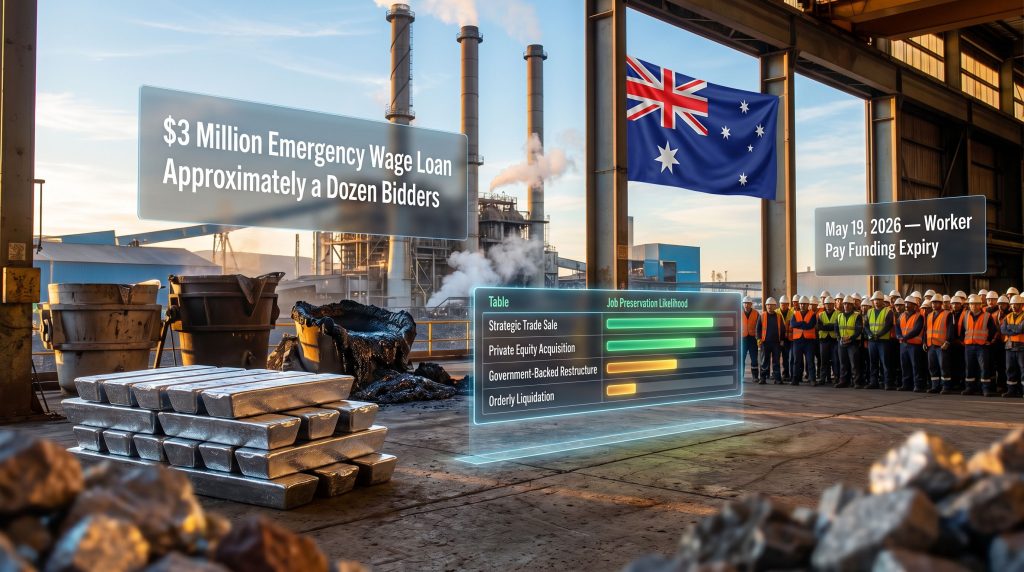
| April 22, 2026 | Joint $3 million emergency wage loan announced by state and federal governments on a 50/50 basis |
| April 29, 2026 | ASIC withdraws wind-up proceedings |
| May 9, 2026 | Non-binding indicative offer window closes |
| May 19, 2026 | Worker pay funding expiry deadline |
The August 2025 sequence is particularly instructive. Freedom of information documents obtained by ABC News revealed that White Oak's North Carolina-based chairman Tom Otte had already been engaging Tasmanian government officials for several months before his August 8 correspondence with Minister Ellis. His written communication to the Minister outlined multiple scenarios under which White Oak could work alongside the Tasmanian government to support ongoing smelter operations and return the facility to viability, while emphasising the urgency of the financial commitments the business was facing at that time.
The following day after the August 25 meeting, the Minister announced the $20 million ore loan. The proximity of those events does not establish causation, but it does illustrate how closely the secured lender's strategic positioning was aligned with subsequent government financing decisions.
White Oak Global Advisors: The Secured Lender Now Shaping the Outcome
The role of White Oak Global Advisors in this situation represents a case study in how secured creditors in modern industrial insolvency situations retain substantial influence over asset disposition outcomes, even when formal administration is underway.
White Oak, a US-based private credit and advisory firm, assumed control of GFG Alliance's secured lending position over Liberty Bell Bay and subsequently directed the appointment of EY as voluntary administrators. This sequencing is not unusual in distressed asset situations, but it has important implications for understanding the incentive structure guiding the sale process.
A secured creditor with a priority claim over asset proceeds has fundamentally different interests from unsecured creditors, employees, or government stakeholders. Their preference is typically recovery of the outstanding secured debt, which may or may not align with preserving operational continuity, workforce retention, or community economic outcomes.
Professor Harris noted that early meetings between secured lenders and government representatives are not only common but expected in distressed situations involving strategically significant employers. His assessment was that such engagement reflects appropriate conduct for governments seeking to prevent major regional employers from collapsing entirely. The key distinction, which the Freedom of Information documents illuminate, is that this engagement was occurring as early as August 2025, well before the formal administration timeline that became public knowledge.
How Many Buyers Have Expressed Interest?
Approximately a dozen parties submitted non-binding indicative offers ahead of the May 9, 2026 deadline, with interest spanning both domestic and international potential acquirers. The breadth of that interest is encouraging from an outcome perspective, but the non-binding nature of these submissions means administrators and stakeholders must wait for the next stage before assessing genuine financial commitment.
What a Non-Binding Indicative Offer Actually Means in Practice
A non-binding indicative offer (NBIO) is a structured expression of acquisition intent that outlines a proposed price range and key commercial terms without creating any legal obligation for the submitting party. In industrial insolvency sale processes, NBIOs serve as a screening mechanism, allowing administrators to identify which parties possess the financial capacity, operational capability, and strategic rationale to progress to a binding offer stage.
The submission of a dozen NBIOs does not guarantee that any will convert to binding proposals. Prospective buyers must first complete due diligence on a range of complex variables, including:
- The capital expenditure required to return the facility to full operational capacity
- Manganese ore supply chain security and long-term feedstock availability, noting the role of South32's Groote Eylandt operations as a potential domestic supply source. In addition, a strategic manganese deposit elsewhere in the supply chain could further influence long-term sourcing strategy
- The industrial relations landscape and workforce retention obligations attached to any acquisition
- Environmental compliance costs and regulatory requirements associated with smelting operations
- The trajectory of global ferromanganese pricing and downstream steel sector demand signals
- Whether any government co-investment or transitional support arrangements remain available post-acquisition. Mining beneficiation strategies in other jurisdictions offer useful comparative context for how such arrangements can be structured
The next major ASX story will hit our subscribers first
The Worker Entitlement Crisis and the Pay Cliff
For the 175 workers directly caught in the administration process, the financial mechanics of the sale timeline have created a deeply precarious situation. The jointly funded $3 million emergency wage loan, split equally between the Tasmanian and federal governments, provided approximately three weeks of wage coverage from its April 22 announcement, with funding expiring on May 19, 2026.
Australian Workers' Union Assistant National Secretary Chris Donovan articulated the fundamental problem with managing a large industrial workforce on rolling short-term funding cycles. His position was that while the initial $3 million commitment represented a necessary intervention, it failed to address the underlying instability, and that workers should not be placed in the position of questioning their employment status with each passing week.
A union delegation travelled to Canberra in the days following the NBIO deadline, seeking a longer-term funding commitment that would allow workers and their families to plan financially while the sale process progressed toward binding offers and due diligence.
The psychological cost of week-by-week employment uncertainty is difficult to quantify but well-documented in occupational health literature. For workers in remote or regionally concentrated industrial settings, where alternative comparable employment is limited, the anxiety of rolling uncertainty compounds the financial stress in ways that damage community cohesion and workforce retention simultaneously.
The Four Realistic Pathways Forward
The sale process could resolve in several distinct ways, each with materially different consequences for workers, government finances, and Australian industrial supply chains.
| Pathway | Job Preservation Likelihood | Estimated Timeline | Government Exposure | Complexity |
|---|---|---|---|---|
| Strategic Trade Sale to Industrial Buyer | High | 3 to 6 months | Low to Medium | Medium |
| Private Equity Consortium Acquisition | Medium | 4 to 8 months | Low | High |
| Government-Backed Restructure | Medium to High | 6 to 12 months | High | Very High |
| Orderly Wind-Down and Asset Liquidation | None | 2 to 4 months | Low | Low |
The most commercially attractive outcome from a workforce preservation perspective is acquisition by a strategic trade buyer, specifically an integrated steelmaker or specialty metals producer with existing ferromanganese offtake requirements and the operational expertise to manage a restart. Such a buyer would benefit from access to established smelting infrastructure without greenfield development costs, proximity to domestic ore sources, and existing workforce expertise in the facility's specific processes. Furthermore, the Butcherbird manganese expansion in Western Australia highlights the growing appetite for manganese processing investment in Australia, which may attract additional strategic interest.
Private equity acquisition introduces more uncertainty around operational intentions and timelines, as financial sponsors typically target returns over defined investment horizons that may not align with long-term industrial community expectations.
A government-backed restructure or partial nationalisation scenario would preserve jobs but carries significant fiscal risk and political complexity, particularly given that the $20 million ore loan already represents a taxpayer exposure that ended in default.
Orderly liquidation remains the outcome that all parties publicly claim to be working against, but it becomes more probable with each passing week that the funding gap remains unresolved and buyer confidence erodes.
Why ASIC's Withdrawal of Wind-Up Proceedings Changed the Dynamics
The April 29 decision by the Australian Securities and Investments Commission to discontinue wind-up proceedings against Liberty Bell Bay removed a material legal obstacle that had been clouding the sale process. Wind-up proceedings, if successful, would have forced an immediate and compulsory dissolution of the entity rather than an orderly administration, eliminating the possibility of a going-concern sale and triggering immediate job losses.
ASIC's decision to step back created the legal breathing room necessary for EY to conduct a proper sale campaign. For prospective buyers, it also removed the risk that a competing legal process could accelerate asset disposition in a manner that disrupted due diligence timelines or complicated title transfer arrangements.
ASIC's action against GFG Alliance and the subsequent withdrawal of proceedings marked a pivotal moment in the administration timeline. ASIC's broader investigation into Sanjeev Gupta's Australian operations continues in parallel, with multiple matters under examination across the collapsed portfolio. The Liberty Bell Bay situation represents one node in a significantly larger corporate failure with ramifications across multiple Australian states and industry sectors.
What the Manganese Market Outlook Means for Acquisition Attractiveness
Global manganese market dynamics are relevant context for understanding why international interest in the Liberty Bell Bay smelter buyer process exists alongside domestic bidders. Ferromanganese demand is fundamentally correlated with crude steel production volumes, and with global steel output remaining elevated despite periodic demand softness in China, underlying ferromanganese consumption has held at levels that support viable smelter economics when operating costs are controlled.
The geographic concentration of global ferromanganese production in a small number of producing countries, primarily South Africa, China, Norway, and Georgia, creates periodic supply vulnerability for steel producers seeking supply chain diversification. An Australian facility, backed by domestic high-grade ore from resources like Groote Eylandt, offers a geographically differentiated supply source that carries strategic value for buyers concerned about concentrated import dependency.
For any acquirer able to secure ore supply agreements with South32 and achieve operational restart, the facility's competitive position within the regional supply landscape would be structurally sound. The key unknowns remain the capital cost of rehabilitation and the timeline to reach stable full-capacity production.
Frequently Asked Questions About the Liberty Bell Bay Smelter Sale
Who currently controls Liberty Bell Bay?
Following GFG Alliance's collapse, US-based private credit firm White Oak assumed the secured lending position over the facility and directed the appointment of EY as voluntary administrators in late March 2026.
How many workers are affected by the administration?
Approximately 175 workers out of a total 216-strong workforce were directly affected by the administration ultimatum issued in April 2026.
What happens if no Liberty Bell Bay smelter buyer is found?
An orderly liquidation of assets becomes the most probable outcome, resulting in permanent closure of Australia's only manganese smelting operation and the loss of all remaining positions at the facility.
Has government committed to a long-term rescue?
Both the Tasmanian and federal governments provided emergency wage funding totalling $3 million on a 50/50 cost-sharing basis. Neither government has committed to a long-term rescue package beyond facilitating a commercial sale outcome.
What is ferromanganese and why does its domestic production matter?
Ferromanganese is a manganese-iron alloy used as a deoxidising and strengthening agent in steelmaking. Losing Australia's only domestic production facility would increase import dependency and expose domestic steel producers to additional supply chain and currency risks.
Why did ASIC drop its case?
ASIC's withdrawal of wind-up proceedings on April 29, 2026 removed a legal mechanism that could have forced immediate closure, giving administrators the necessary runway to complete a sale process.
What the Liberty Bell Bay Crisis Reveals About Industrial Insolvency in Australia
The Liberty Bell Bay smelter buyer search distils several systemic tensions that recur in Australian industrial insolvency cases involving strategic assets. The first is the conflict between secured creditor rights and public interest outcomes, where a private lender's contractual priority positions it to control the disposition of an asset with significant community consequences. The second is the limitation of emergency wage support as a policy tool: it addresses immediate financial distress without resolving the underlying commercial uncertainty that drives that distress.
The third, and perhaps most instructive, tension is between the upstream resource wealth Australia possesses in commodities like high-grade manganese ore and the downstream processing capability the country has failed to sustain. Bell Bay's smelter situation is a microcosm of a structural pattern visible across multiple Australian commodity sectors, where raw materials are exported and processed products are reimported at higher cost.
Whether the search for a Liberty Bell Bay smelter buyer produces a viable commercial outcome will depend on whether prospective acquirers see a rehabilitation opportunity with recoverable economics, or a distressed facility with structural liabilities that outweigh its strategic appeal. The administrators, the secured lender, and the two levels of government involved are all working toward the same nominal outcome, though with different tolerances for risk, loss, and timeline. That alignment of stated intent, without alignment of underlying incentives, is precisely what makes this situation as complex as it is consequential.
This article is based on publicly available information including reporting by ABC News investigative reporter Paddy Manning (published May 11, 2026). It does not constitute financial or investment advice. Forward-looking scenarios and outcome projections involve inherent uncertainty and should not be relied upon as predictions of actual events.
Want To Stay Ahead of Significant ASX Mineral Discoveries Before the Broader Market?
Discovery Alert's proprietary Discovery IQ model delivers real-time alerts on significant ASX mineral discoveries — including manganese and other strategic commodities central to Australia's industrial supply chain — instantly empowering subscribers to identify actionable opportunities ahead of the broader market. Explore historic examples of exceptional discovery returns or begin your 14-day free trial today to secure your market-leading advantage.