June 15, 2026
When Risk Management Becomes the Difference Between a Project That Gets Built and One That Doesn't
In capital-intensive industries, the difference between a project reaching financial close and one stalling indefinitely often comes down to a single factor: whether the risk architecture surrounding that project is sophisticated enough to satisfy lenders, regulators, and equity partners simultaneously. Across the global resources and energy sectors, this dynamic is playing out with increasing intensity. Insurance is no longer a back-office line item. It has become a structural prerequisite for project viability, sitting at the intersection of finance, engineering, environmental compliance, and geopolitical strategy.
Chile sits at the centre of this shift. The country's combined pipeline of mining and energy investment has reached a scale that few Latin American economies can match, and the complexity of risks embedded in those projects demands a level of insurance sophistication that was simply not required a decade ago. Understanding why seguros para proyectos mineros y energéticos en Chile have become a strategic priority requires examining not just the volume of capital at stake, but the nature of the risks converging on these assets simultaneously.
When big ASX news breaks, our subscribers know first
The Investment Pipeline Reshaping Chile's Risk Landscape
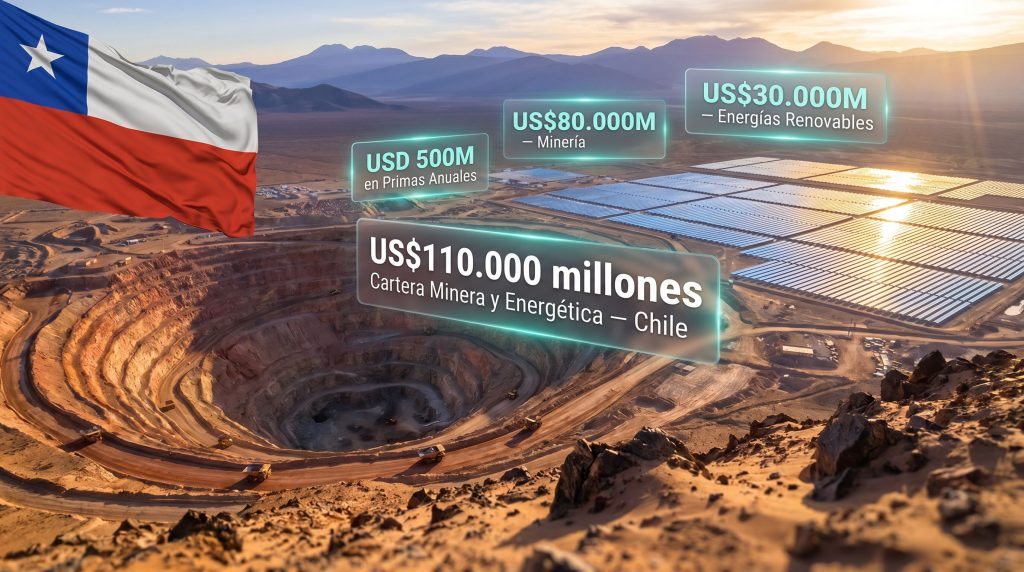
Chile's mining sector is carrying a project portfolio that exceeds US$80 billion toward 2032, according to data from COCHILCO, Chile's copper commission. The energy sector adds a further US$30 billion, concentrated in renewable generation and transmission infrastructure. The combined figure of more than US$110 billion in active and planned investment positions Chile as one of the most significant project finance markets in the Latin American region.
What makes this investment cycle structurally different from previous ones is not merely its scale, but its technological and geographic complexity. Modern mining projects in Chile are larger, more automated, and more deeply embedded in remote Andean terrain than at any previous point in the industry's history. Renewable energy installations, particularly utility-scale solar farms in the Atacama Desert, introduce entirely different risk profiles tied to weather parametrics, grid interconnection, and long-duration offtake agreements.
This complexity has made insurance program design a core competency for project developers, not an afterthought. International lenders operating in Chilean project finance markets routinely require comprehensive risk transfer structures as a condition precedent to disbursement. Without those structures in place, projects cannot access competitive financing terms, regardless of their technical merits or resource quality.
What the Numbers Reveal About Market Scale
The specialised insurance market serving Chile's mining and energy sectors generates an estimated USD 500 million in annual premiums, reflecting the depth and operational complexity of the assets requiring coverage. This figure positions the segment as one of the most significant within Chile's broader insurance industry.
| Segment | Estimated Investment | Time Horizon | Primary Insurable Risks |
|---|---|---|---|
| Mining Portfolio (COCHILCO data) | US$80 billion | Through 2032 | Property, business interruption, environmental liability |
| Renewables and Transmission | US$30 billion | 2025-2030 | Construction, equipment, parametric climate |
| Combined Total | US$110 billion | Medium term | Integrated risk portfolio |
Furthermore, several forces are simultaneously amplifying demand for specialised coverage:
- Project scale has increased substantially, expanding the total insurable value of individual assets well beyond what domestic insurance markets can absorb alone.
- ESG compliance requirements from institutional investors and multilateral lenders now embed insurance obligations that previously existed only as optional best practice.
- The growing participation of international equity partners and lenders in Chilean project finance means that insurance programs must meet standards set in London, New York, and Zurich, not only Santiago.
- Replacement cost inflation, running at approximately 4% annually in the current global energy shock environment, continuously erodes the adequacy of static sum insured figures, requiring regular program reviews.
Five Converging Risks That Are Rewriting Insurance Terms in Chile
Geopolitical Instability and the Supply Chain Realignment
The geopolitical risk in mining environment surrounding Chile's investment cycle has shifted dramatically. Escalating conflict in the Middle East pushed Brent crude to US$107.67 per barrel on May 11, 2026, with prices approaching US$120 per barrel in the weeks prior, representing an increase of approximately US$43 over the preceding year. For mining and energy operations with significant diesel and fuel oil exposure, this price environment materially elevates operating costs and creates logistical vulnerabilities.
The broader consequence of this instability is a reordering of global supply chains. Critical inputs for large infrastructure projects, including semiconductors, industrial helium, and agricultural chemicals, are being rerouted through what analysts describe as "friendshoring" networks. Consequently, trade wars and supply chains are directly reshaping procurement strategies, redirecting sourcing toward geopolitically aligned suppliers rather than lowest-cost sources. For insurance underwriters, this introduces new territorial risk exposures in transit and cargo policies, particularly where exclusion clauses have not been updated to reflect current routing realities.
The interaction between elevated oil prices and supply chain fragmentation creates a compounding risk for long-duration projects: cost overruns during construction phases can trigger project delays that themselves generate business interruption losses, cascading across multiple policy layers simultaneously.
The Structural Water Crisis Facing Chilean Operations
Chile's hydrological situation represents one of the most significant and underappreciated risk factors for mining and energy operators. The flow of the Río Maipo, a critical water source for central Chile's industrial corridor, has registered a historical reduction of 56%, reflecting not a cyclical drought pattern but a structural decline in water availability driven by long-term climate shifts and Andean glacier retreat.
For mining operations dependent on water-intensive processing methods, and for hydroelectric generation that relies on consistent upstream flow, this deterioration creates operational continuity risks that conventional property and business interruption policies were not designed to address efficiently. The loss demonstration requirements of traditional indemnity-based policies introduce delays precisely when operators need rapid liquidity support to manage production disruptions.
Parametric insurance products are the insurance industry's direct response to this challenge. Unlike conventional coverage, these products activate payment automatically when an objectively measurable index, such as reservoir levels, precipitation volumes, or river flow rates, crosses a predefined threshold. No damage assessment is required, and claim payments can be triggered within days rather than months. For operations in northern Chile where water scarcity is a permanent operating condition, parametric structures represent a fundamental advance in risk transfer design.
Seismic and Geographic Extremes Across the Cordillera
Chile's position along the Pacific Ring of Fire makes seismic risk a baseline underwriting consideration for every mining or energy asset in the country. High-altitude operations in the Andes face compounded exposure: seismic activity, flash flooding from sudden glacial melt events, and the logistical isolation that makes damage assessment and equipment replacement substantially more time-consuming than at lower-altitude facilities.
All Risks Property policies for Chilean mining operations typically require several technical features that reflect this environment:
- Automatic reinstatement clauses that restore policy limits following a paid claim without requiring renegotiation, critical in high-frequency seismic zones.
- Additional expenses coverage that funds the incremental costs of emergency operations, temporary equipment hire, and accelerated logistics following a seismic event.
- Extended debris removal provisions that account for the volume of displaced material in high-altitude landslide and aluvión scenarios.
- Suppliers extension endorsements that protect revenue when upstream damage to processing facilities or power infrastructure interrupts mine output even if the mine itself is undamaged.
Digital Transformation, AI Adoption, and the Emerging Cyber Threat Surface
The digitalisation of Chilean mining and energy operations has accelerated sharply. Survey data indicates that 86% of corporate leaders in Chile increased their investment in artificial intelligence through 2026, deploying predictive maintenance systems, autonomous equipment management platforms, and remote monitoring infrastructure across their operational footprints.
This technological advancement simultaneously reduces certain categories of physical risk while creating entirely new cyber exposure. Industrial control systems, known as SCADA and ICS platforms, manage the physical processes of mineral processing plants, solar generation facilities, and power transmission infrastructure. A successful cyberattack on these systems can cause physical equipment damage, operational shutdowns, and environmental incidents, producing losses that span property, business interruption, and liability policies concurrently.
Specialised cyber insurance for critical infrastructure, designed specifically for OT/IT convergent environments rather than conventional IT networks, is transitioning from an optional supplementary coverage to a core program requirement. The distinction matters technically: standard cyber policies designed for commercial IT environments often exclude physical damage arising from cyber events, leaving industrial operators exposed to their most significant cyber-related loss scenarios.
Environmental Liability and the Long Tail of Operational Risk
Expanding environmental legislation in Chile and internationally is creating liability exposures that extend decades beyond the operational life of a project. Accidental contamination of underground aquifers, tailings storage facility failures, and closure liability for residual site conditions represent loss scenarios that can materialise long after an asset has been decommissioned.
Standard general liability policies are not structured to address these temporal dynamics. Environmental liability products with extended discovery periods, sometimes spanning 10 to 30 years beyond policy expiry, are required to provide meaningful protection against these latent exposures. As ESG scrutiny of mining and energy assets intensifies among institutional investors, directors and senior executives face growing personal liability risks tied to environmental governance decisions. In addition, natural capital in mining considerations are increasingly shaping how insurers assess long-term environmental exposure, reinforcing demand for Directors and Officers coverage alongside operational liability structures.
A Coverage Framework for Mining and Energy Projects in Chile
Construction Phase: Where Risk Density Is Highest
The construction and installation phase of a major mining or energy project concentrates the greatest volume of risk into the shortest period of the project lifecycle. Key coverages during this phase include:
- Construction and Erection All Risks (CAR/EAR): Covers civil works, equipment, and materials against accidental physical damage throughout the build and installation period, including testing and commissioning phases.
- Performance and Advance Payment Bonds: Guarantee contractor compliance with the terms of the principal construction contract and protect against the financial consequences of contractor insolvency during critical build phases. A solar project such as the US$90 million Bastián Solar facility in the O'Higgins Region, for example, would face severe schedule and cost consequences if its principal contractor failed during mounting operations without bond protection in place.
- Construction Third Party Liability: Provides coverage for bodily injury and property damage claims arising from construction activities, including exposure to sub-contractors and adjacent third parties.
Operational Phase: Protecting Revenue and Asset Value
Once a project reaches commercial operation, the insurance program's focus shifts toward protecting the cash flows and physical assets that service debt and generate returns for equity investors.
| Coverage | Function | Specific Relevance |
|---|---|---|
| All Risks Property | Physical damage protection for installed assets and structures | Essential in seismically active and remote zones |
| Business Interruption (BI) | Revenue replacement during covered downtime | Critical for high-throughput copper and lithium operations |
| Machinery and Mobile Equipment | Coverage for heavy equipment fleets | Core requirement in open-pit and underground mining |
| Machinery Breakdown | Mechanical and electrical failure not covered by property | Complements property coverage for processing equipment |
| Stock and Inventory | Ore stockpiles, concentrates, and consumables in transit | Increasingly relevant given volatile commodity price impacts |
Liability and Third-Party Exposures
- General and Employers Liability: Statutory requirements in Chile mandate minimum coverage levels for operations employing contractors and permanent staff. Major mining operators including Codelco, BHP, and Antofagasta Minerals typically impose contractual limits substantially above the legal minimum.
- Cross Liability: Protects consortium members or joint venture partners from reciprocal claims within a shared project structure, an increasingly relevant consideration as project complexity grows.
- Environmental Impairment Liability: Covers remediation costs and third-party claims arising from gradual or sudden pollution events, with discovery periods calibrated to match the latency of environmental damage.
- Directors and Officers (D&O): With ESG regulatory scrutiny intensifying, executives face personal exposure for governance decisions related to environmental compliance, water use, and community relations, making D&O coverage a first-order requirement rather than a discretionary addition.
Emerging and Next-Generation Coverage Products
- Parametric Climate Products: Trigger automatic indemnity payments based on measured meteorological or hydrological indicators, eliminating the loss adjustment delay that undermines the utility of traditional coverage during acute operational disruptions.
- Cyber Insurance for Critical Infrastructure: Specifically architected for OT environments, covering physical damage arising from cyber incidents, system recovery costs, and business interruption caused by process control system compromise.
- Political Risk and Structured Credit: Relevant for projects with international financing or those located in areas of elevated community sensitivity, covering expropriation, contract frustration, and currency transfer risks.
- Green Hydrogen and Emerging Technology Coverage: A nascent but rapidly developing product category addressing the specific risks of electrolyser equipment, compressed hydrogen storage systems, and green energy export logistics. This reflects Chile's significant ambitions in the hydrogen sector, which are closely tied to critical minerals and energy security objectives at a national level.
How to Structure an Insurance Program for a Major Chilean Project
The Strategic Role of a Specialist Broker
The function of a specialist mining and energy insurance broker extends considerably beyond policy placement. In the context of large Chilean projects, the broker's value proposition includes several distinct technical contributions:
- Technical risk engineering: Independent quantification of project-specific exposures, including probabilistic loss modelling for seismic and hydrological scenarios.
- Coverage architecture design: Structuring a modular program that eliminates coverage gaps between construction, commissioning, and operational phases, including clear treatment of the handover period where both CAR/EAR and operational property policies may need to overlap.
- International reinsurance market access: For projects valued above approximately US$100 million, domestic Chilean insurance capacity is insufficient to retain the full risk exposure. Brokers with global networks distribute these risks across specialist markets in London's Lloyd's market, Zurich, Singapore, and New York.
- Claims advocacy and management: Technical representation during the claims process, engaging with adjusters and engineering experts to maximise recovery under the specific policy terms negotiated.
- Continuous program maintenance: Annual review of insured values against inflation, scope changes, and regulatory developments, ensuring the program remains adequate throughout the project's operational life.
Specialist insurers such as Marsh's mining and energy practice provide the kind of global technical capability and reinsurance market access that large Chilean projects increasingly demand, particularly where international lenders are involved.
Selecting the Right Insurance Partner: Key Evaluation Criteria
| Criterion | Why It Matters |
|---|---|
| Sector-specific technical experience | Mining and energy risk differs fundamentally from general commercial insurance |
| International reinsurance market access | Required for projects above domestic capacity thresholds |
| In-house risk engineering capability | Independent technical assessment improves program design quality |
| Complex claims management track record | Verifiable outcomes from large-scale loss events provide due diligence evidence |
| CMF regulatory knowledge | Chilean financial regulator compliance affects policy admissibility for financing purposes |
Mining vs. Renewables: How Insurance Needs Differ Across Chile's Two Major Investment Sectors
| Dimension | Mining Project | Renewable Energy Project |
|---|---|---|
| Dominant risk | Structural collapse, operational interruption, environmental liability | Climatic damage, electronic equipment failure, grid connectivity |
| Typical coverage duration | 10-25 years (mine life) | 20-30 years (concession term) |
| Average insured value | High (US$500M to US$5B+) | Medium-high (US$50M to US$500M) |
| Most demanded products | Property, BI, environmental liability, D&O | CAR/EAR, parametric climate, cyber |
| Reinsurance requirement | Essential for all major operations | Recommended for projects above US$100M |
| ESG insurance dimension | Closure liability, tailings management | Intrinsically aligned with green finance standards |
A critical and often overlooked distinction between the two sectors involves the timing of peak risk exposure. Mining projects carry their highest loss frequency during the operational phase, when processing equipment, underground workings, and tailings infrastructure are under continuous mechanical stress. Renewable energy projects, conversely, face their greatest single-event loss exposure during the construction and commissioning phase. For operators seeking specialised renewable energy insurance, Howden's energy and mining division offers tailored solutions for both construction and long-term operational phases across Chile's energy sector.
This asymmetry has direct implications for insurance budget allocation and the sequencing of coverage procurement. Developers who treat both sectors identically are systematically under-insuring one phase or the other.
The next major ASX story will hit our subscribers first
The Inflation Problem That Most Project Operators Underestimate
One of the most persistent and underappreciated risks in long-duration project insurance is the erosion of insured values by construction cost inflation. With global inflation running at approximately 4% annually in the current energy price environment, a project whose insured value was accurately assessed at financial close can be materially underinsured within three to five years if the sum insured is not regularly reviewed and adjusted.
For a mining project with a replacement value of US$1 billion at construction completion, a 4% annual erosion of real insured value means the effective insurance gap reaches approximately US$216 million within five years if no upward adjustment is made. In the event of a major loss during that window, the co-insurance penalty applied by the insurer for underinsurance can dramatically reduce actual claim recovery, precisely at the moment when the operator is most financially stressed.
Insurance programs for Chilean mining and energy projects should incorporate automatic indexation provisions that adjust insured values annually in line with published construction cost indices, removing the risk that administrative inertia creates significant coverage shortfalls over time.
Regular independent asset valuations, ideally conducted by engineering firms with sector-specific expertise in Chilean mining and renewable energy infrastructure, provide the empirical foundation for maintaining adequate sum insured levels throughout the project lifecycle. This is not a discretionary governance practice; for projects with international project finance debt, it is typically a lender covenant requirement. Ensuring that seguros para proyectos mineros y energéticos en Chile are reviewed and updated regularly is, consequently, as much a financial compliance obligation as it is a risk management best practice.
This article presents general information about insurance structures and risk management frameworks applicable to mining and energy projects. It does not constitute financial, legal, or insurance advice. Specific insurance requirements for individual projects should be assessed by qualified specialists familiar with the project's particular technical, geographic, regulatory, and financial characteristics. Statistics and market figures referenced reflect information available at the time of writing and are subject to change.
Want to Stay Ahead of Significant ASX Mineral Discoveries the Moment They Hit the Market?
Discovery Alert's proprietary Discovery IQ model delivers real-time alerts on major ASX mineral discoveries, transforming complex resource data into actionable investment insights for traders and long-term investors alike — explore the historic returns major discoveries have generated to understand the opportunity, and begin your 14-day free trial at Discovery Alert to position yourself ahead of the broader market.