August 6, 2026
The Physics of Lifting More Than You Weigh: Why Drone Engineering Is Hitting a Wall
Every mechanical system that lifts something off the ground must first carry itself. That fundamental constraint has defined aviation engineering for over a century, and it remains the core tension inside every unmanned aircraft design lab operating today. The heavier your aircraft, the more power you need. The more power you need, the heavier your power source. And the heavier your power source, the less capacity remains for the thing you actually want to carry. Breaking this cycle without violating the laws of physics is not a software problem or a design preference. It is one of the most demanding unsolved challenges in aerospace engineering.
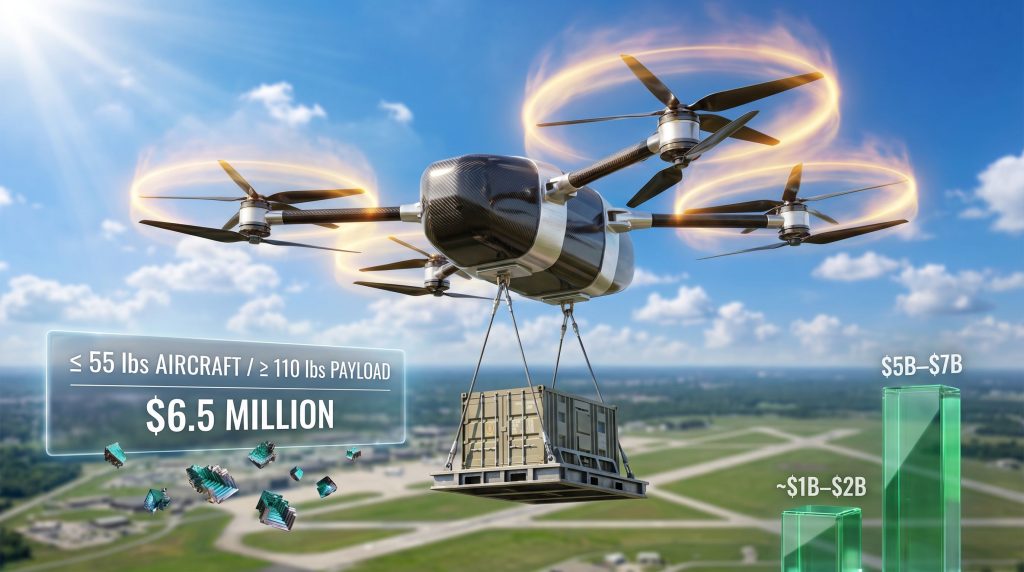
That is precisely the problem DARPA decided to formalise in 2025 with a competition structure, a prize pool, and a ticking clock. The result is the DARPA Lift Challenge, a $6.5 million contest that asks competitors to build a vertical-takeoff-and-landing unmanned aircraft weighing no more than 55 pounds that can carry a minimum of 110 pounds across a 5-nautical-mile course. The payload-to-weight ratio that implies, exceeding 2:1 at minimum and targeting 4:1 or beyond, sits well above the threshold most conventional multirotor architectures can achieve. Competing for that prize is PyroDelta Energy Corp., an 83%-owned subsidiary of Canadian-listed First Tellurium Corp. (CSE: FTEL | OTC: FSTTF), applying a solid-state thermoelectric power generation platform to a problem that has stumped far larger organisations.
Disclaimer: This article contains forward-looking statements and speculative analysis regarding technology performance, market projections, and commercial outcomes. None of this constitutes financial or investment advice. Investors should conduct their own due diligence before making any investment decisions.
When big ASX news breaks, our subscribers know first
Understanding the DARPA Lift Challenge: What the Numbers Actually Demand
The technical bar set by the DARPA Lift Challenge is worth examining in granular detail, because the challenge specifications are not arbitrary. Each parameter exists to eliminate solutions that look impressive on paper but fail in realistic operating conditions.
| Competition Parameter | Requirement |
|---|---|
| Maximum aircraft weight (including power source) | 55 lbs |
| Minimum payload carried | 110 lbs |
| Required payload-to-weight ratio | Greater than 2:1 (targeting 4:1+) |
| Total course distance | 5 nautical miles |
| Loaded flight leg | 4 miles |
| Unloaded return leg | 1 mile |
| Maximum flight time | Under 30 minutes |
| Operating altitude | 350 ft |
The loaded leg distance of 4 miles matters as much as the payload ratio. A drone that can briefly hover with a 110-pound load achieves nothing operationally useful. Maintaining controlled flight, stability, and energy efficiency across a 4-mile loaded run while keeping total aircraft weight below 55 pounds is a systems integration challenge of the highest order.
Regulatory prerequisites add a further filter before any aircraft can even reach the start line. Competing teams must secure FAA Part 107 certification, obtain experimental airworthiness approval, and hold commercial drone licensing. These are not formalities. They are substantive regulatory hurdles that eliminate underprepared entrants well before the August trials.
Why the 2:1 Threshold Transforms Drone Utility
The distinction between a drone carrying roughly its own weight and one carrying twice that amount is not simply a matter of degree. It represents a categorical shift in operational applicability.
Below the 2:1 threshold, heavy-lift drones occupy a niche role in specialised cargo operations. Above it, the economics change entirely. Military forward resupply becomes viable in terrain where ground vehicles cannot operate. Humanitarian relief drops into disaster zones become faster and more scalable. Construction and energy sector equipment delivery shifts from helicopter-dependent logistics to autonomous aerial transport. The DARPA Lift Challenge is structured to find designs that cross this threshold, and the prize structure reflects the genuine difficulty of doing so.
PyroDelta's Four-Pillar Technical Strategy for the PyroDelta DARPA Lift Challenge
PyroDelta's approach to the PyroDelta DARPA Lift Challenge does not rest on a single breakthrough. The engineering architecture the company has developed over roughly six months of intensive development integrates four interdependent improvements that compound each other's effectiveness.
-
Thermoelectric power generation — A lightweight, solid-state generator that harvests thermal gradients produced by propeller airflow and converts them into supplementary electrical output, extending effective flight range without adding mechanical complexity.
-
Advanced rotor design — Modifications to rotor geometry and configuration that improve the relationship between lift generated and power consumed, directly addressing the efficiency losses that cap conventional multirotor payload capacity.
-
Structural weight reduction — Material and design choices that minimise airframe mass, preserving the weight budget for payload rather than the aircraft itself.
-
Transmission optimisation — Drivetrain refinements that reduce energy losses between the power source and the rotors, recovering usable energy that conventional architectures waste as heat.
What makes this architecture strategically interesting is the interaction between pillars. Weight reduction increases the payload ceiling directly. Rotor efficiency improvements reduce the power demand for a given lift figure, which in turn reduces the required generator size, which further reduces weight. Transmission optimisation feeds additional power to the rotors without requiring a larger power source. Each improvement amplifies the others rather than operating in isolation.
How Propeller Airflow Becomes Electricity
The thermoelectric generator at the centre of PyroDelta's design deserves particular technical attention because the core mechanism is counterintuitive. When a propeller spins, it does not just generate lift. It creates localised temperature differentials between the airstream it accelerates and the surrounding structural surfaces of the aircraft. These temperature gradients are normally a wasted byproduct of flight.
PyroDelta's system captures these thermal differentials and routes them through solid-state thermoelectric modules. The underlying physics is the Seebeck effect: when two dissimilar semiconductor materials are joined and exposed to a temperature gradient, electron flow across the junction produces a measurable and usable electrical voltage. No turbines. No moving parts. No additional rotating components that add vibration, maintenance requirements, or failure modes.
The semiconductor material enabling this conversion is bismuth telluride (Bi₂Te₃), the dominant thermoelectric compound for near-room-temperature applications and the material class where PyroDelta's technology sits. Bismuth telluride's electronic band structure makes it exceptionally effective at converting modest thermal gradients — the kind that propeller operation generates — into electrical output.
The Capillary Casting Difference
PyroDelta's modules are manufactured through a patent-pending Capillary Casting process that the company developed initially for automotive waste heat recovery and emergency power generation applications before redirecting the technology toward aerospace. The manufacturing approach is designed to produce thermoelectric modules with weight and form-factor characteristics that conventional TEG fabrication methods cannot match.
In aerospace power systems, every gram of generator weight is a gram subtracted from the payload ceiling. The practical implication of Capillary Casting is not abstract. A thermoelectric module that delivers equivalent power output at lower mass directly increases the competition-relevant payload-to-weight ratio. Third-party testing clarification milestones reached in October 2025 provided an early credibility signal for the technology before the DARPA submission was filed.
Why Tellurium Is the Critical Material Underpinning This Technology
The material science behind PyroDelta's generator connects directly to a supply chain dimension that extends well beyond drone technology. Tellurium, the element at the heart of bismuth telluride thermoelectric modules, is classified as a critical mineral by multiple governments, including the United States Geological Survey, due to its supply concentration and strategic applications. Furthermore, the surging critical minerals demand across defence and technology sectors has intensified focus on materials like tellurium that sit at the intersection of both.
Global tellurium production is predominantly a byproduct of copper refining rather than primary mining, which creates inherent supply constraints. Output scales with copper production volumes and investment decisions made for entirely different economic reasons. This structural supply limitation is one reason governments have specifically identified tellurium in critical mineral frameworks.
For PyroDelta and its parent company First Tellurium Corp., this supply dynamic is not incidental. The company's name and strategic positioning reflect an explicit focus on tellurium as both a material input and a broader investment thesis. Bismuth telluride thermoelectric modules are not experimental curiosities — they already underpin established applications across automotive waste heat recovery, industrial process monitoring, and remote sensor power systems. What PyroDelta is advancing is the integration of this proven material science into aerospace power architectures where the weight constraints are uniquely demanding.
It is worth understanding that tellurium operates in a different supply dynamic than battery metals like lithium or cobalt. Because it is not mined primarily for its own value, supply cannot be rapidly scaled in response to rising demand from new application sectors like thermoelectric aerospace power.
Comparing Power Architectures: Where Thermoelectric Generation Fits
The PyroDelta DARPA Lift Challenge entry sits within a competitive field where multiple power generation strategies are in play. Understanding where thermoelectric generation sits relative to alternatives clarifies both its advantages and its constraints.
| Power Strategy | Key Advantage | Key Limitation |
|---|---|---|
| Lithium battery only | Simplicity, no emissions | Energy density ceiling limits endurance |
| Hydrogen fuel cell | High gravimetric energy density | Storage infrastructure and complexity |
| Internal combustion engine | High sustained power output | Mechanical complexity, vibration |
| TEG and battery hybrid | Continuous generation, no moving parts | Requires sustained thermal gradient |
| TEG with airflow harvesting | Leverages existing operational heat sources | Novel architecture, limited large-scale field validation |
The thermoelectric approach does not replace stored energy. It adds a continuous generation layer on top of it. Where a battery-only architecture gradually depletes its energy reserve from the moment of takeoff, a TEG-integrated system generates electricity throughout the flight, effectively extending the energy budget without increasing stored capacity or total aircraft mass in proportion.
This architectural difference is particularly relevant to the DARPA competition's 4-mile loaded flight leg. Endurance under load, not just peak lift, determines whether a design is operationally viable.
Submission Status and What Happens Next
PyroDelta has cleared every pre-competition regulatory and documentation milestone ahead of the August trials. The company has filed its Final Concept Paper, engineering drawings, photographs, and UAS certification with both DARPA and the Federal Aviation Administration. Registration for the competition closed May 1, 2026.
The remaining pre-event requirement is a video demonstration of the drone in operation, scheduled for mid-May 2026, after which PyroDelta advances to the live competition phase. For further detail on the submission process and competition structure, the official challenge overview provides a comprehensive breakdown of DARPA's requirements and judging criteria.
PyroDelta's Head Engineer Michael Abdelmaseh confirmed that the team has met the competition's demanding technical specifications, including the benchmark of lifting more than twice the drone's own weight, describing the standards as extremely demanding while affirming complete readiness to compete at Wright-Patterson Air Force Base, Ohio, during the August trial window.
Key Dates at a Glance
| Milestone | Date |
|---|---|
| DARPA Lift Challenge launched | 2025 |
| Third-party technology testing clarification | October 2025 |
| PyroDelta development program initiated | Approximately November 2025 |
| Competition registration closed | May 1, 2026 |
| Final Concept Paper, drawings, and UAS certification filed | May 2026 |
| Video demonstration to DARPA | Mid-May 2026 |
| Live trials at Wright-Patterson AFB, Ohio | August 2–9, 2026 |
The next major ASX story will hit our subscribers first
The Commercial and Defense Market Context
The strategic timing of PyroDelta's entry reflects a broader market acceleration that has made heavy-lift drone capability a high-priority development target. Demand for heavy-lift unmanned aircraft is projected to grow from roughly $1 billion to $2 billion at present to an estimated $5 billion to $7 billion over the next decade, driven by the convergence of several application sectors simultaneously reaching scale.
The primary demand drivers include:
- Military forward logistics — Autonomous resupply into contested environments where manned vehicles present unacceptable risk
- Humanitarian operations — Rapid aerial delivery into disaster zones where road infrastructure has been compromised
- Construction and infrastructure — Equipment transport to elevated or otherwise inaccessible work sites
- Energy sector operations — Component delivery to remote installations across oil, gas, and renewable energy infrastructure
- Agricultural supply chains — Input delivery and harvest support in regions with limited ground transport networks
The conflict-driven urgency around autonomous aerial resupply has sharpened defence sector interest considerably. Demonstrated performance at a DARPA competition translates into a validated technical record that defence acquisition programmes can reference without sponsoring primary development themselves. For a technology-stage company, that visibility can compress the timeline from proof-of-concept to procurement consideration substantially. Indeed, this mirrors broader trends seen across military-critical metals, where defence applications are consistently driving premium valuations and accelerated development timelines.
Beyond Defense: The Broader Thermoelectric Opportunity
First Tellurium's CEO Tyrone Docherty has been direct in characterising the drone sector as the nearest-term commercialisation pathway for PyroDelta's thermoelectric platform, while simultaneously maintaining that the underlying technology addresses multiple high-growth markets. The company has specifically identified AI data centre thermal management and solar power augmentation as additional application vectors.
The data centre application is worth examining on its own merits. High-density computing infrastructure generates substantial waste heat that current architectures largely dissipate without recovering. Thermoelectric modules integrated into server cooling systems could convert a portion of that waste heat into usable electrical output, reducing net energy consumption in facilities where energy costs represent a dominant operating expense.
Solar augmentation follows similar logic. Photovoltaic panels convert only a fraction of incoming solar radiation into electricity, with the remainder converted to heat. TEG integration at concentrated solar installations could capture energy from the thermal portion of the spectrum that standard PV cells cannot use, improving overall system efficiency.
The company's stated position is that the DARPA stage functions as a proof-of-concept platform that reduces buyer risk across all these sectors simultaneously, not just within defence. Whether that strategy delivers commercial sales at scale, and on what timeline, remains to be demonstrated.
What a Heavy-Lift Drone Breakthrough Means for Critical Mineral Supply Chains
There is a feedback loop between drone capability advancement and the critical mineral sector that rarely receives focused analysis. Successful heavy-lift drone platforms do not just create demand for the materials inside them. They transform the economics of operating in remote environments where critical minerals are found.
Last-mile logistics in remote mining and resource extraction operations currently depends heavily on helicopter charters and purpose-built road infrastructure, both of which impose substantial cost and time penalties on exploration programmes. Autonomous heavy-lift aerial resupply with payload-to-weight ratios exceeding 2:1 would materially change that equation. Equipment that currently requires helicopter flights could be delivered by automated drones operating without crew risk or aviation certification overhead.
From a materials composition standpoint, scaling drone fleets also creates its own critical mineral demand signal:
- Structural components — Carbon fibre composites, aluminium alloys, and titanium in lightweight airframe construction
- Power systems — Lithium, cobalt, and nickel in battery packs; tellurium and bismuth in thermoelectric modules
- Motors and magnets — Rare earth elements including neodymium and dysprosium in high-efficiency propulsion systems
- Navigation and sensors — Rare earth elements and specialty metals in guidance electronics
The supply pressures around bismuth are also worth noting in this context. Bismuth export controls implemented by major producing nations have already begun to reshape procurement strategies for manufacturers relying on bismuth telluride compounds, and the resulting bismuth price surge has added further urgency to supply chain diversification efforts. Similarly, constraints affecting rare earth supply chains feeding into drone propulsion systems represent a structural challenge that scales directly with fleet deployment ambitions.
As heavy-lift drone fleets scale from prototype competitions to operational deployment, their aggregate demand for materials like bismuth telluride becomes a supply chain consideration in its own right — particularly given tellurium's structural supply constraints as a copper byproduct metal.
The intersection of PyroDelta's DARPA Lift Challenge entry with these broader materials and logistics dynamics makes it a more layered story than a single competition entry. It represents an early data point in the longer-term question of whether solid-state thermoelectric power generation can earn a durable place in aerospace power architecture, and whether the critical minerals enabling that technology can be supplied at the scale a successful answer would require.
Want to Stay Ahead of the Next Major ASX Mineral Discovery?
Discovery Alert's proprietary Discovery IQ model delivers real-time alerts on significant ASX mineral discoveries — including critical minerals like tellurium that underpin next-generation technologies — instantly translating complex data into actionable investment insights for both short-term traders and long-term investors. Explore historic discoveries and their market returns, then begin your 14-day free trial at Discovery Alert to position yourself ahead of the broader market.