July 11, 2026
The Alumina Bottleneck India Has Been Building Toward Solving
For decades, the global aluminium industry has operated on a simple but rarely examined principle: the country that controls alumina refining controls the economics of the entire value chain. Bauxite, the raw ore, is abundant and widely distributed. Finished aluminium, while valuable, is a commoditised downstream product. Alumina, the intermediate oxide powder refined from bauxite and fed into smelters, is where margin compression or expansion quietly plays out. Nations that depend on imported alumina are perpetually exposed to price volatility, currency risk, and supply disruption. The Aditya Birla Odisha alumina refinery expansion, executed through Hindalco Industries, represents the most consequential attempt yet to change that equation.
When big ASX news breaks, our subscribers know first
Two Projects, One Integrated Thesis
Utkal Alumina: The Completed Foundation
The first pillar of the Aditya Birla Odisha alumina strategy is already operational. The Utkal Alumina International refinery, located in the Kashipur and Kucheipadar area of Rayagada District, underwent an expansion that lifted its nameplate capacity from 1.5 million tonnes per annum (MTPA) to approximately 2.0 to 2.12 MTPA, at a capital cost of ₹1,500 crore. Engineering services for the expansion were provided by L&T's MMH Business Division, and the expanded facility was inaugurated by Odisha Chief Minister Naveen Patnaik.
This expansion added roughly 0.5 MTPA of incremental output, a meaningful volume increase that immediately reduces the smelter feedstock gap within Hindalco's integrated operations. Utkal Alumina International is a wholly owned Hindalco subsidiary, meaning the economics of the expanded refinery feed directly into the consolidated group margin structure.
Kansariguda: The Proposed Scale-Up
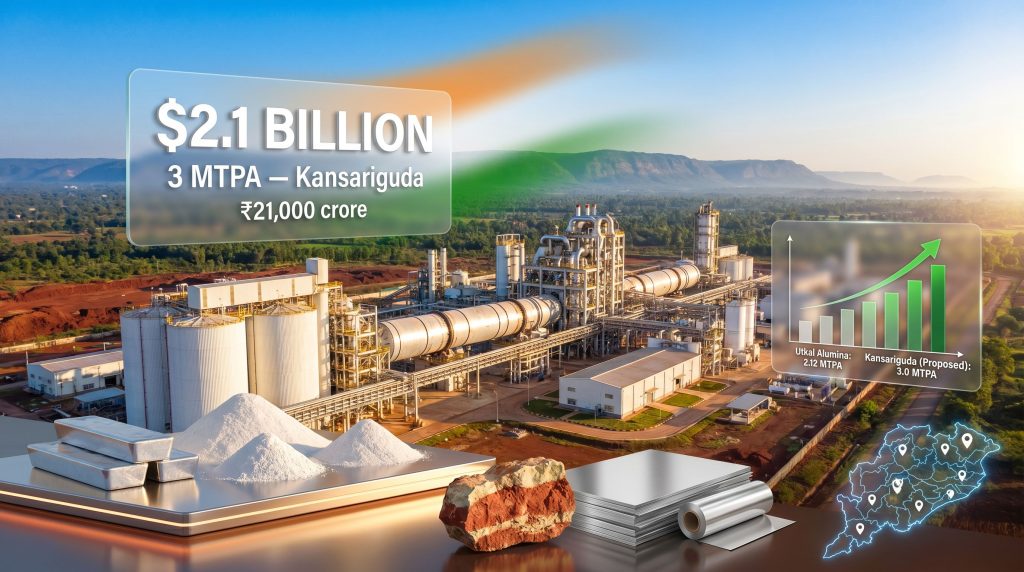
The second and far larger component of the Aditya Birla Odisha alumina refinery expansion is the proposed Kansariguda project. At a standalone investment of ₹12,000 crore, approximately $1.26 billion USD at current exchange rates (using a reference rate of $1 = ₹95.32), the Kansariguda expansion proposes to triple refining capacity at that site to 3 million MTPA. This would position Kansariguda as one of the largest single-site alumina refining operations in South Asia.
The Kansariguda project does not stand alone. It forms part of a broader ₹21,000 crore Odisha investment blueprint (approximately $2.1 billion) that includes:
- Alumina refining capacity at Kansariguda (₹12,000 crore, the largest single component)
- Expansion of aluminium smelting capability for downstream processing
- A flat-rolled products (FRP) facility targeting the automotive and packaging sectors
- A battery foil manufacturing unit directly aligned with India's electric vehicle supply chain
| Project Component | Investment | Status |
|---|---|---|
| Kansariguda Alumina Refinery | ₹12,000 crore (~$1.26B) | Proposed / Planning Phase |
| Utkal Alumina Refinery Expansion | ₹1,500 crore | Completed |
| Smelter + FRP + Battery Foil | Balance of ₹21,000 crore plan | Proposed |
| Total Odisha Commitment | ₹21,000 crore (~$2.1B) | Multiple Phases |
How Kansariguda Benchmarks Against Global Refining Operations
Context matters when evaluating a 3 MTPA refinery. The global alumina refining industry is dominated by a small number of very large sites, most concentrated in Australia, Brazil, and China. Furthermore, global bauxite production patterns heavily influence where refining capacity is built, making Odisha's geology particularly strategic. Placing the proposed Kansariguda expansion within its peer group reveals just how significant this project is in absolute scale terms.
| Refinery / Operator | Country | Annual Capacity (MTPA) |
|---|---|---|
| Alcoa Pinjarra | Australia | ~4.2 |
| Rio Tinto Yarwun | Australia | ~3.4 |
| Hindalco Kansariguda (Proposed) | India | 3.0 |
| Utkal Alumina (Post-Expansion) | India | 2.12 |
| Average Global Mid-Tier Refinery | Various | 1.0 to 2.5 |
At 3 MTPA, Kansariguda would sit in the same tier as Rio Tinto's Yarwun facility in Queensland, a refinery that took decades of capital investment and incremental expansion to reach that scale. The ambition embedded in the Kansariguda proposal is therefore not incremental — it is a step-change in India's positioning within the global alumina supply architecture.
Alumina is not simply an input material. It is a strategic intermediate that determines who captures value in the aluminium supply chain. A country that refines its own bauxite at scale keeps that value onshore, from ore extraction through to smelter feedstock delivery.
The Geology Underpinning the Strategy
Why Odisha Is Not an Arbitrary Location
The concentration of both Hindalco projects in Odisha is not coincidental. The state holds India's largest bauxite reserves, distributed across the Eastern Ghats mountain range in a geological formation studied extensively by the Geological Survey of India. The bauxite deposits in districts like Koraput, Kalahandi, and Rayagada are characterised by high alumina content and relatively low silica levels, a quality profile that meaningfully reduces refining complexity and chemical reagent consumption during the Bayer Process.
The Bayer Process, which is the universally employed method for refining alumina from bauxite, involves digesting crushed bauxite in hot caustic soda (sodium hydroxide) solution under pressure. The alumina dissolves selectively, while impurities including silica, iron oxides, and titanium compounds remain as an insoluble residue known in the industry as red mud. Higher silica content in raw bauxite directly increases caustic soda consumption, raising per-tonne refining costs. Odisha's favourable alumina-to-silica ratio gives refineries located there a structural cost advantage.
The Eastern Ghats deposits are also characterised by:
- Shallow ore body depths, reducing open-cut mining costs
- Proximity to refinery sites, minimising ore haulage distances and associated logistics costs
- High gibbsite content in some deposits, which allows for lower-temperature digestion and reduced energy consumption in refining
This geological advantage, rarely discussed in mainstream coverage of the Aditya Birla Odisha alumina refinery expansion, is a foundational reason why Odisha consistently attracts large-scale alumina investment rather than other bauxite-bearing Indian states.
Four Strategic Drivers Behind a $1.26 Billion Commitment
India's Structural Aluminium Demand Gap
India's per-capita aluminium consumption remains well below 3 kilograms per year, compared to global averages closer to 11 kilograms in developed economies and approximately 30 kilograms in China. This gap is not a sign of weakness; it is a long-duration demand runway. Infrastructure investment in power transmission, railways, urban construction, and defence equipment is systematically pulling aluminium consumption higher. Consequently, the top aluminium producers are accelerating capacity investments to meet this trajectory over the next two to three decades.
EV and Energy Transition Material Demand
The battery foil manufacturing facility included in the ₹21,000 crore Odisha plan is strategically significant. Battery foil, an ultra-thin aluminium product used in lithium-ion cell construction as the cathode current collector, is a precision-grade material that commands a substantial premium over standard rolled aluminium. In addition, the broader energy transition demand for lightweight, high-performance materials is accelerating investment in exactly this category of advanced aluminium products.
Including battery foil within the same investment envelope as upstream refining capacity signals that Hindalco is constructing a vertically integrated chain from raw ore to advanced EV components within a single state. Furthermore, the battery raw materials market is evolving rapidly, reinforcing the strategic logic of locking in upstream feedstock security before downstream demand intensifies.
Import Substitution at the Feedstock Level
India currently imports a meaningful proportion of its alumina requirements. These imports expose domestic smelters to global commodity price cycles, ocean freight costs, and currency depreciation risk. Scaling domestic refining eliminates this exposure for Hindalco's internal smelter operations and potentially creates surplus alumina available for third-party sale, transforming what was a cost centre into a potential revenue stream. However, this substitution strategy must also contend with broader resource export challenges reshaping global alumina trade flows.
Vertical Integration as a Margin Shield
In commodity industries, integrated producers that control inputs from extraction through to processing consistently outperform pure-play smelters or fabricators across commodity price cycles. When aluminium prices soften, integrated producers absorb the downturn across a wider cost structure. When prices rise, they capture value at multiple points simultaneously. The Kansariguda expansion deepens Hindalco's vertical integration precisely at the most strategically valuable point in the value chain.
Execution Risks and Structural Challenges
Environmental Complexity in the Eastern Ghats
The Eastern Ghats are not simply a mining landscape. They are also home to ecologically sensitive forest zones and communities including Scheduled Tribes whose land rights are protected under India's Forest Rights Act and the Panchayats (Extension to Scheduled Areas) Act, commonly known as PESA. Any bauxite mining expansion feeding new refinery capacity must navigate free, prior, and informed consent processes with affected communities, environmental impact assessments, and forest clearance applications under the Forest Conservation Act.
This regulatory landscape has historically created timeline uncertainty for large-scale mining and refinery projects in Odisha. Project timelines should therefore be evaluated with this complexity factored into commissioning assumptions.
Red Mud Management at Scale
A 3 MTPA alumina refinery produces substantial volumes of red mud as a refining byproduct, typically 1 to 1.5 tonnes of red mud per tonne of alumina produced. At full capacity, Kansariguda would generate 3 to 4.5 million tonnes of red mud annually. Red mud is alkaline, contains trace heavy metals, and requires engineered containment. Managing this volume sustainably, whilst complying with India's environmental regulations and avoiding the catastrophic failures seen at red mud impoundment sites globally (such as the Ajka disaster in Hungary in 2010), represents a genuine long-term operational challenge.
Capital Concentration Risk
₹21,000 crore deployed into a single Indian state across multiple simultaneous facility types represents concentrated capital allocation risk. Commodity price cycles in aluminium have historically been volatile. If aluminium prices were to soften materially during the multi-year construction window for Kansariguda, the economics of the investment could come under pressure before the facility reaches commercial production.
Disclaimer: The above analysis contains forward-looking considerations about commodity markets and project timelines that are inherently speculative. Investors should conduct independent research and consider their own risk tolerance before drawing financial conclusions from this content.
The next major ASX story will hit our subscribers first
Construction Progress and Commissioning Milestones
Reports indicate that one expansion phase within the broader Odisha programme was approximately 85% complete as of mid-2026, with commissioning targeted for June 2026. Large-scale alumina refinery construction involves long-lead procurement of specialised equipment including digestion autoclaves, heat exchangers, clarification tanks, and calcination kilns. Supply chain delays for these items, many of which are custom-fabricated, can meaningfully shift commissioning timelines.
Hindalco's use of L&T's MMH (Materials and Minerals Handling) Business Division as engineering partner for the Utkal expansion reflects a preference for domestic engineering capability over international contractors. Domestic contractors typically offer better alignment on Indian regulatory requirements and site conditions, whilst carrying their own capacity constraints during India's current infrastructure investment supercycle.
What This Means for India's Aluminium Industry
Shifting the Refining Centre of Gravity
If the Kansariguda project reaches its proposed 3 MTPA output, India's total domestic alumina refining capacity would increase substantially. Combined with the expanded Utkal facility at 2.12 MTPA and capacity from other operators including National Aluminium Company (NALCO) and Vedanta Aluminium's Lanjigarh refinery, India's aggregate refining position would move meaningfully closer to alumina self-sufficiency.
A Template for Industrial Deepening
The structure of the ₹21,000 crore Odisha plan — integrating upstream refining with midstream smelting and downstream value-added manufacturing in one geographic cluster — is a model that other Indian industrial conglomerates are likely to study. Colocation of the value chain within a single state reduces interplant logistics costs, allows shared infrastructure investment, and creates a concentrated industrial ecosystem that attracts ancillary suppliers and services.
| Summary Metric | Value |
|---|---|
| Kansariguda Expansion Investment | ₹12,000 crore / ~$1.26 billion |
| Total Odisha Aluminium Investment | ₹21,000 crore / ~$2.1 billion |
| Proposed Kansariguda Capacity | 3 MTPA |
| Utkal Alumina Completed Capacity | 2.0 to 2.12 MTPA |
| Utkal Expansion Cost | ₹1,500 crore |
| Executing Entity | Hindalco Industries Ltd. |
| Broader Scope | Smelter, FRP plant, battery foil facility |
| Exchange Rate Reference | $1 = ₹95.32 |
The Aditya Birla Odisha alumina refinery expansion is ultimately a long-duration industrial thesis expressed in capital. It is built on Odisha's geological advantage, India's consumption growth trajectory, the economics of vertical integration, and the strategic imperative of reducing import dependency in a critical industrial material. Whether the Kansariguda project executes on timeline and budget will determine how much of that thesis converts from ambition into structural competitive advantage for Hindalco and for India's aluminium industry as a whole.
Want to Track the Next Major Mineral Discovery Before the Market Does?
Discovery Alert's proprietary Discovery IQ model delivers real-time alerts on significant ASX mineral discoveries across 30-plus commodities, instantly converting complex geological data into actionable investment insights — explore the historic returns major discoveries have generated and begin your 14-day free trial today to position yourself ahead of the broader market.