June 24, 2026
Aluminium's Decarbonisation Paradox: Why Cleaner Production Is Both Urgent and Structurally Difficult
Few industrial challenges illustrate the complexity of the net-zero transition as clearly as aluminium. The metal sits at the intersection of two competing forces: an accelerating demand curve driven by electric vehicles, solar infrastructure, and lightweight aerospace applications, and a stubborn emissions profile rooted in century-old electrochemical technology. The global aluminium sector is responsible for roughly 2% of total worldwide CO₂ emissions, yet demand for the metal is projected to climb significantly as clean energy buildout intensifies. Furthermore, the energy transition mineral demand dynamic means that under moderate climate scenarios, demand for low-carbon aluminium could reach 1.8 times current levels by 2050, with more aggressive policy frameworks pushing that threshold even higher.
The arithmetic creates an uncomfortable reality. Expanding output to serve the energy transition, while simultaneously transforming how that output is produced, requires more than incremental efficiency improvements. It demands a fundamental rethink of smelting architecture. That is precisely the context in which the Rio Tinto AP60 expansion in Quebec needs to be understood.
When big ASX news breaks, our subscribers know first
Why China's Dominance Makes Western Low-Carbon Capacity Strategically Critical
Between 2000 and 2024, global aluminium production more than doubled. China drove the overwhelming majority of that growth, accounting for 59% of world production in 2024 according to the Aluminum Climate Impact 2025 benchmarking report. The bulk of Chinese smelting capacity relies on coal-fired electricity, meaning the global average emissions intensity for aluminium production remains stubbornly high despite technological progress elsewhere.
This concentration creates a structural gap in the market. Buyers in the automotive, aerospace, and renewable energy sectors are increasingly unable to source sufficient quantities of verifiably low-carbon primary aluminium to meet their own sustainability commitments. Western producers with access to renewable baseload power are therefore positioned not merely as competitors on price, but as suppliers of a materially different product in terms of embedded carbon. The top aluminium producers with clean power access hold a structural competitive edge that will only grow more valuable as carbon pricing expands internationally.
The global aluminium industry's emissions problem is not evenly distributed. It is heavily concentrated in coal-dependent production regions, which means geographically advantaged producers with clean power access hold a structural competitive edge that will only grow more valuable as carbon pricing expands internationally.
AP60 Technology: How Advanced Electrolysis Changes the Emissions Equation
Understanding why the Rio Tinto AP60 expansion in Quebec matters requires a working knowledge of what makes AP60 different from conventional smelting. Aluminium is produced through the Hall-Héroult process, in which alumina is dissolved in molten cryolite and subjected to electrolysis. Carbon-based anodes are consumed during this process, releasing CO₂ as a direct chemical byproduct, not merely as a consequence of energy source.
AP60 is an advanced potline technology developed through Rio Tinto's proprietary research programme. Its distinguishing characteristics include:
- Higher operating amperage than conventional pot configurations, enabling greater aluminium output per unit of energy consumed
- Optimised pot geometry and thermal management systems that extend operational lifespan and reduce maintenance-related downtime
- Reduced fluoride emissions, which carry both environmental and regulatory compliance significance
- Enhanced process stability that allows more consistent performance across the full potline
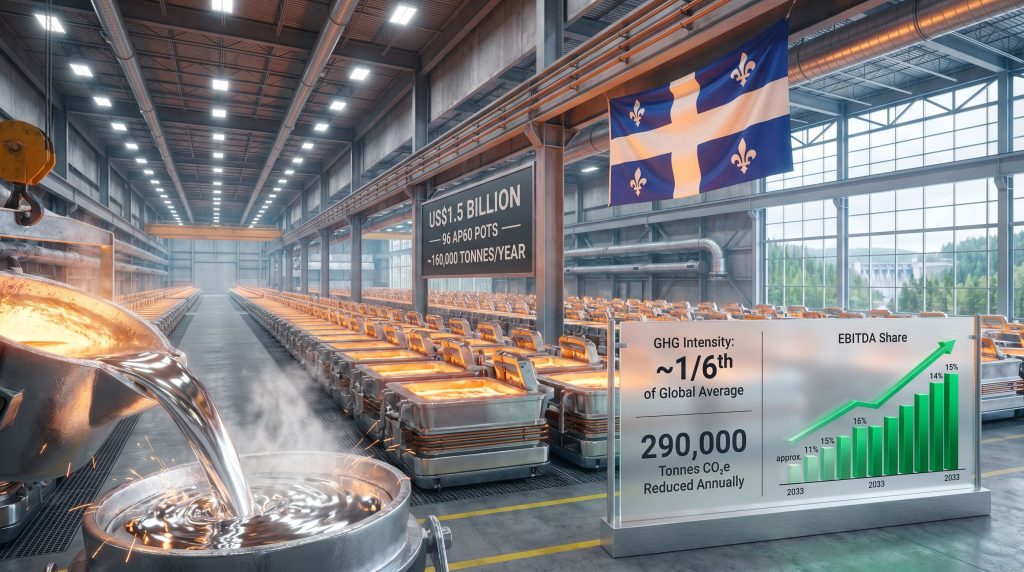
When powered by Quebec's hydroelectric grid, these efficiency advantages translate into an emissions intensity approximately one-sixth of the global industry average. Compared to the older Arvida potroom infrastructure the expansion replaces, AP60 produces roughly half the greenhouse gas emissions per tonne of aluminium.
AP60 vs. Conventional Smelting: Performance at a Glance
| Performance Metric | AP60 (Quebec, Hydropower) | Global Industry Average | Legacy Arvida Potrooms |
|---|---|---|---|
| GHG Emissions Intensity | ~1/6th of global average | Baseline | ~2x AP60 output |
| Fine Particulate Reduction | Up to 90% lower | Baseline | Higher PM10/PM2.5 |
| Annual Capacity (post-expansion) | ~220,000 tonnes | Varies | Being phased out |
| Energy Source | Quebec hydropower | Mixed (coal-heavy globally) | Hydro (older config) |
A critical and often underappreciated point: the technology itself accounts for only part of AP60's emissions advantage. Quebec's hydroelectric grid is the indispensable enabler. Without access to renewable baseload power, the same AP60 technology operating on a coal-heavy grid would deliver a fraction of the carbon benefit. Geography and grid composition are therefore as important as smelting architecture when evaluating low-carbon aluminium credentials.
Inside the $1.5 Billion Arvida Expansion: Scope, Scale, and Commissioning Timeline
The Rio Tinto AP60 expansion in Quebec represents one of the most significant capital commitments to low-carbon primary aluminium production currently underway globally. Rio Tinto officially commissioned the expansion following an announcement confirming the project's progression. The following table summarises the project's key parameters:
| Project Parameter | Detail |
|---|---|
| Total Capital Investment | US$1.5 billion (revised upward from US$1.4 billion in 2023) |
| Location | Complexe Arvida, Saguenay, Quebec, Canada |
| New Electrolytic Pots | 96 AP60 pots |
| Incremental Annual Capacity | ~160,000 tonnes of primary aluminium |
| Total AP60 Annual Output (post-completion) | ~220,000 tonnes |
| Commissioning Start | March 2026 |
| Expected Full Completion | Late 2026 |
| Legacy Potroom Closure | June 2026 |
The commissioning sequence follows a staged pot-activation approach across all 96 new cells, with output building progressively through 2026. This phased ramp-up is designed to maintain supply continuity for downstream customers during the transition period, offsetting volumes lost from the retirement of older potrooms scheduled for closure by June 2026.
Alongside the primary smelting expansion, Rio Tinto is developing a complementary aluminium recycling facility at the Arvida site. This is a strategically important but less-discussed element of the project. Recycled aluminium requires approximately 95% less energy to produce than primary metal, meaning the recycling centre will materially reduce the lifecycle carbon intensity of the site's total output once operational.
ELYSIS: The Technology AP60 Is Designed to Transition Toward
The AP60 expansion is not the final destination in Rio Tinto's aluminium decarbonisation roadmap. It functions as a transitional platform designed to prepare the Arvida site, its workforce, and its operational infrastructure for the eventual deployment of ELYSIS technology.
ELYSIS is a joint development initiative in which Rio Tinto is a founding partner. Its objective is the complete elimination of process CO₂ emissions from aluminium smelting. Conventional smelting consumes carbon anodes that are chemically oxidised during electrolysis, making CO₂ release an inherent byproduct regardless of the electricity source. ELYSIS replaces these carbon anodes with inert materials, shifting the electrochemical output from carbon dioxide to oxygen.
If ELYSIS achieves commercial scale, it would represent the most consequential transformation in aluminium manufacturing since the Hall-Héroult process was first developed in the 1880s. In addition, a full-scale demonstration facility is currently under development in Quebec, underscoring the region's growing role as a hub for low-carbon smelting innovation.
AP60 and ELYSIS occupy different chapters of the same decarbonisation story. AP60 delivers substantial, commercially validated emissions reductions using proven technology available today. ELYSIS targets the elimination of process emissions entirely, but remains in the demonstration phase. The Arvida expansion is explicitly structured to serve both objectives.
Rio Tinto's Emissions Trajectory: Progress, Exposure, and Hard-to-Abate Limits
In 2025, Rio Tinto reported gross Scope 1 and Scope 2 emissions of 31.5 million tonnes of CO₂ equivalent, a reduction of 0.2 million tonnes from the prior year. Since establishing its 2018 baseline, the company has achieved a 14% reduction in operational emissions. When high-integrity carbon offsets are applied, net emissions currently sit 17% below the 2018 baseline.
These are meaningful reductions, but the pathway to net-zero by 2050 becomes considerably steeper from here. Rio Tinto explicitly acknowledges that approximately half of its remaining emissions originate from sources where current technology cannot yet deliver full elimination. Process emissions from carbon-anode smelting and fossil fuel dependence in certain mining and logistics operations represent the bulk of this hard-to-abate category.
The company's Australian aluminium operations illustrate the exposure clearly. Smelters drawing power from fossil-fuel-heavy grids face escalating cost pressure as carbon pricing mechanisms expand and tighten. Consequently, Rio Tinto Gladstone repowering initiatives are actively addressing this exposure within the Australian portfolio, whilst the Quebec AP60 expansion simultaneously shifts a significant portion of total aluminium production toward near-zero operational carbon intensity.
The next major ASX story will hit our subscribers first
Financial Implications: Premium Markets, Carbon Costs, and Earnings Growth
The financial case for the Rio Tinto AP60 expansion in Quebec extends well beyond emissions compliance. Three distinct value drivers are converging:
1. Green aluminium price premiums
European regulatory frameworks, most notably the Carbon Border Adjustment Mechanism (CBAM), are structuring carbon costs directly into import pricing. Aluminium with high embedded emissions will face effective price penalties in European markets, while low-carbon certified product from hydropower-based operations will be insulated from these costs and increasingly able to command premiums. Similarly, the Alcoa green aluminium venture reflects how competitors are also racing to position themselves in this premium segment.
2. Earnings growth from capacity expansion
Aluminium contributed approximately 11% of Rio Tinto's group EBITDA on average between 2019 and 2023. The company's internal modelling anticipates this contribution rising to around 15% by 2033 as low-carbon capacity expands and premium pricing materialises. The 160,000 tonnes of incremental annual capacity from the AP60 expansion represents a substantial revenue uplift at current aluminium prices once fully operational.
3. Carbon cost avoidance
The AP60 expansion is projected to reduce annual greenhouse gas emissions by approximately 290,000 tonnes of CO₂ equivalent compared to the legacy potroom configuration it replaces. At prevailing carbon pricing levels in regulated markets, this carries direct financial value in avoided compliance costs and potential carbon credit generation.
Quebec's Economic and Strategic Dividend
The economic impact of the Rio Tinto AP60 expansion in Quebec extends well beyond Rio Tinto's balance sheet. During the construction phase, the project supported over 1,500 workers at peak activity. Total economic benefits to the Quebec economy through contractor, supplier, and local services spending during construction are estimated at over $1 billion. Upon full commissioning, the facility is expected to sustain approximately 100 permanent skilled positions at the Arvida site.
Quebec's competitive positioning in low-carbon metals production is a function of several reinforcing factors:
- Abundant large-scale hydroelectric generation providing some of the world's cleanest industrial power
- Established industrial infrastructure and a skilled smelting workforce built over decades
- Proximity to major North American manufacturing markets for automotive, aerospace, and clean energy applications
- An evolving provincial and federal policy environment supportive of green industrial investment
Growing commercial and political pressure to localise critical materials supply chains within North America, particularly for EV and clean energy applications, is increasing the strategic value of Quebec-based production. Furthermore, renewable mining solutions across Canada are reinforcing the broader narrative that geography and clean power access are decisive competitive advantages. Buyers requiring verified low-carbon aluminium provenance are finding that Arvida's output meets the bar that coal-based alternatives cannot.
Air Quality, Particulate Emissions, and the Broader Environmental Picture
Carbon intensity receives the most attention in decarbonisation discussions, but AP60's environmental advantages extend to local air quality. The technology platform is projected to reduce fine particulate matter emissions (PM2.5 and PM10) by up to 90% compared to the older Arvida potroom infrastructure it replaces. For communities in the Saguenay region surrounding the complex, this represents a tangible public health benefit independent of climate outcomes.
Across its broader portfolio, Rio Tinto tracks sulfur oxides (SOx), nitrogen oxides (NOx), fluoride compounds, and particulate matter. SOx, NOx, and fluoride emissions have remained broadly stable over the past five years. However, particulate matter has shown a modest upward trend over the most recent three-year measurement period, an area the company identifies as requiring continued investment in monitoring and abatement technology.
Quebec's environmental regulatory framework imposes stringent standards on industrial facilities, requiring continuous monitoring and public disclosure. The AP60 expansion was designed to perform above current regulatory thresholds, providing a compliance buffer as standards are expected to tighten through the 2030s.
The Road Ahead: Milestones in Rio Tinto's Aluminium Decarbonisation Roadmap
- Near-term (to late 2026): Complete AP60 commissioning across all 96 pots at Arvida; retire legacy high-emission potrooms; activate the recycling centre
- Medium-term (2027–2035): Scale ELYSIS demonstration results toward commercial deployment; expand renewable energy procurement for non-hydro operations; pursue CBAM-aligned certification for European market access
- Long-term (to 2050): Achieve net-zero operational emissions across the full aluminium portfolio; deploy inert anode technology at commercial scale if ELYSIS development milestones are met
The degree of difficulty increases substantially in the later phases. Rio Tinto's own climate disclosures make clear that the 2050 net-zero target is contingent on technological breakthroughs not yet available at commercial scale. The AP60 expansion addresses the near-term and medium-term dimensions of this challenge with proven technology. ELYSIS addresses the long-term dimension with technology still in development. Neither is sufficient alone; both are necessary components of a coherent decarbonisation trajectory.
What the Arvida site represents, once the AP60 transition is complete, is a functional proof of concept for low-carbon primary aluminium production at industrial scale. For an industry still overwhelmingly reliant on coal-fired smelting and conventional carbon anodes, that proof of concept carries significance well beyond a single company's emissions ledger.
Disclaimer: This article contains forward-looking projections and financial estimates drawn from company disclosures and industry modelling. These projections are subject to change based on commodity prices, regulatory developments, technological progress, and macroeconomic conditions. This content is for informational purposes only and does not constitute investment advice.
Want to Stay Ahead of the Next Major Mineral Discovery on the ASX?
Discovery Alert's proprietary Discovery IQ model delivers real-time alerts on significant ASX mineral discoveries, transforming complex mineral data into clear, actionable insights for both short-term traders and long-term investors — explore historic discoveries and their exceptional returns to understand the opportunity, then begin your 14-day free trial at Discovery Alert to position yourself ahead of the market.