June 6, 2026
The Manufacturing Revolution Quietly Transforming Aluminium Markets
Across the global manufacturing landscape, a quiet but consequential restructuring is underway. The industries that consume aluminium are increasingly dictating its value, its development, and its future. For decades, the aluminium industry's story was written at the smelter. Today, it is being written in automotive plants, grid infrastructure corridors, and advanced die-casting facilities. Understanding aluminium downstream markets, EV demand, and giga-casting technology is no longer optional for investors and procurement strategists — it is foundational.
The shift matters because downstream demand signals are becoming the primary driver of alloy development, capital allocation, and long-term price formation. From the pressurised interiors of giga-casting machines to the cable trenches of India's renewable energy buildout, the metal's destiny is now shaped by what happens after it leaves the smelter. Furthermore, the top aluminium companies are increasingly aligning their capital strategies with these downstream shifts.
When big ASX news breaks, our subscribers know first
What Giga-Casting Actually Does to the Supply Chain
To understand giga-casting's significance, it helps to start not with the technology itself, but with the problem it solves. Traditional automotive body assembly involves dozens of stamped steel or aluminium components, welded together through multi-stage processes that require large factory footprints, extensive tooling, and significant labour input. Each joining point is a potential structural weakness and a cost centre.
Giga-casting eliminates this complexity by injecting molten aluminium into a single enormous die, producing a unified structural component in one shot. Machines capable of delivering this process can weigh up to 410 tonnes and operate at injection pressures exceeding 1,500 bar. The result is a single casting that replaces as many as 70 individual components, compressing assembly steps, reducing part count, and improving dimensional accuracy across high-volume production runs.
The supply chain implications extend well beyond factory floor efficiency. By concentrating structural aluminium demand into large-format castings, giga-casting fundamentally changes what type of aluminium product manufacturers actually need. Stamped sheet demand in underbody and structural applications faces displacement pressure, while demand for specialised casting alloys capable of performing reliably under high-pressure injection conditions accelerates.
Giga-casting does not simply substitute one manufacturing method for another. It restructures the entire upstream supply chain by concentrating demand at the casting stage, changing alloy specifications, tooling requirements, and foundry economics simultaneously.
Automaker adoption is broadening rapidly. The following table summarises confirmed or reported giga-casting activity across major manufacturers:
| Automaker | Giga-Casting Status |
|---|---|
| Tesla | Pioneer adopter; applied to rear and front underbody modules |
| BYD | Active development programme underway |
| Toyota | Pursuing large-format casting approaches |
| Volvo | Integrating into next-generation platform design |
| Hyundai | Confirmed adoption in EV architecture development |
| NIO | Deploying in premium EV platforms |
| Xiaomi | Incorporating into first mass-market EV models |
For conventional die-casting operations producing small-to-medium automotive components, this transition carries structural displacement risk. Foundries, alloy formulators, and tooling manufacturers face a choice: recalibrate toward large-format, high-integrity casting systems, or risk becoming peripheral to the most important growth segment in automotive manufacturing. According to market forecasts for giga-casting, sustained capacity expansion is expected through 2032 and beyond.
The Alloy Science Behind Giga-Casting
One of the less widely understood dimensions of giga-casting adoption is the alloy development challenge it creates. Standard high-pressure die-casting alloys used in conventional automotive applications are not always suitable for the scale and structural performance requirements of giga-castings. Large single-piece castings must exhibit consistent mechanical properties throughout their entire volume, including tensile strength, elongation, and impact resistance, without the benefit of post-weld correction.
This has accelerated research into heat-treatment-free casting alloys, sometimes referred to in the industry as self-hardening or non-heat-treatable alloys. These formulations are engineered to achieve adequate mechanical performance directly from the casting process, eliminating the distortion risk associated with heat-treating large, complex-geometry parts. The alloy development race is a largely invisible but commercially critical frontier in the giga-casting ecosystem.
EV Architecture and the Aluminium Intensity Equation
Electric vehicles consume more aluminium per unit than comparable internal combustion engine vehicles. The primary reason is physics: battery packs add substantial mass to the platform, making structural weight reduction a direct contributor to driving range, which is a primary purchasing consideration for consumers.
Every kilogram eliminated from the body structure, underbody, or closures translates directly into extended range or reduced battery capacity requirements. This creates a powerful and durable engineering incentive to replace steel with aluminium across as many structural applications as possible. Consequently, aluminium downstream markets, EV demand, and giga-casting are becoming increasingly inseparable in automotive design strategy.
The following table maps EV-specific structural changes to their downstream aluminium consequences:
| EV-Driven Structural Change | Aluminium Downstream Consequence |
|---|---|
| Battery mass requiring structural offset | Higher aluminium content in body-in-white and underbody modules |
| Platform simplification and part consolidation | Concentrated demand for large structural castings |
| Reduction of welded steel sub-assemblies | Shift from stamped sheet toward cast aluminium modules |
| High-volume EV production scaling | Expanded investment in giga-casting press capacity and casting alloys |
| Thermal management requirements | New demand for precision-extruded and cast heat management components |
Beyond structural applications, EV-specific components including battery trays, motor housings, thermal management systems, and crash members are all aluminium-intensive. Extrusions continue to grow in battery enclosure and structural frame applications, while sheet products maintain relevance in closures, hoods, and body panels. However, the castings segment represents the highest-growth downstream category by a meaningful margin.
Research from S&P Global automotive insights indicates that giga-casting adoption is being driven primarily by rising EV production volumes, with China emerging as the leading deployment market globally. Industry forecasts project sustained market expansion for giga-casting capacity through 2032 and beyond, underpinning long-run demand for the specialised alloys and process capabilities this technology requires.
BYD's Aluminium Frame: A Case Study in Performance Engineering
BYD's development of an aluminium frame architecture for the Yangwang U8L SUV offers a concrete illustration of how the industry's aluminium integration is advancing. The new frame delivers approximately 56 kg of weight reduction compared with an equivalent steel structure, while simultaneously improving tensile strength and corrosion resistance. The design successfully completed a 12-tonne structural lifting test, validating its load-bearing capacity under extreme conditions.
What makes this development notable is not just the weight saving, but the performance premium it delivers. The conventional narrative around aluminium substitution has often framed it as a trade-off between weight and strength. BYD's engineering outcome challenges that framing, demonstrating that modern aluminium architectures can exceed steel's structural benchmarks rather than merely matching them.
This echoes a precedent established decades earlier. Audi's decision to develop an aluminium-bodied flagship sedan, driven by competitive pressure from heavier rivals in the BMW 7 Series and Mercedes-Benz S-Class segments, proved that aluminium could meet the structural, safety, and manufacturing requirements of volume automotive production. Ford's subsequent adoption of aluminium body structures in its best-selling truck platform validated the commercial economics at mass-market scale, creating the engineering confidence and supply infrastructure that now supports giga-casting adoption industry-wide.
Q1 2026 Global EV Sales: A Three-Region Divergence
The most important regional story in EV markets during Q1 2026 was not a single number, but a divergence. Total electrified vehicle sales across Europe, China, and the United States exceeded 5.45 million units in the quarter, but the distribution of that volume carried very different implications for aluminium demand geography.
Europe delivered the standout performance:
- Combined EV sales across the EU, UK, and EFTA countries reached 2.43 million units, an 18% year-on-year increase
- Battery electric vehicle sales rose 26% to 724,000 units
- Plug-in hybrid sales increased 32% to 354,000 units
- Hybrid vehicle sales climbed 11% to 1.35 million units
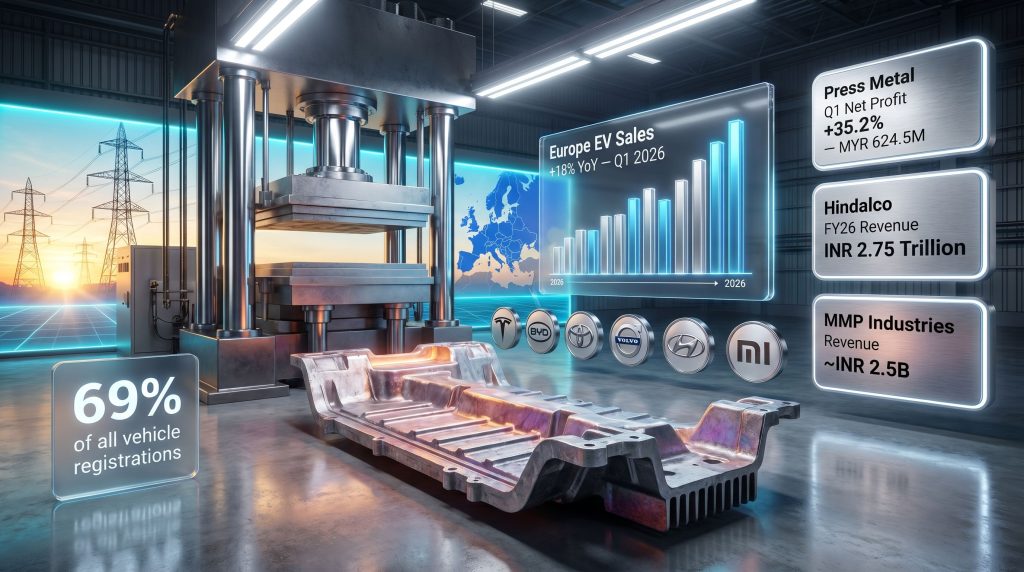
- Electrified vehicles accounted for 69% of all vehicle registrations across the region
Against this, China recorded a 21% decline in EV sales during the quarter, while the US market contracted by 9% following changes to federal incentive programmes. In addition, the broader impact of US aluminium tariffs has further complicated procurement planning for North American downstream operators.
The strategic implication for aluminium downstream operators is significant. European automotive suppliers and aluminium processors are positioned to capture accelerating structural demand. Chinese and US-facing operations must simultaneously manage volume uncertainty and input cost exposure, creating a two-speed dynamic across the global aluminium supply chain. Supply chain diversification and regional production flexibility are evolving from best-practice recommendations into operational necessities.
Downstream Earnings: Divergence Across the Sector
Corporate earnings results across the downstream aluminium sector illustrate that higher aluminium prices do not translate uniformly into improved profitability. Scale, operational efficiency, and product mix diversity determine who captures the upside.
Record performances were recorded at several major operators:
- Press Metal Aluminium Holdings (Malaysia): Q1 net profit rose 35.2% year-on-year to MYR 624.5 million, extending a consecutive run of record quarterly earnings supported by higher aluminium prices, stronger sales volumes, and reduced input costs
- Kaiser Aluminum (United States): Revenue increased 42% despite institutional shareholding adjustments, with shares closing at USD 175.47; institutional ownership remained above 99%
- MMP Industries (India): Q4 net profit rose 64% year-on-year; revenue from operations increased approximately 23% quarter-on-quarter to INR 2.5 billion, supported by demand for aluminium powder, pastes, and atomised powders across construction and industrial applications
- Hindalco Industries (India): Closed FY26 with record consolidated revenue of INR 2.75 trillion (up 15.28% year-on-year) and record EBITDA of INR 380.97 billion (up 7.33%), though profit after tax declined 16.32% to INR 133.91 billion following exceptional losses linked to the Novelis Oswego plant fires
Earnings compression appeared at the smaller end of the market:
- Maan Aluminium (India): Profit after tax fell 55.5% to INR 17 million; PBDIT declined to INR 16.4 million and the operating profit-to-net sales ratio weakened to 0.64%, reflecting one of the company's weakest quarterly performances in recent years
The earnings divergence across downstream aluminium companies reveals a structural truth about the current market environment: scale operators with diversified product portfolios and cost discipline are capturing the pricing upside, while smaller and less diversified businesses face margin compression even in a constructive price environment.
The Hindalco result deserves particular attention from an analytical perspective. Record revenue and EBITDA alongside a significant decline in net profit illustrates how exceptional operational events, such as the Novelis Oswego plant fires, can obscure underlying business strength when evaluating headline earnings. Investors assessing downstream aluminium operators need to distinguish between structural performance and event-driven distortions.
Infrastructure Electrification: The Structural Demand Driver Beyond Automotive
While automotive applications attract the most attention in discussions around aluminium downstream markets, EV demand, and giga-casting, infrastructure electrification represents an equally important and arguably more durable demand driver. Unlike automotive sales cycles, which can fluctuate with consumer sentiment, infrastructure investment programmes tend to be multi-year, politically committed, and volume-predictable.
India's cable and wire industry provides one of the clearest current illustrations of this dynamic. The sector is forecast to deliver revenue growth of 28 to 30 per cent in FY27, underpinned by an investment pipeline valued at INR 10 to 12 trillion spanning:
- Power transmission infrastructure
- Renewable energy project connectivity
- Real estate and construction development
- Data centre construction
- Smart-meter rollout programmes
The sector recorded volume-led growth exceeding 20% in FY26, establishing a strong baseline for continued expansion. Tighter global aluminium supplies combined with rising prices are expected to contribute further to revenue growth, reinforcing the relationship between primary market conditions and downstream sector performance. Furthermore, wire rod casthouse investment across European operations reflects the same infrastructure electrification impulse driving demand in emerging markets.
Data centre construction deserves specific attention as an emerging demand vector. The global expansion of AI computing infrastructure is generating substantial new requirements for both structural and electrical aluminium in purpose-built data facilities. This application area is at an early stage relative to its eventual scale, and downstream aluminium operators with exposure to electrical conductor and enclosure segments are positioned to benefit as the buildout accelerates.
The next major ASX story will hit our subscribers first
Japan's Supply Chain Vulnerability: Middle Eastern Concentration Risk
Supply security has re-emerged as a critical strategic variable for major aluminium consumers. Japan's automotive industry represents one of the most exposed positions in the global aluminium supply chain. Based on 2024 UN Comtrade data, approximately 30% of Japan's total aluminium and aluminium alloy imports originate from Middle Eastern suppliers.
This concentration creates meaningful procurement risk for Japanese automotive manufacturers, particularly regarding specialised casting alloys sourced from the region. Rising procurement costs and potential supply disruptions are projected to affect Japanese carmakers through at least 2027.
The broader lesson extends beyond Japan. Downstream manufacturers globally are reassessing single-region sourcing dependencies following supply disruptions experienced in recent years. Three operational responses are emerging as standard risk mitigation tools:
- Alloy specification flexibility — engineering product lines to accommodate multiple alloy sources without performance compromise
- Strategic inventory management — maintaining buffer stocks of critical alloy inputs beyond standard just-in-time thresholds
- Supplier diversification programmes — actively developing secondary and tertiary supply relationships in geographically distinct regions
Packaging Innovation and Emerging Application Niches
Aluminium's downstream story extends beyond automotive and infrastructure into packaging innovation and emerging material science applications.
The collaboration between Canovation and CANPACK to advance the CanReseal resealable aluminium can-end system represents a commercially meaningful development in functional packaging. The partnership is focused on completing remaining development and manufacturing engineering work required before commercial rollout. Resealable aluminium packaging addresses consumer convenience demands while preserving the material's core advantages: recyclability, barrier performance, and formability.
In a less conventional context, research into aluminium foil's capacity to redirect Wi-Fi signal paths has drawn broader attention to the material's electromagnetic reflective properties. While the application remains informal and experimental, the underlying physics are sound: aluminium's high electrical conductivity produces strong electromagnetic reflection, which can be exploited to redirect wireless signal paths in specific directions. The broader implication is that aluminium's diverse material properties continue to generate interest in non-traditional application contexts well beyond established markets.
The Strategic Outlook for Downstream Aluminium Investors
Three structural forces will define the next phase of growth across aluminium downstream markets, EV demand, and giga-casting, and investors would do well to consider their intersecting effects:
- Automotive platform transformation — Giga-casting adoption across seven or more major automakers is concentrating structural aluminium demand in large-format castings, requiring foundries and alloy suppliers to scale capabilities or face displacement from the fastest-growing segment
- Electrification infrastructure build-out — Power transmission, renewable energy, and digital infrastructure investment is creating durable, multi-year volume demand for aluminium in cables, conductors, and structural components that operates largely independently of consumer sentiment cycles
- Geographic demand rebalancing — Europe's EV market acceleration is creating a new centre of gravity for automotive aluminium demand, partially offsetting near-term contractions in China and the US markets
Downstream operators with exposure to large-format casting, EV supply chains, and infrastructure electrification are best positioned for above-market growth trajectories. Companies dependent on conventional die-casting for traditional internal combustion engine platforms face structural volume risk as EV architectures scale and giga-casting penetration deepens. However, the Alcoa joint venture and the repositioning of Gladstone aluminium operations both illustrate how major producers are actively repositioning to align with these downstream structural shifts. Supply chain resilience, particularly for specialised casting alloys, is becoming a competitive differentiator as sourcing concentration risks become increasingly visible to procurement teams and investors alike.
Disclaimer: This article contains forward-looking statements and financial analysis drawn from publicly available industry data. Forecasts, projections, and market estimates involve inherent uncertainty and should not be construed as investment advice. Readers should conduct independent due diligence before making investment or procurement decisions based on information contained herein.
Readers seeking additional context on aluminium flat rolled products market dynamics and forecasting can explore the Aluminium Flat Rolled Products: Insights & Forecast to 2030 report published by AL Circle, which provides forward-looking analysis of a key downstream segment referenced in this article.
Want to Identify the Next Major ASX Mineral Discovery Before the Broader Market?
Discovery Alert's proprietary Discovery IQ model delivers real-time alerts on significant ASX mineral discoveries, transforming complex mineral data into actionable insights for investors across all experience levels — start your 14-day free trial today and explore how historic discoveries have generated substantial returns for those who positioned early.