
June 6, 2026
The Battery Age Has Turned African Soil Into a Geopolitical Battleground
When historians reflect on the first quarter of the twenty-first century, the scramble for battery minerals may well occupy the same chapter as the oil crises of the 1970s. Just as petroleum reshaped sovereign power and international investment flows for decades, the minerals underpinning the clean energy transition are now doing the same, and nowhere is this dynamic more visible than across sub-Saharan Africa.
Mozambique resource nationalism in mining is no longer an abstract policy debate. It is a lived commercial reality that is actively reshaping how foreign operators calculate risk, structure agreements, and plan capital allocation across one of the world's most mineralogically significant regions.
Understanding the forces driving this shift, and the strategic responses available to operators, requires looking well beyond individual country regulations. Furthermore, it requires examining the continental architecture of sovereign mineral control that is being constructed in real time.
When big ASX news breaks, our subscribers know first
What Is Driving the African Resource Nationalism Wave?
For most of the post-colonial era, African governments exchanged access to mineral wealth for foreign capital, technical expertise, and employment. The model was largely extraction-focused: foreign operators mined raw materials, exported them for processing elsewhere, and returned a share of proceeds through royalties and taxes. Governments received a relatively thin slice of the total value chain.
That model is now breaking down across multiple jurisdictions simultaneously, and the reason is straightforward: governments have become acutely aware of how much value leaves their borders unprocessed.
Graphite mined in Mozambique, for instance, has far greater economic value as battery-grade anode material than as raw flake. Lithium extracted in Zimbabwe is worth multiples more as refined lithium carbonate than as spodumene concentrate. The processing margin, which historically flowed to refiners in China, Japan, or South Korea, is now viewed by African governments as value that belongs within their own economies.
Resource nationalism, in this context, is not ideological posturing. It is a rational economic response to the realisation that raw material exports represent an enormous transfer of wealth away from the country of origin.
The Five Instruments of State Control
Resource nationalism encompasses a range of policy tools, deployed with varying intensity depending on the jurisdiction and the mineral in question:
- Mandatory state equity participation, where governments acquire ownership stakes in mining ventures, often without capital contribution
- Local beneficiation requirements, compelling operators to process materials within the country before export
- Export restrictions and quota systems, limiting the volume or condition of minerals that may leave the country
- Royalty and tax renegotiation, increasing the government's revenue share from existing licence holders
- Export permit suspensions, used as an enforcement mechanism when compliance is disputed
Each instrument carries different commercial implications, but the combined effect of multiple tools applied simultaneously creates a fundamentally different operating environment from the one Western mining companies built their Africa strategies around.
The Three-Country Pattern That Signals a Structural Shift
The near-simultaneous tightening of critical minerals demand regulation across Zimbabwe, the Democratic Republic of Congo, and Mozambique is one of the most significant, and underreported, developments in global mining over the past two years.
Collectively, these three nations hold dominant global reserves of lithium, cobalt, and graphite — the three minerals most central to lithium-ion battery production and grid-scale energy storage. Their coordinated policy direction is not coincidental. It reflects a shared awareness of strategic leverage at a moment when global demand for these materials is structurally accelerating.
How Each Country Has Acted
Zimbabwe moved first, imposing export quotas on lithium while simultaneously introducing local processing mandates. At one point, the government suspended exports of lithium and other unprocessed materials entirely, citing what it described as operational malpractice and value leakage among mining operators.
The DRC took a more surgical approach. President Felix Tshisekedi implemented a cobalt geopolitical rivalry export suspension before transitioning to an annual quota system. The quota mechanism caps cobalt exports at 96,600 tonnes for the 2026–2027 period, a figure calibrated not just for fiscal objectives but explicitly for market influence. Tshisekedi publicly described the quota as a lever designed to give the DRC direct influence over this strategic commodity market, according to Reuters. That framing is significant: it positions resource policy as a geopolitical instrument, not merely a revenue tool.
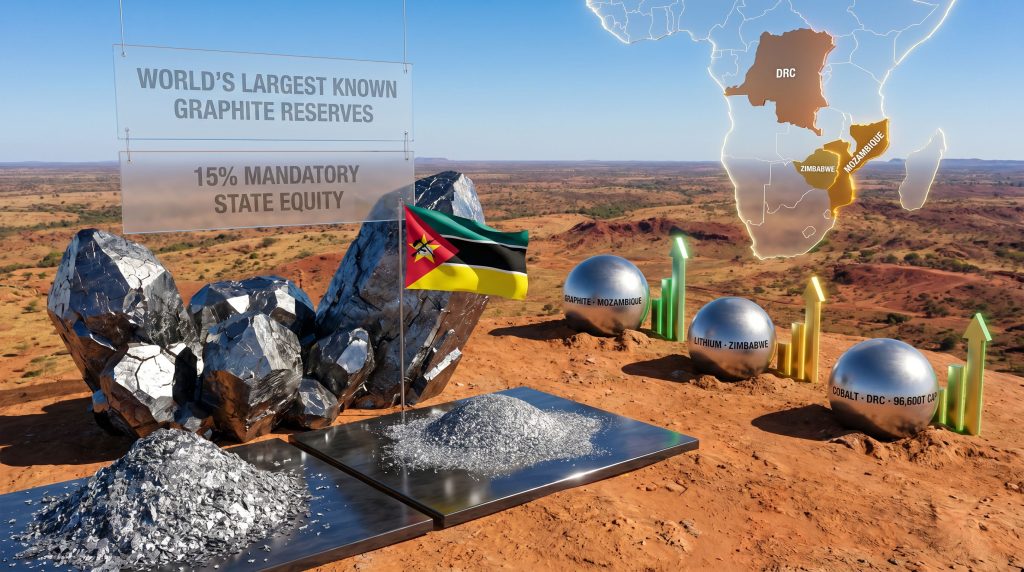
Mozambique's approach centres on two pillars: mandatory 15% state equity in all mining ventures, acquired without capital contribution by the state, and requirements for local processing of extracted materials.
| Country | Primary Critical Mineral | Key Policy Measure | State Equity Requirement |
|---|---|---|---|
| Mozambique | Graphite | 15% mandatory state stake + local processing mandates | 15% (zero-cost to state) |
| Zimbabwe | Lithium | Export quotas + processing mandates + temporary export suspension | Progressive equity requirements |
| DRC | Cobalt and Copper | Annual cobalt export quota system (96,600 tonne cap 2026–2027) | State enterprise participation |
Mozambique's Mineral Profile: Why the Stakes Are So High
To appreciate the commercial gravity of Mozambique's new regulatory framework, it helps to understand the country's mineral endowment in full.
Graphite: An Anode Material the World Cannot Substitute
Mozambique holds the world's largest known graphite reserves, concentrated in the Cabo Delgado province in the country's north. The Balama operation, one of the highest-capacity graphite production facilities on the planet, sits at the centre of this endowment.
What makes graphite strategically irreplaceable is its position within the battery value chain. Graphite constitutes approximately 95 to 99% of the anode material in lithium-ion batteries. Without it, there is no battery cell, and without battery cells, there is no electric vehicle or grid-scale storage system. No commercially viable substitute currently exists at scale.
As EV adoption accelerates globally, the global graphite shortage grows increasingly acute alongside grid-scale storage demand and renewable energy infrastructure investment. Mozambique's reserve position makes it structurally irreplaceable in that supply chain, a fact its government is now actively leveraging.
Beyond Graphite: A Diverse Resource Base
Mozambique's strategic mineral significance extends beyond graphite alone:
- Ruby mining: The Montepuez deposit in northern Mozambique is the world's largest ruby reserve, operated by UK-listed Gemfields
- Thermal and coking coal: Significant reserves exist in the Tete province, representing a separate dimension of the country's resource base
- Natural gas and LNG: Mozambique has emerged as a material new entrant in global LNG production, adding complexity to the broader resource sovereignty debate
The new ownership regulations apply across this entire mineral portfolio, meaning operators from the battery minerals space and the coloured gemstone sector alike must navigate the same structural changes.
The Commercial Arithmetic of a Zero-Cost State Stake
The 15% mandatory equity requirement deserves careful financial analysis, because its implications are more significant than headline policy coverage typically conveys.
When a government acquires a 15% equity stake without capital contribution, the mechanics of project economics shift immediately and permanently. The foreign operator bears 100% of capital expenditure, 100% of development risk, and 100% of operating cost burden. From the first day of production, however, 15% of cash flows are directed to the state without any corresponding capital recovery.
For projects with high upfront capital intensity — which describes almost every large-scale mining operation — this structure compresses the return profile materially. A project that might have generated an internal rate of return of, for example, 18% under the previous framework may now sit closer to 14 or 15%, depending on project scale, financing costs, and processing obligations. In some cases, this compression moves projects below minimum investment thresholds for institutional capital.
The local processing mandate adds further cost layers:
- Capital expenditure for in-country processing infrastructure, which must be funded entirely by the operator
- Higher per-unit operating costs relative to export-raw-material business models
- Extended project timelines as processing facility permitting and construction adds years to development schedules
- Workforce localisation and training compliance costs
- Ongoing regulatory relationship management, which requires dedicated personnel and in-country institutional knowledge
The Hidden Advantage: Barriers to Entry for New Competitors
There is a counterintuitive dynamic embedded in this new regulatory architecture. While established operators absorb higher compliance costs, the same framework simultaneously raises the minimum viable investment threshold for new entrants so dramatically that the competitive landscape thins considerably.
A greenfield operator evaluating a Mozambique project in 2026 must price in state equity dilution from day one, higher processing costs, greater regulatory complexity, and elevated political risk premiums. Many projects that would have been economically viable under the previous framework no longer are. Consequently, the pool of potential competitors for established operators paradoxically shrinks as regulation tightens.
Operators with existing licences, established government relationships, and already-sunk infrastructure costs find their competitive moat deepened by the very regulations that are nominally designed to reduce foreign operator advantage.
What the Chinese Operator Precedent Reveals About Long-Term Strategy
Western mining companies are currently attempting to replicate, under significantly more competitive conditions, a strategy that Chinese operators have been executing across Africa for more than two decades.
Chinese mining and industrial companies entered African jurisdictions with a partnership-first philosophy: treating governments as co-investors rather than regulatory counterparties, proactively investing in local processing and infrastructure, and building deep institutional relationships with state entities. The long-term result of this approach is measurable dominance across several stages of critical mineral processing and refining, particularly in cobalt and graphite.
Western operators that treated African governments primarily as licensing authorities, focused on extraction efficiency, and optimised for short-term margin are now facing a policy environment partly shaped by the success of a competing model. The lesson is not subtle.
Two Strategic Models in Practice
Compliance-Minimum Model:
- Treats mandatory equity and processing requirements as regulatory costs to be minimised
- Prioritises near-term margin protection over relationship investment
- Generates friction in regulatory interactions and increases licence renewal risk
- Exposes operators to retroactive policy changes and renegotiation pressure
Partnership-First Model:
- Treats the government as a legitimate co-participant in resource development
- Proactively invests in local processing capability ahead of mandate enforcement deadlines
- Builds institutional goodwill that translates into preferential treatment during regulatory negotiations
- Generates long-term access advantages that outweigh short-term margin compression
The operators most likely to retain access to Mozambique's mineral endowment across the next decade are those currently choosing the second model — not because it is more comfortable, but because the battery metals investment case for the alternative is increasingly incompatible with operating in Africa at all.
The next major ASX story will hit our subscribers first
Risk Matrix: What Investors and Operators Must Price In
| Risk Category | Specific Risk | Severity | Mitigation Strategy |
|---|---|---|---|
| Regulatory | Retroactive equity mandate application | High | Early legal review of existing licence terms |
| Financial | IRR compression from state equity dilution | High | Revised project economics modelling |
| Operational | Local processing cost overruns | Medium-High | Phased infrastructure investment |
| Political | Policy instability or government transition | Medium | Diversified stakeholder engagement |
| Geopolitical | Alignment shift toward non-Western capital | Medium | Transparent ESG and community investment |
| Reputational | Perceived exploitation narrative | Medium | Local employment and value-add commitments |
Building a Durable Operating Model for the Resource Nationalism Era
For mining companies operating in or evaluating entry into Mozambique and the broader African critical mineral corridor, the strategic repositioning required is significant but navigable.
The core pillars of a partnership-oriented operating model include:
- Early equity structure negotiation: Proactively engage state entities on participation terms before mandates crystallise, retaining commercial leverage in the process
- Domestic processing investment: Commission feasibility studies for in-country beneficiation infrastructure as both a compliance mechanism and a long-term cost reduction strategy
- Local workforce development: Formalise training programmes and employment targets that exceed minimum regulatory requirements, building genuine community and government goodwill
- Community investment frameworks: Establish transparent social investment programmes aligned with government development priorities, creating a visible stake in the success of the operation at the national level
- Regulatory intelligence systems: Develop in-country policy monitoring capabilities to anticipate legislative changes before they take effect, allowing proactive rather than reactive positioning
The operators who absorb short-term margin compression to build these capabilities are not simply managing compliance. They are constructing structural advantages that will determine who retains access to these mineral endowments across the next several decades.
Frequently Asked Questions: Mozambique Resource Nationalism in Mining
What is resource nationalism in the context of African mining?
Resource nationalism refers to government policies that increase state control over a country's mineral wealth. In the African mining context, this includes mandatory state equity stakes, export restrictions on unprocessed materials, local processing requirements, and revised royalty and tax frameworks. The core objective is to capture a greater proportion of the economic value generated by mineral extraction within the country, rather than allowing that value to be realised primarily by foreign operators and overseas downstream processors.
Why has Mozambique introduced a 15% state ownership requirement?
Mozambique's new mining law mandating 15% state equity reflects a broader continental trend of governments seeking direct participation in the financial upside of mineral extraction. The policy is also linked to domestic beneficiation objectives, specifically the goal of ensuring that more of the value-adding processing of Mozambique's minerals occurs within the country, generating local employment and contributing to industrial development rather than exporting that economic activity alongside the raw material.
How does Mozambique's graphite reserve position make it strategically significant?
Mozambique hosts the world's largest known graphite reserves. Graphite serves as a critical input for lithium-ion battery anodes, constituting between 95 and 99% of anode material by composition. As global demand for electric vehicles and grid-scale energy storage grows, the strategic importance of graphite supply security increases proportionally. This positions Mozambique as a key node in the global clean energy supply chain and gives its government substantial leverage in shaping access terms for foreign operators.
Does resource nationalism in Africa affect new mining entrants differently than established operators?
Yes, significantly. Mandatory equity stakes, local processing requirements, and increased regulatory complexity raise the minimum viable investment threshold for new entrants considerably. This creates a structural barrier to entry that paradoxically strengthens the competitive position of operators already holding licences and established government relationships. New entrants must price in higher compliance costs and greater political risk from project inception, reducing the number of projects that remain commercially viable under the new framework.
How are Western mining companies responding to increased resource nationalism?
Western mining companies are adopting divergent responses. Some are treating new regulations as compliance costs to be minimised, while others are proactively repositioning as long-term development partners to governments, investing in local processing infrastructure, workforce development, and community programmes. Operators who adopt the partnership model are generally better positioned to secure long-term licence stability and preferential regulatory treatment, following a template that Chinese operators established across African jurisdictions over the preceding two decades.
Africa's Critical Minerals Are Non-Negotiable: Only the Terms of Access Are Changing
The era of low-friction, extraction-oriented mineral access in Africa is structurally finished. Governments across the continent have recognised that the global energy transition has transformed their mineral endowments from commodity assets into instruments of genuine geopolitical leverage. Lithium, cobalt, and graphite are no longer simply raw materials. They are the foundational inputs of an energy system that the world's largest economies are racing to build.
For mining operators, this means the commercial environment of the past two decades is not returning. What exists in its place is a more complex, more expensive, and in some ways more sophisticated operating landscape — one where the quality of government relationships is as commercially important as the quality of the ore body.
The global demand trajectory for battery minerals is not speculative. It is embedded in energy policy commitments, automotive production targets, and infrastructure investment programmes across every major economy. The DRC cobalt export ban demonstrates clearly that countries holding critical reserves are prepared to act decisively to shape market conditions. That demand will be met from somewhere, and the countries that hold the reserves know it.
Operators who recognise this dynamic early — who invest in local capability, build genuine partnerships with state entities, and accept that sovereign participation is the price of access rather than an obstacle to profitability — are the ones who will still be operating in Africa when the next generation of battery technology comes online.
The minerals are not moving. The question is simply who will be positioned to access them.
For further reporting on mining regulation and critical mineral supply chain developments across major jurisdictions, visit Mining Digital.
Want to Stay Ahead of the Next Major Critical Mineral Discovery?
Discovery Alert's proprietary Discovery IQ model delivers real-time alerts the moment significant ASX mineral discoveries are announced — cutting through complex data across more than 30 commodities to surface actionable opportunities in battery minerals and beyond. Explore Discovery Alert's discoveries page to see how historic finds have generated substantial returns, and begin a 14-day free trial to position yourself ahead of the broader market.