July 11, 2026
The Architecture of a Green Steel Future: Understanding Latin America's Most Ambitious Industrial Pivot
The global steel industry is undergoing a structural transformation unlike anything seen in the past century. Across Europe, Asia, and increasingly the Americas, the blast furnace model that powered industrial civilisation for over 150 years is facing a reckoning driven by carbon pricing mechanisms, tightening emissions standards, and a fundamental shift in how institutional capital evaluates industrial assets. For Latin America, where legacy steelworks represent both economic heritage and industrial vulnerability, the question is no longer whether to decarbonise but how to do it without sacrificing the regional employment and economic complexity that integrated steel production historically delivers.
It is within this strategic context that the CAP and AZA business combination to reactivate Huachipato with green steel plans emerges not simply as a corporate transaction, but as a potential template for how resource-rich, renewable-energy-abundant economies can reposition mothballed industrial infrastructure for the low-carbon economy.
When big ASX news breaks, our subscribers know first
Understanding the Deal Structure and Why It Matters Beyond the Headline Number
The transaction between CAP, Chile's dominant iron ore and steel group, and Aceros AZA, the country's leading scrap-based steelmaker, has been structured as a business combination rather than a conventional acquisition. This distinction is commercially meaningful. A straightforward asset sale would transfer risk entirely to the buyer and sever the seller's strategic relationship with the facility. The combination model instead creates a shared-interest architecture, one in which both parties carry exposure to the outcome.
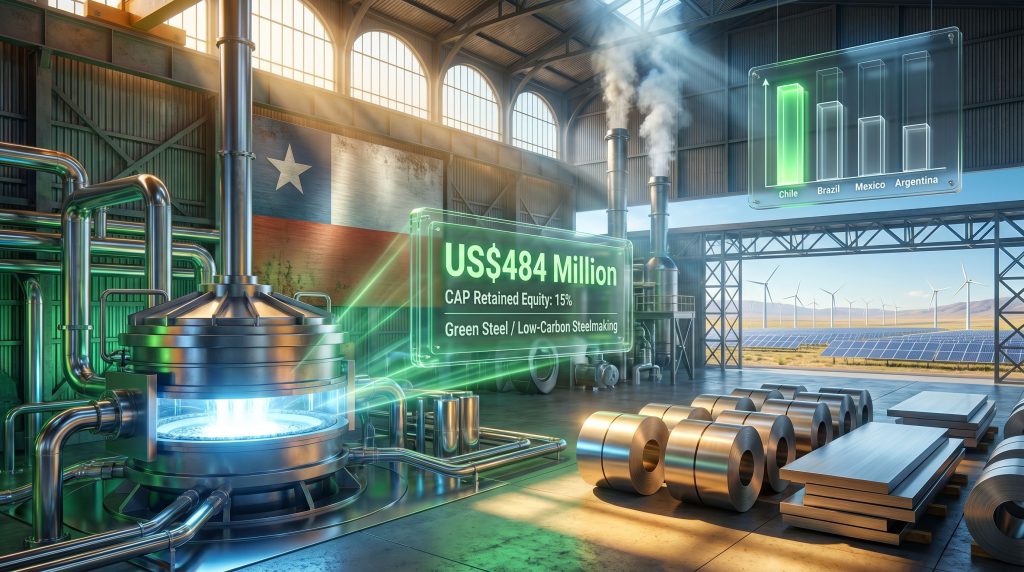
The total reported transaction envelope sits at approximately US$484 million, a figure that encompasses several distinct components:
| Element | Detail |
|---|---|
| Total Transaction Value | ~US$484 million |
| Asset Consideration (reported range) | US$130M to US$150M |
| CAP Retained Equity | 15% in new steel entity |
| Operational Control | Transferred to Aceros AZA |
| Production Model | Green steel / low-carbon steelmaking |
| Geographic Focus | Biobío Region, Chile |
The gap between the asset consideration range of US$130 million to US$150 million and the total US$484 million figure reflects the deal's broader investment commitments, including technology upgrades, working capital provision, and the capitalisation of the new operating entity. CAP's retention of a 15% equity stake in the restructured steel company is particularly telling. Rather than a clean exit, CAP is maintaining upside exposure while transferring operational complexity to a partner with a proven low-carbon production model. This structure functions simultaneously as a financial hedge and a signal of confidence in the long-term viability of the green iron production and green steel thesis.
Who Is Aceros AZA and What Makes Them a Credible Green Steel Operator?
Understanding why AZA is the right counterparty for this transformation requires a brief examination of how the company actually makes steel. Unlike CAP's Huachipato facility, which historically operated as an integrated steelworks using blast furnace technology and iron ore as its primary feedstock, AZA has built its business around electric arc furnace (EAF) production powered predominantly by recycled scrap metal.
This distinction is not merely technical. It represents a fundamentally different emissions profile. Conventional blast furnace steelmaking generates roughly 1.8 to 2.1 tonnes of CO₂ per tonne of steel produced, while scrap-based EAF production can reduce that figure to approximately 0.4 to 0.6 tonnes of CO₂ per tonne, depending on the energy source powering the furnace. When that electricity comes from renewable sources, emissions can fall even further, approaching genuinely near-zero intensity.
AZA's existing operational philosophy aligns directly with this lower-emissions pathway, making the company a strategically coherent rather than merely opportunistic acquirer of Huachipato's assets. The combination pairs CAP's iron ore and legacy steelmaking infrastructure with AZA's circular-economy production expertise, creating a complementary rather than redundant industrial partnership. Furthermore, CAP's evaluation of producing green steel with German assistance reinforces the technical credibility of the decarbonisation ambition underpinning this deal.
Decoding What Green Steel Actually Means in Practice
The term green steel has entered mainstream industrial discourse rapidly enough that its meaning has become somewhat elastic. In the context of the CAP and AZA business combination to reactivate Huachipato with green steel plans, it is worth establishing what the concept means operationally versus aspirationally.
There are three primary production pathways that qualify under the green steel framework:
-
Scrap-based electric arc furnace steelmaking powered by renewable electricity. This is the lowest-capital-intensity pathway and the most immediately deployable. AZA's existing operational model sits squarely in this category.
-
Hydrogen-based direct reduced iron (DRI), where green hydrogen produced from renewable-powered electrolysis replaces coal or natural gas as the reductant in the ironmaking process. This hydrogen iron reduction pathway produces a high-purity iron feedstock that can then be processed in an EAF, achieving very low overall emissions. It is also capital-intensive and currently dependent on green hydrogen achieving competitive cost parity.
-
Carbon capture, utilisation and storage (CCUS) retrofitted to existing blast furnace or basic oxygen furnace operations. This pathway is generally considered the least preferred due to its high ongoing operating cost and the permanence questions around geological carbon storage.
CAP's prior technical collaboration with SMS Group and its subsidiary Paul Wurth on hydrogen-based and low-carbon steelmaking processes at Huachipato is particularly relevant here. Paul Wurth and SMS Group have joined forces with CAP to decarbonise iron ore mining and steelmaking operations in Chile, and its involvement in Huachipato's earlier decarbonisation studies suggests that the facility's transformation pathway has been technically evaluated at a meaningful level of detail, not merely conceptualised.
Green Steel Accountability Framework: Institutional investors and ESG-focused lenders are increasingly demanding measurable, third-party verified emissions benchmarks rather than general decarbonisation commitments. For the Huachipato project, establishing credible scope 1 and scope 2 emissions reporting from the point of reactivation will be critical to accessing concessional green finance and premium-priced green steel offtake contracts.
Chile's Renewable Energy Advantage as a Structural Enabler
One of the less-discussed but strategically critical dimensions of this transaction is Chile's exceptional renewable energy resource base. The country consistently ranks among the world's most cost-competitive solar markets, particularly in the Atacama region of the north, while also possessing significant wind resources along its extended coastline and hydropower capacity in the south.
This energy endowment matters enormously for green steel economics. The cost of green hydrogen, which is the central input for DRI-based low-carbon steelmaking, is directly determined by the cost of renewable electricity used in the electrolysis process. Industry analysis suggests that achieving green hydrogen at below US$2 per kilogram, widely regarded as the threshold for economic viability in industrial applications, requires access to electricity at approximately US$20 to US$30 per megawatt-hour or lower. Chile's solar irradiation levels in the north place it among the handful of countries globally where this cost threshold is potentially achievable within the current decade.
For Huachipato specifically, located in the Biobío region in south-central Chile, the proximity to hydropower and wind resources provides a viable renewable electricity supply for EAF operations, even if the green hydrogen supply chain for a full DRI transition would require longer-term infrastructure development. This positions Chile's green iron transition ambitions on comparably strong structural footing to other resource-rich nations pursuing similar pathways.
Three Strategic Scenarios for the Huachipato Reactivation
The trajectory of this transaction is not predetermined. Depending on market conditions, technology deployment timelines, and financing availability, several distinct scenarios are plausible over the next five to ten years.
Scenario 1: Full Green Steel Reactivation at Scale
Under the most optimistic scenario, Huachipato restarts with renewable-powered EAF operations in the near term while longer-term hydrogen DRI infrastructure is developed in parallel. Chile's decarbonising grid provides an increasingly low-carbon electricity supply over time, and the facility achieves premium green steel pricing in export markets, particularly under the European Union's Carbon Border Adjustment Mechanism (CBAM), which from 2026 onward places a carbon cost on steel imports that do not meet EU emissions standards. This scenario delivers maximum regional employment recovery and positions Chile as a genuine green steel exporter.
Scenario 2: Phased Transition with Hybrid Operations
A more measured trajectory sees Huachipato restart under partially conventional or hybrid operating conditions while green technology infrastructure is commissioned progressively. CAP's 15% equity retention functions as a financial bridge in this scenario, maintaining alignment between the two partners during a capital-intensive transition period. Green steel remains the stated destination, but the timeline extends materially.
Scenario 3: Structural Headwinds Delay the Transition
The most challenging scenario involves global steel overcapacity, particularly from low-cost Asian producers, compressing steel margins to the point where the green premium fails to materialise at sufficient scale. Financing gaps for technology upgrades widen, and the timeline for green hydrogen supply chain development in Chile extends beyond initial projections. In this scenario, Huachipato's reactivation stalls or operates at significantly reduced capacity, with meaningful consequences for the Biobío region's industrial employment base.
The next major ASX story will hit our subscribers first
Latin America's Broader Green Steel Positioning
The CAP and AZA business combination to reactivate Huachipato with green steel plans does not exist in regional isolation. Across Latin America, the steel sector is grappling with comparable transformation imperatives, though the pathways and starting points differ considerably by country. Indeed, the broader steel and iron ore market dynamics globally are reshaping how regional producers must position themselves competitively.
| Country | Key Steel Approach | Transition Pathway | Renewable Energy Position |
|---|---|---|---|
| Chile | CAP / AZA (Huachipato) | EAF + Hydrogen DRI | High (solar, wind, hydro) |
| Brazil | Large integrated producers | Charcoal-based BF + EAF hybrid | Moderate (biomass, hydro) |
| Mexico | EAF-dominant industry | EAF expansion, grid decarbonisation | Moderate (significant solar potential) |
| Argentina | Mixed integrated and EAF | Incremental efficiency gains | Developing |
Brazil's steel sector has long leveraged sustainably sourced charcoal from managed eucalyptus plantations as a partial substitute for metallurgical coal in blast furnace operations, giving Brazilian producers a historical emissions advantage that most other integrated steelmakers lack. Mexico's industry is already more structurally aligned with the green steel future, given its higher proportion of EAF-based production. Chile's challenge and opportunity lie in the fact that its flagship integrated steelworks was built for an era that is now ending, but its renewable energy abundance provides the raw material for a credible reinvention.
Key Risk Factors Investors and Policymakers Should Monitor
Several risk dimensions warrant close attention as the CAP-AZA combination progresses toward execution:
-
Steel price volatility: Global benchmark hot-rolled coil prices have demonstrated significant cyclicality, and the capital-intensive nature of a green steel transition requires sustained price support to justify investment.
-
Green hydrogen supply chain maturity: The Biobío region's proximity to renewable energy does not automatically translate into available green hydrogen at industrial scale. Pipeline infrastructure, electrolyser capacity, and storage logistics all require parallel investment.
-
EU CBAM compliance dynamics: While the CBAM creates a commercial incentive for low-carbon steel exports to Europe, navigating the certification and reporting requirements is administratively complex and may advantage larger, better-resourced producers in the near term.
-
Workforce transition: Converting an integrated steelworks from blast furnace to EAF or DRI-based operations changes the skills profile of the workforce substantially. The Biobío region's employment outcomes will depend heavily on the quality and pace of workforce reskilling programs.
-
Scrap metal availability: EAF-based steelmaking is scrap-dependent, and Chile's domestic scrap supply base is relatively thin compared to more industrially mature economies. Import logistics for scrap feedstock add cost and supply chain complexity.
Frequently Asked Questions
What is the total value of the CAP and AZA business combination to reactivate Huachipato with green steel plans?
The total reported transaction value is approximately US$484 million, encompassing the asset transfer consideration, equity structure, and associated investment commitments. The direct asset consideration has been cited in the range of US$130 million to US$150 million, with the remainder reflecting broader investment obligations tied to the reactivation and green transition plan.
Why was Huachipato shut down?
Huachipato's closure reflected converging pressures including global steel overcapacity, rising input costs, and the competitive disadvantage of operating older blast furnace infrastructure without the capital investment required to modernise or decarbonise. The facility's closure created a significant industrial employment gap in the Biobío region, which the AZA-led reactivation is designed to address. Consequently, the closure's impact on Chile's steel industry future has prompted urgent policy and private sector responses alike.
What stake does CAP retain after the transaction?
CAP retains a 15% equity interest in the newly structured steel operating entity, with full operational control transferring to Aceros AZA. This structure preserves CAP's upside exposure to a successful green steel transition while removing the operational burden of running the facility.
How does the EU Carbon Border Adjustment Mechanism affect this deal's commercial logic?
The CBAM, which places a carbon cost on steel and other materials imported into the European Union based on their embedded emissions, creates a tangible commercial incentive for producers in countries like Chile to decarbonise. Steel produced via renewable-powered EAF or hydrogen DRI routes could qualify for significantly reduced CBAM liabilities, improving its competitive position in European markets relative to conventionally produced alternatives. Furthermore, a zero-carbon steel partnership approach, as seen in other markets, demonstrates the growing global momentum behind this commercial logic.
Is Huachipato's green steel plan technically credible?
The facility's prior technical engagement with SMS Group and Paul Wurth on hydrogen-based steelmaking processes suggests the green transition pathway has been evaluated with meaningful technical rigour. Whether the commercial and financing conditions align to execute the transition at the envisaged pace remains the central open question.
What the Deal Signals for the Future of Industrial Strategy in the Region
The CAP and AZA business combination to reactivate Huachipato with green steel plans represents something more consequential than a single corporate transaction. It is a test of whether the business combination model, pairing legacy asset holders with operationally agile low-carbon operators under a retained-equity structure, can serve as a repeatable mechanism for transforming stranded industrial infrastructure across Latin America.
The metrics that will ultimately determine the deal's legacy extend well beyond financial returns:
- Production restart timeline and initial capacity utilisation rates
- Verified emissions intensity benchmarks from commencement of operations
- Progress toward green hydrogen and renewable energy supply agreements
- Employment outcomes in the Biobío region over a five-year horizon
- Ability to access green steel premium pricing in export markets
If the Huachipato reactivation succeeds on these dimensions, it will offer a credible blueprint for other legacy steelworks across the region facing the same structural crossroads. If it falls short, it will nonetheless generate important lessons about the preconditions required to make the green steel transition economically viable at the scale that Latin America's industrial ambitions demand.
The structural importance of this transaction lies not in its financial architecture alone, but in what it reveals about the conditions under which industrial decarbonisation can be commercially viable in emerging market contexts. Chile's renewable energy abundance, AZA's operational expertise, and CAP's willingness to accept a minority position rather than a full exit together create an unusually well-aligned set of incentives for a genuinely transformative industrial outcome.
Disclaimer: This article is intended for informational purposes only and does not constitute financial, investment, or legal advice. Scenario projections and forward-looking statements involve inherent uncertainty. Readers should conduct their own due diligence before making investment or commercial decisions related to the companies or transactions discussed.
Want to Stay Ahead of the Next Major Mineral Discovery Driving the Green Metals Revolution?
Discovery Alert's proprietary Discovery IQ model delivers real-time ASX alerts on significant mineral discoveries powering the global decarbonisation transition — including the iron ore, scrap metal, and critical minerals underpinning green steel ambitions like Huachipato's — turning complex data across 30-plus commodities into clear, actionable insights. Explore how historic mineral discoveries have generated extraordinary returns and begin your 14-day free trial today to position yourself ahead of the market.