
July 11, 2026
The Mechanics Behind Africa's Shifting Reserve Landscape
Angola yuan reserve requirements have moved from a technical footnote to a signal worth examining closely. Central banks rarely make headlines with technical regulatory adjustments. Yet when a major oil-exporting economy quietly expands the list of currencies its commercial banks can use to satisfy mandatory reserve obligations, the implications extend well beyond balance sheet accounting. The architecture of reserve eligibility shapes how cross-border commerce flows, how banks manage liquidity, and how deeply a foreign currency embeds itself into a nation's financial system.
Understanding this mechanics-first reality is essential before assessing what Angola's July 2026 directive actually means for African monetary policy and for the yuan's expanding role on the continent. Furthermore, the broader geopolitical mining landscape context makes this shift even more consequential for commodity-dependent economies navigating shifting alliances.
When big ASX news breaks, our subscribers know first
What Foreign-Currency Reserve Requirements Actually Do
The Difference Between Domestic and External Stability Tools
Most discussions of central bank reserve requirements focus on domestic liquidity buffers — the percentage of customer deposits that commercial banks must hold in reserve to prevent bank runs and maintain payment system integrity. Foreign-currency reserve requirements operate on a separate but related principle. Rather than targeting domestic deposit stability, they govern the composition of external buffers held by commercial banks, ensuring that institutions carrying foreign-currency liabilities also hold sufficient qualifying foreign assets.
The currencies a central bank approves for this purpose are not chosen arbitrarily. Eligible currencies are typically selected based on a combination of trade volumes, the denomination of external debt obligations, correspondent banking relationships, and the practical availability of those currencies within the domestic financial system. Consequently, adding or removing a currency from the eligibility list signals something concrete about the central bank's assessment of that currency's relevance to the real economy it oversees.
Angola's Four-Currency Reserve Framework
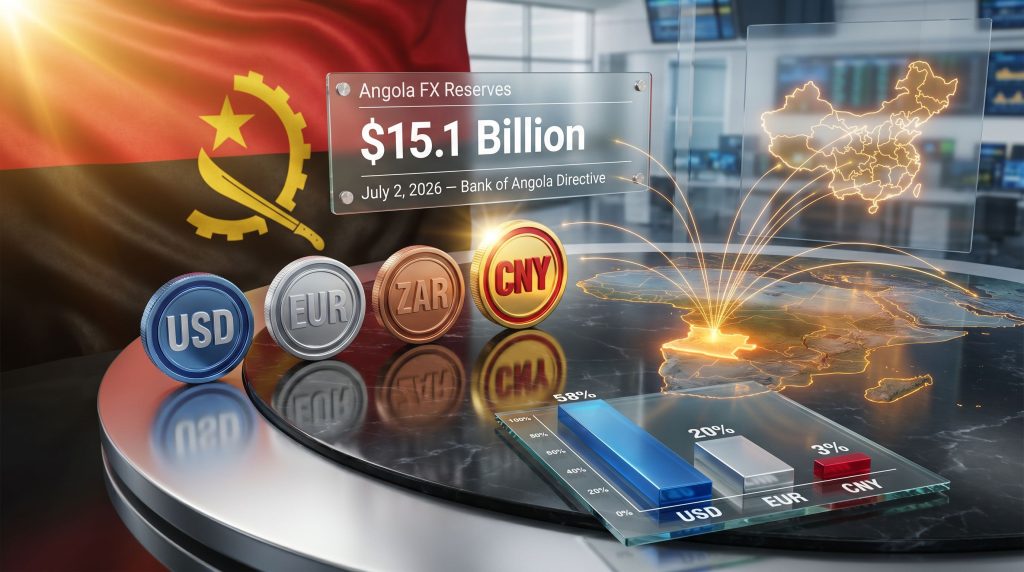
Prior to the July 2026 directive, Angola's eligible foreign-currency reserve framework centred on three currencies. The Bank of Angola's updated directive formally expanded this to four:
| Reserve Currency | Approximate Global Reserve Share | Primary Rationale for Angola |
|---|---|---|
| U.S. Dollar (USD) | ~58% of global reserves | Dominant commodity pricing currency |
| Euro (EUR) | ~20% of global reserves | European trade and investment linkages |
| South African Rand (ZAR) | Regional anchor currency | SADC regional trade integration |
| Chinese Yuan (CNY) | ~2-3% of global reserves | Largest bilateral trading partner and infrastructure creditor |
Sources: IMF COFER data; Bank of Angola directive, July 2, 2026.
The yuan's inclusion alongside currencies commanding far greater shares of global reserves underscores a critical point: Angola's decision is anchored in trade-relationship logic, not financial-market weight. The yuan matters to Angola's banking system because China matters to Angola's economy, not because of the renminbi's standing in global capital markets.
Angola's total foreign exchange reserves stood at approximately $15.1 billion as of August 2025, providing the scale context within which this currency diversification operates.
Deconstructing the Bank of Angola's July 2 Directive
What the Policy Does and Does Not Require
Precision matters here, and conflation of two distinct concepts has already muddied public discussion of this directive. The Bank of Angola's July 2, 2026 regulatory instruction made the Chinese yuan an eligible currency for satisfying foreign-currency reserve requirements. This is categorically different from establishing a mandated minimum ratio for yuan holdings.
Policy Clarity: Angola has not imposed any minimum percentage threshold requiring commercial banks to hold a specific proportion of reserves in yuan. The directive expands the menu of qualifying currencies. Banks gain the option, not the obligation, to apply existing yuan balances toward their reserve compliance calculations. This is a permissive regulatory expansion, not a prescriptive mandate.
This distinction carries meaningful practical implications. The actual scale of yuan accumulation within Angola's commercial banking sector will depend on the organic flow of yuan through trade settlement and correspondent banking channels, not on a regulatory minimum. The central bank gains flexibility in how it assesses reserve adequacy; commercial banks gain efficiency in how they satisfy obligations using currencies they are already receiving from business operations.
The Policy Timeline: From Legal Tender to Reserve Eligibility
Angola's yuan integration has followed a deliberate, multi-stage progression:
-
August 2023: The Angolan government formally designated the Chinese yuan as the country's second legal tender alongside the Angolan Kwanza, permitting its use in domestic payments, commercial invoicing, and transaction settlement.
-
July 2, 2026: The Bank of Angola extended yuan eligibility into the commercial banking reserve framework, embedding the currency into the regulatory architecture governing financial system stability.
This sequence is significant. Legal tender status addressed the transactional layer of the economy. Reserve eligibility addresses the structural layer. Moving the yuan from a currency businesses can use in daily transactions to one that counts toward the banking system's mandatory safety buffers represents a qualitative deepening of integration, not simply an administrative update.
Why Angola: The Structural Case for Yuan Reserve Integration
Two Decades of Chinese Economic Engagement
Angola's relationship with China has evolved through sustained economic interdependence built across commodity trade, infrastructure financing, and diplomatic engagement spanning more than two decades. China absorbs the dominant share of Angola's crude oil exports, making it the country's largest bilateral trading partner by volume. Alongside commodity purchases, Chinese financing has underwritten billions of dollars in Angolan infrastructure across roads, railways, hydroelectric facilities, and telecommunications networks.
The financial consequence of this relationship is straightforward: when your largest trading partner and primary infrastructure creditor transacts substantially in its own currency, holding that currency as a reserve asset reduces friction throughout the system. Angolan commercial banks receiving yuan from oil settlements or trade transactions no longer face the same operational incentive to convert those balances into dollars before depositing them against reserve obligations.
The 2023 bilateral monetary agreement that accompanied the legal tender designation also established a reciprocal currency recognition framework, with the Angolan Kwanza accepted in China for certain transaction purposes, creating a two-way foundation for deeper financial integration. In addition, this development reflects the escalating US-China trade impacts that are reshaping how developing economies position themselves between competing financial systems.
Angola Within the Broader African Yuan Adoption Pattern
Angola is not an isolated case. Approximately 14 countries in eastern and southern Africa have either adopted or are actively evaluating yuan reserve integration. The structural drivers are consistent across these economies:
- Elevated exposure to Chinese trade as a share of total bilateral commerce
- Significant infrastructure debt with Chinese lenders, sometimes denominated in yuan or requiring yuan-adjacent servicing
- Practical interest in reducing double-conversion foreign exchange costs
- Desire to reduce concentration risk in reserve portfolios dominated by a single currency
- Active engagement with China's expanding cross-border payment infrastructure
| Country | Yuan Reserve/Settlement Status | Primary Driver |
|---|---|---|
| Angola | Reserve eligible (2026); legal tender (2023) | Oil exports + infrastructure debt |
| South Africa | Yuan clearing hub; PBoC swap line | Regional financial centre function |
| Kenya | CIPS participant; settlement expansion | Trade finance diversification |
| Egypt | Yuan-denominated bond issuance | Debt portfolio diversification |
| Nigeria | PBoC yuan swap line | Import financing for Chinese goods |
Note: Reserve and settlement status varies across countries; table reflects publicly reported positions as of mid-2026.
How Yuan Reserve Eligibility Works in Practice
Step-by-Step: Commercial Bank Compliance Under the New Framework
For Angolan commercial banks, the operational process for meeting foreign-currency reserve requirements now functions as follows:
-
Calculate total foreign-currency reserve obligation based on deposit liabilities and the Bank of Angola's applicable ratio.
-
Identify eligible currency holdings from the approved list: USD, EUR, ZAR, and now CNY.
-
Allocate yuan balances toward reserve compliance where yuan has been received through trade settlement, correspondent banking, or other legitimate inflows.
-
Report reserve composition to the Bank of Angola on the required schedule, demonstrating that the aggregate obligation is met regardless of the specific currency mix applied.
-
Reduce double-conversion costs by avoiding the intermediate step of converting yuan to dollars solely to satisfy reserve requirements before converting back to yuan for operational purposes.
This operational efficiency gain is not trivial. In economies where bilateral trade with China runs into billions of dollars annually, the foreign exchange transaction costs of constant currency conversion represent a measurable drag on the banking system's efficiency.
Is the Dollar Under Threat? A Grounded Assessment
Putting Yuan Reserve Share in Global Perspective
The U.S. dollar retains approximately 58% of global foreign exchange reserves according to IMF COFER data, while the Chinese yuan accounts for roughly 2-3%. The euro, Japanese yen, and British pound each command greater shares of global reserves than the renminbi. A single African country's regulatory adjustment cannot meaningfully shift these structural realities.
Key Insight: The yuan's expanding presence in African reserve frameworks is better understood as pragmatic trade alignment than as ideological de-dollarisation. Countries are not abandoning the dollar; they are reducing the friction costs of doing business with their largest commercial partner.
Separating De-Dollarisation Rhetoric from Reserve Diversification Reality
These two concepts are frequently conflated in media coverage but represent genuinely different phenomena:
-
De-dollarisation in its strict definition involves deliberate policy to displace the dollar as the primary unit of account, settlement mechanism, and reserve store of value across a monetary system.
-
Reserve diversification involves the incremental addition of alternative qualifying currencies to reduce concentration risk and improve operational efficiency, while the dollar retains its dominant position.
Angola's directive sits firmly in the second category. The U.S. dollar remains the primary pricing currency for Angola's crude oil exports and the dominant instrument in its international debt obligations. The yuan's reserve eligibility reflects a technocratic adjustment to regulatory reality, not a geopolitical declaration.
The next major ASX story will hit our subscribers first
China's Renminbi Internationalisation Architecture
The Infrastructure Behind the Yuan's Global Push
China's campaign to expand the yuan's international role rests on several interconnected pillars that operate simultaneously. Understanding this architecture is essential context for evaluating Angola yuan reserve requirements within the wider renminbi strategy:
-
CIPS expansion: The Cross-Border Interbank Payment System provides an alternative settlement infrastructure to SWIFT for yuan-denominated transactions, lowering the operational cost of renminbi cross-border payments across participating institutions.
-
Bilateral currency swap lines: The People's Bank of China has established swap agreements with numerous central banks, providing yuan liquidity access to trading partners without requiring dollar intermediation.
-
Renminbi clearing bank designations: In the weeks preceding Angola's July 2026 directive, the People's Bank of China authorised expanded yuan clearing arrangements across Africa through major banking partners, directly reducing the cost of yuan settlement for businesses across the continent.
-
Petro-yuan initiatives: China's ongoing effort to price and settle oil transactions in yuan carries particular relevance for Angola as one of Africa's largest crude exporters, as it creates a natural channel through which yuan enters Angola's financial system at scale.
Africa as a Strategic Priority for Yuan Internationalisation
Africa presents a structurally favourable environment for yuan adoption relative to other emerging market regions for several reasons. China has been the continent's largest bilateral trading partner for over a decade. Chinese infrastructure financing has created yuan-adjacent debt service obligations across dozens of economies.
This phase-based evolution also connects directly to the China trade strategy underpinning Beijing's broader resource-access objectives, where financial architecture and commodity supply chains reinforce one another. The phase-based evolution of China's African engagement illustrates how financial architecture integration follows naturally from earlier commercial foundations:
-
Phase 1 (2000–2010): Resource-for-infrastructure model, with Chinese loans financing African projects in exchange for commodity export agreements.
-
Phase 2 (2010–2020): Trade deepening, with China becoming the dominant bilateral trading partner across most of sub-Saharan Africa.
-
Phase 3 (2020–present): Financial architecture integration, with yuan inclusion in reserve frameworks, legal tender designations, clearing bank networks, and cross-border payment systems embedding Chinese financial infrastructure into African monetary systems.
Risks and Limitations That Deserve Scrutiny
Convertibility Constraints and Managed Exchange Rate Risk
The yuan remains a managed currency. The People's Bank of China maintains significant control over its exchange rate through a managed float mechanism, meaning that in periods of financial stress, accessing yuan liquidity or converting yuan reserves into other currencies may be constrained in ways that dollar or euro reserves are not. Angola's Kwanza is itself a managed currency with limited convertibility, meaning the bilateral financial relationship carries compounded exchange rate complexity that reserve managers must account for.
The Creditor-Currency Concentration Problem
A structural risk specific to heavily China-indebted economies deserves particular attention. Angola carries significant external debt obligations to Chinese creditors. Simultaneously increasing yuan reserve holdings while managing yuan-adjacent debt service obligations creates a pro-cyclical vulnerability: during periods of economic deterioration, the same bilateral relationship generating yuan inflows through trade also generates yuan outflow demands through debt service. Sovereign reserve management frameworks in similar positions must stress-test this dynamic explicitly.
Transparency and Reporting Gaps
Angola has not publicly disclosed the currency breakdown of its approximately $15.1 billion in foreign exchange reserves. The absence of a mandated minimum yuan holding ratio means the actual scale of yuan accumulation within the commercial banking system remains opaque to external observers. This limits independent assessment of Angola's true exposure to yuan-denominated assets and makes monitoring of systemic risk more difficult.
Furthermore, the critical minerals demand surge reshaping commodity markets adds another layer of complexity, as resource-rich nations like Angola must balance financial integration decisions against strategic resource positioning. The geopolitical minerals race unfolding globally underscores how currency policy and resource access are increasingly inseparable strategic considerations.
Key Facts at a Glance
| Policy Dimension | Detail |
|---|---|
| Directive Date | July 2, 2026 |
| Issuing Authority | Bank of Angola |
| Regulatory Change | Yuan added as eligible foreign-currency reserve currency |
| Currencies Now Eligible | USD, EUR, ZAR, CNY |
| Mandatory Yuan Ratio | None; voluntary diversification framework |
| Legal Tender Precedent | Yuan designated second legal tender, August 2023 |
| Angola's Total FX Reserves | ~$15.1 billion (August 2025) |
| African Countries Considering Yuan Reserve Integration | ~14 in eastern and southern Africa |
| Primary Strategic Driver | Trade alignment with China as largest bilateral partner |
| Dollar Displacement Risk | Low; dollar remains dominant reserve and pricing currency |
Frequently Asked Questions: Angola Yuan Reserve Requirements
What did Angola's central bank actually approve?
The Bank of Angola issued a directive on July 2, 2026, making the Chinese yuan an eligible currency for commercial banks to use when satisfying mandatory foreign-currency reserve requirements. The yuan joins the U.S. dollar, euro, and South African rand as approved reserve currencies. The change is permissive, giving banks the option to apply yuan holdings toward reserve obligations without imposing a minimum yuan holding threshold.
Does Angola have a mandatory minimum yuan reserve requirement?
No. Angola has not established any fixed percentage requiring commercial banks or the central bank itself to hold a specific proportion of reserves in yuan. This is voluntary diversification eligibility, not a prescriptive mandate.
When did Angola first integrate the yuan into its financial system?
Angola formally designated the Chinese yuan as its second legal tender alongside the Kwanza in August 2023, permitting its use in domestic payments and commercial transactions. However, as African central banks have increasingly explored yuan adoption, Angola's move predated many of its regional peers in formalising this step. The July 2026 directive represents the next stage of that integration at the banking system level.
Does this signal Angola moving away from the U.S. dollar?
No. The U.S. dollar remains Angola's primary reserve and trade settlement currency. The yuan reserve eligibility reflects the practical reality of Angola's trade relationships rather than a strategic decision to displace dollar holdings. Angola's oil exports continue to be priced primarily in dollars, and the country's international debt obligations are predominantly dollar-denominated.
How many African countries are exploring yuan reserve integration?
Approximately 14 countries in eastern and southern Africa have either adopted or are actively evaluating yuan reserve integration, driven primarily by the scale of Chinese trade exposure and infrastructure investment across the continent.
Disclaimer: This article is intended for informational purposes only and does not constitute financial or investment advice. Figures relating to reserve shares, foreign exchange reserves, and bilateral trade relationships are drawn from publicly available data and are subject to revision. Readers should conduct independent research before making any financial decisions.
Want to Stay Ahead of the Next Major Mineral Discovery on the ASX?
Discovery Alert's proprietary Discovery IQ model delivers real-time alerts on significant ASX mineral discoveries, transforming complex data across 30-plus commodities into clear, actionable insights for both short-term traders and long-term investors — explore historic discovery returns on Discovery Alert's dedicated discoveries page and begin your 14-day free trial to position yourself ahead of the broader market.