August 8, 2026
The Hidden Bottleneck Slowing Critical Mineral Supply Chains
The global race to secure critical minerals is not simply a geological or geopolitical problem. It is, at its core, a technology adoption problem. Billions of dollars worth of copper, rare earth elements, and other strategically vital materials sit in deposits that conventional extraction methods cannot reach economically or responsibly. Meanwhile, the mine sites that have already been worked sit in legal and ecological limbo for decades, waiting for monitoring systems slow enough to frustrate regulators, communities, and investors alike.
This is the structural gap that digital funding for mining technology is designed to close. Not through basic research, but through accelerating the commercialisation of tools that already exist in prototype form and need only the financial bridge and operational proving ground to reach industrial scale.
Understanding why this matters requires stepping back from the headlines and looking at what the mining sector's digital transition actually demands.
When big ASX news breaks, our subscribers know first
Why Conventional Extraction Is Hitting Its Limits
Traditional bulk mining approaches, whether open pit or conventional underground development, were engineered around a simple principle: move as much material as possible, then sort out what is valuable. That logic worked well for thick, uniform orebodies. It breaks down almost entirely when applied to narrow veins, geologically complex structures, or deposits situated in jurisdictions where community scrutiny and environmental regulation make large surface footprints commercially and socially unacceptable.
The numbers illustrate the problem clearly. A significant proportion of known critical mineral resources globally remain either undeveloped or only partially accessed precisely because existing methods generate too much waste, too much disruption, and too much long-term liability to justify the capital expenditure.
This is not a future risk. It is a present constraint. Copper demand tied to electric vehicle manufacturing, grid infrastructure, and defence electronics is rising sharply, while discovery rates and mine development timelines have not kept pace. The International Energy Agency has consistently flagged copper and rare earth elements as among the most supply-constrained materials in the energy transition. The production gap is not theoretical. Furthermore, critical minerals demand continues to outpace the industry's ability to bring new deposits into production responsibly.
Post-mining site closure compounds this problem from the opposite end of the mine lifecycle. Under conventional monitoring frameworks, ecological restoration is tracked through periodic, disconnected assessments covering biology, soil chemistry, and landscape conditions in separate cycles that rarely integrate into a coherent picture. The result is that mine closure certification can stretch across multiple decades, creating open-ended financial provisioning requirements and persistent community trust deficits that affect an operator's social licence across their entire portfolio.
What Canada's DIGITAL Cluster Actually Does
Established in 2018 under Canada's Cluster Initiative, DIGITAL occupies a specific and often misunderstood role in the innovation funding ecosystem. It is not a research grant program. It does not fund early-stage laboratory science. Its mandate is commercialisation acceleration, which means connecting technology developers who have functional systems with industry partners willing to test and validate those systems in live operational environments.
The co-investment structure is central to how this works. Public capital is matched by industry partner contributions, creating shared accountability for field performance rather than allowing the risk to sit entirely with either the developer or the public funder. This architecture is deliberately designed to generate the real-world performance data that procurement decision-makers at operating mines require before they will commit capital to unfamiliar technology.
DIGITAL projects a C$750 million five-year revenue impact for Canadian mining technology companies across its full portfolio, driven by the combination of domestic market validation and the international credibility that comes from proven field deployment.
C$6.7 Million Targeting the Full Mine Lifecycle
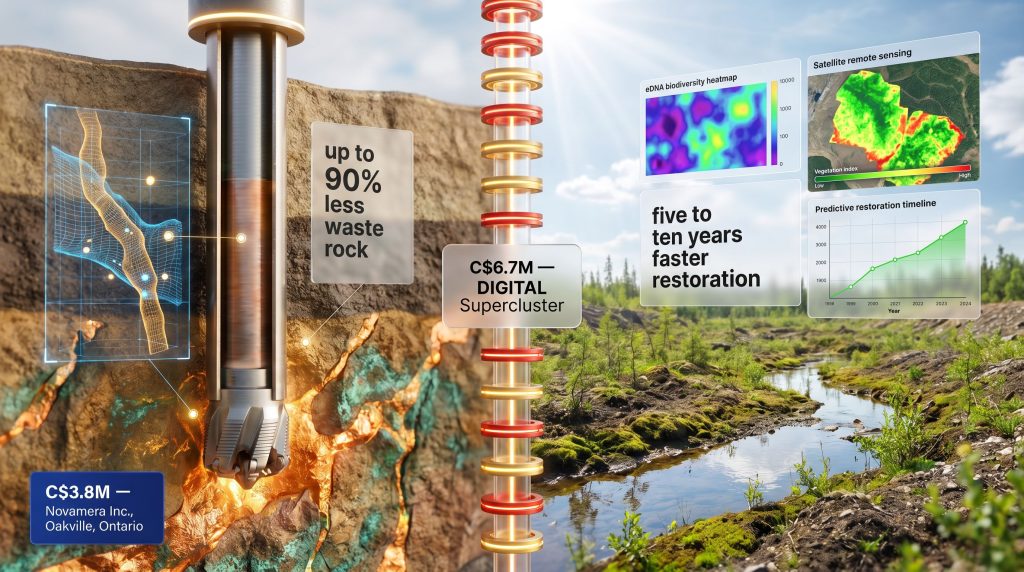
In July 2026, DIGITAL announced a C$6.7 million co-investment commitment directed at two projects chosen specifically because they address different ends of the mine lifecycle. Together, they represent a coherent investment thesis: that the most durable value in digital funding for mining technology comes from solving both the extraction problem and the closure problem simultaneously.
| Project | Company | Headquarters | DIGITAL Funding | Technology Domain |
|---|---|---|---|---|
| Surgical Mining for Critical Minerals | Novamera Inc. | Oakville, Ontario | C$3.8M (~US$2.7M) | Subsurface imaging, AI vein modelling, robotics, reverse circulation drilling |
| Multi-lens Ecological Restoration Platform | Koonkie Canada Inc. | Vancouver, BC | C$2.9M (~US$2.0M) | eDNA, mobile soil analysis, remote sensing, AI forecasting |
| Combined Commitment | C$6.7M (~US$4.7M) | Front-to-back mine lifecycle digital transformation |
Surgical Mining: Precision Extraction as a Supply Chain Strategy
The Engineering Problem in Plain Terms
Narrow-vein deposits present a specific technical challenge that goes beyond simple drilling difficulty. When the mineralised material occupies a vein that may be only centimetres to a few metres wide, surrounded by barren or lower-grade host rock, any extraction method that disturbs a large volume of surrounding material generates enormous dilution. The ore grade reaching the processing plant drops, processing costs per unit of recovered metal rise, and the economic case for the deposit collapses.
This is not a marginal problem. A substantial portion of undeveloped copper and rare earth supply chains globally are constrained by exactly this geometry, particularly in older, structurally complex terranes where high-grade material is concentrated in fault-controlled veins rather than bulk disseminated systems.
Novamera's CEO Jim Hollis has stated publicly that North America does not face a shortage of critical minerals so much as a shortage of methods to bring them into production quickly and responsibly. That framing is industrially precise. The resource is there. The extraction pathway is what has been missing.
How Novamera's Surgical Mining System Works Step by Step
The surgical mining process is built around a sequence of tightly integrated steps, each of which depends on the accuracy of the preceding one:
-
Downhole sensor deployment: Instruments are lowered into the target zone to capture high-resolution data on the geometry, orientation, and composition of the mineralised vein. Techniques associated with downhole geophysics are central to this step, providing the subsurface imaging that makes precision extraction possible.
-
Three-dimensional vein modelling: AI software processes the sensor data to construct a precise digital model of the vein, defining its boundaries and internal variability.
-
Drilling path optimisation: Guidance algorithms calculate the trajectory that will intercept the mineralised zone with maximum precision and minimum disturbance to surrounding host rock.
-
Reverse circulation extraction: A large-diameter reverse circulation drill, assisted by air-lift technology, brings the orebody material directly to surface through the drill string rather than via conventional mucking.
-
Cemented void backfill: The excavated void is filled with cemented aggregate material, stabilising the subsurface structure and eliminating long-term open-void hazard.
The comparison to laparoscopic surgical technique is technically apt. The system uses real-time imaging to navigate within a confined, structurally complex space while minimising collateral tissue disruption. The analogy is not merely rhetorical. It reflects the core engineering philosophy: intervene precisely, extract specifically, and leave the surrounding material intact.
Performance Metrics and Prior Field Validation
The claimed up to 90% reduction in waste rock generation relative to conventional methods is the headline figure, but the deeper operational significance lies in what that reduction enables. A project that would generate insufficient margins under conventional bulk extraction, because of dilution, waste handling costs, or environmental footprint constraints, may cross the viability threshold under a surgical approach. That is a direct expansion of the addressable resource base, not merely an incremental improvement in process efficiency.
DIGITAL's prior commitment of C$3.5 million in 2024 supported a Novamera field demonstration on narrow-vein deposits in eastern Canada, conducted in partnership with Great Atlantic Resources and Maritime Resources. The 2026 funding builds directly on that validated foundation, funding the development of higher-resolution imaging tools, upgraded AI processing pipelines, and commercial-scale testing at an active Canadian copper project.
A component of the new funding also supports collaborative work with the Province of Ontario toward a faster permitting pathway for surgical mining operations. This is a critical acknowledgement that technical validation alone does not determine adoption rates. Regulatory cycle times represent an equally significant barrier, and addressing it requires deliberate policy engagement alongside technological development.
AI-Powered Ecological Restoration: Restructuring the Economics of Mine Closure
Why Conventional Mine Closure Is Financially Broken
Mine closure provisioning is one of the most significant long-tail financial risks in resource sector investment. Under conventional frameworks, operators carry open-ended reclamation liabilities for decades because ecological monitoring systems cannot generate the integrated, real-time data needed to demonstrate that restoration benchmarks have been met.
The absence of this data is not a regulatory choice. It reflects a genuine technical limitation. Biological surveys, soil chemistry assessments, and landscape monitoring have historically been conducted through separate methodologies, by different specialists, on different timelines, and with outputs that are difficult to integrate into a unified restoration trajectory model. The result is that no single picture of ecological recovery ever exists. However, mine reclamation innovation is beginning to address this gap through integrated digital monitoring platforms.
Koonkie's Multi-Lens Platform: Four Data Streams, One AI Model
Koonkie's approach addresses this integration problem directly by combining four complementary data streams into a single AI-powered analytical layer:
-
Environmental DNA analysis: eDNA sampling across the site identifies the full biological community, from soil microbial consortia through plant and invertebrate species to larger fauna, providing both a baseline and a continuous recovery trajectory. This is a particularly significant technical advance because eDNA can detect species presence and community composition far more comprehensively and cost-effectively than traditional biological surveys.
-
Mobile soil analysis: Portable instruments map nutrient profiles, organic matter content, contamination indicators, and physical soil structure across the site in near real-time, replacing laboratory-dependent sampling cycles that previously introduced multi-week delays into the data pipeline.
-
Remote sensing imagery: Satellite and aerial platforms capture landscape-scale changes in vegetation cover, hydrology, surface temperature, and land use, providing spatial context that ground-based sampling alone cannot deliver.
-
Indigenous ecological knowledge integration: This is arguably the most methodologically significant element of the platform architecture. Traditional land steward knowledge systems are formally embedded into the monitoring framework as a structured data input, not as supplementary commentary. This means restoration targets are calibrated against both scientific benchmarks and culturally significant ecological indicators, producing a compliance framework that is more robust and more socially legitimate than science-only approaches.
The integration of Indigenous ecological knowledge into a digital AI platform is a structural departure from consultation-as-process toward knowledge-as-data. It has the potential to redefine what mine closure certification means, both technically and socially, particularly in jurisdictions where Indigenous land rights carry legal weight in the regulatory process.
Projected Restoration Outcomes
The performance projections attached to the Koonkie platform are substantial:
-
Ecological restoration timelines shortened by five to ten years relative to conventional monitoring approaches.
-
Restoration cost reductions of up to 40% compared to legacy methods, driven by integrated real-time data replacing redundant periodic assessments.
-
Evidence-based closure decisions replacing milestone-driven assessments conducted without a unified ecological picture.
For the resource investment community, the financial implication is direct. If mine closure timelines can be shortened by a decade and associated costs reduced by 40%, the net present value of reclamation liabilities across an operator's portfolio improves materially. That is not an abstract environmental outcome. It is a balance sheet event.
The next major ASX story will hit our subscribers first
The Broader Digital Mining Investment Landscape
Digital funding for mining technology does not operate in isolation. It reflects a global reorientation of both public and private capital toward adoption-acceleration rather than research funding, a distinction that matters enormously for how quickly technologies reach commercial deployment.
| Funding Program | Region | Scale | Primary Mechanism |
|---|---|---|---|
| DIGITAL Supercluster | Canada | C$750M projected 5-yr revenue impact | Co-investment, commercialisation acceleration |
| U.S. DOE Mine of the Future | United States | $80M grant, part of $1B initiative | Proving grounds, minimum 20% cost-share |
| Private and venture capital | Global | $400M+ estimated in dual-use tech | Commercial return, technology scaling |
| Corporate IT investment | Global | >90% of mining leaders increasing digital spend | AI, digital twins, automation, data analytics |
The U.S. Department of Energy's Mine of the Future program, part of a broader $1 billion federal initiative to secure domestic critical mineral supply chains, applies the same proving-ground philosophy as DIGITAL. Real-world testing environments, not laboratories, are the proving ground of record. The minimum 20% industry cost-share requirement ensures that private sector accountability is built into every funded project from inception. In addition, AI in mineral exploration is attracting growing proportions of both public and private investment across these programs.
Technology Categories Attracting the Most Capital
Across both public programs and private investment, the following technology domains are drawing the most sustained attention:
-
Artificial intelligence and machine learning applied to geological modelling, process optimisation, and predictive environmental monitoring.
-
Robotics and automation reducing human exposure in hazardous environments while improving operational precision and consistency.
-
Digital twins enabling virtual scenario modelling across mine planning, equipment maintenance, and closure management. The Minerals Council of Australia's digital mine report outlines how digital twin adoption is reshaping operational decision-making across the sector.
-
Environmental DNA and advanced ecological sensing emerging as a critical compliance category as regulators tighten biodiversity offset and closure certification requirements.
-
IoT sensor networks providing continuous real-time visibility across distributed mine assets, replacing periodic inspection regimes.
Barriers That Capital Alone Cannot Overcome
The DIGITAL funding model is well-designed for what it targets. However, it is worth being precise about what it does not solve.
Permitting cycle times remain one of the most persistent non-technical barriers to mining technology adoption. The Novamera-Ontario permitting pathway initiative is a direct acknowledgement that a technology can be technically validated and commercially ready while still facing multi-year regulatory approval cycles before deployment can proceed at scale.
Workforce capability gaps represent a second structural constraint. Deploying AI-integrated extraction and restoration systems requires data science literacy, systems thinking, and digital operational competence that are not uniformly distributed across the mining workforce. Technology investment without workforce investment produces underutilised systems. EY's digital mine analysis highlights this skills gap as one of the foremost barriers to sustained digital transformation in the resources sector.
Community and Indigenous engagement cannot be reduced to data integration. The Koonkie platform's knowledge integration approach is a significant methodological advance, but embedding Indigenous knowledge into a digital system is not a substitute for the sustained relationship-building and shared governance structures that underpin genuine partnership. The technology enables, but the relationships must precede it.
Frequently Asked Questions: Digital Funding for Mining Technology
What is DIGITAL and how does its co-investment model work?
DIGITAL is Canada's federally-established Global Innovation Cluster for digital technologies, created in 2018. It pairs public funding with industry partner contributions to test and validate technologies in operating environments. The shared financial structure creates accountability for real-world performance rather than purely technical demonstration.
What is surgical mining and why is it relevant to critical mineral supply chains?
Surgical mining uses downhole sensors, AI-driven vein modelling, and reverse circulation drilling to selectively extract mineralised material from narrow or irregular deposits while leaving surrounding rock largely undisturbed. The method can reduce waste rock generation by up to 90% and makes previously uneconomic deposits commercially viable, directly expanding the available critical mineral resource base.
How does eDNA analysis improve mine restoration monitoring?
Environmental DNA sampling identifies the full biological community present at a site, including microbial, plant, and animal species, far more comprehensively and cost-effectively than traditional survey methods. When integrated with soil analysis and remote sensing within an AI platform, eDNA data enables continuous tracking of ecological recovery rather than periodic snapshot assessments.
What financial impact could faster mine closure have for investors?
If AI-integrated restoration platforms can reduce closure timelines by five to ten years and cut associated costs by up to 40%, the net present value of outstanding reclamation liabilities improves materially across an operator's portfolio. This has direct implications for asset valuation, project financing terms, and long-term return on capital in the resource sector.
How does Canada's DIGITAL program compare to U.S. mining technology initiatives?
Both programs prioritise real-world proving grounds over laboratory research and require industry co-investment. DIGITAL projects a C$750 million five-year revenue impact across its portfolio. The U.S. DOE's Mine of the Future program offers $80 million in grants as part of a broader $1 billion federal commitment to critical mineral supply chain security, with a minimum 20% cost-share requirement for all funded projects.
This article contains forward-looking statements and projections including cost reduction estimates, timeline compression forecasts, and revenue impact figures. These represent projected outcomes based on current development plans and program parameters and are subject to change. Readers should conduct independent research before making any investment decisions.
Want to Track the Next Major ASX Mineral Discovery Before the Market Moves?
Discovery Alert's proprietary Discovery IQ model scans ASX announcements in real time, instantly identifying significant mineral discoveries across critical commodities — including the copper and rare earth sectors reshaping global supply chains — and converting complex data into clear, actionable insights for investors at every experience level. Start a 14-day free trial with Discovery Alert today, or explore the historic returns major discoveries have delivered to understand what early positioning can mean for a portfolio.