
August 8, 2026
When the Majority Moves Against the Minority: The Economics of Bauxite Takeovers
In global commodity markets, the moment a majority shareholder launches a below-market takeover bid for a resource company on the cusp of production, it rarely signals weakness in the asset itself. More often, it reflects a calculated decision to consolidate control before the project transitions from capital-intensive development into cash-generating operations. This dynamic sits at the centre of one of the more consequential corporate events currently unfolding in African mineral development.
The A2MP takeover bid for Canyon Resources and its flagship Minim Martap bauxite project in Cameroon encapsulates a broader tension that recurs throughout junior mining: the competing interests of a controlling shareholder seeking to reshape an asset's strategic trajectory, and minority shareholders who may have invested on the basis of a fundamentally different value proposition.
When big ASX news breaks, our subscribers know first
Understanding the Offer: Structure, Price, and Strategic Intent
A2MP Investments FZCO currently controls 55.56% of Canyon Resources through its associates, making it the dominant force in the company's shareholder register. The off-market cash bid targets the remaining 44.44% of Canyon shares not currently under A2MP's umbrella.
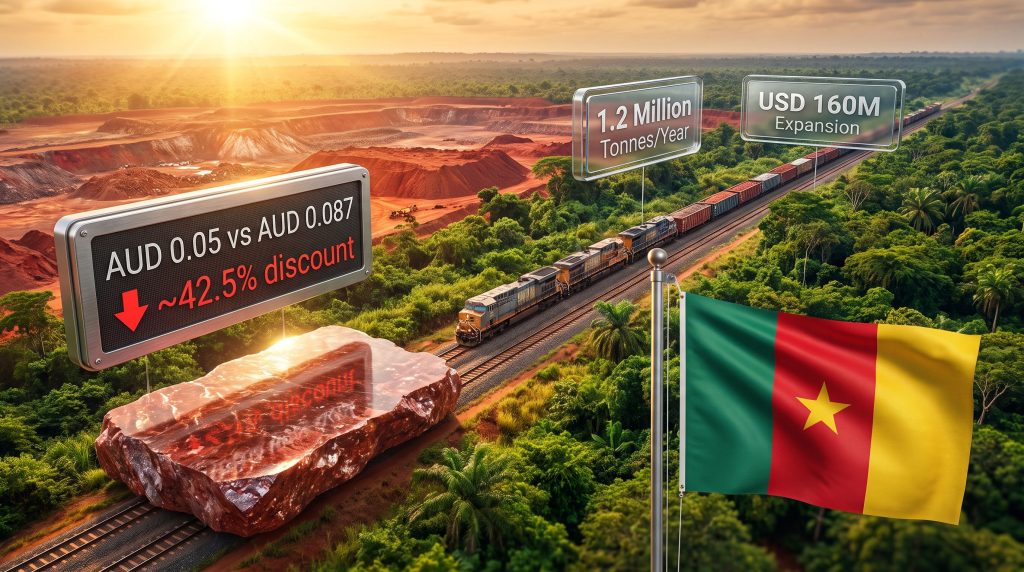
The offer price of AUD 0.05 per share (approximately USD 0.035) implies a total equity valuation of roughly AUD 103 million (USD 72.1 million). On the surface, this might appear a reasonable entry point for a project of Minim Martap's scale. The problem is that Canyon's shares were trading at AUD 0.087 (USD 0.061) at the reference date of July 28, 2026, meaning the bid is pitched at a discount of approximately 42.5% to the prevailing market price.
| Metric | Value |
|---|---|
| Offer price per share | AUD 0.05 (USD 0.035) |
| Canyon closing price (July 28, 2026) | AUD 0.087 (USD 0.061) |
| Implied discount to market | ~42.5% |
| Implied total equity valuation | ~AUD 103 million (USD 72.1 million) |
| A2MP current ownership | 55.56% |
| Shares targeted by bid | 44.44% |
| Minimum acceptance threshold | 75% of total shares |
The bid is fully funded with no financing conditions attached, and the only substantive condition beyond the standard no prescribed occurrences clause is a minimum 75% acceptance threshold. Since A2MP already holds 55.56%, it needs to capture a meaningful portion of the remaining minority to cross that line.
A fully funded, condition-light offer from an entrenched majority shareholder is not a tentative market test. It signals a deliberate intent to achieve a definitive outcome, with economic justifications assembled in advance to support the price being offered.
The DFS Under Fire: Dissecting A2MP's Economic Challenge
The intellectual engine driving this takeover is A2MP's assertion that Canyon's September 2025 Definitive Feasibility Study (DFS) was constructed on assumptions that have since become disconnected from market realities. This is not merely a negotiating tactic: the specific numbers A2MP has put forward represent a serious challenge to the project's financial architecture. A definitive feasibility study of this kind forms the bedrock of investor confidence, making any challenge to its assumptions highly consequential.
The Marketing Premium Dispute
Bauxite marketing premiums are a frequently misunderstood feature of the industry. Unlike commodities traded on recognised exchanges, bauxite is priced through bilateral negotiation between miners and alumina refineries, with premiums above a base reflecting factors such as alumina content, reactive silica levels, moisture, and origin logistics. High-grade African bauxite has historically attracted premium pricing from Asian refineries seeking to blend with lower-grade feed.
Canyon's DFS assumed a marketing premium of USD 11 per dry metric tonne. A2MP, after conducting direct customer discussions over approximately six months, estimates this premium has contracted to around USD 5 per dry tonne, representing a reduction of 54.5%. If accurate, this single revision would significantly compress the project's revenue assumptions before a single tonne reaches the port.
Freight Cost Escalation
The freight assumption in the DFS of USD 17 per tonne appears increasingly difficult to defend against current dry bulk shipping market conditions. A2MP's revised estimate of USD 32 to USD 36 per tonne reflects a more than doubling of the transport cost line, drawing on prevailing Panamax and Supramax freight rates for West African bulk cargo movements to Asian destinations.
| Cost Assumption | DFS Figure | A2MP Estimate | Variance |
|---|---|---|---|
| Marketing premium (per dry tonne) | USD 11 | USD 5 | -USD 6 |
| Freight cost (per tonne) | USD 17 | USD 32-36 | +USD 15-19 |
| Combined economic impact | – | – | -USD 21-25/tonne |
Beyond these headline adjustments, A2MP has flagged additional cost pressures across insurance, export duties, fuel, sampling, and logistics infrastructure that may compound the margin deterioration further. The aggregate economic impact, per A2MP's analysis, is a reduction of USD 21 to USD 25 per tonne in project economics relative to the DFS baseline.
A2MP has also raised concerns that, under revised assumptions, the project's future cash flows may be insufficient to service the existing AFG Bank Cameroon financing facility, introducing a structural solvency dimension to what might otherwise be read as a purely operational disagreement.
Minim Martap: What the Asset Actually Represents
Before accepting A2MP's economic narrative at face value, it is worth understanding what is at stake in terms of the underlying asset.
Located in the Adamawa Region of Cameroon, Minim Martap is classified among the world's largest undeveloped high-grade bauxite deposits. The Canyon Resources Minim Martap project outlined a production target of 1.2 million tonnes per year in its DFS, positioning the project as a significant long-term supplier to global alumina refining capacity.
Within the global bauxite supply landscape, production is heavily concentrated across Guinea, Australia, and Indonesia. Understanding global bauxite production dynamics reveals that Guinea alone accounts for a substantial proportion of seaborne traded volumes, making geographic diversification a persistent strategic objective for major alumina refiners seeking supply chain resilience. African bauxite, particularly high-grade material capable of achieving favourable mono-hydrate to tri-hydrate ratios in the refining process, commands interest precisely because it can reduce blending costs for refineries working with lower-grade feedstocks.
The reactive silica content of bauxite is a critical quality metric rarely discussed in mainstream financial commentary. High reactive silica consumes caustic soda during the Bayer refining process, directly increasing operating costs for alumina producers. High-grade deposits with low reactive silica profiles, characteristics associated with quality African bauxite deposits, therefore carry intrinsic economic advantages that pure grade percentages alone do not fully capture.
The true value of a high-grade bauxite deposit is not simply its alumina content. The refinery economics depend on the interplay between available alumina, reactive silica, and moisture, making deposit-level quality assessments far more nuanced than headline grade figures suggest.
On-the-Ground Progress: What A2MP's Narrative Omits
A critical dimension of this takeover situation that shareholders must weigh carefully is the operational momentum Canyon has accumulated independent of the economic debate.
Infrastructure Milestones Achieved
Canyon's Cameroonian subsidiary, CAMALCO, has executed a formal rail operations agreement with Camrail, establishing a defined transport corridor from the Adamawa Region mining area to the Port of Douala. This agreement is not a memorandum of understanding or an expression of intent: it is a contractual framework for commercial rail operations. Furthermore, Canyon's mine-to-port logistics strategy has been progressively assembled through considerable capital and negotiation effort.
The company has assembled a fleet of 7 locomotives and 160 rail wagons. The first 60 wagons are expected to arrive in Cameroon by mid-August 2026, with the remaining 100 wagons scheduled for delivery later in the year. Phase 1 rail operations are designed to move approximately 35,000 tonnes of bauxite per month, implying annualised throughput capacity of around 420,000 tonnes.
CAMALCO has also increased its equity stake in Camrail to 26.9% and acquired an interest in Terminal Bois du Port de Douala, giving it integrated oversight of both the rail corridor and port terminal infrastructure. This vertical integration of the logistics chain is a strategically significant achievement that took considerable time and capital to assemble.
Claude Misse Ntone, Director of Railway Transport at Cameroon's Ministry of Transport, publicly acknowledged the progress achieved by CAMALCO and noted the subsidiary's intention to commence bauxite transport operations imminently. This public acknowledgement from a government transport authority is not a trivial formality.
Operational Timeline at a Glance
| Milestone | Original Target | Current Expectation |
|---|---|---|
| First commercial bauxite shipment | H1 2026 | Q4 2026 |
| Rail capacity: Phase 1 | – | 35,000 tonnes/month (~420,000 tpa) |
| Rail capacity: Phase 2 target | Q3 2027 | Requires USD 160M additional capital |
| Full DFS production target | – | 1.2 million tonnes/year |
The first commercial shipment, initially targeted for the first half of 2026, has slipped to Q4 2026. Timeline delays of this nature are common in African infrastructure-linked resource projects and do not, in themselves, invalidate the development thesis.
The USD 160 Million Expansion Gap: A Critical Funding Question
Scaling rail transport capacity from 35,000 tonnes per month to 105,000 tonnes per month by the third quarter of 2027, the threshold needed to support full DFS production volumes, requires an estimated USD 160 million in additional capital expenditure. This would fund:
- 15 additional locomotives to expand rail haulage capacity
- 400 more rail wagons to increase consist lengths and frequency
- Targeted rail network upgrades on critical segments of the Cameroon rail corridor
Without this capital injection, annual throughput remains capped at approximately 420,000 tonnes, representing just 35% of the 1.2 million tonne per year DFS production target. The USD 160 million requirement sits on top of A2MP's existing concerns about the adequacy of the AFG Bank Cameroon facility, creating a compounding capital challenge that Canyon's board must address with specificity in its Target's Statement.
This funding gap is arguably the most significant unresolved variable in the entire project development narrative. Consequently, it is noteworthy that A2MP's takeover rationale and Canyon's public disclosures both orbit around it without a clear resolution being articulated from either side.
The next major ASX story will hit our subscribers first
Two Visions, One Asset: What Happens Next Under Each Scenario?
The strategic divergence between A2MP and Canyon's current board is not simply a disagreement about commodity price assumptions. It represents fundamentally different theories about how Minim Martap's value should be realised. In addition, it raises broader questions about how minority shareholders are protected when a majority stakeholder challenges a project's published economics.
Scenario A: Canyon's Large-Scale Export Model
- Full execution of the September 2025 DFS framework targeting 1.2 million tonnes per year
- Resolution of the USD 160 million rail expansion funding requirement
- Maintenance of the AFG Bank Cameroon financing structure
- Marketing premiums and freight assumptions validated by offtake agreements at commercially acceptable terms
- Canyon remains an independent, ASX-listed bauxite development company
Scenario B: A2MP's Integrated Value Chain Approach
- Comprehensive project review conducted under A2MP's strategic direction following full ownership
- The large-scale standalone export model potentially replaced with a smaller-scale operation integrated into A2MP's broader African aluminium business
- Altered production volumes, revised capital allocation, and potentially different offtake structures aligned with A2MP's downstream interests
- Minority shareholders exit at AUD 0.05 per share, approximately 42.5% below the last traded price
The Minim Martap takeover is not a passive investment transaction. It is a strategic fork-in-the-road moment that will determine whether one of Africa's premier undeveloped bauxite deposits reaches its potential as a large-scale export operation, or is repurposed to serve a narrower integrated aluminium business model.
What the Broader Market Dynamic Reveals
The A2MP takeover bid for Canyon Resources and the Minim Martap bauxite project illuminates a structural pattern that recurs with notable frequency in junior resource development: majority shareholders leveraging periods of economic uncertainty or project delay to acquire remaining minority equity at a discount, before the asset transitions into production and its value becomes more readily quantifiable.
This pattern creates an inherent tension between two legitimate but competing interests. Majority shareholders holding controlling stakes can credibly argue that their more intimate knowledge of project economics justifies a re-rating of the asset. Minority shareholders, by contrast, acquired their exposure based on published feasibility studies and publicly available information, and face significant information asymmetry when a majority shareholder challenges those same assumptions.
The independent expert assessment that Canyon's board is obligated to include in its Target's Statement serves as the primary protective mechanism within this framework. Independent experts in Australian mining transactions apply methodologies including discounted cash flow analysis, comparable transaction analysis, and net asset value approaches to arrive at a fair value range. The question of whether AUD 0.05 per share falls within, below, or above that range will be the pivotal determination for minority shareholders.
Cameroon's evolving position within the global bauxite trade also warrants attention. As Guinea's dominant market position attracts increasing regulatory and geopolitical scrutiny, landlocked African deposits with access to functioning rail and port infrastructure become strategically interesting alternatives. For instance, examining the leading bauxite mines globally highlights how geographic diversification has become increasingly valuable to alumina refiners seeking supply chain resilience.
CAMALCO's integrated logistics model, if sustained through the ownership transition uncertainty, represents a replicable template for monetising African mineral deposits that historically have been stranded by infrastructure constraints. Similarly, the Niagara bauxite project in Western Australia demonstrates how alternative bauxite development models are emerging to compete for refinery supply contracts.
Canyon's board has advised shareholders to take no action until the Target's Statement is released. The questions that statement must answer with rigour include: whether the independent expert validates or disputes A2MP's revised economics, how Canyon proposes to bridge the USD 160 million rail expansion funding gap, and what realistic timeline the board can defend for first commercial exports at Q4 2026 and beyond.
The outcome will be scrutinised not just by Canyon's shareholders but by the broader community of investors and development financiers assessing the risk-reward profile of African bauxite and aluminium projects in the years ahead. Canyon Resources' corporate announcements continue to be closely monitored by the market as this situation develops.
This article is intended for informational purposes only and does not constitute financial or investment advice. Readers should conduct their own due diligence and seek professional advice before making any investment decisions. Forward-looking statements, project timelines, and economic assumptions referenced in this article are subject to material change and inherent uncertainty.
Ready to Identify the Next Major Mineral Discovery Before the Market Does?
Discovery Alert's proprietary Discovery IQ model delivers real-time alerts on significant ASX mineral discoveries, transforming complex resource data into actionable investment insights for both short-term traders and long-term investors — explore the historic returns major discoveries have generated and begin your 14-day free trial today to position yourself ahead of the market.