August 8, 2026
The Material Layer Beneath the Digital Revolution
Every era of technological transformation eventually runs into the same wall: physical constraints. The semiconductor revolution stalled until lithography techniques advanced. The electric vehicle transition hit bottlenecks in lithium and cobalt. Now, the artificial intelligence buildout is quietly colliding with a material reality that few mainstream narratives have caught up to. At the centre of that collision sits a metal most people associate with jewellery and catalytic converters, yet one whose properties make it structurally irreplaceable across nearly every layer of AI hardware.
The relationship between platinum and AI is not theoretical. It is already embedded in operational hardware inside the world's largest data centres, semiconductor fabrication facilities, and robotics manufacturing lines. Understanding this relationship requires stepping back from software benchmarks and GPU announcements and looking instead at the metallurgical foundations that make the entire AI stack physically possible.
When big ASX news breaks, our subscribers know first
Why Platinum's Physical Properties Create an Irreplaceable Role
The Metallurgical Case for Platinum in High-Technology Applications
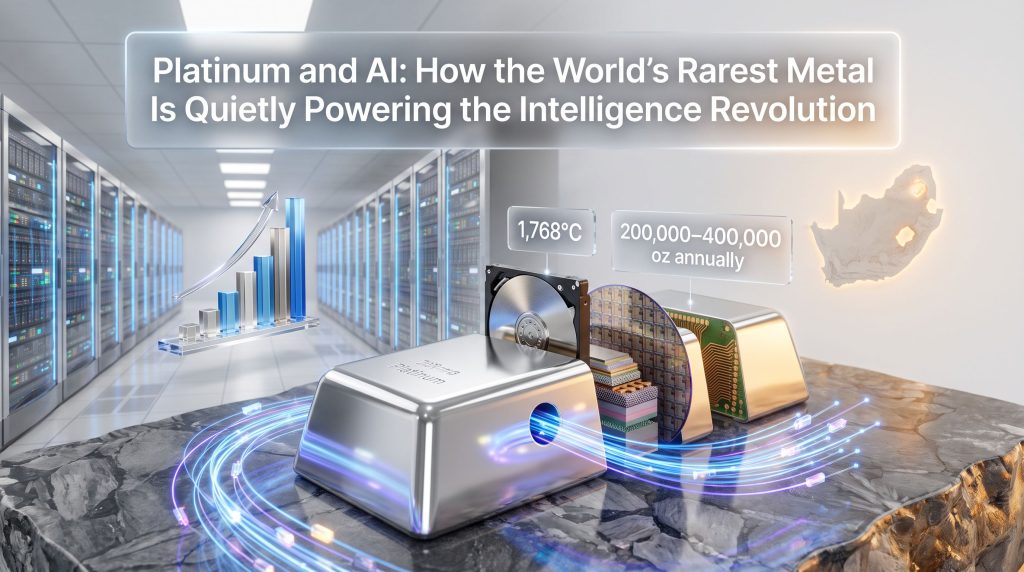
Platinum's relevance to advanced manufacturing begins with properties that no engineered substitute has yet been able to fully replicate in combination. Its melting point of 1,768°C (3,215°F) places it among the most thermally resilient metals used in commercial manufacturing. More importantly, it reaches that thermal threshold while simultaneously remaining chemically non-reactive, electrically stable, and catalytically exceptional.
That combination is rarer than the metal itself.
| Property | Platinum | Gold | Silver | Palladium |
|---|---|---|---|---|
| Melting Point | 1,768°C | 1,064°C | 961°C | 1,555°C |
| Electrical Conductivity | High and stable | Very high | Highest | High |
| Chemical Reactivity | Non-reactive | Non-reactive | Reactive | Moderate |
| Catalytic Activity | Exceptional | Low | Low | High |
| Thermal Stability | Extreme | Moderate | Low | High |
Gold melts at barely half platinum's threshold. Silver, despite its superior raw conductivity, corrodes and degrades in the precision environments where platinum excels. Palladium shares some catalytic overlap, but its performance drops under the thermal conditions where platinum holds firm.
This is why platinum, despite its cost, remains the material of choice wherever temperature extremes, chemical purity, and electrical reliability must coexist in a single component. Furthermore, understanding the broader platinum and palladium markets helps contextualise how each metal's distinct properties drive its respective demand profile.
Platinum vs. Palladium and Ruthenium: Where the Lines Are Drawn
The platinum group metals are often discussed interchangeably, but their AI-relevant applications diverge meaningfully:
-
Platinum vs. Palladium: Both metals share catalytic roles in automotive emissions systems, but platinum's superior thermal stability gives it a decisive advantage in fuel cell applications and semiconductor-grade thin film deposition. Where operating temperatures spike and chemical purity requirements tighten, platinum dominates.
-
Platinum vs. Ruthenium: Ruthenium is gaining traction in certain next-generation memory chip architectures, particularly in resistance RAM (RRAM) development. However, platinum continues to dominate storage media magnetic alloys and sensor fabrication, where its combination of stability and conductivity is unmatched at commercial scale.
Substitution in fringe applications may be technically feasible. In core AI hardware categories, it remains either impractical or prohibitively expensive.
Where Platinum and AI Infrastructure Physically Intersect
Data Storage: The FePt Layer Enabling Hyperscale Memory
The modern data centre stores information at a scale that was inconceivable a decade ago. Every major AI model requires access to petabytes of training data, inference logs, and operational records. The hard disk drives storing that data are coated with platinum-based magnetic alloys, a detail almost never mentioned in discussions of AI infrastructure costs.
More specifically, the emergence of heat-assisted magnetic recording (HAMR) technology has elevated platinum's role significantly. HAMR drives use an iron-platinum (FePt) alloy layer on the recording media, enabling substantially higher data density per square inch than conventional recording methods. As AI workloads demand ever-greater storage capacity within fixed physical footprints, HAMR adoption is accelerating, and with it, platinum consumption per drive unit is increasing.
Hyperscalers collectively invest hundreds of billions of dollars annually in storage infrastructure. Each unit of that investment contains platinum embedded within its core recording architecture.
Semiconductor Fabrication: Thin Films and Sputtering Targets
Inside semiconductor fabrication facilities, platinum is deposited onto chip substrates through a process called physical vapour deposition (PVD), using platinum sputtering targets. The resulting thin films provide the electrical stability and precise conductivity required for consistent electron flow in AI processors and memory chips.
Beyond conductors, platinum-coated sensors embedded within AI systems improve measurement precision at the hardware level, reducing the volume of calibration data required during model training. This is a less-discussed efficiency lever: better sensors mean less redundant data, which translates into lower computational overhead across the entire training pipeline. According to SFA Oxford's analysis of critical minerals in AI, this intersection of materials science and AI performance is increasingly attracting attention from both industry analysts and investors.
Printed Circuit Boards: The Invisible Platinum in Every AI Server
Every printed circuit board in existence relies on a fiberglass substrate as its structural backbone. What almost no one outside the manufacturing sector knows is that the fiberglass used to make PCBs is shaped using platinum-lined tools and crucibles. Platinum is the only commercially viable material capable of withstanding the temperatures required to process molten glass at production scale without degrading or contaminating the melt.
This means every PCB inside every AI server, GPU cluster, networking switch, and data centre rack contains fiberglass formed with platinum tooling. It is one of the most pervasive yet invisible applications of platinum in modern technology.
Optical Interconnects: Platinum Crucibles and the Neural Highways of Machine Learning
AI systems are not monolithic processors. They are distributed architectures where processing units must communicate at extraordinary speeds. Optical interconnects serve as the high-bandwidth pathways that carry data between chips, boards, and server nodes within a data centre.
The crystalline materials used to manufacture these optical components are grown in platinum crucibles at extremely high temperatures. Without platinum's thermal resilience, the precision required to grow defect-free crystals at commercial production volumes would not be achievable. Consequently, every optical interconnect link inside an AI training cluster traces back, indirectly, to a platinum crucible.
Humanoid Robotics: Platinum Catalysts and the Physical Face of AI
One of the fastest-growing and least-anticipated demand categories for platinum is humanoid robotics. Medical-grade silicone, the material used to give AI-enabled robots realistic physical characteristics, is manufactured using platinum-based catalysts during the curing process.
China's humanoid robotics sector represents the most rapidly expanding market for platinum-cured silicone globally, according to industry analysis from the World Platinum Investment Council (WPIC). As AI capabilities migrate from purely digital environments into physical robotic systems, this demand category is expected to compound at a meaningful rate through the remainder of the decade. These developments also connect directly to the growing critical minerals demand reshaping global supply chains.
Fuel Cells: Backup Power for the AI Economy
AI data centres are among the most energy-intensive facilities ever built. The requirement for uninterrupted power at gigawatt scale has renewed industry interest in proton exchange membrane (PEM) fuel cells as backup and supplemental power infrastructure for data centre campuses.
PEM fuel cell technology uses platinum as its core catalytic component. This positions platinum and AI at the convergence of both the infrastructure buildout and the broader clean energy transition, two of the most heavily capitalised investment themes of the current decade.
Quantifying the AI-Driven Platinum Demand Signal
Current Estimates and the 2030 Projection
The WPIC has confirmed that AI-linked platinum demand is already measurably present across silicone production, fiberglass manufacturing, semiconductor fabrication, and hard disk drive storage. Precise global quantification remains in early stages, but industry estimates suggest the current AI-related demand footprint sits at approximately 200,000 to 400,000 ounces annually.
Projections indicate this figure could increase several-fold by 2030 as global AI infrastructure investment accelerates and hardware manufacturing scales to meet model training and inference demand.
| Application Segment | Platinum Role | Demand Status |
|---|---|---|
| Hard Disk Drives (HDD/HAMR) | FePt magnetic alloy coating | Existing and growing |
| Semiconductor Thin Films | Sputtering targets and thin film deposition | Existing and growing |
| PCB Fiberglass Manufacturing | Platinum tooling for molten glass processing | Existing |
| Optical Interconnect Crystals | Platinum crucibles for crystal growth | Existing |
| Humanoid Robotics (Silicone) | Platinum catalyst in silicone curing | Fastest-growing emerging segment |
| PEM Fuel Cells (Data Centres) | Core catalyst in hydrogen fuel cells | Emerging and scaling |
| Precision Sensors | Platinum thin-film sensor elements | Existing and growing |
While AI-related demand does not yet dominate the overall platinum market, its directional trajectory is structurally significant. A several-fold increase from the current 200,000 to 400,000 oz base by 2030 would materially reshape the demand composition of the market.
The Supply Constraint That Amplifies Everything
Geological Scarcity and the Southern Africa Concentration Risk
Platinum is significantly rarer than gold by both geological occurrence and annual mine output. Global platinum production is a fraction of annual gold production, and the vast majority of the world's economically mineable platinum resource is located within the Bushveld Igneous Complex (BIC) in Southern Africa, specifically concentrated in South Africa and Zimbabwe.
This geological reality creates an extreme supply concentration that has no parallel among major industrial metals:
- Approximately 70 to 80% of global platinum supply originates from a single geographic region
- Mine development timelines in the platinum group metals sector typically span 10 to 15 years from discovery to production
- There is no meaningful strategic reserve or secondary supply buffer capable of absorbing a major primary supply disruption
- Labour disputes, energy infrastructure failures, and regulatory changes in South Africa have historically caused sharp, short-duration supply shocks
Risk Note: The extreme geographic concentration of platinum supply means that macro or geopolitical disruptions in Southern Africa can cause rapid price dislocations. Investors should incorporate this volatility factor into position sizing decisions.
Why Mine Supply Cannot Respond Quickly to Demand Signals
Unlike agricultural commodities or energy, platinum supply cannot be ramped up in response to price signals within a short timeframe. The BIC's ore bodies are deep, structurally complex, and require sophisticated extraction techniques. New mine development requires environmental permitting, capital allocation, infrastructure construction, and years of development drilling before first production.
These mineral processing challenges, combined with accelerating multi-sector demand across automotive catalysts, medical technology, clean energy, and now AI infrastructure, create a structurally supportive price environment over the medium to long term.
Platinum as an Investment in the AI Era
Understanding Platinum's Dual Identity
Gold's investment value derives primarily from monetary demand, inflation hedging, and safe-haven positioning. Platinum operates differently. Its price is anchored to real economic and technological activity, making it responsive to industrial demand cycles in ways that gold is not. This dual identity as both a precious metal and a critical industrial commodity gives platinum a distinct risk-return profile.
| Asset | Primary Value Driver | AI Demand Exposure | Supply Concentration Risk |
|---|---|---|---|
| Gold | Safe-haven and monetary | Low | Moderate |
| Silver | Industrial and monetary | Moderate | Low |
| Platinum | Industrial and precious | High and growing | Very High |
| Palladium | Automotive catalyst | Low to moderate | Very High |
What Investors Should Understand Before Entering the Platinum Market
Platinum prices are historically more volatile than gold, reflecting its tighter market and greater sensitivity to industrial demand cycles. Key considerations for prospective investors include:
-
Physical product formats: Platinum is available in coins, bars, and rounds, each carrying different dealer premiums, liquidity profiles, and storage requirements. For those comparing approaches to physical metals investing, larger bar formats typically carry lower premiums but reduced liquidity compared to sovereign coins.
-
Demand thesis duration: The AI and clean energy demand thesis for platinum is a multi-year, potentially multi-decade structural story. Investors oriented around short-term price movements may misread the signal.
-
Supply concentration awareness: Southern Africa's dominance over platinum supply is a persistent risk factor that can create both price spikes and buying opportunities, depending on the nature of the disruption.
-
Portfolio diversification value: Platinum provides exposure to the AI infrastructure megatrend through a physical, tangible asset rather than equity, derivative, or fund-based instruments, offering a different correlation profile to technology sector equities.
The next major ASX story will hit our subscribers first
The Convergence of Two Megatrends: AI Infrastructure and Clean Energy
Where the Demand Vectors Overlap
PEM fuel cells powered by platinum catalysts serve both AI data centre backup power needs and the broader hydrogen energy transition simultaneously. This dual-demand convergence is among the most structurally compelling aspects of platinum's long-term investment thesis. According to the IPA's assessment of PGMs in artificial intelligence, this convergence is already influencing how industry bodies are framing platinum's strategic importance.
The compounding effect is meaningful: as data centre construction accelerates globally and hydrogen infrastructure investment grows independently, platinum consumption within the fuel cell segment grows from two distinct capital expenditure streams rather than one.
Medical technology adds a third. Platinum's role in implantable devices, chemotherapy agents, and AI-enabled diagnostic hardware represents a demand stream that grows largely independently of both technology and energy cycles, providing additional demand diversification within the same metal.
Frequently Asked Questions: Platinum and AI
Does AI actually use platinum, or is this a speculative narrative?
Platinum's role in AI infrastructure is not speculative. It is already embedded in commercially deployed technologies including hard disk drives, semiconductor fabrication processes, PCB fiberglass manufacturing, and optical interconnect crystal production. The World Platinum Investment Council has confirmed that AI-related demand is measurably present in current production data across multiple segments.
How much platinum does the AI sector currently consume?
Current industry estimates place AI-linked platinum consumption at approximately 200,000 to 400,000 ounces per year, with projections suggesting a several-fold increase by 2030 as data centre construction and AI hardware manufacturing continue to scale.
Is platinum rarer than gold?
Yes. Platinum is significantly rarer than gold by both geological occurrence and annual mine output. Total global platinum production is substantially lower than annual gold production, and the overwhelming majority of supply comes from a single region in Southern Africa.
Can platinum be substituted in AI hardware applications?
In isolated niche applications, partial substitution may be technically feasible. However, in core use cases including FePt storage alloys for HAMR drives, platinum crucibles for optical crystal growth, and PEM fuel cell catalysts, substitution is either technically impractical or economically unviable at current alternative metal prices.
Why is the Bushveld Igneous Complex so important to platinum markets?
The BIC in Southern Africa hosts the world's largest known platinum group metal reserves. Its geological formation, a layered igneous intrusion formed roughly two billion years ago, created an unusually high concentration of platinum group elements in horizontally layered reef structures. The three primary ore reefs mined within the BIC — the Merensky Reef, the UG2 Chromitite Layer, and the Platreef — collectively account for the majority of global platinum production. No comparable geological formation exists elsewhere at commercially viable grades.
Key Takeaways
- Platinum is embedded across at least six distinct AI infrastructure application categories, from data storage to backup power systems
- AI-related platinum demand is already measurable at an estimated 200,000 to 400,000 ounces annually, with projections suggesting several-fold growth by 2030
- Platinum's melting point of 1,768°C and non-reactive chemical profile make it functionally irreplaceable in many high-temperature precision manufacturing contexts
- Supply remains 70 to 80% concentrated in Southern Africa, creating structural scarcity that amplifies the demand growth story
- Platinum offers investors dual market exposure: precious metal safe-haven characteristics alongside growing AI and clean energy industrial demand
- Mine development lead times of 10 to 15 years mean that today's supply constraints cannot be quickly resolved, regardless of price signals
This article is for informational purposes only and does not constitute financial or investment advice. Demand projections and market estimates referenced herein are based on publicly available industry sources including the World Platinum Investment Council and should not be relied upon as guarantees of future performance. Investors should conduct independent research and consult qualified financial advisers before making investment decisions. Platinum prices are volatile and past performance is not indicative of future results.
For further research on platinum's role in technology and investment markets, the World Platinum Investment Council publishes ongoing supply and demand analysis at platinuminvestment.com. The APMEX Platinum Investing Guide provides accessible foundational content for investors new to platinum as an asset class.
Want to Stay Ahead of the Next Major Mineral Discovery Driving the AI and Clean Energy Megatrends?
Discovery Alert's proprietary Discovery IQ model delivers real-time alerts on significant ASX mineral discoveries — including those tied to the critical metals underpinning AI infrastructure and the clean energy transition — instantly translating complex data into actionable investment insights. Explore Discovery Alert's discoveries page to see how historic mineral discoveries have generated substantial returns, and begin your 14-day free trial today to position yourself ahead of the broader market.