
August 8, 2026
When Labour Speaks Louder Than Markets: Understanding the BHP Port Hedland Strike
The global iron ore trade operates on a foundation of logistical precision. Millions of tonnes of material move from pit to port to steel mill across an intricate web of shipping lanes, loading schedules, and contractual commitments. When any single node in that system falters, the consequences ripple outward in ways that are not always visible in commodity price screens alone. The BHP Port Hedland strike, which escalated into a structured two-day industrial action in August, offers a rare window into the fragilities beneath one of the world's most profitable export operations and what they mean for investors, analysts, and the broader resources sector.
When big ASX news breaks, our subscribers know first
Port Hedland: A Single Point of Enormous Consequence
Understanding the stakes of the BHP Port Hedland strike requires first appreciating the sheer scale of what flows through this small coastal town in Western Australia's Pilbara region.
Port Hedland is not simply a large port. It is the single largest iron ore export facility on the planet, and its strategic concentration makes it structurally irreplaceable in the short term. During the financial year to June, the port accounted for approximately 75% of all iron ore exports from the Pilbara region, which itself supplies a dominant share of seaborne iron ore consumed by Asian steel producers, particularly in China, Japan, and South Korea.
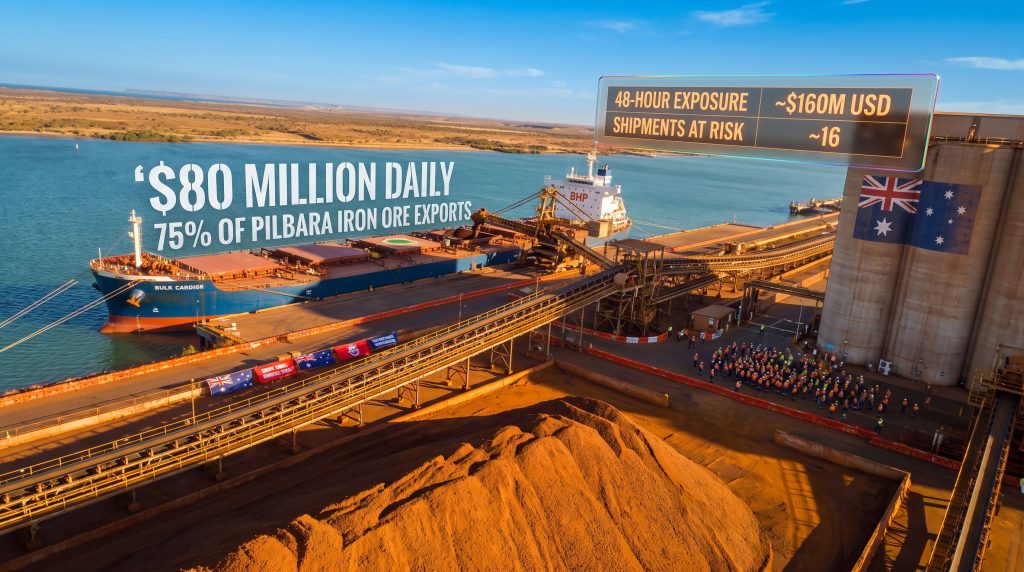
For BHP specifically, the numbers are striking. The company ships an estimated $80 million USD worth of iron ore every single day through Port Hedland's Bulk Export Terminal. This is not a generalised throughput estimate. It reflects the economic velocity at which Australia's iron ore advantages translate through one physical bottleneck into global markets.
A useful way to contextualise the port's role is through a simple hierarchy of exposure:
| Dimension | Detail |
|---|---|
| Global rank of Port Hedland | Largest iron ore export hub in the world |
| Share of Pilbara iron ore exports | ~75% |
| BHP's daily export value | ~$80 million USD |
| BHP's global iron ore ranking | Third-largest miner worldwide |
| Other major operators at port | Fortescue (ASX: FMG), Hancock Prospecting |
Critically, while Fortescue and Hancock Prospecting also use Port Hedland as their primary export gateway, the current industrial action is entirely isolated to BHP's operations. Neither competitor has been operationally affected by the dispute, which underscores that this is a workforce relations issue rather than a port-wide infrastructure crisis.
The Architecture of the Industrial Action
The August BHP Port Hedland strike did not emerge overnight. It was the product of more than seven months of enterprise bargaining negotiations between BHP and the Combined BHP Ports Unions (CBPU), the body representing approximately 450 operators and maintenance workers at the port.
The dispute's escalation followed a deliberate and strategically sequenced pattern:
-
An initial eight-hour work stoppage in mid-July, representing one of the most significant labour interruptions at the port in over two decades.
-
A formal notice of further action, culminating in a two-day strike on August 8 and 9, structured in two distinct phases:
- Phase 1: A 24-hour ban on ship-loading operations at the Bulk Export Terminal.
- Phase 2: A 24-hour complete work stoppage across port operations.
Approximately 150 workers were expected to participate in the August action, a subset of BHP's total port workforce which exceeds 800 people. The CBPU confirmed that the nature and structure of the action remained unchanged despite ongoing dialogue. Reuters reported that the union formally announced the August 8 and 9 strike dates in late July, signalling its intent well in advance.
The Participation Numbers Dispute: Reading Between the Lines
One of the more analytically interesting aspects of this dispute is the significant gap between the figures cited by each party regarding strike participation:
| Workforce Category | Approximate Figure |
|---|---|
| Total BHP Port Hedland workforce | 800+ |
| CBPU-represented workers (operators and maintenance) | ~450 |
| Expected August strike participants (CBPU estimate) | ~150 |
| July stoppage participants (union claim) | ~200 |
| July stoppage participants (company/industry estimate) | ~63 |
This discrepancy is not accidental. In enterprise bargaining disputes, both employers and unions have strong incentives to manage public and media perception of strike momentum. Unions benefit from projecting broad worker solidarity to strengthen their negotiating hand. Employers benefit from minimising the perceived scale of disruption to protect investor confidence and discourage further escalation. The gap between these figures should be read as a communication strategy from both sides rather than a factual disagreement alone.
What Workers Are Actually Seeking
The CBPU's demands centre on a proposed four-year enterprise bargaining agreement covering the following core areas:
-
Meaningful increases to base pay that reflect both inflation and the company's elevated profitability.
-
Structured and transparent wage progression pathways to address career advancement ambiguity.
-
Clearer conditions around employment terms in a cost-of-living environment that has placed sustained pressure on Pilbara-based workers.
-
Proportionate sharing of financial gains during a period when BHP has recorded record share prices and strong divisional earnings.
The FIFO (fly-in, fly-out) workforce model, which is standard across Pilbara operations, creates a distinctive cost structure for workers that differs substantially from metropolitan employment. Housing, travel, and remoteness costs compound the impact of inflation in ways that standard wage benchmarks often fail to capture. This structural reality has contributed to the depth of worker dissatisfaction even during periods of apparent negotiating progress.
Workers in remote resource communities operate in a fundamentally different cost environment from capital city employees, and enterprise agreements that ignore this distinction frequently fail to hold over multi-year terms.
Quantifying the Economic Exposure
While BHP publicly downplayed the operational impact of the August action, the headline exposure figures are worth examining carefully:
| Metric | Estimated Value |
|---|---|
| BHP daily iron ore export value | ~$80 million USD |
| Potential 48-hour gross revenue exposure | ~$160 million USD |
| Shipments expected to face delays | ~16 |
| Vessels that completed loading over strike weekend | ~8 |
| Strike duration | 48 hours |
However, gross revenue exposure is not the same as revenue loss. BHP maintains buffer stockpiles, and partial loading operations continued throughout the weekend, with approximately eight vessels completing the loading process. Furthermore, Argus Media confirmed that the strike ultimately failed to halt iron ore exports entirely, suggesting that actual financial impact is materially lower than the headline figure implies.
How Iron Ore Futures Markets Respond to Short Disruptions
A critical and underappreciated dynamic in situations like the BHP Port Hedland strike is the divergence between physical supply disruption and psychological market impact. On the Dalian Commodity Exchange, which serves as the primary derivatives pricing mechanism for iron ore in Asia, short-duration stoppages at a single operator within a multi-operator hub rarely produce sustained spot price moves.
What they can produce is a brief but sharp psychological response in the hours immediately following an announcement, driven by:
-
Algorithmic trading systems flagging supply disruption keywords.
-
Speculative positioning by traders anticipating further escalation.
-
Procurement anxiety from steel mills already managing tight inventory buffers.
BHP's measured public communication throughout the dispute, consistently emphasising contingency planning and operational continuity, is consistent with a deliberate strategy to dampen speculative market reactions. This approach also aligns with how iron ore price trends tend to respond to short-term supply interruptions, which could complicate contract discussions with downstream steel producers and create unwanted earnings volatility in proximity to results season.
A Break in Decades of Labour Stability
The significance of the BHP Port Hedland strike extends well beyond the immediate operational disruption. This action represents the first major strike at BHP's port operations in more than 20 years, and that context matters enormously for how investors should interpret the event.
Extended labour stability at critical export infrastructure tends to become embedded as a baseline assumption in operational risk models and investor communications. When that stability breaks, it does not simply introduce a one-time disruption. It signals that the conditions supporting that stability have structurally changed and that the bargaining dynamic between resource employers and their unionised workforces has shifted.
Historically, Australia's resources sector has navigated periods of intense labour friction, including the waterfront disputes of the late 1990s and various Pilbara-region actions in the 2000s. What distinguishes the current situation is the phased, escalating structure of the action, which reflects a sophisticated union playbook designed to maximise financial pressure on the employer while preserving worker income, public sympathy, and legal protection under the Fair Work Act's protected industrial action provisions.
The next major ASX story will hit our subscribers first
Scenario Analysis: Three Pathways Forward
Scenario 1: Negotiated Resolution
Both parties have demonstrated willingness to continue talks, with the next scheduled session aligned with BHP's annual results announcement on August 18. If the company reports strong earnings, the optics of simultaneously resisting worker wage demands become politically and reputationally difficult, creating mutual incentive for resolution. In addition, BHP's iron ore strategy of prioritising long-term divisional stability further strengthens the case for an early settlement.
- Market impact: Minimal sustained disruption; operations normalise within days.
- Precedent risk: A generous settlement may create benchmarking pressure across BHP's broader Australian enterprise agreements.
Scenario 2: Prolonged Dispute Beyond August
Seven months of failed negotiations and the CBPU's decision to proceed with action despite reported progress on August 4 suggests that incremental offers have not addressed the underlying structural concerns of workers.
- Market impact: Accumulating shipment delays, heightened spot price sensitivity, possible force majeure notifications to buyers.
- Operational response: Accelerated deployment of automation technologies and increased reliance on non-union contractor arrangements as medium-term contingencies.
Scenario 3: Fair Work Commission Intervention
If industrial action reaches a threshold of significant economic harm to a third party or the broader national interest, the Fair Work Commission holds statutory powers to suspend or terminate protected action and impose structured arbitration.
- Historical precedent: Commission intervention has been used in previous Australian resources disputes to impose mandatory cooling-off periods.
- Outcome: Likely to produce an arbitrated outcome rather than a freely negotiated agreement, with implications for how workers perceive the adequacy of the bargaining framework itself.
For BHP shareholders, the most material long-term risk is not the August action in isolation, but the possibility that Port Hedland's operational reliability, a cornerstone input to iron ore divisional earnings guidance, becomes subject to recurring uncertainty.
The Broader Labour Relations Signal for Australian Mining
The BHP Port Hedland strike is best understood not as an isolated industrial event but as a leading indicator of wider enterprise agreement pressure building across Western Australia's resource and port infrastructure workforce. Consequently, understanding how this feeds into the broader China steel and iron ore market dynamics is essential for investors tracking downstream demand signals.
Several structural forces are converging to create conditions for sustained labour friction across the sector:
-
Commodity price gains versus wage stagnation: When benchmark iron ore prices and BHP share valuations reach record levels, workers positioned closest to the physical production process naturally reassess their share of value creation.
-
FIFO cost compounding: Fly-in-fly-out workers face accommodation, travel, and remoteness costs that amplify the real-terms impact of inflation well beyond headline CPI figures.
-
Tight labour market conditions: Skills shortages across the Pilbara have structurally shifted bargaining power toward experienced operational workers, particularly in specialised port and loading roles.
-
Automation anxiety: As BHP and peers accelerate investment in autonomous haul trucks, remote operation centres, and AI-assisted logistics, workers in roles perceived as automation targets have stronger incentives to lock in favourable conditions now rather than later.
This last point deserves particular attention. The long-term automation trajectory of iron ore port operations creates a paradox: the very technological investments designed to reduce labour dependency also reduce union leverage over time. Furthermore, the iron ore market tariff impacts adding external pressure mean the current bargaining window is strategically important for workers in ways that extend well beyond the immediate wage negotiation.
Frequently Asked Questions
What triggered the BHP Port Hedland strike?
The dispute arose from more than seven months of unresolved enterprise bargaining negotiations between BHP and the CBPU, covering approximately 450 operators and maintenance workers seeking improved pay, structured wage progression, and better employment conditions during a period of elevated company profitability.
Does the strike affect Fortescue or Hancock Prospecting?
No. The industrial action is specific to BHP's workforce and terminal operations. Fortescue (ASX: FMG) and Hancock Prospecting, both of which operate through Port Hedland, are not affected by the current dispute.
How is the August action structured?
The two-day action on August 8 and 9 consisted of a 24-hour ship-loading ban followed by a 24-hour complete work stoppage at BHP's Bulk Export Terminal.
Why is the August 18 negotiation date significant?
August 18 coincides with BHP's annual results announcement, creating a high-stakes communication environment where the outcome of bargaining talks will be closely scrutinised alongside financial performance disclosures.
Is this the first strike at Port Hedland in recent memory?
Yes. The current dispute marks the first major strike at BHP's Port Hedland operations in more than two decades, breaking an extended period of labour stability that had become a baseline assumption in the company's operational risk profile.
This article is intended for informational purposes only and does not constitute financial or investment advice. Forecasts, scenario analyses, and market assessments involve inherent uncertainty and should not be relied upon as predictions of future outcomes. Readers are encouraged to conduct independent research and seek professional advice before making investment decisions.
Want To Stay Ahead of ASX Mineral Discoveries That Could Reshape the Resources Sector?
While labour disruptions at major iron ore operations like Port Hedland highlight the complexities of resource sector investing, the real transformative opportunities often lie in significant new mineral discoveries — and Discovery Alert's proprietary Discovery IQ model instantly identifies these high-potential ASX announcements in real time, turning complex data across more than 30 commodities into clear, actionable insights. Explore historic discovery returns on Discovery Alert's dedicated discoveries page to see why early positioning matters, then begin your 14-day free trial to secure a market-leading edge.