July 16, 2026
India's Downstream Aluminium Moment: Why Integrated Producers Are Moving Decisively Into Foil and FRP
Across the global metals industry, a well-documented pattern repeats itself: commodity producers eventually discover that the real value lies not in raw material output, but in the finished products derived from it. Primary aluminium smelting is energy-intensive, capital-heavy, and subject to volatile commodity pricing. Aluminium foil and flat rolled products, by contrast, serve end markets where specifications, tolerances, and application performance matter far more than spot metal prices. India's downstream aluminium sector is now navigating precisely this transition, and the commissioning of the Shyam Metalics Odisha aluminium foil facility in Sambalpur represents one of the clearest expressions of that shift.
When big ASX news breaks, our subscribers know first
Why India's Downstream Aluminium Sector Is Reaching an Inflection Point
The Demand-Supply Gap Driving Greenfield Capacity
India has long occupied an uncomfortable position in the global aluminium value chain. Despite being a significant primary aluminium producer, the country has historically under-invested in downstream processing, leaving domestic consumers of foil and flat rolled products dependent on imports, particularly from China and other Asian suppliers. Furthermore, several structural forces are converging to close this gap:
- Domestic packaging consumption is expanding rapidly, driven by organised retail growth, pharmaceutical sector expansion, and food safety regulation
- Automotive lightweighting trends are increasing demand for aluminium sheet and strip in vehicle manufacturing
- Construction sector activity across Tier 2 and Tier 3 cities is creating sustained demand for architectural aluminium products
- Flexible electronics and HVAC equipment manufacturing are adding new foil consumption categories
The result is a demand profile that is growing faster than existing domestic production capacity can service, creating a clear economic opening for integrated producers willing to invest in downstream infrastructure. In addition, top aluminium mining companies globally are similarly reassessing their value chain strategies as conversion margins continue to outperform upstream returns.
Where Aluminium Foil Sits Within the Industrial Value Chain
Understanding why the Shyam Metalics Odisha aluminium foil facility matters requires some appreciation of where foil sits within the broader aluminium product hierarchy.
Primary aluminium is cast into ingots or rolling slabs. Those slabs are then hot-rolled and cold-rolled to progressively thinner gauges. At the thinner end of that spectrum, typically below 200 microns, the product is classified as foil. Below 6 microns, specialised vacuum deposition techniques are often required, but the 6-to-40-micron range that the Sambalpur facility targets sits squarely within the technically demanding zone where pharmaceutical blister packaging, food-grade barrier wrapping, and HVAC fin stock compete for supply.
This is not a commodity segment. Thin-gauge foil requires precise metallurgical control over grain structure, surface finish, and pinhole density. A single pinhole in pharmaceutical blister foil can compromise sterility and trigger regulatory rejection of an entire production batch. The technical barriers to entry in this segment are meaningfully higher than those in primary smelting, which helps explain why margin profiles in foil manufacturing typically exceed those of upstream production.
What Is the Shyam Metalics Odisha Aluminium Foil Facility?
Facility Specifications and Structural Setup
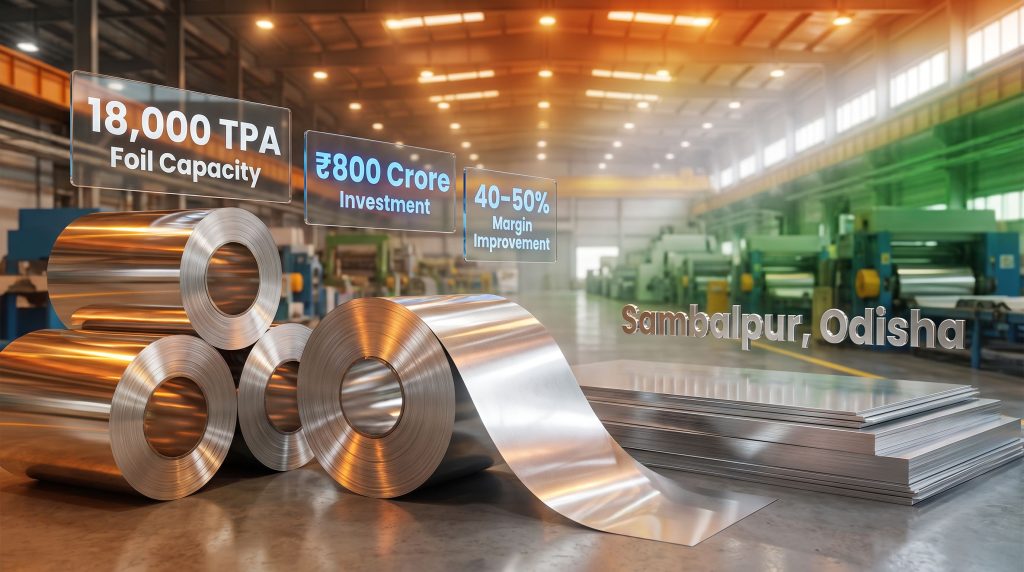
The Shyam Metalics Odisha aluminium foil facility operates through SMEL Steel Structural Pvt. Ltd., a step-down subsidiary of Shyam Metalics and Energy Ltd. The plant is located in Sambalpur, Odisha, and commenced commercial production in mid-2026 with an installed capacity of 18,000 tonnes per annum (TPA), producing aluminium foil across a thickness range of 6 to 40 microns.
Key Facility Snapshot
Attribute Specification Operating Entity SMEL Steel Structural Pvt. Ltd. Location Sambalpur, Odisha Foil Capacity 18,000 TPA Foil Thickness Range 6 to 40 microns FRP Capacity (Pipeline) 60,000 TPA FRP Thickness Range 0.3 mm to 4.0 mm Total Downstream Investment Approximately ₹800 crore FRP Commercial Target September 2026
The foil plant is the first operational phase of a larger two-stage downstream aluminium complex being developed at Sambalpur. The second phase, an aluminium flat rolled products (FRP) plant with a capacity of 60,000 TPA, is scheduled to reach commercial production by September 2026.
Together, these two facilities will create a vertically integrated downstream processing hub capable of serving the full spectrum of aluminium conversion markets, from ultra-thin pharmaceutical-grade foil to structural-grade sheet and plate.
The ₹800 Crore Investment in Context
The combined downstream aluminium investment at Sambalpur totals approximately ₹800 crore. To contextualise this figure, greenfield aluminium foil rolling capacity is among the more capital-intensive segments of downstream metal processing. Rolling mills capable of achieving consistent sub-10-micron output require high-precision equipment, controlled atmospheric conditions, and significant quality assurance infrastructure.
The company's 467 MW of captive power generation provides a critical cost control advantage. Aluminium rolling is an energy-intensive process, and access to captive power insulates operations from grid tariff volatility, a meaningful competitive differentiator in the Indian manufacturing context.
How This Investment Reshapes Shyam Metalics' Business Model
Transitioning From Steel-Dominant to Multi-Metal Integration
Shyam Metalics and Energy Ltd. is headquartered in Kolkata and operates across West Bengal, Odisha, Jharkhand, and Madhya Pradesh. Its existing product portfolio spans steel, ferro alloys, stainless steel, and aluminium. With an aggregate installed metal production capacity of 16.78 million tonnes per annum (MTPA), the company already operates at meaningful industrial scale.
The Sambalpur downstream complex signals a deliberate strategic evolution. Rather than expanding further in steel, where margins are constrained by input cost cycles and import competition, Shyam Metalics is channelling capital toward premium-grade aluminium conversion. This is a structurally different business: the margin stack in foil and FRP is supported by specification performance and customer switching costs rather than commodity price arbitrage.
The Margin Logic: What 40-50% Operating Margin Improvement Actually Means
The company has projected that its aluminium foil and FRP operations will improve operating margins by approximately 40 to 50 percent through an enhanced product mix and higher per-unit realisations. Separately, the downstream aluminium business is expected to support revenue growth of two to two-and-a-half times through expanded domestic and international market presence.
These are substantial projections, and it is worth understanding the mechanism behind them:
-
Primary aluminium vs. downstream conversion: A tonne of primary aluminium trading at London Metal Exchange benchmark prices commands a fixed commodity value. The same tonne converted into pharmaceutical-grade blister foil can command a significant conversion premium, reflecting processing complexity, quality certification costs, and supply security value to the buyer.
-
Customer stickiness: End users in pharmaceutical and food packaging operate under strict regulatory frameworks. Once a foil supplier is qualified in a customer's supply chain, switching costs are high. This translates into more stable revenue and pricing power compared to commodity metal sales.
-
Export market access: Premium foil and FRP products can access international markets where Indian producers have historically been underrepresented, further diversifying the revenue base beyond domestic demand cycles.
Disclaimer: The financial projections cited above, including margin improvement estimates and revenue growth targets, are forward-looking statements based on company guidance. Actual outcomes will depend on market conditions, production ramp-up timelines, input cost dynamics, and competitive developments. These figures should not be relied upon as guarantees of future performance.
What Makes Sambalpur, Odisha a Strategic Manufacturing Location
Proximity to Raw Material Supply Chains
Odisha is not an incidental choice for aluminium downstream investment. The state sits within eastern India's established aluminium production corridor. Odisha and neighbouring Jharkhand collectively hold substantial bauxite reserves, and the region hosts significant alumina refining and primary smelting infrastructure. Locating a downstream processing facility close to upstream aluminium supply reduces logistics costs and shortens material lead times, a meaningful operational efficiency in a capital-intensive manufacturing environment.
Industrial Infrastructure and Logistics
Sambalpur sits within Odisha's western industrial belt, connected to road and rail networks that serve both coastal ports for export logistics and inland manufacturing clusters. The region has attracted consistent industrial investment in metals and minerals processing, providing an established ecosystem of ancillary services, engineering talent, and industrial utilities.
The facility is also expected to generate direct and indirect employment within Sambalpur district, contributing to Odisha's ongoing economic diversification beyond primary resource extraction. The chairman and managing director of Shyam Metalics and Energy Ltd. noted at the time of commissioning that the facility is intended to supply specialised aluminium products to high-growth sectors while supporting employment and economic development in the region.
Aluminium Foil Market Dynamics: Where 18,000 TPA Fits
India's Foil Market and the Import Substitution Opportunity
India's aluminium foil market has grown consistently over the past decade, driven by pharmaceutical sector expansion, organised food retail penetration, and flexible packaging adoption across consumer goods categories. However, domestic production capacity has historically lagged behind consumption growth, leaving a structural import dependency, particularly for thinner gauge and higher specification foil grades.
The 6-to-40-micron range targeted by the Sambalpur facility directly addresses the most import-exposed segments of the domestic market. Pharmaceutical blister foil, for example, requires consistent metallurgical certification and regulatory documentation that has historically favoured established international suppliers. A domestically produced, quality-certified alternative creates both cost and supply chain resilience advantages for Indian pharmaceutical manufacturers.
It is also worth noting that broader trade policy shifts, including US aluminium tariffs introduced in 2025, are reshaping global supply flows and creating new opportunities for Indian producers to capture market share as traditional trade channels adjust.
Competitive Landscape in India's Downstream Aluminium Sector
| Segment | Key Domestic Players | Capacity Profile |
|---|---|---|
| Aluminium Foil | Hindalco Industries, Shyam Metalics (new entrant) | Varies by grade and specification |
| Flat Rolled Products | Hindalco, Novelis India, Vedanta | Large-scale integrated capacity |
| Specialty Thin Foil | Smaller specialty converters | Fragmented, grade-specific |
Hindalco Industries, through its Novelis subsidiary internationally and domestic rolling operations, dominates the established FRP and foil landscape in India. However, the market is large enough to support multiple producers, particularly as demand from new application categories, including electric vehicle thermal management systems and advanced flexible electronics, expands the total addressable market. Consequently, Alcoa's recent market recalibrations further illustrate how competitive dynamics across the aluminium value chain continue to evolve globally.
Emerging Demand Vectors Through 2035
Several demand drivers are expected to compound existing foil consumption growth through the second half of this decade:
- EV battery thermal management: Aluminium foil is increasingly specified in battery thermal interface applications and cell-level packaging within lithium-ion battery modules. As India's EV manufacturing sector scales, this represents a structurally new demand pool.
- Flexible electronics: The growth of foldable and wearable device manufacturing requires ultra-thin conductive and barrier foil layers that sit within the 6-to-20-micron range.
- Pharmaceutical sector expansion: India's pharmaceutical industry, already the world's largest generic drug exporter by volume, continues to expand blister packaging consumption as export compliance standards tighten globally.
- Food safety regulation: Tightening food packaging regulations across Indian and export markets are driving shifts from plastic-dominant to aluminium-dominant barrier packaging formats.
The next major ASX story will hit our subscribers first
Understanding the Flat Rolled Products Plant: A Technical Primer
What Aluminium Flat Rolled Products Actually Are
Aluminium flat rolled products encompass sheets, coils, and plates produced by passing aluminium slabs through a series of rolling stands, reducing thickness in controlled increments while managing grain structure, temper, and surface finish. The Sambalpur FRP facility will produce material in the 0.3 mm to 4.0 mm thickness range, which spans a broad application spectrum.
At the thinner end of this range, 0.3 mm to approximately 0.8 mm, the product serves applications such as automotive body panel stock, appliance fascias, and flexible packaging lidding. In the mid-range, 1.0 mm to 2.5 mm, construction cladding, roofing, and HVAC ductwork dominate consumption. At the thicker end approaching 4.0 mm, industrial plate applications and structural fabrication become the primary markets.
Target End Markets for the 60,000 TPA FRP Capacity
- Automotive: Lightweight structural components, heat shields, and body panel applications where weight reduction directly translates into fuel efficiency or electric range improvement
- Construction: Architectural cladding systems, roofing profiles, and curtain wall panels where corrosion resistance and long service life are primary selection criteria
- Consumer appliances: Panels and formed components for refrigeration, air conditioning, and kitchen equipment
- Packaging: Thicker-gauge lidding and semi-rigid container formats that sit at the boundary between foil and sheet classification
The combined operation of both the foil and FRP facilities creates internal cross-selling opportunities. A customer sourcing thin-gauge foil from the Sambalpur complex may also require thicker sheet stock for associated packaging machinery components or secondary packaging formats, concentrating more of the supply relationship within a single integrated facility. For instance, Rio Tinto's recent moves to repower its aluminium operations illustrate how integrated producers globally are similarly investing to strengthen downstream competitiveness.
Production Milestones and Commissioning Timeline
The Sambalpur downstream complex is advancing through a defined commissioning sequence:
- Mid-2026: The aluminium foil facility achieves commercial production status at 18,000 TPA capacity across the 6-to-40-micron thickness range.
- September 2026 (target): The aluminium FRP plant is scheduled to commence commercial production at 60,000 TPA capacity across the 0.3 mm to 4.0 mm thickness range.
- Post-commissioning ramp: Full utilisation of both facilities positions Sambalpur as a significant multi-product downstream aluminium processing hub within the eastern India industrial corridor.
It is worth noting that greenfield rolling mill ramp-up timelines in the aluminium industry often extend beyond initial commercial production targets as production teams optimise rolling parameters, qualify output with end customers, and build out logistics and distribution infrastructure. The September 2026 FRP target represents the commercial production milestone, with full utilisation likely achieved progressively over the subsequent quarters.
Furthermore, the broader tariff environment, including Trump's 2025 steel and aluminium tariffs, continues to influence global supply chain decisions and may present additional export opportunities for Indian producers as international buyers seek to diversify their sourcing strategies.
Frequently Asked Questions: Shyam Metalics Odisha Aluminium Foil Facility
What is the production capacity of the Shyam Metalics aluminium foil plant in Odisha?
The Shyam Metalics Odisha aluminium foil facility in Sambalpur has an installed production capacity of 18,000 tonnes per annum (TPA), producing aluminium foil across a thickness range of 6 to 40 microns.
Who operates the Sambalpur aluminium foil facility?
The plant is operated by SMEL Steel Structural Pvt. Ltd., a step-down subsidiary of Shyam Metalics and Energy Ltd., headquartered in Kolkata.
What is the total capital commitment to the Sambalpur downstream complex?
Shyam Metalics has committed approximately ₹800 crore to the combined aluminium foil and FRP operations at Sambalpur, Odisha. You can review the full investor presentation for further detail on the company's strategic rationale and financial projections.
When is the FRP plant expected to begin production?
The aluminium flat rolled products facility, with a capacity of 60,000 TPA and a thickness range of 0.3 mm to 4.0 mm, is targeted for commercial production by September 2026.
What financial impact is anticipated from the downstream aluminium operations?
The foil and FRP facilities are projected to improve operating margins by 40 to 50 percent and support two to two-and-a-half times revenue growth through higher product realisations and expanded market access. These are forward-looking projections and are subject to execution risk and market conditions.
Which industries will the Sambalpur facility primarily serve?
The facility targets pharmaceutical packaging, food-grade barrier wrapping, automotive components, construction products, and consumer goods sectors, with potential expansion into EV thermal management and flexible electronics applications as those markets develop in India.
Key Takeaways: The Strategic Significance of the Sambalpur Complex
-
The Shyam Metalics Odisha aluminium foil facility marks the first operational phase of a two-stage downstream aluminium hub that will eventually process 78,000 TPA of combined foil and flat rolled products from a single Odisha location.
-
The decision to invest in thin-gauge foil manufacturing (6 to 40 microns) reflects a deliberate move into technically demanding, specification-driven markets where conversion premiums and customer switching costs support structurally higher margins than primary aluminium output.
-
A projected 40 to 50 percent improvement in operating margins and revenue growth of two to two-and-a-half times provide the financial rationale for committing ₹800 crore to downstream conversion capacity rather than commodity-grade expansion.
-
Sambalpur's position within Odisha's established industrial corridor, combined with 467 MW of captive power generation, provides both logistical and cost structure advantages that are difficult for new entrants to replicate quickly.
-
As Indian pharmaceutical, packaging, and automotive sectors continue to grow, and as EV battery manufacturing emerges as a new aluminium foil consumption category, the timing of this capacity addition aligns with a multi-year demand expansion cycle, though investors should treat forward-looking market projections with appropriate caution.
Want to Track the Next Major Mineral Discovery Before the Broader Market Does?
Discovery Alert's proprietary Discovery IQ model scans ASX announcements in real time, instantly identifying significant mineral discoveries across more than 30 commodities and converting complex data into clear, actionable investment insights — explore historic discoveries and their returns to understand the opportunity, then begin your 14-day free trial at Discovery Alert to position yourself ahead of the market.