July 16, 2026
The Export Chokepoint That Moves Global Steel Markets
Somewhere between the mine face and the blast furnace lies a narrow strip of Western Australian coastline that quietly governs the rhythm of global steel production. Most market participants think about iron ore supply in terms of tonnes mined, grades processed, or pricing benchmarks negotiated in Beijing. Far fewer focus on the single point of physical vulnerability that connects all of it: the port through which that ore must pass before it reaches any market at all.
Port Hedland is that point. And in July 2026, it became the focal point of the most significant industrial action in Australian mining in over a decade, triggering an immediate reassessment of near-term export flows, fiscal year production guidance integrity, and the durability of labour relations at the world's most consequential bulk commodity terminal.
Understanding the full implications of the Port Hedland strike and BHP iron ore exports requires more than tracking a single work stoppage. It demands a structured analysis of supply chain architecture, wage negotiation dynamics, Chinese buyer leverage, and the critical distinction between what BHP mines and what it can actually ship.
When big ASX news breaks, our subscribers know first
Why Port Hedland Has No Functional Equivalent in Global Iron Ore Trade
The Arithmetic of Daily Throughput
Scale alone makes Port Hedland remarkable. The port processes in excess of 500 million tonnes of iron ore annually, a volume that represents an outsized share of global seaborne iron ore trade. No other single iron ore export facility on the planet comes close to matching this throughput, and the concentration of that volume through a single geographic point creates supply chain dependencies that extend far beyond Australia's borders.
The port handles approximately $80 million worth of iron ore exports each day across all operators, with BHP representing the dominant share of that activity. This daily flow underpins the financial architecture of Western Australian royalty revenues, vessel scheduling networks, and the procurement calendars of Chinese steelmakers who rely on Pilbara ore as a foundational input.
BHP's fiscal year 2026 results confirm the scale of the company's position within this system:
- Western Australia iron ore production reached 291.2 million tonnes, up marginally from 290 Mt in fiscal 2025
- Realized iron ore prices improved 3% year-on-year to $84.56 per wet tonne
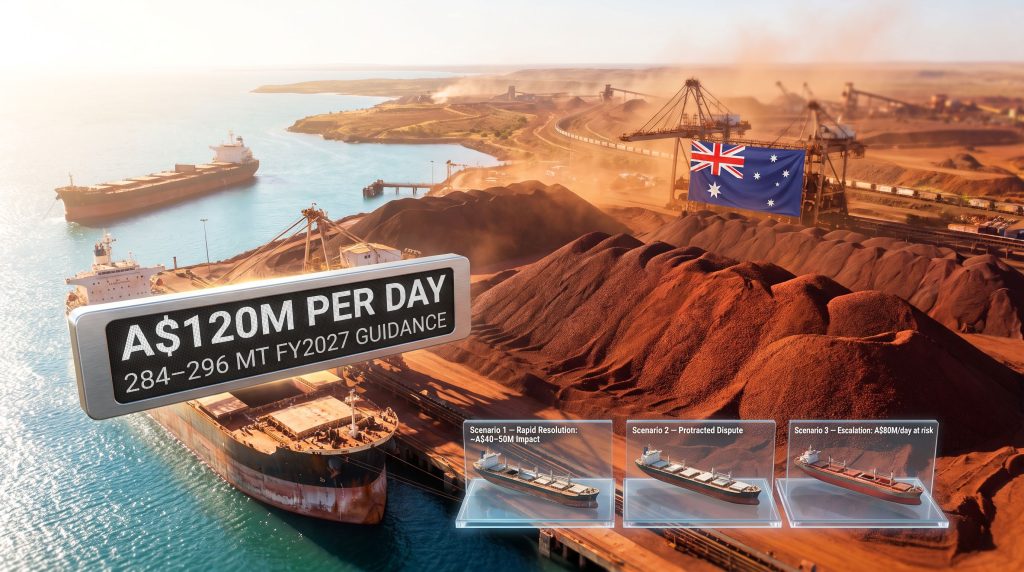
- Fiscal 2027 production guidance was set at 284 to 296 million tonnes
- Capital expenditure approval of $900 million was granted for the Ministers North project, targeting first production in fiscal year 2029
These figures represent operational strength at the extraction level. The strike, however, operates at a fundamentally different point in the supply chain.
The Distinction That Changes Everything
One of the most commonly misunderstood aspects of port-level industrial action is its relationship to production volumes. The Port Hedland strike does not affect mine-site output. Ore continues to be extracted from BHP's Pilbara operations and stockpiled at rail transfer facilities. The disruption occurs at the export interface, where vessel loading, berth sequencing, and ship scheduling are interrupted.
This distinction is critical for interpreting production guidance. A company can simultaneously report record extraction figures and suffer meaningful export volume shortfalls if port access is constrained for an extended period.
For investors assessing BHP's fiscal 2027 guidance range of 284 to 296 Mt, the relevant question is not whether the mines are running, but whether accumulated stockpiles can be cleared through the port before the end of the reporting period.
Pilbara's Role in China's Steel Supply Chain
China's structural dependence on Pilbara iron ore creates the context within which any Port Hedland disruption must be evaluated. The China steel and iron ore market reached record global trade volumes in 2025, with China importing 1.33 billion tonnes across all sources. Brazil, the only supply source of comparable scale to Australia, exported 413.6 million tonnes in 2025, providing Chinese buyers with a degree of diversification.
However, the logistical reality of iron ore procurement means that switching costs between Australian and Brazilian supply are substantial. Longer voyage distances, different moisture and grade profiles, and contractual commitment structures all limit the speed with which Chinese steelmakers can reallocate procurement away from Australian sources during a disruption event.
Seven Months of Stalled Bargaining: How the Strike Came to Pass
The Workforce at the Centre of the Dispute
The industrial action that began on July 16, 2026 involved approximately 150 to 200 unionised workers performing operator and maintenance roles across Port Hedland's export facilities. Three unions collectively participated under the banner of the Combined Ports Unions, comprising the Electrical Trades Union, the Australian Manufacturing Workers' Union, and the Western Mine Workers' Alliance.
The stoppage ran for precisely eight hours, commencing at 2:00 PM and concluding at 10:00 PM, representing a structured and deliberate escalation rather than an indefinite walkout. This sequencing reflects a calculated industrial strategy designed to maximise financial pressure on BHP while preserving the unions' capacity for further escalation if negotiations remain unresolved.
The Wage Gap That Triggered Action
The core disagreement driving industrial action centres on several intersecting demands:
| Union Demand | BHP's Documented Position |
|---|---|
| Equal pay for equivalent roles across site classifications | 16% pay increase offered over four years |
| Replacement of individual contracts with a unified enterprise agreement | Enterprise agreement framework under negotiation |
| Improved shift allowances and transparent career progression | Not publicly detailed |
The 16% pay offer over four years, while not negligible, was dismissed by unions as inadequate. Their benchmark for comparison was a 16% wage increase reportedly secured at a nearby BHP operation, which unions cited as evidence that comparable outcomes were achievable and that the port workforce was being treated inequitably relative to other BHP employee cohorts.
Negotiations had been ongoing since October 2025, meaning the dispute represented more than seven months of unresolved bargaining before any industrial action commenced. A July 14 mediation session ended without agreement, directly triggering the strike two days later.
Why This Strike Is Historically Significant
Context matters when assessing the severity of industrial disputes. The Port Hedland strike stands out across three dimensions:
- It is the first strike at Port Hedland in over a decade, with the last comparable action occurring in 2008
- Industry observers have described it as potentially the most significant industrial action in Western Australian mining in approximately 25 years
- The timing, coming immediately after a record production announcement, creates a sharp and visible contrast between operational capability and export delivery risk
The rarity of industrial action at Port Hedland is itself informative. It reflects both the historically robust labour relations framework governing Pilbara operations and the elevated stakes that attach to any breakdown in that framework given the port's irreplaceable role in global supply chains.
Financial Exposure: Quantifying the Cost of a Port Stoppage
Direct Revenue Impact
At a port generating approximately $80 million in daily export value, an eight-hour stoppage represents a theoretical single-day export loss in the range of $26 to $30 million, though the unions' own cost estimate for the action reached as high as $50 million when factoring in downstream vessel scheduling disruptions, demurrage costs, and the cascading delays that accumulate across berth queues following any significant operational interruption.
The Western Australian state government faces parallel royalty revenue exposure, with estimates suggesting up to $7 million in daily royalty income at risk if disruptions extend beyond isolated stoppages.
Three Scenarios for the July 21 Fair Work Talks
The outcome of Fair Work Commission proceedings scheduled for July 21 represents the most consequential near-term variable in the dispute's trajectory. Three distinct scenarios frame the range of possible outcomes:
Scenario 1: Rapid Resolution — Fair Work Commission talks on July 21 produce a framework agreement. Further stoppages are avoided. Total financial impact remains contained near the $50 million estimate. BHP's fiscal 2027 guidance of 284 to 296 Mt remains intact, with accumulated stockpiles cleared through normal shipping schedules.
Scenario 2: Protracted Dispute — Negotiations extend beyond July 21 without resolution. Rolling stoppages accumulate over several weeks. Vessel scheduling disruptions create cascading delays across berth availability. Fiscal 2027 production guidance comes under pressure at the lower end of the 284 Mt range, and unit cost guidance becomes increasingly difficult to defend.
Scenario 3: Full Escalation — Fair Work proceedings break down entirely. Extended or indefinite strike action materially interrupts BHP's export flow for weeks. Pilbara-wide economic activity is affected. BHP's August 18 annual results become a focal point for investor concern around production delivery and cost guidance integrity.
A Closer Look at the Production-Export Divergence
For investors tracking BHP's production numbers, the disconnect between what is mined and what is shipped deserves careful attention. During the period of industrial action, BHP's Pilbara operations continue extracting ore at rates consistent with fiscal year guidance. That ore accumulates at stockpile facilities and rail transfer points rather than moving through vessel loading systems.
If the dispute resolves quickly, accumulated stockpiles can be cleared through expedited shipping schedules without any material impact on reported annual volumes. If the dispute extends, the backlog grows to a point where clearing it within the reporting period becomes operationally challenging, creating a genuine risk that extracted tonnes are not converted into shipped tonnes within the fiscal year window.
Global Iron Ore Market Dynamics: What Context Reveals
China's Structural Leverage
The broader global iron ore market context is essential for evaluating how a Port Hedland disruption would propagate through pricing and procurement decisions. China's position as the world's dominant iron ore buyer, accounting for the majority of global seaborne trade at 1.33 billion tonnes imported in 2025, gives its state-backed purchasing entities significant leverage in annual pricing negotiations. Furthermore, understanding iron ore price trends is essential for contextualising how prolonged disruptions translate into market-level pricing shifts.
China Mineral Resources Group has maintained purchasing restrictions that continued to apply downward pressure on annual contract pricing through fiscal 2026. Despite this institutional pressure, BHP managed to achieve a 3% improvement in realized prices to $84.56 per wet tonne during the period, suggesting that supply-side factors partially offset buyer-side leverage.
A sustained Port Hedland disruption would theoretically reduce Australian seaborne iron ore availability, providing short-term upward price support. However, several factors limit this effect:
- Brazil's 413.6 million tonnes of 2025 exports provide Chinese buyers with a credible alternative supply source
- Chinese port iron ore inventories have historically been managed at levels that provide 30 to 45 days of buffer against supply disruptions
- The relatively short duration of initial strike action limits the scope for meaningful inventory drawdowns that would force spot market price adjustments
Grade Dynamics and the Pilbara Premium
A less commonly discussed dimension of the Port Hedland disruption involves iron ore grade specifications. Pilbara ore is predominantly Marra Mamba and Brockman ore types, characterised by relatively high iron content averaging 61 to 62% Fe for standard products, with premium lump products reaching 63 to 64% Fe.
Chinese steelmakers have historically paid a lump premium for physically larger ore particles that can be charged directly into blast furnaces without sintering, reducing energy consumption and improving efficiency metrics. Any extended disruption to Port Hedland lump exports would force Chinese mills to substitute with sinter fines or pellets, adding processing costs and potentially affecting blast furnace productivity ratios during the transition period.
This grade-specific disruption effect is rarely captured in simple revenue loss calculations but represents a genuine operational cost for downstream steel producers that could persist beyond the immediate disruption window.
BHP's Response: Contingency Architecture and Long-Term Confidence
Immediate Operational Measures
BHP confirmed that robust contingency measures were activated to maintain export flows during the industrial action. The specific mechanics of these contingencies, while not publicly detailed, typically involve a combination of:
- Accelerated pre-strike vessel loading schedules
- Temporary redeployment of non-union supervisory personnel to critical berth positions
- Stockpile management to prioritise highest-value product grades for early vessel loading
- Coordination with vessel operators to manage berth queue sequencing and minimise demurrage exposure
The company's Section 240 application to the Fair Work Commission, which seeks formal conciliation assistance, was criticised by unions as a procedural manoeuvre designed to delay rather than resolve the underlying dispute. This characterisation reflects a common dynamic in Australian industrial relations where formal legal mechanisms are frequently deployed as leverage tools rather than genuine resolution pathways.
The Ministers North Investment Signal
Against the backdrop of near-term labour disruption, BHP's approval of $900 million in capital expenditure for the Ministers North project carries meaningful strategic significance. This investment, targeting first production in fiscal year 2029, demonstrates that BHP views the current dispute as a manageable cyclical challenge rather than a structural threat to its Western Australian iron ore franchise.
The Ministers North approval also signals confidence in the long-term iron ore price outlook, as major capital commitments of this scale are typically underpinned by internal price deck assumptions extending well beyond current market conditions. BHP CEO Brandon Craig's attribution of fiscal 2026 record output to disciplined operational performance reinforces this narrative of underlying asset quality that transcends near-term labour relations friction. In addition, Australia's iron ore leadership in global markets remains firmly anchored by the Pilbara's structural cost advantages, even as short-term industrial disruptions test export reliability.
The Pilbara Community Dimension
The economic exposure from the dispute extends beyond BHP's balance sheet. With BHP employing approximately 7% of Port Hedland's total population, the company functions as the dominant private sector economic engine for the entire region. A prolonged work stoppage would reduce direct wage income, suppress retail and services spending, and create financial pressure across the supply chain of contractors and service providers whose revenues depend on continued mining activity.
This community exposure dimension adds a political complexity to the dispute that purely financial analyses frequently overlook, as prolonged economic disruption in a resource community carries implications for state government relations, regulatory relationships, and social licence considerations that extend beyond any single bargaining round.
The next major ASX story will hit our subscribers first
Key Milestones Defining the Dispute's Trajectory
| Date | Event | Market Significance |
|---|---|---|
| July 16, 2026 | Eight-hour strike commences at Port Hedland | First industrial action at the port in over a decade |
| July 21, 2026 | Fair Work Commission talks resume | Binary outcome event determining escalation risk |
| August 18, 2026 | BHP Annual Results released | Fiscal 2027 guidance and unit cost disclosure reveals strike impact |
The July 21 session carries the most immediate weight. A successful framework agreement effectively caps losses near current estimates and allows BHP to defend its fiscal 2027 guidance range with confidence. A breakdown in those talks opens the door to scenario two or three outcomes, with compounding financial and reputational consequences.
The August 18 annual results will serve as the definitive accounting. Production volumes, unit cost per tonne, and any revisions to fiscal 2027 guidance will collectively reveal whether the strike remained a contained cost item or evolved into a material operational risk that BHP's contingency measures failed to fully absorb. Consequently, the iron ore logistics update across Western Australia's broader export infrastructure will also be closely monitored as operators assess contingency routing options.
Frequently Asked Questions: Port Hedland Strike and BHP Iron Ore Exports
How much iron ore does Port Hedland export each day?
Port Hedland handles approximately $80 million worth of iron ore exports daily across all operators, making it the highest-value single-commodity export facility on the planet.
How long had the BHP wage dispute been running before the strike?
Negotiations between BHP and the Combined Ports Unions began in October 2025, meaning the dispute had accumulated more than seven months of unresolved bargaining before industrial action commenced in July 2026.
Does the strike reduce BHP's iron ore production volumes?
No. The strike targets port logistics and vessel loading operations, not mine-site extraction activity. BHP's Pilbara mines continue operating, but export delivery timelines diverge from production timelines as shipment scheduling is disrupted.
What is BHP's fiscal 2027 production guidance for Western Australia iron ore?
BHP has guided 284 to 296 million tonnes for Western Australia iron ore in fiscal year 2027. This guidance does not currently incorporate any assumption of extended industrial action impacts.
What is a Section 240 application under Australian industrial law?
A Section 240 application invokes the Fair Work Commission's formal dispute resolution jurisdiction, requesting that the Commission assist parties in resolving a bargaining deadlock through structured conciliation. BHP filed this application after the July 14 mediation session concluded without agreement.
When was the last comparable strike at Port Hedland?
The most recent comparable industrial action at Port Hedland occurred in 2008, making the July 2026 stoppage the first in over a decade and, by several industry assessments, the most strategically significant labour dispute in Western Australian mining in approximately 25 years.
Synthesising the Risk: Three Dimensions for Investors
The Port Hedland strike and BHP iron ore exports situation is most accurately understood not as a production event but as an export infrastructure stress test with financial, operational, and structural dimensions that each carry distinct implications.
Financial Exposure remains manageable within BHP's earnings base at current estimates. The $50 million union-estimated cost represents a fraction of BHP's quarterly revenue from Western Australia iron ore operations. However, each additional day of unresolved industrial action compounds losses and introduces unit cost pressure that will be visible in August results.
Production Guidance Integrity depends almost entirely on the duration of the dispute. BHP's fiscal 2027 guidance range of 284 to 296 Mt provides meaningful buffer at the upper end, and a brief dispute resolving before late July is unlikely to threaten delivery. A dispute extending into August creates genuine downside risk to the lower bound of that range.
Structural Labour Relations Risk represents the most significant and underappreciated dimension of this dispute. The seven-month negotiation timeline, the historical rarity of Port Hedland strike action, and the involvement of multiple union bodies suggest this is not a routine bargaining cycle. Furthermore, the iron ore tariff impacts already weighing on global trade flows mean that any sustained disruption to Australian export volumes arrives at a particularly sensitive moment for market stability. If the Fair Work process fails to produce a durable agreement, BHP faces the prospect of recurring disruption at its most critical export infrastructure, a risk that extends well beyond any single quarter's production figures.
The outcome of the July 21 Fair Work Commission talks will determine whether this episode remains a footnote in BHP's fiscal 2027 results or the opening chapter of a more prolonged operational and reputational challenge for Australia's largest iron ore exporter. For further context on the broader industrial dispute, the Australian Financial Review's coverage provides additional detail on the economic stakes involved.
This article is intended for informational purposes only and does not constitute financial advice. All forecasts, scenario analyses, and production guidance references reflect available information at the time of publication and are subject to change. Investors should conduct their own due diligence before making investment decisions.
Want to Stay Ahead of ASX Mineral Discoveries Before the Broader Market Reacts?
While major port disruptions and production guidance shifts dominate headlines, the real edge for investors lies in identifying significant mineral discoveries the moment they hit the ASX — Discovery Alert's proprietary Discovery IQ model scans daily announcements in real time, delivering actionable insights across more than 30 commodities to both short-term traders and long-term investors. Explore historic discoveries and their market returns, then begin your 14-day free trial at Discovery Alert to position yourself ahead of the next major find.