July 16, 2026
Middle-Power Diplomacy in an Age of Great-Power Conflict
When two heavily armed states find themselves locked in escalating military exchanges, the conventional assumption is that resolution will come through superpower intervention, multilateral institutions, or sheer military exhaustion. History, however, repeatedly demonstrates a more nuanced reality: some of the most consequential moments in conflict de-escalation have been engineered not by the world's most powerful nations, but by strategically positioned middle powers operating with credibility on multiple fronts simultaneously. Pakistan's current role in the US-Iran crisis is precisely this kind of moment.
As Pakistan urges US and Iran to resume talks amid a sixth consecutive day of renewed hostilities, Islamabad is navigating one of the most consequential diplomatic assignments any middle power has undertaken in the post-Cold War era. Understanding why this matters requires moving beyond the immediate news cycle and examining the structural architecture of both the conflict and the mediation framework that has emerged from it.
When big ASX news breaks, our subscribers know first
The Islamabad MoU: What the Framework Actually Contains
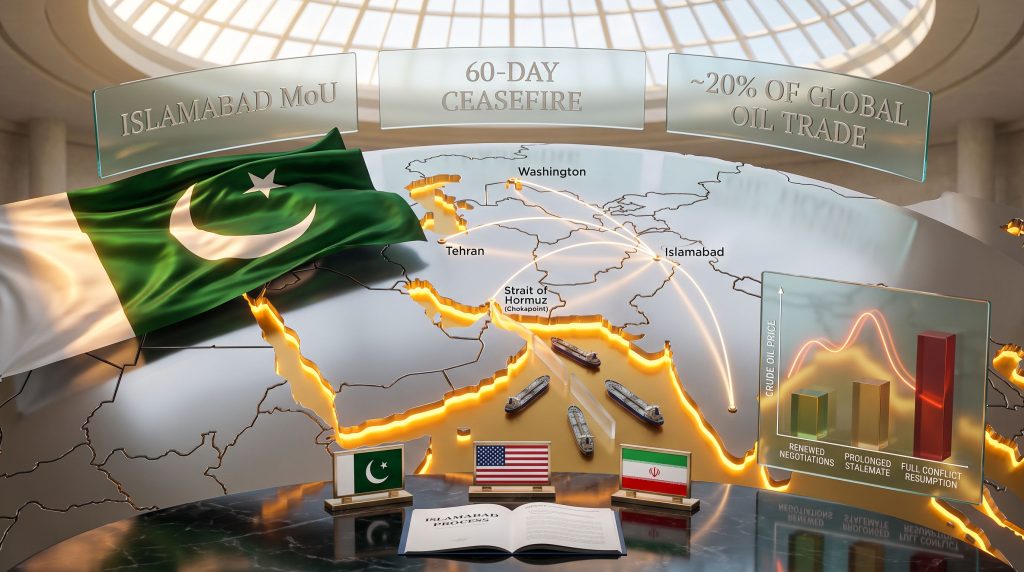
The Islamabad Memorandum of Understanding, brokered through Pakistani facilitation in June 2026, represented something genuinely unprecedented in modern diplomatic history: the first direct high-level engagement between American and Iranian officials since the Islamic Revolution of 1979. That it happened at all is a testament to Pakistan's unique positioning.
The MoU's architecture rests on three interlocking components:
- A 60-day ceasefire mechanism designed to create space for substantive negotiations
- Provisions for the reopening of the Strait of Hormuz to commercial shipping
- A structured timetable for concluding a final agreement covering both the military conflict and Iran's nuclear programme
The distinction between this framework and a durable peace agreement is critical and frequently misunderstood. A ceasefire architecture creates conditions for negotiation; it does not itself constitute resolution. Conflating the two generates false optimism that, when the framework comes under stress, produces a correspondingly sharp collapse in confidence. What Pakistan is now managing is precisely the gap between those two realities.
Pakistani Foreign Office spokesman Tahir Andrabi articulated Islamabad's position with considerable diplomatic precision at a weekly press briefing, noting that while the MoU's implementation faces challenges, the logical template it provides survives the current escalation. His framing was deliberate: the logic of the Islamabad MoU still exists, and whenever both parties determine that the escalation cycle has exhausted itself, the pathway back to negotiation runs through the framework already established.
The concept of a diplomatic framework surviving active military conflict is not theoretical. The Korean War armistice negotiations continued for over two years while active combat operations proceeded. The Paris Peace Accords on Vietnam were signed after years of parallel fighting and negotiating. The Islamabad MoU's survival as a viable template is historically coherent, not merely aspirational.
Pakistan expects US-Iran talks to resume soon, according to statements from Islamabad's Foreign Office, reinforcing the view that the framework retains its structural validity even under the pressure of renewed hostilities.
Why the Strait of Hormuz Is the Structural Core of This Conflict
Any analysis of this crisis that treats the Strait of Hormuz as merely a geographic backdrop misunderstands the conflict's fundamental architecture. Approximately 20% of the world's seaborne oil trade passes through this 33-kilometre-wide chokepoint, along with significant volumes of liquefied natural gas. Iran's geographic position gives it both the capacity to disrupt this passage and strong incentive to use that capacity as leverage in negotiations.
The economic consequences of sustained Hormuz disruption radiate outward with particular severity across the Global South. Consider the exposure profile of the most vulnerable economies:
| Region | Primary Exposure | Secondary Effect |
|---|---|---|
| South Asia | Direct energy import cost increases | Agricultural input inflation |
| Southeast Asia | Shipping cost escalation | Export competitiveness erosion |
| Sub-Saharan Africa | Fuel price spikes | Food security deterioration |
| Middle East (non-GCC) | Energy supply uncertainty | Economic instability |
Pakistan's Foreign Office spokesman specifically acknowledged that nations across the Global South are bearing disproportionate costs from the Hormuz disruption. Furthermore, he framed Pakistan's mediation efforts not merely as a bilateral service to Washington and Tehran but as a responsibility toward the broader community of import-dependent economies whose populations are facing rising fuel and food costs through no involvement of their own.
This framing is diplomatically sophisticated. By positioning Pakistan as an advocate for developing-world economic interests rather than simply as a US-adjacent interlocutor, Islamabad strengthens its credibility with Tehran. The broader geopolitical oil price factors at play here are amplifying pressure on all parties to find a resolution before energy markets deteriorate further.
The Negotiating Deadlock: Why Both Sides Are Stuck
The resumption of hostilities following the Islamabad MoU reflects a classic sequencing deadlock that has derailed numerous diplomatic processes throughout history. Both parties have legitimate concerns, but the order in which those concerns must be addressed is itself a contested negotiating point.
| Dimension | Washington's Position | Tehran's Position |
|---|---|---|
| Nuclear Guarantees | Must be verified and binding before sanctions relief | Sanctions relief is a precondition, not a reward |
| Naval Blockade | Maintained as compliance leverage | Removal required before any formal talks resume |
| Ceasefire Conditions | Conditional on Iranian compliance | Unconditional cessation of US military operations demanded |
| Deal Sequencing | Structured within MoU timetable | Disputes the ordering of mutual obligations |
Iran's President Pezeshkian has specifically demanded removal of what his administration describes as operational barriers, a formulation that refers primarily to the US naval blockade around Iranian waters. Washington views that blockade as its primary leverage instrument and is unwilling to relinquish it absent verifiable nuclear guarantees, consequently creating a circular impasse where each party's precondition for talking is precisely the thing the other refuses to concede before talks begin.
Adding complexity to this dynamic, US Vice President JD Vance revealed that elements within the Israeli government sought to influence Washington's position on the Iran deal, an indication that third-party interference is actively complicating bilateral mediation. The broader oil market impacts of this prolonged deadlock are already reverberating through global energy benchmarks. Externally applied pressure on the US negotiating position narrows Washington's flexibility and makes it harder for Pakistani intermediaries to identify landing zones both parties can accept.
Is Pakistan Urging US and Iran to Resume Talks Enough to Break the Deadlock?
Pakistan urges US and Iran to resume talks through sustained back-channel diplomacy rather than public ultimatums, recognising that coercive framing would compromise Islamabad's access to both parties. However, Foreign Minister Ishaq Dar has urged a ceasefire with considerable urgency, noting that the window for restoring the MoU framework narrows with each additional day of escalation.
How Pakistan's Mediation Model Actually Functions
Pakistan's approach to this mediation differs meaningfully from the formal multilateral models most commonly associated with international conflict resolution. Rather than convening structured multilateral sessions under institutional auspices, Islamabad is operating what diplomats describe as shuttle diplomacy: maintaining separate, active communication channels with both Washington and Tehran while working to identify the specific concessions each party could accept without publicly abandoning their stated positions.
Interior Minister Mohsin Naqvi conducted direct engagement in Tehran, while Foreign Minister Ishaq Dar has been the primary advocate for ceasefire extension within the diplomatic framework. Türkiye and Egypt are playing supporting roles within this architecture, reinforcing Islamabad's mediation without displacing Pakistan as the primary intermediary.
Effective mediation in asymmetric conflicts requires the intermediary to avoid being perceived as aligned with either party's maximalist demands. Pakistan's public language, emphasising maximum restraint and the rationality of peace over the logic of escalation, is precisely calibrated to preserve this perceived neutrality. Any statement that could be read as validating one party's military position would compromise Pakistan's access to the other.
The communication channel preservation doctrine is perhaps Pakistan's most underappreciated contribution. When formal negotiations collapse and military escalation resumes, the most strategically valuable asset is not a peace proposal but a functioning back-channel that keeps both parties talking at some level. Pakistan's sustained engagement, even as the MoU faces implementation challenges, is directed at preserving exactly this infrastructure.
Scenario Analysis: Three Possible Trajectories in the Coming 60 Days
The 60-day window originally established by the Islamabad MoU provides a useful analytical frame for assessing the range of plausible outcomes. Three distinct trajectories merit examination:
| Scenario | Required Conditions | Likely Regional Impact |
|---|---|---|
| Renewed Negotiations | Escalation exhausts both parties; Pakistan facilitates technical-level re-engagement | Hormuz reopens partially; oil prices stabilise |
| Prolonged Stalemate | Neither party returns to MoU; low-intensity conflict continues | Sustained energy price volatility; inflation pressure |
| Full Conflict Resumption | Escalation crosses defined red lines; MoU abandoned entirely | Severe global supply chain disruption; recession risk |
The third scenario, while carrying the lowest probability, cannot be dismissed. Iran's retaliatory strikes on Bahrain, Kuwait, and Jordan following the expansion of US military operations inside Iranian territory represent a significant geographic escalation. When a bilateral military conflict begins generating strikes on third-party nations, the risk of uncontrolled escalation increases substantially.
Oil markets are already pricing a meaningful conflict risk premium into current crude benchmarks. This potential oil price shock is of mounting concern to energy sector analysts globally. A sustained two-week Hormuz closure historically produces significant crude price spikes that translate into consumer fuel and food price increases within approximately six to eight weeks, with the sharpest impacts concentrated in economies with limited foreign exchange reserves.
Could This Escalation Trigger a Broader Recession?
The recession risk analysis emerging from financial market observers suggests that a full conflict resumption scenario would generate cascading economic effects well beyond the immediate region. In addition, the disproportionate burden on developing-nation importers could trigger sovereign debt stress in economies already operating with narrow fiscal margins.
The next major ASX story will hit our subscribers first
Pakistan's Emerging Role as a Model for Middle-Power Mediation
The diplomatic architecture Pakistan has constructed around the Islamabad Process merits examination beyond the immediate crisis context. Pakistan is navigating a mediation role that requires simultaneous credibility with a Western superpower, a heavily sanctioned regional power, and a coalition of developing nations affected by the conflict's economic spillover effects. That is an extraordinarily complex balancing act.
A useful structural comparison is Qatar's role in the Gaza negotiations, where Doha maintained functional relationships with Hamas, Israel's interlocutors, and Washington while hosting the technical-level talks that produced the ceasefire framework. The architectural similarities are significant:
- Both Qatar and Pakistan leveraged geographic positioning and dual-access relationships as their primary mediation assets
- Both operated through back-channel shuttle diplomacy rather than formal multilateral convening
- Both framed their roles as communication facilitators rather than arbiters imposing solutions
- Both faced intense pressure from parties seeking to use the mediation process to extract unilateral concessions
The differences are also instructive. Pakistan brings a nuclear-armed status, a Muslim-majority identity, and an active security relationship with the United States that Qatar does not possess. These attributes give Islamabad specific forms of credibility with both Tehran and Washington that are genuinely difficult to replicate. Furthermore, the broader geopolitical mining landscape offers a useful parallel: middle powers operating at the intersection of competing great-power interests frequently discover that their leverage derives precisely from their refusal to fully align with either side.
What a Durable Framework Would Actually Require
Moving from the current ceasefire template to a binding, durable peace architecture would require progress across three distinct policy pillars simultaneously. Confidence-building measures would need to precede any binding commitment, establishing verified de-escalation steps small enough that neither party interprets them as unilateral concession but significant enough to demonstrate good faith.
The International Atomic Energy Agency's verification architecture will be essential to any nuclear component of a final agreement. Given that both parties have articulated nuclear guarantees as a core demand, the IAEA's institutional role as a neutral verification body provides exactly the kind of third-party architecture that allows each party to accept monitoring without accepting the other's political framing.
Pakistan's sustained position — that peace processes do not die but rather wait for escalation logic to exhaust itself — reflects a sophisticated understanding of how protracted conflicts ultimately resolve. The historical record suggests this framework is analytically sound. The question is not whether negotiations will eventually resume, but whether the back-channel infrastructure Islamabad has built will still be functional when both parties are ready to use it. As Pakistan urges US and Iran to resume talks through every available channel, the durability of that infrastructure may prove to be the defining variable in this crisis.
This article contains analysis of an active geopolitical situation. Assessments of diplomatic outcomes, conflict trajectories, and economic impacts involve inherent uncertainty. Readers should treat scenario modelling as analytical framing rather than prediction. The situation as of July 16, 2026, remains fluid and subject to rapid change.
Want to Stay Ahead of the Market Opportunities Created by Geopolitical Disruption?
When conflicts reshape energy markets and commodity prices, the window for informed investment action can be measured in hours, not days. Discovery Alert's proprietary Discovery IQ model delivers real-time alerts on significant ASX mineral discoveries — including those in commodities directly exposed to geopolitical volatility — so subscribers can identify actionable opportunities well ahead of the broader market. Explore historic examples of major discovery returns and begin a 14-day free trial to position yourself at the forefront of market-moving events.