July 16, 2026
The Industrial Logic Behind North America's First Integrated Manganese Supply Chain
For decades, the architecture of global critical mineral supply chains has followed a familiar and deeply flawed pattern: resource-rich nations extract raw materials, ship them to processing hubs concentrated in a handful of countries, and finished products flow back to consuming economies at a significant markup. Manganese, one of the most industrially indispensable metals on the periodic table, has followed exactly this trajectory. The consequence is a structural vulnerability that has grown more visible as geopolitical tensions reshape trade relationships and governments reassess the strategic exposure embedded in their industrial base.
The formation of the North American Critical Manganese Alliance (NACMA) in July 2026 represents a coordinated attempt to break this pattern entirely, not by incrementally improving one segment of the supply chain, but by building a fully integrated platform from the ground up across two countries simultaneously.
When big ASX news breaks, our subscribers know first
Why Manganese Deserves Far More Strategic Attention Than It Receives
Manganese occupies a paradoxical position in the global materials economy. It is simultaneously one of the most widely used metals in the world and one of the least discussed in mainstream investment and policy conversations. This underappreciation is partly structural: manganese rarely commands the media attention of lithium or cobalt, yet its removal from the industrial system would be catastrophic.
Approximately 90% of global steel production depends on manganese as a non-substitutable alloying agent. The metal improves steel's hardness, tensile strength, and resistance to wear and impact, properties that are fundamental to construction, automotive manufacturing, rail infrastructure, and defence applications. No commercially viable alternative currently exists at the scale required by global industry.
What has changed dramatically in recent years is the emergence of a second major demand driver: lithium manganese iron phosphate (LMFP) battery chemistry. LMFP cathodes are gaining significant traction in electric vehicle and grid-scale energy storage applications for several reasons that are not yet widely understood by generalist investors. Furthermore, the battery raw materials market is evolving rapidly, placing manganese at the centre of new supply chain strategies.
- LMFP offers a higher energy density than standard lithium iron phosphate (LFP) chemistry while retaining excellent thermal stability and cycle life
- The chemistry uses manganese as a primary cathode input, and unlike nickel-manganese-cobalt (NMC) formulations, it eliminates cobalt entirely, addressing both cost and ethical supply chain concerns
- Leading battery manufacturers in China have already begun commercialising LMFP at scale, and the chemistry is expected to see substantial adoption in North American and European EV supply chains over the next several years
- Demand for high-purity manganese sulphate monohydrate (HPMSM), the refined manganese product used in battery cathode production, is forecast to grow significantly faster than overall manganese demand
Despite this structural demand shift, North America currently has no integrated domestic manganese supply chain capable of producing battery-grade manganese products at commercial scale. This is the precise gap that NACMA has been designed to address. In addition, the broader critical minerals demand surge across North America and Europe is intensifying the urgency of building sovereign processing capabilities.
Understanding the Woodstock Project: North America's Geological Anchor
Any credible manganese supply chain initiative in North America must begin with geology, and on that front, the Woodstock Project in New Brunswick, Canada, presents a genuinely compelling foundation. The project hosts what is recognised as North America's largest known manganese carbonate system, a geological distinction that carries significant implications for processing strategy and long-term resource economics. For context, this parallels the significance of a strategic manganese deposit in Europe's own critical mineral landscape.
Manganese carbonate deposits (principally rhodochrosite mineralogy) differ meaningfully from the oxide-dominant deposits more commonly found elsewhere in the world. Several characteristics make carbonate-hosted systems particularly well-suited to hydrometallurgical processing pathways:
- Carbonate mineralogy responds favourably to acid leaching processes, enabling efficient dissolution of manganese into solution with relatively low reagent consumption compared to harder oxide ores
- The resulting leach solution can be purified and processed through solvent extraction and electrowinning or crystallisation steps to produce high-purity manganese compounds including HPMSM for battery applications
- Carbonate deposits typically exhibit more homogeneous grade distribution than oxide systems, which supports more predictable processing performance and reduces metallurgical variability risk
New Brunswick's geological setting also provides logistical advantages. The province's developed infrastructure, proximity to major eastern seaboard industrial centres, and established regulatory framework in Canada's mining sector all contribute to the project's development attractiveness.
Geological note: Manganese carbonate deposits of the scale and quality represented by the Woodstock Project are relatively rare in North America. The combination of deposit scale, carbonate mineralogy, and hydrometallurgical amenability makes Woodstock a strategically unique asset within the continental resource base.
NACMA's Four-Member Structure and the Logic of Vertical Integration
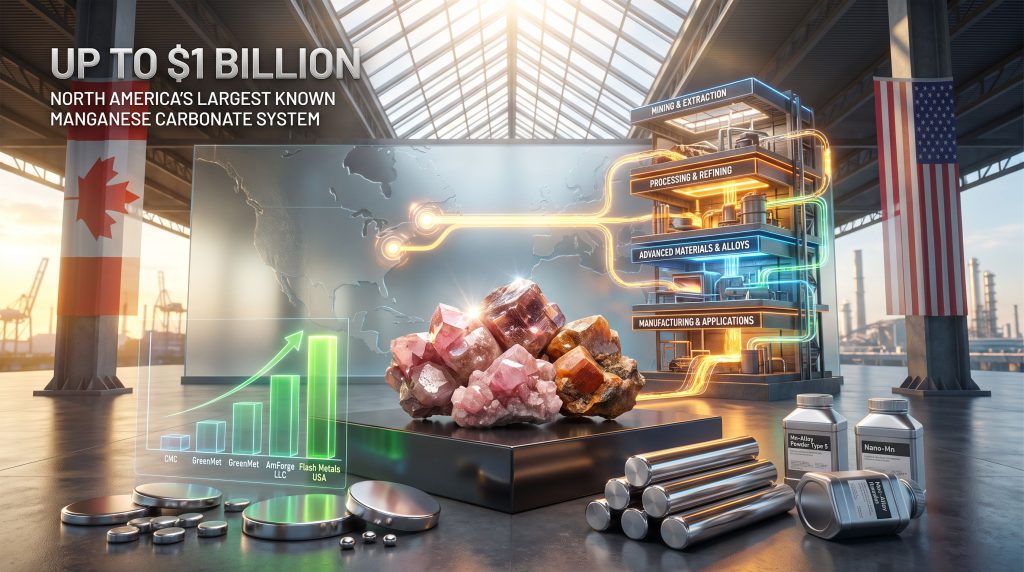
The North American Critical Manganese Alliance was structured from inception as a vertically integrated industrial platform rather than a conventional mining venture. This distinction matters considerably for how investors and policymakers should evaluate the initiative. As reported by Investing News, the alliance brings together four founding members, each contributing capabilities that correspond to a specific segment of the manganese value chain.
| Alliance Member | Jurisdiction | Core Contribution to NACMA |
|---|---|---|
| Canadian Manganese Company (CMC) | Canada | Resource development and upstream feedstock supply via the Woodstock Project |
| GreenMet | USA (Washington D.C.) | Strategic capital formation, industrial partnerships, and government engagement |
| AmForge LLC | USA | Advanced manufacturing capabilities for defence and aerospace applications |
| Flash Metals USA | USA | Specialty manganese processing and product development |
The two-platform architecture that underpins NACMA's design is worth examining carefully, as it reflects a deliberate strategic choice to optimise each geography for what it does best.
The Canadian Platform: Upstream Resource and Refining
The Canadian arm of NACMA is built around the Woodstock Project's resource endowment and is focused on the upstream stages of the manganese value chain. Activities within this platform span:
- Mining and beneficiation of manganese carbonate ore from the Woodstock deposit
- Hydrometallurgical refining to produce intermediate manganese products suitable for downstream processing in the United States
The selection of hydrometallurgy as the processing pathway is technically significant. Unlike pyrometallurgical approaches that require high-temperature smelting and generate significant emissions, hydrometallurgical processing operates at lower temperatures. It produces higher-purity outputs suitable for battery applications and aligns more favourably with environmental permitting requirements in North American jurisdictions. Indeed, this mirrors advanced processing technology trends seen across other critical mineral sectors.
The U.S. Platform: Downstream Transformation in West Virginia
The American platform, anchored in West Virginia, is oriented toward higher-value product categories that command premium pricing and serve strategically sensitive end markets:
- Battery-grade manganese sulphate targeting LMFP cathode supply chains for electric vehicles and grid storage
- Specialty manganese chemicals for industrial applications across multiple sectors
- Defence and aerospace-grade manganese alloys leveraging the metal's performance characteristics in high-stress applications
- Additive manufacturing feedstocks for advanced industrial production processes
West Virginia's selection as the U.S. manufacturing hub reflects a combination of factors including existing industrial infrastructure, workforce capabilities, and proximity to major manufacturing corridors in the eastern United States. Furthermore, the defence critical materials strategies being developed across allied nations underscore how important sovereign manganese processing has become for national security planners.
GreenMet's $1-Billion Capital Formation Mandate: What It Actually Means
The appointment of GreenMet as the exclusive strategic development and capital formation partner for NACMA under a letter of intent signals an approach to project financing that differs substantially from conventional mining project capital raises.
The targeted programme of up to $1 billion in long-term capital commitments is structured across multiple development phases and is designed to draw from a deliberately diversified pool of capital sources. This multi-source capital strategy is intended to reduce dependency on any single investor class and to align capital structure with the long-term industrial nature of the platform.
The capital formation approach encompasses:
- Strategic equity investments from industry participants with commercial interests in the manganese value chain
- Project financing structures tied to specific development phases and asset construction milestones
- Government-supported funding programmes relevant to critical mineral development
- Export credit agency financing for cross-border capital flows
- Infrastructure capital from long-term asset-focused investors
- Industrial partnership arrangements with offtake and commercial dimensions
- Original equipment manufacturer participation from EV and battery sector participants
- Institutional investment from pension funds, sovereign wealth funds, and infrastructure allocators
GreenMet's Washington D.C. location is strategically relevant to its government engagement mandate. Proximity to federal agencies, the Department of Defense, export credit institutions, and congressional policy offices provides direct access to the decision-makers who control critical mineral financing programmes and procurement policy. As IndexBox has noted, the alliance's structure is designed specifically to leverage these governmental relationships as a core competitive advantage.
Important disclaimer: As of July 2026, NACMA remains a framework agreement. The $1-billion capital target represents a programme objective, not secured commitments. No binding capital has been formally raised, and investors should evaluate this initiative with full awareness of the substantial execution pathway that lies ahead.
Key Risks That Sophisticated Investors Should Evaluate
The ambition of NACMA's integrated supply chain vision is genuinely significant. However, the distance between a strategic framework and an operational industrial platform is substantial, and the risks along that pathway deserve clear-eyed assessment.
The following table summarises NACMA's current development status against the milestones required for operational reality:
| Development Milestone | Status as of July 2026 |
|---|---|
| Alliance framework and member mandates established | Completed |
| GreenMet appointed as exclusive capital formation partner | Completed |
| Binding capital commitments secured | Not yet achieved |
| Canadian permitting and regulatory approvals | In progress |
| U.S. processing facility permitting | In progress |
| Construction of hydrometallurgical processing platform | Not commenced |
| Downstream specialty manufacturing establishment | Not commenced |
| First commercial production | Not commenced |
Beyond the standard project development risks, NACMA faces several challenges that are specific to its integrated, multi-jurisdictional structure:
- Coordination complexity across four founding members, two national regulatory systems, and multiple investor classes simultaneously
- Technology execution risk in hydrometallurgical processing, where pilot-scale performance does not always translate directly to commercial-scale operations without meaningful capital and engineering investment
- Market timing uncertainty around LMFP battery chemistry adoption rates in North America, which will directly influence the commercial attractiveness of battery-grade manganese products
- Capital market conditions for critical mineral projects, which have been volatile and will influence the cost and availability of the institutional capital NACMA is targeting
- Policy dependency, where portions of the capital formation strategy involve government-supported financing programmes that can be subject to administrative and legislative change
The next major ASX story will hit our subscribers first
How NACMA Fits Within the Broader Critical Minerals Realignment
The structural context within which NACMA is operating deserves attention, because the macro environment for North American critical mineral development has shifted considerably. Both the U.S. and Canadian governments have formally classified manganese as a critical mineral, a designation that reflects its strategic importance to steel production, battery technology, and defence manufacturing rather than constituting project-specific support for any individual initiative.
The global shift toward LMFP battery chemistry represents a structural demand inflection that is not yet fully priced into manganese market outlooks. As battery manufacturers diversify away from NMC chemistries that depend on nickel and cobalt, and as LFP producers seek higher energy density without sacrificing safety, LMFP occupies an increasingly attractive middle ground.
The manganese intensity of this chemistry creates a demand profile that existing global supply chains, concentrated primarily in South Africa, Gabon, and Australia for ore production and China for refined products, are not well-positioned to serve for North American industrial consumers.
NACMA's integrated model, combining Canadian ore with U.S. advanced manufacturing, mirrors the supply chain architecture that has been pursued in adjacent critical mineral sectors including lithium and rare earths, where standalone mining projects have consistently struggled to create durable value without downstream processing integration.
Whether the North American Critical Manganese Alliance can navigate the complex pathway from strategic framework to operational supply chain platform will depend on execution quality, capital market conditions, regulatory timelines, and the pace of LMFP adoption in North American battery manufacturing. The coming 12 to 24 months will be formative in determining which of those variables proves most favourable or most constraining for the alliance's development trajectory.
This article is intended for informational purposes only and does not constitute financial or investment advice. Forward-looking statements regarding NACMA's development timeline, capital programme, and commercial outcomes involve assumptions and uncertainties that may cause actual results to differ materially. Readers should conduct independent due diligence before making any investment decisions.
Want to Track the Next Major Critical Mineral Discovery Before the Market Does?
Discovery Alert's proprietary Discovery IQ model delivers real-time alerts on significant ASX mineral discoveries — instantly translating complex mineral data into actionable opportunities across manganese, battery materials, and over 30 other commodities. Explore historic discoveries and their returns to understand what early positioning can mean, then begin your 14-day free trial at Discovery Alert to gain a market-leading edge.