July 16, 2026
The Global Diamond Trade Is Shifting East — And Africa's Producers Are Paying Attention
For most of the twentieth century, the geography of the global diamond trade was fixed and familiar. Rough stones moved from African mines through a small cluster of Western trading centres, most notably Antwerp, before reaching cutting hubs in India and consumer markets in the United States and Europe. That architecture is now being dismantled — not through disruption, but through the quiet gravitational pull of capital, geography, and buyer concentration shifting decisively toward the Middle East and Asia.
This structural reorientation is not merely a logistical curiosity. For countries like Botswana, whose entire economic architecture rests on a single commodity, the question of where diamonds are sold is inseparable from how much the state earns, how quickly that revenue materialises, and how much control Gaborone retains over its own resource wealth. The emerging Botswana diamonds sales route in Dubai is both a commercial strategy and a sovereignty question.
When big ASX news breaks, our subscribers know first
When One Commodity Defines an Entire Nation
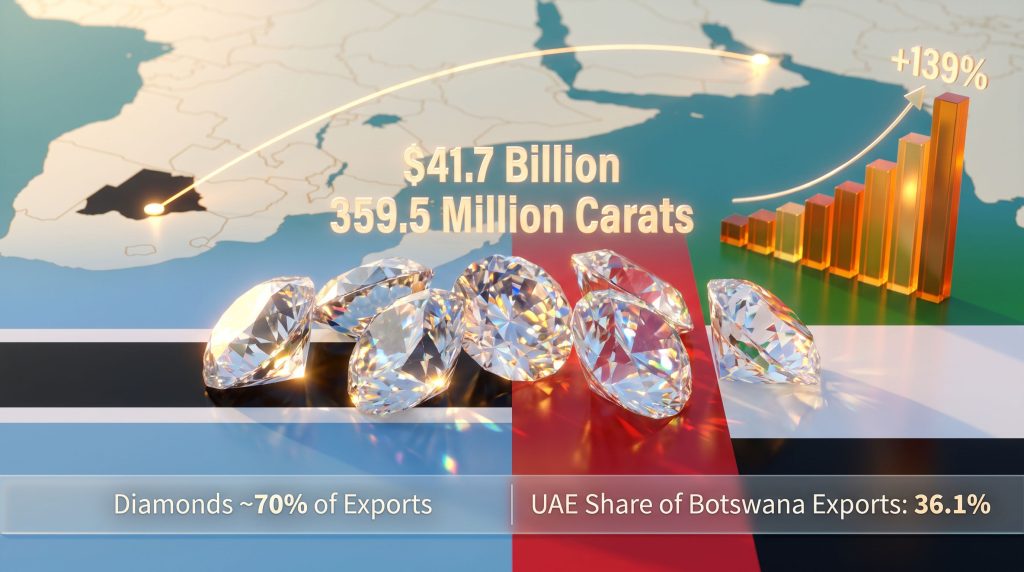
Botswana's relationship with diamonds is unlike almost any other resource-dependent economy on the planet. Diamonds account for approximately 70% of the country's total exports, a concentration level that leaves virtually no macroeconomic buffer when global rough diamond prices soften. Unlike diversified mineral exporters that can offset weakness in one commodity with strength in another, Botswana's fiscal receipts, foreign currency reserves, and GDP growth rate all move in near-lockstep with rough diamond market conditions.
The consequences of this dependency have been stark in recent years. Global rough diamond demand deteriorated sharply from 2022 onward, driven by a combination of factors including post-pandemic demand normalisation, weak Chinese consumer sentiment, and the accelerating penetration of lab-grown diamonds into the mid-tier jewellery segment. Botswana absorbed the full force of this downturn, recording a GDP contraction of 2.8% in 2024 followed by a further 0.9% contraction in 2025.
| Indicator | Figure |
|---|---|
| Diamonds as share of total exports | ~70% |
| GDP contraction in 2024 | -2.8% |
| GDP contraction in 2025 | -0.9% |
| UAE share of Botswana exports (January 2026) | 36.1% |
| ODC's share of Debswana diamond output marketed | 30% |
What makes this vulnerability particularly acute is the speed of transmission. When spot prices for rough diamonds fall, the impact reaches Botswana's government budget within a single fiscal quarter. There is no futures market for rough diamonds, no price hedging mechanism available to sovereign producers, and no synthetic instrument that can insulate state revenues from demand shocks. The fiscal exposure is direct, immediate, and structurally unavoidable under the current model. Furthermore, Australia's resource export challenges offer a useful parallel, demonstrating how commodity-dependent economies can face rapid fiscal pressure when global demand shifts.
Botswana's fiscal architecture is structurally anchored to diamond revenues. When global rough diamond prices soften, the economic transmission is near-immediate, affecting government receipts, foreign exchange reserves, and GDP simultaneously.
Understanding the Botswana–Dubai Diamond Sales Corridor
How the New Trade Architecture Is Structured
The Botswana diamonds sales route in Dubai is built around a formal commercial linkage between the Okavango Diamond Company (ODC) and the Dubai Diamond Exchange (DDE), which operates within the broader Dubai Multi Commodities Centre (DMCC) ecosystem. Rather than routing rough stones exclusively through Antwerp or other established Western centres, this corridor creates a dedicated Southern African supply channel into one of the world's most rapidly expanding commodity trading platforms.
The mechanism is straightforward in design, even if its execution carries considerable complexity:
- Seller: Okavango Diamond Company (ODC), Botswana's state-controlled diamond marketing entity
- Platform: Dubai Diamond Exchange (DDE), operating within the DMCC free zone framework
- Method: Competitive tender parcels offered to registered DDE buyers across multiple diamond categories
- Scope: ODC gains direct commercial access and bidding facilitation within Dubai's trading ecosystem
- Expected launch: First commercial tenders are anticipated before the end of 2026
The MOU formalising this arrangement was signed on July 15, 2026, during the 41st World Diamond Congress, marking what both parties described as a new phase of cooperation. This extends well beyond the diamond trade into copper, coal, soda ash, critical minerals, beef, and agricultural commodities. However, rough diamonds have been explicitly designated as the commercial priority for the corridor's initial operational phase.
The Botswana Mercantile Exchange Connection
One dimension of this arrangement that receives less attention than it deserves is the role of the Botswana Mercantile Exchange (BMX). The MOU is structured to connect the BMX with Dubai's broader commercial and financial infrastructure, suggesting that Botswana's ambitions extend beyond a simple diamond tender arrangement.
If the BMX can establish genuine connectivity with DMCC's institutional framework, it could eventually serve as a regional hub for commodity price discovery across multiple sectors, not just diamonds. That longer-term ambition, however, depends entirely on the corridor producing tangible commercial results in its initial phase.
Dubai's Ascent: The Numbers Behind the Strategic Logic
The decision to target Dubai as a primary marketing destination is not arbitrary. The emirate's rise from a regional trading post to the world's dominant rough diamond hub represents one of the most significant structural shifts in commodity trade geography of the past two decades. Indeed, the geopolitical landscape in metals and mining has accelerated this eastward migration of trading power considerably.
| Metric | Figure |
|---|---|
| Total diamond trade value through Dubai (2025) | $41.7 billion (record) |
| Total carats traded through Dubai (2025) | 359.5 million carats |
| Growth in diamond trade value since 2020 | +139% |
| Volume growth since 2020 | ~2x (doubled) |
| Annual diamond re-exports from Dubai | ~$10 billion |
The city's advantages over traditional trading centres are structural rather than incidental:
- Tax and regulatory efficiency within the DMCC free zone, which eliminates value-added tax on commodity transactions
- Geographic proximity to Indian cutting centres, particularly Surat, which processes the overwhelming majority of the world's rough diamond volume
- Established logistics corridors connecting Africa, South Asia, and East Asia within competitive freight timeframes
- Deep buyer liquidity across all diamond categories, from small industrial stones to large gem-quality rough
Dubai's position as the critical intermediary between African producing nations and the dominant consumer markets of India and China gives it a structural gravity that Antwerp, for all its historical prestige, increasingly struggles to replicate. For a country like Botswana seeking to build independent buyer relationships outside existing commercial networks, Dubai offers access to a buyer pool of a scale and diversity that no other single trading centre currently matches.
The 2020 Precedent: What a $110 Million Sale Revealed
Botswana's commercial relationship with Dubai's diamond trading infrastructure predates the 2026 MOU. During the 2020 Dubai Expo, ODC executed a landmark rough diamond sale of approximately $110 million through DMCC facilitation, demonstrating at scale that both the commercial infrastructure and the buyer appetite existed within the emirate's ecosystem.
A subsequent MOU was signed between ODC and the DMCC in 2022, establishing a framework for regular auctions and promotional activity in Dubai. Yet no publicly documented evidence of large-scale sustained commercial activity emerged from that agreement. This pattern is important context for evaluating the 2026 announcement.
Memoranda of understanding establish intent, not commercial obligation. The gap between the 2022 agreement and any publicly verifiable commercial follow-through represents the central structural risk that the 2026 initiative must overcome.
The reasons why MOUs in commodity trading can fail to generate sustained trade flows are worth examining directly:
- Buyer pool depth: Competitive tenders require a critical mass of registered buyers to generate pricing above a seller's reserve threshold. Without sufficient participation, tenders either fail or produce distressed pricing.
- Supply consistency: Buyers build procurement cycles around predictable supply. An irregular or one-off tender schedule discourages the relationship investment that generates repeat participation.
- Incumbent competition: Producers already embedded in Dubai's network have established buyer relationships that new entrants must displace or supplement, rarely at equivalent price levels.
- Market timing: Tenders launched into soft demand conditions systematically disadvantage new entrants who lack the brand recognition and relationship depth to command premium valuations.
Who Actually Controls Botswana's Diamond Supply Chain
The Debswana-De Beers-ODC Structural Triangle
Understanding the ODC's role requires clarity about the broader supply chain architecture within which it operates.
| Entity | Role |
|---|---|
| Debswana | Joint venture between Botswana government and De Beers; primary diamond producer |
| De Beers | Minority JV partner; controls established global sightholder marketing network |
| Okavango Diamond Company (ODC) | State entity responsible for marketing 30% of Debswana's output |
| Dubai Diamond Exchange (DDE) | Target trading platform for ODC's Dubai-routed parcels |
ODC markets 30% of Debswana's diamond production, with the remainder flowing through De Beers' proprietary sightholder system. The sightholder model is a curated network of approved buyers who purchase rough diamonds through long-term commercial relationships managed entirely by De Beers. For decades, this architecture meant that Botswana's access to the world's major diamond buyers was structurally mediated through a private company's commercial decisions.
The Dubai strategy is fundamentally an attempt to build a parallel, state-controlled commercial channel that reduces that dependency. If successful, the ODC's presence on the DDE would accomplish several objectives simultaneously:
- Create independent price discovery through open competitive tenders, unmediated by De Beers' commercial framework
- Establish direct relationships with Indian and Chinese cutting houses that currently access Botswana diamonds only through the sightholder network
- Build Botswana's sovereign diamond brand presence within a globally visible, high-liquidity trading environment
- Generate market intelligence on rough diamond pricing that is independent of the established intermediary model
The next major ASX story will hit our subscribers first
The Competitive Realities ODC Will Face in Dubai
A Crowded Market With Established Players
Botswana is not entering an empty marketplace. The Dubai Diamond Exchange already facilitates rough diamond supply from a range of producing nations, including Zimbabwe, Angola, Canada, and historically significant Russian-linked supply chains now subject to varying degrees of Western sanctions pressure. ODC's tender parcels will compete directly and immediately on price, quality, and parcel composition against supply relationships that buyers have built and refined over years.
The lab-grown diamond variable adds further complexity. The rise of synthetic diamonds has compressed natural diamond pricing in the mid-tier consumer segment, the very price range where the majority of rough diamond volume is transacted. Chinese consumer demand, which represented one of the most important growth drivers for diamond jewellery in the decade before 2022, has not recovered to pre-downturn levels. This demand structure systematically disadvantages new supply entrants attempting to establish price floors.
In a buyer-favoured market, new supply entrants without established relationships often face a valuation discount relative to incumbent suppliers, regardless of stone quality. Access to a trading platform is not equivalent to competitive pricing power within it.
How African Peers Have Approached State Diamond Marketing
Botswana's challenge is not unique. Several African diamond-producing nations have pursued aggressive state-controlled marketing strategies with instructive results. In addition, commodity trading giants are increasingly focusing on African assets, adding another layer of competitive complexity to the landscape.
| Country | Primary Sales Mechanism | Key Trading Hub | State Control Level |
|---|---|---|---|
| Botswana (ODC) | State tender + De Beers sightholder | Dubai (emerging), Antwerp | Moderate (30% via ODC) |
| Angola (Sodiam) | State tender + international auction | Antwerp, Dubai | High |
| Zimbabwe (ZCDC) | State-controlled sales | Dubai, China | Very high |
| Namibia (Namdia) | State tender | Antwerp, Mumbai | High |
Angola's Sodiam and Namibia's Namdia offer the most instructive comparisons. Both entities have built genuine state marketing capabilities, but success in both cases required sustained investment in buyer relationship development over multiple years, not simply platform access. The common elements in models that have generated consistent value include supply predictability, transparent tender processes that attract repeat participation, and downstream processing incentives that give value-adding buyers a commercial reason to prioritise a particular producer's supply.
Scenario Analysis: Three Pathways for the 2026 Initiative
Scenario 1: Successful Integration (Optimistic Case)
Conditions required for this outcome:
- First 2026 tenders generate competitive pricing above ODC's reserve thresholds, demonstrating buyer appetite
- Buyer pool on the DDE expands to include major Indian cutting houses and Gulf-based trading entities
- A regular quarterly tender schedule is established and maintained through mid-2027
- ODC builds direct buyer relationships that operate independently of De Beers' network
Economic impact if achieved: Meaningful diversification of Botswana's diamond revenue base; reduced price-setting dependency on single-channel marketing; early evidence that the BMX corridor concept has commercial substance.
Scenario 2: Partial Activation (Base Case)
Conditions:
- Tenders proceed at modest scale relative to ODC's total annual marketing volume
- The Dubai route supplements rather than meaningfully displaces existing commercial channels
- The MOU framework requires renegotiation or expansion before generating consistent results
Economic impact: Marginal improvement in market access; limited near-term macroeconomic relief for Botswana's diamond-dependent economy; the corridor remains commercially real but commercially limited.
Scenario 3: Structural Stagnation (Risk Case)
Conditions:
- Weak global demand persists through 2026 and 2027, suppressing tender participation rates
- ODC parcels fail to attract sufficient competitive bids at acceptable pricing levels
- The Dubai route replicates the 2022 MOU outcome: institutional ambition without sustained commercial delivery
Economic impact: No material change to Botswana's market access constraints; the diamond revenue shortfall that has driven two consecutive years of GDP contraction continues without a new offsetting channel.
What Botswana Must Do Beyond Signing Agreements
The Botswana diamonds sales route in Dubai addresses one real and important dimension of the country's market diversification challenge. Physical access to a high-liquidity trading hub with deep buyer participation is a genuine commercial asset. However, market access is necessary, not sufficient. The role of critical minerals in energy transition also underscores a broader point: resource-dependent nations must strategically expand their commodity portfolios well beyond a single export.
The deeper structural requirements for converting the 2026 MOU into a durable commercial channel include:
- Sustained buyer relationship investment: Actively cultivating Indian, Chinese, and Gulf-based cutting and trading houses through consistent commercial engagement, not periodic promotional events
- Supply scheduling discipline: Establishing reliable parcel scheduling that enables buyers to plan procurement cycles in advance, which is the prerequisite for generating repeat participation in tenders
- Price floor credibility: ODC must establish and maintain credible reserve pricing to avoid the reputational damage of distressed selling in soft market conditions
- Downstream integration incentives: Exploring value-added processing partnerships that attract buyers seeking rough-to-polished supply chain integration, giving them a financial reason to prioritise ODC's supply over competing sources
- Parallel economic diversification: The 70% diamond export concentration will remain a structural vulnerability regardless of how the Dubai corridor performs; reducing that concentration through copper, critical minerals, and agricultural export development represents the only durable long-term solution
The difference between a successful trade corridor and an aspirational MOU will be determined by execution discipline, relationship depth, and Botswana's willingness to invest in sustained commercial presence over multiple tender cycles, not simply institutional agreements signed at industry conferences.
The 41st World Diamond Congress signing reflects a broader and legitimate structural trend: African producing nations are actively seeking to reduce commercial dependency on Western-controlled trading infrastructure and build more direct relationships with the Asian and Middle Eastern intermediaries who now dominate global demand. Botswana's move is strategically rational within that context. Whether it proves commercially transformative will be determined not in Dubai's conference rooms, but in the competitive pricing outcomes of ODC's first tender parcels before December 2026.
Furthermore, understanding global diamond production leaders provides additional context for where Botswana sits within the broader competitive landscape it must navigate. For additional context on African commodity trade dynamics and the evolving role of Dubai as a global trading hub, relevant coverage is available through Ecofin Agency's mining and trade reporting.
Want to Stay Ahead of the Next Major Mineral Discovery?
Discovery Alert's proprietary Discovery IQ model scans ASX announcements in real time, instantly identifying significant mineral discoveries across more than 30 commodities — from diamonds to critical minerals — and delivering actionable alerts directly to subscribers. Explore why historic discoveries have generated extraordinary returns and begin your 14-day free trial today to secure a market-leading edge.