July 19, 2026
The Structural Anatomy of a Supply Shock: Why the Gulf Matters So Much to Global Aluminium
Commodity markets move in cycles, but the severity of any given disruption is rarely determined by the shock itself. What matters most is the condition of the market at the moment the shock arrives. Thin inventories, concentrated production geography, and constrained shipping corridors can transform a manageable supply event into a structural crisis. Today, the global aluminium market finds itself at precisely that kind of inflection point, with aluminium prices above $4,000 amid the Gulf supply crisis emerging as a realistic and increasingly discussed scenario among industry analysts.
How the GCC Became the World's Most Concentrated Aluminium Export Zone
Over the past two decades, Gulf Cooperation Council nations built some of the world's most energy-efficient, large-scale primary aluminium smelting complexes. Abundant hydrocarbon energy, sovereign investment mandates, and strategic industrialisation goals made the region a natural host for capital-intensive smelting infrastructure. The result was a highly concentrated export zone, one where geopolitical instability carries outsized consequences for global metal supply.
The Strait of Hormuz, the narrow maritime corridor connecting the Persian Gulf to international shipping lanes, sits at the centre of this vulnerability. Roughly 20% of global oil trade transits this waterway, but its importance to aluminium supply chains is less commonly appreciated. GCC smelters depend on the Strait for importing alumina and raw materials and exporting finished primary aluminium to downstream consumers across Asia, Europe, and beyond. Any sustained disruption to this route is not merely a logistics inconvenience; it is a direct constraint on global metal availability.
Key Metrics: GCC's Share of Global Primary Aluminium Export Capacity
The scale of the current disruption becomes clear when the numbers are laid out together:
| Metric | Estimated Figure |
|---|---|
| GCC production decline (year-on-year) | ~28% |
| Annual capacity forced offline | ~3.4 million tonnes |
| Projected global market deficit | >1.4 million tonnes |
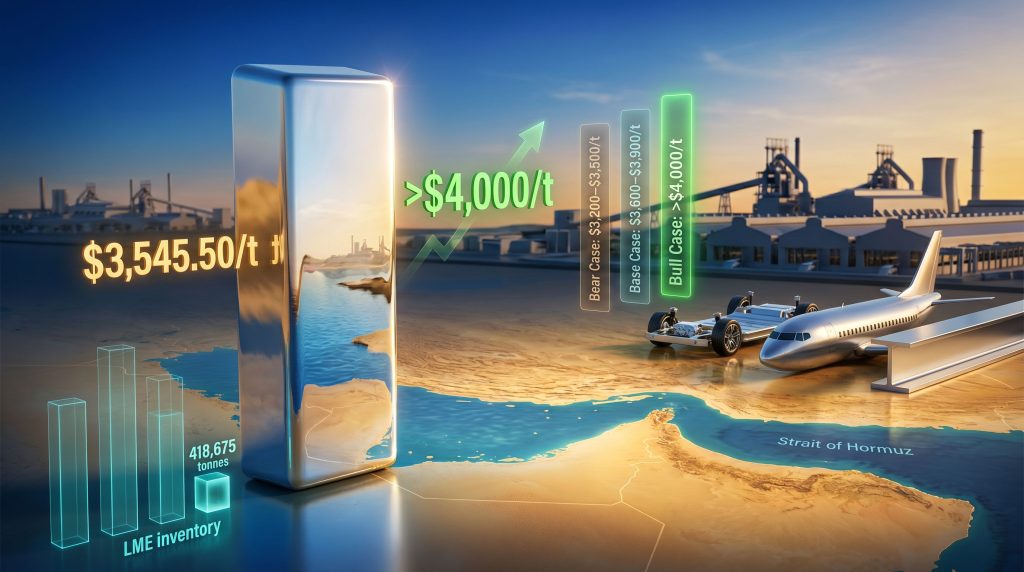
| LME inventory levels (recent low) | ~418,675 tonnes |
| LME 3-month contract price (recent) | ~$3,545.50/tonne |
| Analyst price target under extended disruption | >$4,000/tonne |
These figures, cited by CRU Group at the World Aluminium Summit in London attended by more than 360 industry delegates, paint a picture of a market under acute structural stress.
When big ASX news breaks, our subscribers know first
What Does a 28% Regional Production Decline Actually Mean for Global Supply Chains?
Translating Production Losses Into Real-World Downstream Consequences
A 28% year-on-year production decline across GCC member states does not exist in isolation. It ripples through every tier of the aluminium value chain, from raw material logistics to semi-fabricated product pricing. Downstream buyers of primary aluminium ingot, billet, and slab face tightening spot availability at the same time that regional premiums are climbing, compressing margins for manufacturers in automotive, aerospace, construction, and packaging sectors simultaneously.
Force Majeure Declarations and Emergency Shutdowns: A Cascade Effect in Motion
The operational response across Gulf smelters has moved beyond precautionary adjustments into active production curtailment:
- Emirates Global Aluminium activated emergency procedures at its Al Taweelah complex in Abu Dhabi, including shutdown of the smelter power plant, recycling plant, and refinery operations
- Aluminium Bahrain suspended three smelting lines representing approximately 19% of its total production capacity
- Qatalum initiated controlled shutdown procedures at its Qatari operations
- Force majeure declarations have disrupted logistics and contract fulfilment obligations across the broader region
What makes these shutdowns particularly consequential is the nature of aluminium smelting itself. Unlike many industrial processes, aluminium electrolysis cells cannot simply be switched off and restarted without significant cost and risk. Pot relining, a process required when cells are shut down and restarted, takes months and costs tens of millions of dollars per line. This means that even when geopolitical conditions improve, production recovery is neither immediate nor guaranteed, creating a structural lag between conflict resolution and supply normalisation.
How Thin Inventory Buffers Amplify Every Tonne of Lost Production
LME aluminium inventories near 418,675 tonnes represent a critically thin buffer relative to annual global consumption. To contextualise this: global primary aluminium demand runs at approximately 70 million tonnes annually, meaning current exchange-registered stocks represent less than three days of global consumption. This leaves virtually no cushion to absorb production losses of the magnitude now unfolding across the Gulf.
The Deficit Math: Why 1.4 Million Tonnes of Shortfall Is Harder to Absorb This Cycle
What is the projected aluminium market deficit caused by the Gulf supply crisis?
Industry analysis estimates the global aluminium market will move into a deficit exceeding 1.4 million tonnes in the current cycle, driven by approximately 3.4 million tonnes of annual GCC capacity being taken offline. With LME inventories already near multi-year lows of approximately 418,675 tonnes, the market has significantly less buffer than during previous supply disruptions.
Critically, this deficit projection is calculated without assuming any growth in primary aluminium demand outside China. If consumption recovers in Europe or North America, or if Chinese domestic demand accelerates further, the shortfall widens considerably.
Are Aluminium Prices Heading Above $4,000 Per Tonne? What the Data Says
Current Price Trajectory: From $3,545/t to the $4,000 Threshold
LME three-month aluminium contracts have been trading near $3,545.50 per tonne, already elevated relative to 12-month trailing averages. The distance between current spot prices and the widely discussed $4,000 threshold represents approximately a 13% move, significant but well within the range of historical supply-shock driven price responses in base metals. According to ING Think's analysis, Middle East escalation is actively pushing aluminium into a structural deficit, reinforcing the case for sustained upward price pressure.
Historical Precedent: When Has Aluminium Breached $4,000 Before, and What Drove It?
Aluminium briefly exceeded $4,000 per tonne in March 2022 following Russia's invasion of Ukraine, a conflict that raised immediate questions about Russian aluminium supply, which accounts for roughly 5-6% of global production through Rusal. On that occasion, the market retreated relatively quickly as supply disruptions proved less severe than initially feared and inventories, while declining, were not as critically low as they are today. The current environment differs in a crucial respect: the depth of available buffer stock is categorically smaller.
Furthermore, Argus Media reports that aluminium price forecasts have already reached the $4,000 per tonne level on the basis of Middle East conflict dynamics, reflecting how broadly this threshold is now being discussed across the industry.
Scenario Modelling: Bull, Base, and Bear Cases for Aluminium Pricing Through 2027
| Scenario | Key Assumptions | Price Outlook |
|---|---|---|
| Bear Case | Rapid conflict resolution, supply restored within 3 months | $3,200–$3,500/t |
| Base Case | Disruption persists 6–12 months, partial capacity restored | $3,600–$3,900/t |
| Bull Case | Extended blockade, restart delays compound, demand holds | >$4,000/t (12–18 month horizon) |
Why Analysts Describe the $4,000 Level as a Short-Term Crisis, Longer-Term Opportunity
CRU Group's Head of the Aluminium Value Chain, Paul Williams, characterised the current disruption as simultaneously a near-term crisis and a longer-term structural opportunity at the World Aluminium Summit hosted at Savoy Place in London. The logic here is that price spikes of this magnitude accelerate investment decisions in regions outside the Gulf, ultimately reshaping global supply geography in ways that may benefit the industry over a multi-year horizon. The top aluminium producers are consequently reassessing their strategic positioning in light of these dynamics.
Regional Premiums Spiking: How Spot Market Buyers Are Already Feeling the Pressure
Beyond LME headline prices, the pain is most acutely felt in regional physical premiums. Buyers in Japan, South Korea, and Europe who sourced Gulf material are now competing for alternative tonnes from non-affected producers, driving up Midwest, Rotterdam, and Japanese premiums. These premiums are additive to LME prices, meaning the all-in cost of aluminium for manufacturers is rising faster than headline futures prices suggest.
How Does the Gulf Crisis Compare to Previous Aluminium Supply Disruptions?
A Framework for Evaluating Supply Shock Severity in Commodity Markets
Not all supply shocks are created equal. The severity of any disruption is a function of three variables: the volume of capacity affected, the speed at which alternative supply can respond, and the size of the inventory buffer available to absorb the shortfall while the market rebalances.
| Disruption Event | Capacity Affected | Inventory Context | Price Response |
|---|---|---|---|
| Historical deficit cycles (pre-2020) | Varied | Historically elevated stockpiles | Absorbed with moderate price impact |
| Russia-Ukraine supply scare (2022) | Moderate risk, limited actual curtailment | Declining but not critically low | Brief spike above $4,000/t, rapid retreat |
| 2026 Gulf supply crisis | ~3.4M tonnes offline | Critically low (multi-year drawdown) | Projected >$4,000/t under sustained disruption |
Why Low Inventories Make This Disruption Categorically Different From Past Cycles
The key differentiating factor in the current episode is not the volume of capacity at risk, significant as that is, but rather the absence of any meaningful inventory cushion. Prior cycles where large deficits emerged were navigated partly because consumers could draw down exchange-held and off-warrant stocks. That option is largely exhausted. The market enters this crisis in a structurally weaker position than any comparable disruption in recent memory.
Industry analysis presented at the World Aluminium Summit characterised the current market environment as uniquely hazardous precisely because aluminium inventories have been declining for a sustained period prior to the crisis, leaving the market with far less resilience than it had during previous deficit cycles. This multi-year inventory drawdown means the system has little capacity to self-correct in the short term.
However, broader structural forces were already shaping the market before this crisis emerged. The alumina market pressures visible earlier in 2025, including Alcoa's downgrade impacts, had already signalled tightening conditions upstream, making the Gulf disruption land on a market that was far from robust.
The Role of China's Demand Baseline in Determining How Deep the Deficit Goes
China consumes approximately 60% of global primary aluminium production and has been operating its domestic smelting capacity near structural limits set by the government's 45-million-tonne capacity ceiling. Any acceleration in Chinese demand, whether driven by electric vehicle production, grid infrastructure investment, or construction recovery, narrows the window for non-Chinese buyers to access alternative tonnes. China's demand trajectory therefore functions as a critical variable in determining whether the global deficit lands closer to 1.4 million tonnes or expands meaningfully beyond that figure.
Where Is New Aluminium Capacity Coming From? The Global Investment Pipeline
Chinese-Backed Smelter Projects Reshaping Emerging Market Supply
A significant portion of the new capacity pipeline announced over the past 18 months carries Chinese investment backing, reflecting both China's strategic interest in securing raw material access and the capital intensity that makes these projects difficult to finance through Western channels alone. Countries including Indonesia, Angola, Vietnam, and Saudi Arabia are all hosting or planning Chinese-partnered smelting developments.
Key Development Corridors and Major Projects Under Development
| Project | Location | Key Partners | Target Capacity | Timeline |
|---|---|---|---|---|
| New US primary smelter | United States | EGA + Century Aluminum | TBC | Under development |
| Arctial smelter | Finland, Europe | Arctial + Rio Tinto | 610,000 tonnes/year | First production H2 2029 |
| Chinese-backed projects | Indonesia, Angola, Vietnam, Saudi Arabia | Various | Multiple | Various |
The United States' First Primary Smelter in Nearly 50 Years: Strategic Significance
Emirates Global Aluminium is partnering with Century Aluminum to develop what would become the first new primary aluminium smelter built in the United States in nearly half a century. EGA's Chief Marketing Officer, Adel Abubakar, confirmed at the World Aluminium Summit that the project remains on track despite the ongoing regional conflict affecting EGA's Gulf operations. In addition, the strategic rationale extends beyond commercial returns: the project addresses growing concerns about US dependence on imported primary aluminium, particularly relevant given the ongoing debate around US aluminium tariffs and their broader market implications.
Europe's First New Aluminium Smelter in Three Decades: Finland's 610,000-Tonne Project
What is the Arctial aluminium smelter project in Finland?
The Arctial smelter, being developed in Finland in partnership with Rio Tinto aluminium operations, is projected to become Europe's first new primary aluminium smelter in approximately 30 years. Targeting annual production of 610,000 tonnes, the facility is expected to increase Europe's total aluminium production capacity by approximately 20%, with first hot metal output scheduled for the second half of 2029.
Arctial's Chief Commercial Officer, Maxime Vandersmissen, presented the project at the Summit as a foundational piece of Europe's long-term aluminium supply strategy. Finland's position offers notable advantages: access to renewable hydroelectric power, proximity to European automotive and aerospace manufacturing clusters, and a stable regulatory environment.
Why New Capacity Cannot Solve the Immediate Crisis: The 3-5 Year Lead Time Problem
A fundamental tension exists between the urgency of the current supply deficit and the construction timelines governing new smelter development. From project approval to first hot metal, greenfield primary aluminium smelter construction typically requires three to five years. Even the most advanced projects in the pipeline, including Arctial's Finnish facility, are not expected to produce metal before late 2029. Consequently, the market must navigate the supply shock on its own terms for several years before meaningful new capacity provides relief.
What Industries Face the Greatest Exposure to Aluminium Price Volatility?
Downstream Sector Vulnerability Assessment
| Sector | Aluminium Intensity | Ability to Substitute | Price Sensitivity |
|---|---|---|---|
| Automotive / EV | Very High | Low (short-term) | High |
| Aerospace | High | Very Low | Very High |
| Construction | Moderate–High | Moderate | Moderate |
| Packaging | Moderate | Moderate | Low–Moderate |
Automotive and EV Manufacturing: Aluminium-Intensive Sectors Under Margin Pressure
Electric vehicles use significantly more aluminium than internal combustion engine equivalents, with estimates ranging from 200 to 250 kilograms of aluminium per vehicle depending on platform architecture. As automotive manufacturers accelerate electrification programmes, their aluminium intensity per unit rises precisely at the moment when raw material costs are climbing. This creates a structural margin compression risk for EV producers who have not adequately hedged forward aluminium exposure.
Aerospace, Construction, and Packaging: Downstream Demand Segments Most at Risk
Aerospace is arguably the most acutely exposed sector because aluminium substitution options are extremely limited within current aircraft design cycles. Switching to composites or titanium is a multi-year engineering programme, not a procurement decision. Construction and packaging face meaningful but more manageable exposure, with some ability to substitute materials or adjust product specifications over a 12 to 24-month window. Furthermore, the broader green metals transition underway across multiple industries is adding a new layer of long-term demand pressure that compounds these near-term cost challenges.
How Buyers Are Responding: Long-Term Contracts, Hedging, and Substitution Risks
Sophisticated industrial buyers are pursuing a combination of strategies in response to rising aluminium costs:
- Extending contract tenor with existing suppliers to lock in fixed or capped pricing
- Increasing LME hedge ratios to protect against spot price escalation
- Accelerating assessment of aluminium-to-steel or aluminium-to-composite substitution in non-critical applications
- Building strategic inventory positions to reduce near-term spot market exposure
The next major ASX story will hit our subscribers first
How Should Investors and Procurement Teams Navigate the $4,000 Aluminium Threshold?
Reading the LME Signals: What Inventory Levels and Futures Curves Are Telling the Market
When LME inventories fall to critically low levels, the futures curve often moves into backwardation, where near-term prices trade above longer-dated contracts. This structure signals that the market values immediate metal more highly than deferred delivery, a classic indicator of physical tightness. Monitoring the shape of the LME aluminium forward curve alongside inventory data provides procurement teams and investors with real-time information about the market's assessment of supply adequacy.
Commodity Hedging in a Supply-Constrained Environment: Strategies for Industrial Buyers
In a backwardated market, the conventional wisdom of buying hedges through forward purchases becomes more nuanced. Paying up for near-term protection is expensive, but the alternative, remaining unhedged in a supply-shocked market, carries significant balance sheet risk. A layered hedging strategy, covering 60-80% of near-term requirements at current prices while leaving some exposure to benefit from potential price retreats, offers a reasonable risk-adjusted approach for most industrial consumers.
ASX-Listed Majors With Aluminium Exposure: How BHP, RIO, and S32 Are Positioned
Australian investors tracking the aluminium price trajectory should note that ASX-listed majors carry varying degrees of exposure to the current market dynamics. Rio Tinto operates one of the world's largest integrated aluminium businesses, spanning bauxite mining, alumina refining, and primary smelting across multiple geographies. South32 holds significant aluminium and alumina assets. BHP's exposure is more indirect through its alumina operations. All three companies stand to benefit from sustained elevated aluminium prices, though their specific cost structures, hedging programmes, and geographic exposure profiles differ materially.
Risk Disclosure: Aluminium price forecasts above $4,000 per tonne are scenario-dependent and contingent on the duration and severity of Gulf supply disruptions. A faster-than-expected resolution of regional tensions or accelerated smelter restart timelines could compress the price trajectory significantly. Investors should conduct independent due diligence and seek professional financial advice before making commodity-linked investment decisions. Past price performance is not indicative of future outcomes.
The Case for Structural Re-Rating: Why This Crisis May Accelerate Long-Term Aluminium Demand Premiums
Beyond the immediate price shock, the Gulf crisis may catalyse a more durable re-rating of aluminium's strategic value. Supply chain diversification away from concentrated geopolitical risk zones, growing demand from the energy transition, and the long lead times governing new capacity development collectively support a structural argument for higher average aluminium prices above $4,000 amid Gulf supply crisis conditions across the second half of this decade. The $4,000 level, if reached, may prove not to be a ceiling but rather a new reference point from which the market calibrates future pricing norms.
Frequently Asked Questions: Aluminium Prices and the Gulf Supply Crisis
Why are aluminium prices rising above $4,000 per tonne?
The Gulf supply crisis has taken approximately 3.4 million tonnes of annual production capacity offline, creating a projected market deficit exceeding 1.4 million tonnes at a time when LME inventories are near multi-year lows. This combination of reduced supply and thin buffer stock is driving prices toward the $4,000 per tonne threshold discussed by analysts at the World Aluminium Summit in London.
What is the Strait of Hormuz's role in aluminium supply chains?
The Strait of Hormuz serves as the primary maritime exit for GCC-produced aluminium destined for Asian and European markets. It is also the import corridor for alumina feedstock used in Gulf smelters. Disruption to this waterway simultaneously restricts raw material inputs and finished product exports, creating a dual constraint on GCC aluminium production and trade.
How much GCC aluminium production has been taken offline?
CRU Group estimates that approximately 3.4 million tonnes of annual aluminium production capacity has been taken offline across GCC member states, representing a year-on-year production decline of roughly 28% for the region.
Which countries are building new aluminium smelters to replace Gulf capacity?
New smelter projects are under development or advancing in the United States (EGA and Century Aluminum partnership), Finland (Arctial and Rio Tinto), and various emerging market locations including Indonesia, Angola, Vietnam, and Saudi Arabia, many of which involve Chinese investment partnerships.
How long could the aluminium supply deficit last?
Given the 3-5 year construction timeline for new primary smelting capacity and the operational complexities involved in restarting curtailed Gulf facilities, the supply deficit is likely to persist for at least 12 to 24 months under base case assumptions. The duration depends heavily on the geopolitical trajectory of the Gulf conflict and the speed of smelter restart decisions.
What is the current LME aluminium price and inventory level?
LME three-month aluminium contracts have been trading near $3,545.50 per tonne, with exchange-registered inventories at approximately 418,675 tonnes, representing critically low levels relative to global consumption.
How does the Gulf crisis affect aluminium prices in Australia and Asia-Pacific?
Asia-Pacific buyers, including those in Japan, South Korea, Taiwan, and Australia, have historically sourced a meaningful share of primary aluminium imports from GCC producers. Reduced Gulf availability is diverting these buyers toward Australian, Canadian, and other non-Gulf sources, pushing regional physical premiums higher and increasing all-in aluminium costs for downstream manufacturers across the Asia-Pacific region.
The Long View: Is the Gulf Crisis a Temporary Shock or a Structural Turning Point for Aluminium?
Three Forces That Will Determine Whether $4,000 Becomes the New Floor or a Ceiling
Three variables will ultimately determine whether $4,000 per tonne represents a crisis-driven ceiling or the beginning of a structurally higher pricing regime:
- Conflict duration and resolution pathway — A rapid ceasefire and resumption of Strait of Hormuz transit would accelerate smelter restarts and ease physical premiums, likely returning prices toward the $3,200-$3,500 range over 6-12 months
- Speed of new capacity delivery — If projects currently under development advance faster than expected, particularly US and European facilities, the structural deficit narrows and price pressure moderates
- Energy transition demand acceleration — Electric vehicle adoption, grid expansion, and renewable energy infrastructure all consume aluminium intensively. Faster-than-expected deployment of these technologies widens the demand side of the equation simultaneously
The Energy Transition Wildcard: How Green Aluminium Demand Intersects With Supply Constraints
There is an important and underappreciated dimension to the current crisis: the very sectors driving long-term aluminium demand growth are those with the least ability to substitute away from the metal. EV battery enclosures, solar panel frames, wind turbine components, and high-voltage transmission infrastructure all depend heavily on aluminium. This means that as the energy transition accelerates, it actively competes with existing demand pools for a constrained supply base, adding a structural demand pressure that compounds the cyclical supply shock currently underway.
Geopolitical Risk Premiums in Commodity Markets: A Permanent Feature of the New Trade Order
Perhaps the most significant long-term implication of the Gulf crisis is what it reveals about the fragility of concentrated commodity geography. The aluminium industry spent decades optimising production around the cheapest energy sources, which in practical terms meant building enormous smelting capacity in regions with structural geopolitical risk. The market is now repricing that risk explicitly. Whether through geographic diversification of new investment, long-term contract structures that include force majeure cost-sharing provisions, or the development of strategic aluminium stockpiles analogous to petroleum reserves, the industry is likely to operate with a permanently higher risk premium embedded in pricing from this point forward.
Key Takeaways: What the Data Tells Us
- GCC aluminium production is projected to decline approximately 28% year-on-year, removing an estimated 3.4 million tonnes of annual capacity from global supply
- The global market is forecast to enter a deficit exceeding 1.4 million tonnes, with LME inventories already near multi-year lows of approximately 418,675 tonnes
- Aluminium prices have approached $3,545/t, with analyst consensus pointing to a credible path above $4,000/t under extended disruption scenarios
- New capacity projects, including a 610,000-tonne Finnish smelter and the first US primary smelter in nearly 50 years, cannot resolve near-term shortfalls given 3-5 year construction lead times
- The combination of critically low inventories, concentrated Gulf production, and shipping route vulnerability creates a supply shock environment without close historical parallel in terms of its structural fragility
- Downstream sectors including automotive, EV manufacturing, and aerospace face the greatest margin compression risk, with limited short-term substitution options available
Further context on global aluminium market dynamics and price tracking is available through AL Circle at alcircle.com, which provides ongoing primary aluminium market news and analysis relevant to this topic.
Want to Know When the Next Major Mineral Discovery Hits the ASX?
Discovery Alert's proprietary Discovery IQ model delivers real-time alerts on significant ASX mineral discoveries — including opportunities across aluminium-linked and energy transition commodities — instantly empowering subscribers to identify actionable positions ahead of the broader market. Explore historic discoveries and their exceptional returns, then begin your 14-day free trial to secure your market-leading advantage.