July 18, 2026
Why Every Commodity Market Is Now a Geopolitical Market
For most of the past century, commodity markets operated on a relatively predictable logic: supply and demand fundamentals set prices, with geopolitical risk serving as an occasional, temporary distortion. That model has been thoroughly dismantled by the impact of the Iran war on global commodity markets. What is unfolding across energy, agriculture, metals, and freight is not a simple oil price shock. It is a cascading, multi-sector supply disruption with stagflationary characteristics that is simultaneously rewriting price expectations, trade flows, and long-term investment strategies across the global economy.
Understanding why this conflict has produced such broad commodity market consequences requires examining the physical and financial mechanisms through which regional military conflict converts into global supply scarcity. Furthermore, the Persian Gulf's geographic role makes it uniquely capable of transmitting that disruption to virtually every corner of commodity markets.
When big ASX news breaks, our subscribers know first
The Strait of Hormuz and the Architecture of Global Commodity Dependency
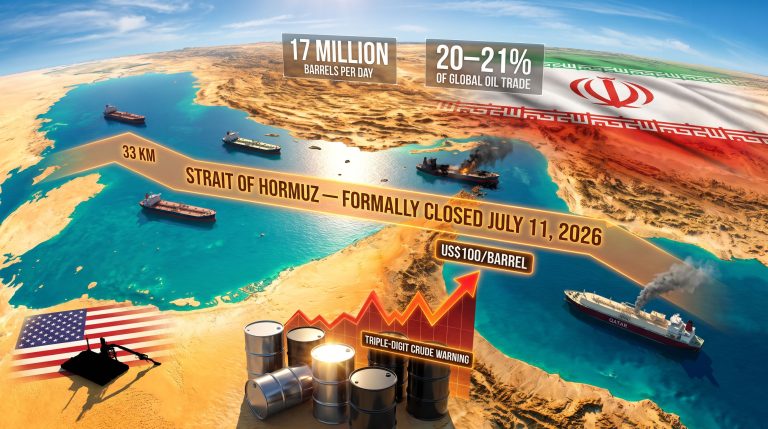
The Strait of Hormuz is a navigational corridor roughly 33 kilometres wide at its narrowest point, connecting the Persian Gulf to the Gulf of Oman and the broader Arabian Sea. Despite its modest dimensions, it functions as the single most consequential chokepoint in global commodity trade.
On any given day before the current conflict, the strait facilitated the transit of:
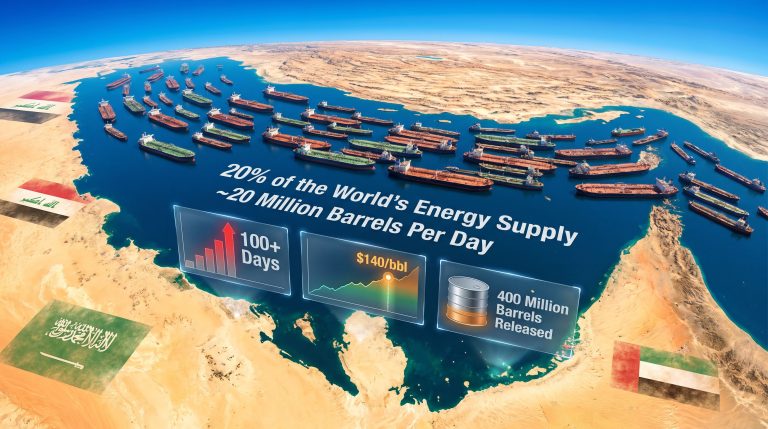
- Approximately 20 to 21 million barrels of crude oil per day, representing roughly one-fifth of global consumption
- A substantial share of the world's liquefied natural gas (LNG) exports, particularly from Qatar, one of the world's largest LNG producers
- A significant proportion of global liquefied petroleum gas (LPG) flows destined for Asia and Africa
- Critical volumes of ammonia, sulphur, petrochemicals, and fertiliser inputs that underpin global agricultural production
What distinguishes the current disruption from previous episodes, including the tanker wars of the 1980s, is the combination of direct infrastructure damage and precautionary shutdowns occurring simultaneously. In earlier conflicts, markets priced in risk of disruption. In the current episode, however, documented infrastructure damage to energy facilities and verified disruption to shipping routes have converted that risk into actual supply loss across multiple commodity categories at once.
According to research published by Argus Media, the geopolitical risks in mining and energy sectors have been fundamentally repriced as a result of these simultaneous disruption pathways.
The Iran conflict is not merely an energy event. It is a multi-commodity supply shock with stagflationary characteristics, affecting everything from crude oil to food prices across both developed and emerging economies.
The distinction between these two disruption pathways matters enormously for recovery timelines. Precautionary shutdowns can be reversed relatively quickly once security conditions improve. Infrastructure damage, however, involves physical repair cycles that persist well beyond the cessation of hostilities, meaning supply normalisation lags the end of conflict by a meaningful and often underestimated margin.
Quantifying the Supply Shock: What a 15%+ Capacity Loss Means in Practice
In commodity market terminology, a capacity loss refers not only to offline production but also to the reduction in export availability caused by logistics disruption, insurance market withdrawals, and shipping route closures. According to analysis published by Argus Media in May 2026, multiple commodity sectors have experienced capacity losses exceeding 15 percent globally as a result of both direct damage and precautionary shutdowns.
The following table illustrates the disruption severity and recovery complexity across the major affected commodity classes:
| Commodity | Estimated Capacity Impact | Primary Disruption Mechanism | Recovery Complexity |
|---|---|---|---|
| Crude Oil | High | Infrastructure damage + route closure | Medium-term |
| LNG | High | Export terminal disruption | Long-term |
| LPG | Very High (>15%) | Supply concentration + route dependency | Extended |
| Ammonia | High | Production shutdown + export bottleneck | Medium-term |
| Sulphur | High | Export bottleneck | Medium-term |
| Fertilisers (Broad) | Significant | Input shortages + logistics disruption | Long-term |
| Aluminium | Moderate-High | Energy cost escalation | Ongoing |
| Base Metals | Moderate | Energy cost + logistics friction | Near-term |
Three distinct recovery pathways are plausible from this point, each producing materially different market outcomes:
-
Rapid De-escalation: Hostilities end within weeks, partial infrastructure restoration occurs, and markets normalise within one to two quarters. Even in this scenario, full supply recovery to pre-war levels is not instantaneous.
-
Prolonged Stalemate: Conflict extends beyond six months, supply chains are rerouted at structurally higher cost, and price elevation persists across most affected commodity classes.
-
Escalation and Widening: Regional conflict expands, Hormuz transit becomes fully impaired for an extended period, and multi-year commodity price disruption materialises alongside meaningful global recessionary risk.
Even under the most optimistic de-escalation scenario, full supply recovery to pre-war levels is expected to lag the end of hostilities by a significant period, due to infrastructure repair timelines, shipping route normalisation, and the compounding lag effects in agricultural supply chains.
Oil and Gas Markets: Price Premiums and the Limits of OPEC+ Flexibility
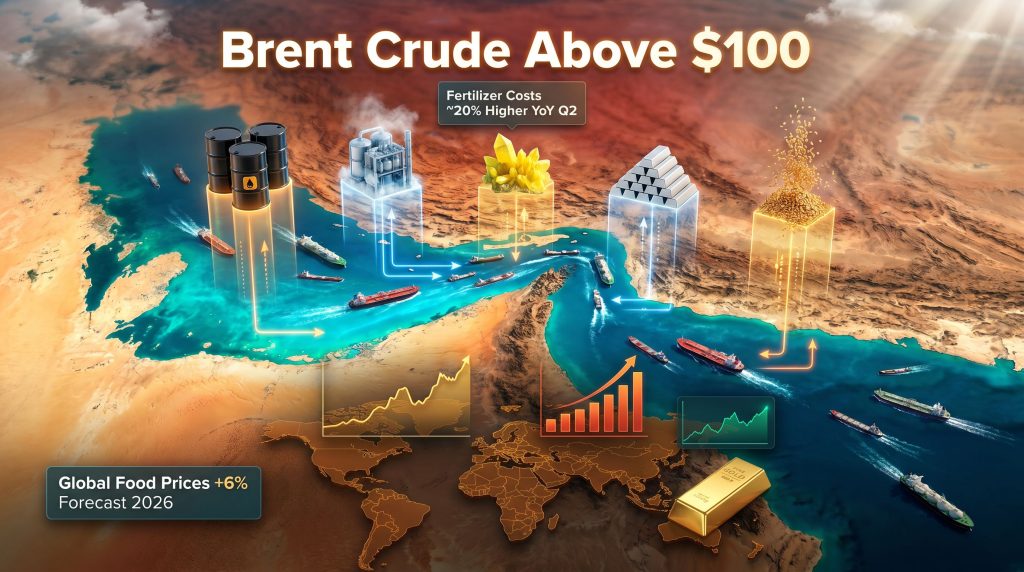
Brent crude has breached $100 per barrel in multiple market assessments since the conflict escalated, reflecting a composite of physical supply loss and a geopolitical risk premium embedded by financial markets ahead of any formal shortage materialising. Decomposing this price move is analytically important: not all of the price elevation represents physical scarcity. A portion reflects forward-looking risk pricing by futures markets anticipating that conditions could deteriorate further.
OPEC+ spare production capacity, while non-trivial, cannot fully offset the loss of Iranian volumes combined with the logistics disruption affecting broader Gulf export flows. The cartel's ability to compensate is constrained by:
- The geographic reality that much of OPEC+ spare capacity is itself located in Gulf states with exposure to the same shipping route vulnerabilities
- Infrastructure lead times required to bring offline production back to market
- Political coordination complexity within the OPEC+ coalition under conflict conditions
Downstream effects are compounding the upstream disruption. Refinery margins have shifted as the crude quality mix available to global refiners changes, and petroleum product availability in certain regional markets has tightened independently of crude price movements.
How Has the LNG Market Responded?
LNG markets have absorbed a parallel shock. The LNG supply outlook has deteriorated sharply, as Gulf export disruptions have tightened global gas balances at a moment when European and Asian buyers had limited strategic inventory buffers. LNG spot prices have moved sharply higher, reinforcing energy security concerns in import-dependent economies.
For Europe particularly, this episode is accelerating the policy debate around domestic gas storage obligations and long-term supply contract diversification.
LPG deserves specific attention because it faces a disproportionately severe disruption relative to other hydrocarbons. The Middle East accounts for an outsized share of global LPG exports, and the commodity's supply concentration combined with route dependency has produced price volatility exceeding that seen in crude or LNG markets. Downstream petrochemical feedstock costs across Asia are rising as a direct consequence, and residential LPG consumers in price-sensitive markets across Africa and South and Southeast Asia are absorbing cost increases that represent a significant share of household expenditure.
Fertilisers, Agriculture, and the Coming Food Price Shock
Perhaps the least discussed but most consequential long-run channel through which the impact of the Iran war on global commodity markets will be felt is the agricultural supply chain. The connection is structural and often invisible to non-specialist observers: modern crop production is critically dependent on synthetic fertilisers, and those fertilisers are critically dependent on Persian Gulf inputs.
The supply chain logic runs as follows:
- Natural gas from Gulf producers feeds ammonia synthesis plants, which produce the foundation input for nitrogen fertilisers
- Sulphur, largely a byproduct of Gulf oil and gas processing, is a primary input for phosphoric acid and phosphate fertiliser production
- Export bottlenecks on both ammonia and sulphur simultaneously constrain the availability of nitrogen and phosphate fertilisers globally
- Reduced fertiliser availability at planting time translates into lower application rates and, with a seasonal lag, reduced crop yields
- Yield compression on staple grains and oilseeds flows through to food price inflation over subsequent quarters
Fertiliser costs are forecast at approximately 20 percent higher year-on-year in the second quarter of 2026, and global food prices are projected to rise by approximately 6 percent across 2026, according to forward-looking market analysis. For lower-income food-importing nations, a 6 percent increase in food prices can push vulnerable populations into food insecurity, particularly when it coincides with higher domestic fuel costs reducing agricultural logistics affordability.
If ammonia and sulphur export constraints from the Gulf persist across two full agricultural growing seasons, grain production shortfalls could emerge across sub-Saharan Africa, South Asia, and parts of Southeast Asia. These are regions where food expenditure represents a high proportion of household income and fiscal capacity to subsidise food imports is limited.
Metals Markets: Energy Costs as the Hidden Transmission Channel
The metals complex faces a different but equally meaningful exposure pathway. Aluminium production is among the most energy-intensive processes in industrial manufacturing, requiring approximately 14 to 15 megawatt-hours of electricity per tonne produced. When energy costs rise structurally due to Gulf supply disruption, aluminium production costs rise globally, regardless of where the smelter is located, because energy markets are internationally linked through fuel pricing.
Analyst consensus points to persistent upside price risk for aluminium as long as energy markets remain disrupted. Downstream industries, including automotive, construction, and packaging, face a compounding cost pressure from both rising aluminium prices and higher energy costs in their own production processes.
For base metals more broadly, copper, zinc, and nickel face a dual exposure:
- Elevated freight costs from shipping route disruption add to delivered cost premiums in consuming markets
- Higher operational energy costs in mining and processing inflate production cost floors, providing a structural price support even if demand-side pressures moderate
In addition, the critical minerals demand picture has been complicated further by this conflict, as supply chain fragility is now a prominent factor in long-term procurement strategies. Furthermore, gold as a safe haven has performed its traditional role as a conflict and inflation hedge with notable effectiveness since escalation, driven by two concurrent forces: a war risk premium reflecting genuine uncertainty about conflict duration, and an inflation expectations premium reflecting commodity-driven CPI pressures building across energy and food categories.
The next major ASX story will hit our subscribers first
Regional Winners, Losers, and the Stagflation Transmission Mechanism
The geopolitical and economic asymmetry created by this commodity shock is stark:
| Region / Economy Type | Net Position | Primary Exposure | Strategic Vulnerability |
|---|---|---|---|
| Energy-exporting nations (non-Iran) | Potential beneficiary | Higher oil/gas revenues | Logistics and volatility risk |
| Europe | High vulnerability | LNG dependency, food inflation | Energy security, GDP drag |
| Asia (import-dependent) | High vulnerability | LNG, LPG, fertilisers | Food and fuel inflation |
| Sub-Saharan Africa | Severe vulnerability | Food and fuel import costs | Food security crisis risk |
| Emerging market importers | High vulnerability | Fuel + fertiliser costs | Currency pressure, inflation |
The macroeconomic mechanism operating here is stagflationary in character. J.P. Morgan has assessed that Brent crude prices sustained near $80 per barrel through mid-year could be sufficient to suppress global GDP growth in the first half of 2026 while materially elevating global consumer price indices. With Brent having moved substantially above that level, the growth drag and inflation lift operating simultaneously represent a genuine policy dilemma for central banks.
The stagflation dynamic is particularly constraining because it removes the conventional monetary policy toolkit. Central banks facing commodity-driven inflation cannot easily cut rates to support growth without risking further inflation entrenchment. Yet raising rates into a supply-shock slowdown risks amplifying the growth deceleration. This policy trap is most acute in emerging market economies, which simultaneously face higher import bills, currency depreciation pressure from capital outflows to safe-haven assets, and limited fiscal room to buffer the shock.
Freight Markets: The Cost Multiplier That Amplifies Every Commodity Shock
Shipping markets function as an often-overlooked amplifier of commodity price disruption. When primary shipping routes become impaired, the economics cascade through several compounding channels:
- Tanker freight rates for crude, LNG, and LPG carriers have surged as vessel owners price Hormuz risk into their rates and available tonnage is redistributed toward alternative routes
- Rerouting via the Cape of Good Hope adds approximately 10 to 14 days to voyages from the Gulf to European and Asian markets, effectively reducing fleet capacity by consuming vessel days on longer passages
- War risk insurance premiums have escalated sharply, adding to delivered commodity costs independently of any underlying commodity price movement
- Port congestion effects are emerging at alternative transit points as vessel traffic redistributes away from affected corridors
These freight cost increases function as an additional price multiplier layered on top of underlying commodity price increases. Consequently, the delivered cost of affected commodities in consuming markets has risen faster than spot commodity prices alone would suggest. For dry bulk commodities including coal, grain, and fertilisers, the freight cost escalation is directly compounding the food security and energy security pressures already building from supply disruption.
Long-Term Structural Implications for Commodity Markets and Investment Positioning
Beyond the immediate price and supply disruptions, the impact of the Iran war on global commodity markets is catalysing structural shifts that will outlast the conflict itself. The broader pattern of global commodity market disruption driven by geopolitical instability has fundamentally altered how institutional investors price long-duration commodity risk.
Energy security investment is accelerating across both Europe and Asia, with renewed policy urgency around LNG import infrastructure diversification, strategic petroleum reserve replenishment, and domestic gas production capacity. These are investment themes with multi-year capital deployment horizons regardless of how quickly the current conflict resolves.
Fertiliser supply chain resilience has emerged as a strategic priority for food-importing nations that previously accepted high dependency on Gulf-sourced ammonia and sulphur. The case for domestic fertiliser production capacity, or at minimum diversified sourcing, has been materially strengthened by this episode.
For investors navigating this environment, several positioning themes present themselves:
- Safe-haven allocation toward gold and defensive equities as conflict duration and inflation trajectory remain uncertain
- Energy infrastructure equity exposure in LNG terminal operators, pipeline infrastructure, and energy storage assets outside the Gulf corridor
- Agricultural input supply chain investment, particularly in fertiliser producers operating outside the Middle East who stand to benefit from both higher prices and redirected demand
- Commodity hedging strategy review at the corporate level, as the repricing of Middle East geopolitical risks in mining and energy into long-term commodity contracts represents a structural shift, not a temporary anomaly
Geopolitical risk has been permanently repriced across commodity markets since escalation began. The question for long-term investors is not whether this repricing is justified, but whether current market prices fully reflect the range of possible conflict trajectories and their respective supply recovery timelines.
The most important analytical point for both market participants and policymakers is that recovery timelines remain deeply uncertain and highly scenario-dependent. Infrastructure repair cycles, shipping route normalisation, fertiliser supply restoration, and the agricultural output lag all compound to ensure that even a near-term peace agreement would not translate quickly into pre-war commodity supply conditions. That asymmetry, between a potentially fast political resolution and a structurally slow physical recovery, is the defining risk management challenge that commodity markets are now navigating.
Disclaimer: This article contains forward-looking analysis, price forecasts, and scenario projections that are inherently uncertain. Commodity market conditions can change rapidly, and nothing in this article should be construed as financial or investment advice. Readers should conduct independent research and consult qualified financial advisers before making investment decisions. Forecasts referenced reflect market assessments available at time of writing and are subject to revision.
Want to Identify ASX Mineral Discoveries Before the Broader Market Does?
As geopolitical disruption reshapes commodity markets and reprices long-duration risk across energy, metals, and agricultural inputs, Discovery Alert's proprietary Discovery IQ model delivers real-time alerts on significant ASX mineral discoveries — instantly translating complex data across 30+ commodities into a single, actionable gold-equivalent metric. Explore historic discoveries and their returns to understand the scale of opportunity, then begin a 14-day free trial at Discovery Alert to position ahead of the next major find.