July 25, 2026
The Hidden Machinery Behind Aluminium Pricing: Why Central Bank Policy Is Only Part of the Story
Most commodity analysts spend considerable time tracking supply deficits, inventory drawdowns, and trade flows when forecasting aluminium prices. Far fewer give adequate weight to the slow-moving but powerful force operating in the background: the transmission of monetary policy through borrowing costs, currency valuations, and industrial credit conditions. Understanding how Fed interest rates and aluminium industry dynamics interact requires looking well beyond the headline rate decision and into the multiple economic channels through which central bank signals reshape the cost of producing, financing, and consuming this metal.
What makes this relationship particularly complex is that aluminium does not respond to monetary policy in the same linear fashion as, say, housing starts or consumer credit. Instead, it sits at the intersection of energy markets, geopolitical supply chains, and industrial demand cycles, each of which amplifies or mutes the Fed's influence in different ways and at different time horizons.
When big ASX news breaks, our subscribers know first
Why the Fed's Rate Environment Matters More Than It Appears
When the Federal Open Market Committee holds or adjusts its benchmark federal funds rate, the immediate market reaction in equities and bonds tends to dominate financial headlines. However, the consequences for industrial metals like aluminium are subtler and more durable.
The transmission operates through several distinct channels simultaneously:
- Currency valuation: Since aluminium is priced in U.S. dollars on the London Metal Exchange, any strengthening of the dollar driven by a restrictive rate environment makes the metal more expensive for buyers operating in other currencies, which typically suppresses global demand.
- Inventory financing costs: Holding physical metal in a warehouse is not free. When interest rates are elevated, the cost of financing those stockpiles rises, which discourages producers and traders from building buffer inventories. This keeps physical markets tight and amplifies price swings during supply disruptions.
- Industrial credit conditions: Downstream manufacturers, automotive assemblers, and construction firms all rely on affordable credit to fund operations and expansion. When rates stay high, capital expenditure slows, project pipelines thin out, and aluminium demand from key end-use sectors softens.
- Risk appetite and speculative positioning: Higher rates typically pull investment flows toward fixed-income assets, reducing speculative long positions in base metals and weighing on price momentum. According to research on aluminium price factors, speculative positioning consistently ranks among the most influential short-term drivers of aluminium price volatility.
Transmission Channel Summary
| Transmission Channel | Rate Hold / Higher Rates | Rate Cuts / Easing |
|---|---|---|
| U.S. Dollar Strength | Strengthens, pressures aluminium prices | Weakens, supports aluminium prices |
| Inventory Financing Cost | Higher, discourages stockpiling | Lower, encourages inventory build |
| Market Risk Appetite | Cautious, reduces speculative positioning | Improves, supports bullish sentiment |
| Industrial Demand Outlook | Constrained credit, slower activity | Cheaper credit, stimulates construction and autos |
| Producer Borrowing Costs | Elevated, delays capex and expansions | Reduced, enables smelter investment |
The Current Rate Environment: Where the Fed Stands in 2026
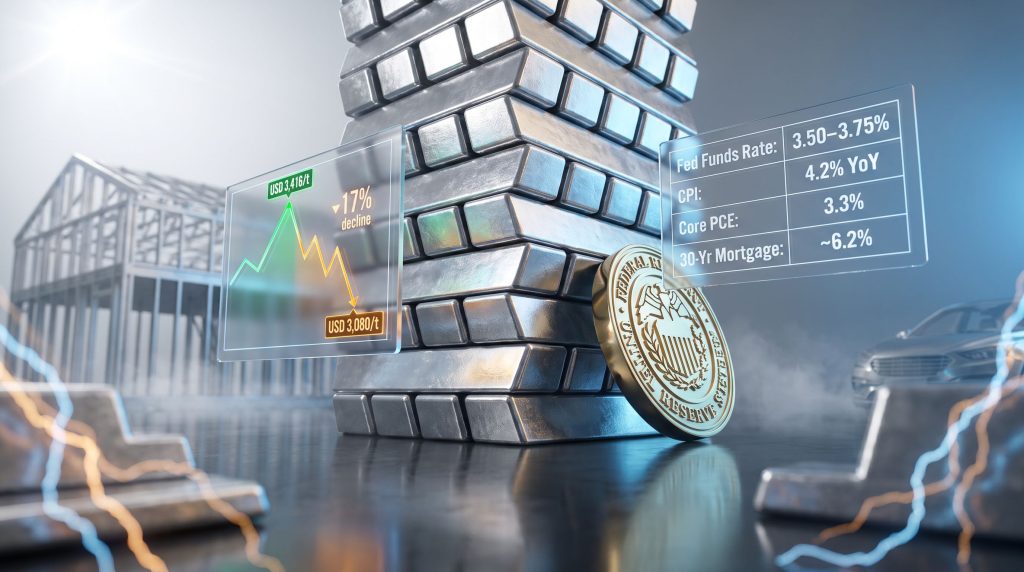
The FOMC voted unanimously, twelve votes to zero, to hold the benchmark federal funds rate at 3.50 to 3.75 percent at its most recent meeting, marking the fourth consecutive policy pause. This places the rate at its lowest level since November 2022, following three reductions executed through 2025 that brought the target down from a starting range of 4.25 to 4.50 percent.
Despite that easing cycle, the Fed finds itself in a holding pattern. Rob Haworth, Senior Investment Strategy Director at U.S. Bank Asset Management Group, has noted that the Fed held rates steady in June because inflation remained above target and rising oil prices complicated the path back to the 2 percent objective. Median forecasts from a Reuters poll of economists indicate that the benchmark rate is expected to remain unchanged for the remainder of 2026, effectively ending any near-term expectation of further relief for borrowers or commodity markets.
The Inflation Picture Fuelling the Pause
The Fed's preferred inflation gauge, the core Personal Consumption Expenditures (PCE) Price Index, registered a 3.3 percent year-on-year increase through April, sitting roughly 1.5 times above the 2 percent target. Headline Consumer Price Index (CPI) data for May showed an even more elevated reading of 4.2 percent year-on-year, with core CPI at 2.9 percent once food and energy are excluded.
Shelter costs, which climbed 3.4 percent, remain a sticky component of the inflation basket, though moderating home price growth may eventually provide some relief. The labour market has stabilised after a difficult 2025, with private employers adding an average of 117,000 jobs per month through May, the unemployment rate sitting at 4.3 percent, and weekly initial jobless claims registering 228,000 for the week ending June 5.
The combination of above-target inflation, elevated energy costs linked to geopolitical disruptions, and a stabilising but not accelerating labour market has created exactly the kind of ambiguous environment in which the Fed is most likely to remain on hold rather than risk either a premature easing or a demand-crushing hike.
Why Aluminium Responds to Inflation Differently Than Broad Price Indices
One of the most important and underappreciated dynamics in the aluminium market is the structural mismatch between how broad inflation indices move and how aluminium prices behave. While core PCE is running at approximately 3.3 percent, aluminium prices have risen at roughly four times that pace on a year-on-year basis. This divergence is not coincidental.
The explanation lies in the energy intensity of primary aluminium production. The Hall-Héroult electrolytic process, which converts alumina into primary aluminium metal, consumes approximately 14,000 kilowatt-hours of electricity per tonne of metal produced. Across a typical smelter operation, electricity costs account for 30 to 40 percent of total production costs, a proportion that dwarfs the energy exposure of almost any broad consumer goods basket.
This means that even a modest increase in wholesale electricity prices can compress smelter margins sharply or push production costs well above prevailing market prices, forcing curtailments that tighten physical supply. Broad inflation indices, which average energy costs across thousands of goods and services, simply cannot capture this concentrated exposure.
A secondary cost layer has also emerged in the form of carbon credit pricing. As emissions trading schemes tighten in key producing regions, smelters face escalating compliance costs that sit entirely outside the scope of conventional CPI measurement, adding further upward pressure on the cost side of the aluminium equation. Furthermore, the aluminum and alumina markets have demonstrated how rapidly shifting input cost dynamics can ripple across the entire supply chain.
The Energy Cost Amplification Effect
Consider the arithmetic: if electricity prices rise by 10 percent across a market where energy represents 35 percent of production costs, the effective cost increase for a primary smelter approaches 3.5 percent per tonne before any other input moves. In a market where aluminium prices are already reflecting tight physical supply, that cost impulse can translate into a much larger percentage swing in spot prices, particularly when inventory buffers are thin.
This structural sensitivity is why monitoring electricity market conditions in key smelting regions, including China, the Middle East, and the Gulf Cooperation Council states, often provides better forward-looking signals for aluminium price direction than tracking headline inflation data or waiting for FOMC meeting minutes. As Mysteel's analysis of the Fed's moves highlights, falling interest rates do not necessarily translate into lower aluminium production costs when energy prices are simultaneously rising.
Geopolitical Disruption: The Variable That Monetary Policy Cannot Control
The mid-2026 price action in aluminium provided a vivid case study in how geopolitical supply disruptions can overwhelm the directional signal from central bank policy. Aluminium prices climbed to approximately USD 3,416 per tonne in mid-June 2026, driven by tight billet availability, elevated production input costs, and rising carbon credit prices. Within weeks, prices had retreated to around USD 3,080 per tonne by early July, a correction of roughly 17 percent from the June peak, as geopolitical concerns eased and market sentiment shifted.
The catalyst was disruption to shipping through the Strait of Hormuz, a trade route associated with approximately 9 percent of global aluminium supply flows. Unlike the gradual, predictable transmission of monetary policy, geopolitical shocks arrive without warning and can shift the supply-demand balance within days rather than quarters. In addition, the aluminium tariffs impact of recent U.S. trade policy decisions has further complicated global supply route planning for producers and traders alike.
Monetary policy operates on a lagged transmission mechanism measured in months. Geopolitical supply shocks operate in real time. The 17 percent aluminium price swing witnessed between June and early July 2026 compressed into weeks what might ordinarily take a full rate cycle to achieve.
This asymmetry has important implications for how aluminium market participants should weight their risk models. The Fed's rate decisions set the structural backdrop for demand and financing conditions, but in the near term, energy supply security and shipping route integrity can be far more decisive price drivers.
Physical Inventory Tightness: The Amplifier That Makes Everything Worse
Underpinning the volatility observed through mid-2026 is a physical market structure that has become increasingly prone to sharp reactions. LME warehouse stocks remain at their lowest level since 2022, while inventories held across Shanghai Futures Exchange facilities have continued to decline in parallel.
Low physical inventories function as an amplifier. When the market holds large stockpile buffers, supply disruptions can be absorbed without dramatic price moves, because traders and end-users can draw on existing stocks while alternative supply is sourced. When inventories are tight, however, even modest shortfalls in supply can trigger outsized price responses because there is no buffer to absorb the shock.
| Inventory Level | Market Condition | Price Reaction to Disruption |
|---|---|---|
| High Inventories | Oversupplied, bearish bias | Muted, buffers absorb shocks |
| Moderate Inventories | Balanced market | Proportional price response |
| Low Inventories (Current) | Tight, bullish bias | Amplified, small disruptions trigger large swings |
This inventory dynamic also interacts directly with the Fed rate environment. When financing costs are high, the incentive to hold excess inventory diminishes, which structurally keeps warehouse levels lower than they might otherwise be. In this way, restrictive monetary policy indirectly contributes to the very supply tightness that amplifies price volatility during disruptions.
The next major ASX story will hit our subscribers first
How Elevated Rates Are Weighing on Aluminium's Biggest End-Use Sectors
Automotive: The Double Compression of High Prices and High Rates
The automotive sector represents one of aluminium's most significant demand drivers, with the metal used extensively in vehicle bodies, engine components, wheels, and structural elements as manufacturers pursue lightweighting strategies to meet emissions targets. However, the combination of elevated borrowing rates and high vehicle prices is creating meaningful demand headwinds.
Key data points from the current environment include:
- The interest rate on a five-year new car loan is hovering near 7 percent in 2026
- The average monthly payment for a new vehicle reached a record USD 773 in Q1 2026, according to data from Edmunds
- Buyers are extending loan terms to manage monthly payment affordability, which increases total ownership costs over time
- Manufacturers face elevated borrowing costs for capital expenditure, plant expansions, and equipment purchases
Consumer insights commentary from Edmunds highlights that buyers are simultaneously squeezed by high sticker prices and high financing costs, with neither pressure showing meaningful signs of relief in the near term. Extended loan terms have shifted from being a temporary coping mechanism to a structural feature of new vehicle financing, which signals sustained affordability stress rather than a temporary anomaly.
Building and Construction: Expensive Financing Meets Rising Material Costs
The construction sector, historically one of aluminium's most reliable demand pillars through applications in window systems, structural cladding, roofing, and curtain wall facades, faces a simultaneous squeeze from both the financing and materials sides of the cost equation. Consequently, the steel market tariff impact on construction budgets has compounded aluminium-specific cost pressures, as project managers contend with rising costs across multiple material categories simultaneously.
The current landscape includes:
- The 30-year fixed mortgage rate remaining near 6.2 percent, despite a 13-basis-point decline following a USD 200 billion mortgage-backed securities buyback by Fannie Mae and Freddie Mac
- 84 percent of homebuilders cited elevated mortgage rates as their primary challenge through 2025
- 65 percent of builders anticipate interest rates will remain a constraint into 2026
- Tariffs on aluminium, steel, and select copper products have reached up to 50 percent
- Overall construction input costs remain approximately 44 percent above 2020 baseline levels
The convergence of expensive financing and elevated materials costs has pushed project delays, scope reductions, and outright cancellations from isolated incidents into industry-wide patterns. For aluminium producers and downstream fabricators supplying the construction sector, this creates a structural demand drag that is unlikely to resolve until either mortgage rates fall meaningfully or materials cost inflation reverses.
Scenario Planning: What Each Fed Path Means for Aluminium Stakeholders
Given the uncertainty surrounding the Fed's policy trajectory, stakeholders across the aluminium value chain need to stress-test their assumptions against multiple rate scenarios rather than anchoring to a single base case.
| Stakeholder Group | Rate Hold Scenario | Rate Cut Scenario | Rate Hike Scenario |
|---|---|---|---|
| Primary Aluminium Smelters | Stable but pressured margins | Improved price environment | Severe margin compression |
| Downstream Manufacturers | Elevated input costs persist | Input cost relief possible | Input costs worsen further |
| Automotive OEMs | Demand softness continues | Consumer financing improves | Demand deteriorates sharply |
| Construction and Real Estate | Project deferrals continue | Activity recovery potential | Sector contraction risk |
| Commodity Traders and LME | Volatility remains elevated | Bullish positioning likely | Defensive repositioning |
Scenario A (Rate Hold): The most likely path based on current consensus. Borrowing costs remain elevated, downstream demand stays constrained, and aluminium prices remain sensitive to any geopolitical or energy supply disruption against a backdrop of thin inventories.
Scenario B (Unexpected Cut): A dollar softening effect would support aluminium prices for non-U.S. buyers, inventory financing costs would decline, potentially triggering a stockpile rebuild cycle, and downstream credit conditions would ease. This scenario would represent the most constructive near-term outcome for aluminium demand.
Scenario C (Renewed Hike Cycle): The most severe outcome for the industry. Smelter margins would face compression from rising financing costs and potential energy price escalation, while demand destruction in automotive and construction could accelerate simultaneously. Furthermore, green steel pricing trends suggest that rising rates in this scenario could also stall the broader low-carbon transition in heavy industry.
Key Macroeconomic Indicators Shaping the Aluminium Outlook
| Indicator | Current Reading | Implication for Aluminium |
|---|---|---|
| Federal Funds Rate | 3.50 to 3.75% | Elevated borrowing costs constrain downstream capex |
| Core PCE Inflation | 3.3% YoY | Fed unlikely to ease; rate environment stays restrictive |
| CPI Headline | 4.2% YoY | Broad cost pressures sustaining input inflation |
| Core CPI | 2.9% YoY | Underlying inflation still above Fed target |
| Unemployment Rate | 4.3% | Moderate labour market; consumer demand tempered |
| Private Payroll Growth | ~117,000/month avg. | Stabilising but below pre-2025 pace |
| 30-Year Mortgage Rate | ~6.2% | Constrains construction activity and aluminium demand |
| New Car Loan Rate (5-yr) | ~7% | Suppresses auto sector aluminium consumption |
Frequently Asked Questions: Fed Interest Rates and the Aluminium Industry
Does a Fed rate cut always lead to higher aluminium prices?
Not automatically. Rate cuts typically weaken the U.S. dollar, which lowers the cost of aluminium for buyers operating in other currencies and tends to support demand. However, the net price outcome also depends on concurrent physical supply conditions, inventory levels, downstream demand strength, and geopolitical factors. A rate cut creates a more supportive macro backdrop but does not override a structurally oversupplied market or a demand-side recession.
Why is aluminium more sensitive to energy prices than to interest rates?
Producing one tonne of primary aluminium through the Hall-Héroult electrolytic process requires approximately 14,000 kWh of electricity. Energy accounts for 30 to 40 percent of total smelter operating costs, making electricity price movements a far more direct and immediate driver of production economics than changes in central bank benchmark rates.
How do low LME inventories interact with the Fed policy environment?
High interest rates increase the cost of financing metal inventories, which discourages stockpiling and keeps physical availability lean. With LME stocks already at multi-year lows, any policy easing that reduces carrying costs could trigger a meaningful inventory rebuild cycle, temporarily tightening spot availability before new supply fills the gap.
Which sectors carry the highest aluminium demand exposure to rate movements?
Automotive and building and construction carry the most direct exposure. Both are credit-sensitive industries where consumer and commercial financing costs directly govern activity levels, and both rely heavily on aluminium across a wide range of end products. For context, leading aluminium producers have consistently cited these two sectors as their primary demand bellwethers when assessing how monetary policy shifts will affect forward order books.
Can geopolitical risk override the Fed's influence on aluminium prices?
In the short term, yes. The mid-2026 price cycle demonstrated that geopolitical supply disruptions can generate price movements of 17 percent within a matter of weeks, a magnitude that would typically require multiple rate adjustments over many months to produce through the standard monetary policy transmission mechanism.
What This All Means for the Aluminium Industry Through the Rest of 2026
The interaction between Fed interest rates and aluminium industry performance in the current environment is best understood not as a simple cause-and-effect relationship, but as a layered system where monetary policy sets the structural conditions while energy markets, geopolitical disruptions, and physical inventory levels determine the near-term outcomes.
Several key conclusions emerge from the current landscape:
- The Fed's rate hold at 3.50 to 3.75 percent reflects a persistent inflation problem that limits near-term easing, keeping financing conditions restrictive across the aluminium value chain
- Aluminium price inflation is running at roughly four times the pace of core PCE, a divergence driven by energy intensity and supply disruption sensitivity rather than by monetary factors alone
- Physical inventory tightness across LME and SHFE warehouses creates a market structure inherently prone to amplified price reactions on any supply shock
- Downstream demand in automotive and construction faces ongoing compression from elevated financing costs, with no meaningful relief visible on the near-term horizon
- Stakeholders across the aluminium value chain should plan for an extended period of restrictive monetary conditions, elevated energy input costs, and geopolitical uncertainty rather than positioning for near-term relief
Disclaimer: This article contains forward-looking statements, macroeconomic projections, and scenario analyses based on publicly available data as of mid-2026. These projections are subject to change and should not be construed as financial advice. Readers should conduct independent research and consult qualified financial advisers before making investment or business decisions based on the information presented.
Want to Stay Ahead of the Next Major Mineral Discovery on the ASX?
While macroeconomic forces like Fed rate policy and energy costs shape commodity markets, the biggest investment opportunities often emerge from significant mineral discoveries — and timing is everything. Discovery Alert's proprietary Discovery IQ model scans ASX announcements in real time, instantly identifying high-potential discoveries across more than 30 commodities and translating complex data into clear, actionable insights for both traders and long-term investors. Explore how historic discoveries have generated substantial returns on Discovery Alert's dedicated discoveries page, and begin your 14-day free trial today to position yourself ahead of the broader market.