July 21, 2026
Understanding the Historical Context of Aluminium Production Cycles
The global aluminium industry operates within complex cycles influenced by technological advancement, energy economics, and evolving environmental standards. Historical production patterns reveal that periods of constrained growth often precede significant structural transformations, where traditional expansion models give way to optimization-focused strategies. The current production environment reflects this dynamic, as established producers navigate competing priorities between capacity utilisation, environmental compliance, and capital allocation efficiency.
Traditional aluminium production expansion followed predictable patterns through the 2000s and 2010s, with annual growth rates typically ranging between 2.5% and 4.5%. However, the convergence of environmental regulations, energy security concerns, and supply chain resilience requirements has fundamentally altered this trajectory. The industry now faces what analysts characterise as a structural inflection point, where conventional growth metrics no longer adequately capture underlying market dynamics.
The significance of 2025's production constraints extends beyond cyclical market fluctuations. With world primary aluminium production growth hitting a 5-year low, the industry confronts supply limitations that reflect deeper systemic changes rather than temporary market adjustments. Furthermore, the mining industry evolution requires new analytical frameworks for understanding how regional production centers, energy economics, and regulatory environments collectively shape global supply availability.
When big ASX news breaks, our subscribers know first
Regional Production Dynamics and Structural Constraints
China's Strategic Production Ceiling Implementation
China's approach to its domestic aluminium production capacity reflects a calculated policy shift toward sustainable industrial development. The implementation of production thresholds represents more than environmental compliance; it signals a strategic reorientation from volume-maximisation toward value-optimisation across the aluminium value chain. This transformation has profound implications for global supply dynamics, as China historically contributed approximately 57% of world primary production.
The policy framework limiting domestic expansion has prompted Chinese producers to explore alternative growth strategies:
• Offshore capacity development through strategic investments in Southeast Asian smelting operations
• Downstream integration initiatives focusing on high-value specialty products
• Technology transfer programs establishing production partnerships in energy-rich regions
• Supply chain optimisation reducing raw material transportation costs through regional clustering
Chinese export patterns have shifted correspondingly, with net export reductions reflecting domestic demand growth and strategic inventory management. This rebalancing creates supply tightness in traditional import markets whilst encouraging regional production development outside China's direct control.
Gulf Cooperation Council Production Challenges
The Gulf Cooperation Council's aluminium production weakness represents a significant development given the region's historically competitive energy advantages. GCC smelters typically benefit from natural gas-based power generation costs ranging between $0.02-0.04 per kilowatt-hour, providing substantial cost advantages over competitors in higher-cost energy markets.
However, several factors have constrained GCC production growth:
Power Grid Infrastructure Limitations:
• Aging transmission systems struggling with industrial load demands
• Competing electricity demand from domestic consumption growth
• Limited grid interconnectivity between production centers and power sources
• Maintenance requirements reducing available industrial power capacity
Economic Diversification Priorities:
• Government investment redirection toward renewable energy projects
• Reduced subsidies for energy-intensive industrial operations
• Capital allocation toward technology sector development
• Strategic focus on downstream manufacturing rather than primary production
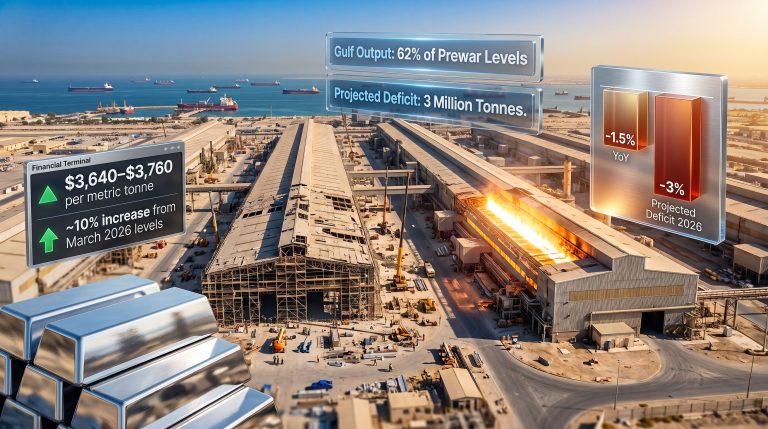
The region recorded its lowest production volumes since 2020, with major facilities operating below designed capacity utilisation rates. This underperformance occurs despite theoretical competitive advantages, highlighting how infrastructure constraints can override economic fundamentals.
Multi-Regional Coordination Challenges
Beyond China and the GCC, production deceleration has affected multiple geographic regions simultaneously, creating unprecedented supply-side pressure:
Asia (excluding China): Regional smelters faced raw material supply chain disruptions and energy cost volatility, limiting expansion capabilities despite growing domestic demand.
Europe: Carbon pricing mechanisms and environmental compliance costs increased operational expenses by an estimated 15-25% annually, forcing production optimisation rather than capacity expansion. Additionally, US steel-aluminum tariffs continue to influence global trade patterns and investment decisions.
Americas: North American facilities experienced 1.5% production decline in November alone, reflecting maintenance schedules and energy market volatility affecting operational economics.
Africa and Oceania: Despite abundant raw material resources, limited infrastructure investment constrained new capacity development, with most regional production focused on maintaining existing operations rather than expansion. However, initiatives such as bauxite project benefits demonstrate potential for future development in these regions.
Quarterly Production Analysis and Market Stress Indicators
Sequential Growth Deceleration Patterns
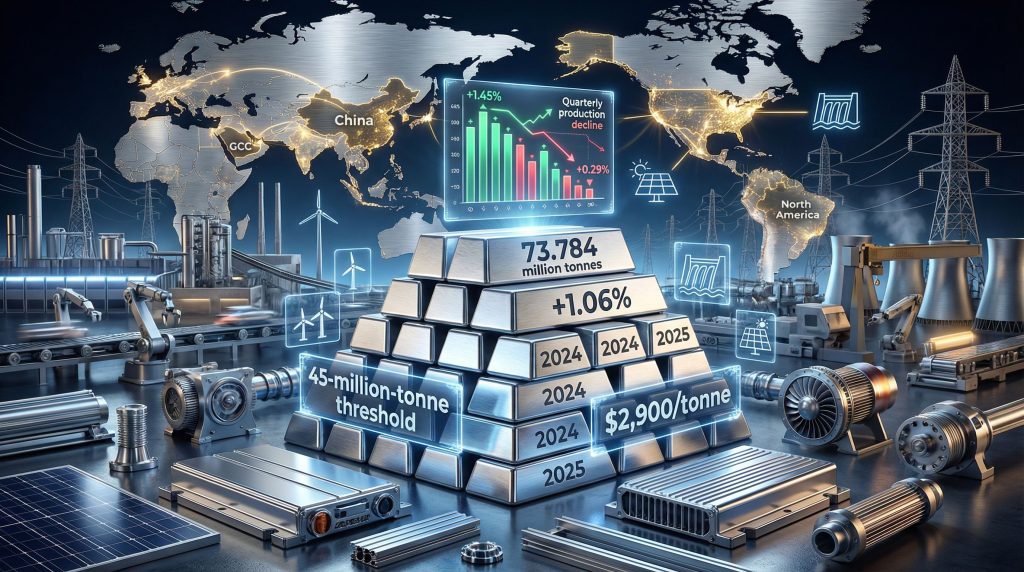
The quarterly production analysis reveals concerning momentum loss throughout 2025, with sequential growth rates declining from 1.45% in Q2 to just 0.29% in Q4. This pattern suggests intensifying supply-side constraints rather than temporary market adjustments.
| Quarter | Production (MT) | Sequential Growth | Trend Analysis |
|---|---|---|---|
| Q1 2025 | 18.115 | Baseline | Establishing production rhythm |
| Q2 2025 | 18.377 | +1.45% | Strong momentum continuation |
| Q3 2025 | 18.619 | +1.32% | Growth rate moderation beginning |
| Q4 2025 | 18.673 | +0.29% | Significant deceleration evident |
This deceleration pattern differs markedly from typical seasonal production cycles. Historical Q4 performance usually reflects planned maintenance schedules and holiday-related production adjustments, but the 2025 pattern suggests structural limitations affecting production capacity utilisation.
Daily Production Metrics and Utilisation Rates
Average daily production reached 202,100 tonnes in 2025, representing a modest 1.3% increase from 2024's 199,500 tonnes. However, this improvement masks significant quarterly volatility and regional disparities that indicate underlying supply chain stress.
The relationship between installed global capacity (estimated at approximately 79-80 million tonnes) and actual production (73.784 million tonnes) reveals a utilisation rate of roughly 92-93%. While this appears healthy, the gap represents approximately 6 million tonnes of potentially available production that remains offline due to various constraints:
• Energy cost pressures making marginal capacity uneconomical
• Environmental compliance requirements limiting operational flexibility
• Raw material supply disruptions affecting consistent production scheduling
• Maintenance backlogs from deferred capital expenditure programs
Economic Forces Driving Supply Chain Transformation
Capital Investment Redirection Trends
Traditional primary aluminium production expansion faces mounting financial headwinds that fundamentally alter investment decision-making processes. Environmental compliance costs have increased by an estimated 15-25% annually across major producing regions, reflecting stricter emissions standards, carbon pricing mechanisms, and waste management requirements.
Investment Priority Shifts:
- Recycling Infrastructure Development: Secondary aluminium processing offers superior return profiles with 95% lower energy requirements compared to primary production
- Downstream Integration Projects: Value-added manufacturing provides higher margins and reduced commodity price exposure
- Renewable Energy Integration: On-site power generation reduces grid dependency and environmental compliance costs
- Technology Upgrades: Automation and process optimisation delivering efficiency gains without capacity expansion
Consequently, renewable energy integration has become a critical factor in determining operational competitiveness and long-term sustainability.
Supply Chain Resilience Investment Strategies
Post-pandemic supply chain vulnerabilities have prompted strategic recalibration across the aluminium industry. Companies now prioritise resilience over pure cost optimisation, accepting higher operational expenses in exchange for reduced supply disruption risks.
Key Resilience Initiatives:
• Geographic diversification reducing single-source supplier dependencies
• Strategic inventory increases accepting higher carrying costs for supply security
• Alternative material research accelerating substitution technology development
• Vertical integration strategies controlling critical supply chain components
These investments require substantial capital commitments that compete with traditional capacity expansion projects, contributing to overall production growth constraints. Moreover, industry consolidation trends are accelerating as companies seek economies of scale and operational synergies.
Market Segment Impact Analysis and Demand Dynamics
High-Growth Sectors Under Supply Pressure
Electric Vehicle Manufacturing Transformation:
The automotive industry's electrification drive creates unprecedented aluminium demand pressure. Modern electric vehicles require 40-60 kilograms of aluminium per vehicle for battery housings, structural components, and thermal management systems. With projected EV demand growth of 25-30% annually through 2028, supply security has become a strategic competitive advantage for automotive manufacturers.
Renewable Energy Infrastructure Requirements:
Solar panel frames, wind turbine components, and grid modernisation projects demand specialised aluminium products with specific strength and corrosion resistance characteristics. Energy storage system casings and thermal management components require high-purity aluminium grades, creating supply bottlenecks for specialised producers.
Aerospace and Defence Applications:
Critical aerospace applications offer limited substitution options, with long-term contracts providing supply certainty premiums. Specialised alloy requirements constrain the supplier base, creating oligopolistic pricing dynamics for high-performance applications.
Consumer Segment Adaptation Strategies
Industrial consumers have implemented comprehensive supply risk management programs responding to production constraints:
Supply Security Measures:
• Diversified supplier portfolios across multiple geographic regions
• Long-term offtake agreements with price corridors protecting against volatility
• Alternative material qualification programs reducing aluminium dependency
• Strategic partnership development with integrated suppliers
Inventory Management Evolution:
• Increased safety stock levels for critical applications accepting higher carrying costs
• Advanced demand forecasting systems incorporating supply constraint modelling
• Supplier performance monitoring dashboards tracking delivery reliability metrics
• Regional inventory positioning reducing transportation-related supply risks
Investment Implications and Market Outlook
Price Discovery Mechanisms Under Structural Pressure
Current market indicators demonstrate sustained supply tightness effects on pricing mechanisms. Spot prices maintain levels around $2,900 per tonne despite demand moderation in certain sectors, indicating that supply constraints rather than demand growth drive current price discovery.
Forward curve analysis reveals persistent backwardation through 2026, suggesting market participants expect continued supply tightness. Regional premiums have expanded as transportation costs increase and supply chain disruptions create geographic arbitrage opportunities. According to Reuters, aluminium's years of plenty are drawing to a close, signalling a fundamental shift in market dynamics.
Emerging Investment Themes
The constrained production environment creates distinct investment opportunities across the aluminium value chain:
Recycling Technology Companies: Benefit from circular economy transition with superior economics compared to primary production. Technology providers focusing on advanced sorting, processing, and purification command premium valuations.
Specialty Alloy Producers: Companies with proprietary alloy development capabilities and specialised manufacturing processes maintain pricing power in high-performance applications.
Integrated Downstream Fabricators: Manufacturers with secured raw material supply chains gain competitive advantages over competitors dependent on spot market purchases.
Energy-Integrated Smelting Operations: Facilities with dedicated renewable energy sources avoid grid constraints and benefit from stable long-term power costs.
The next major ASX story will hit our subscribers first
Strategic Adaptation Framework for Industry Participants
Operational Excellence Priorities
Successful navigation of the constrained growth environment requires comprehensive operational optimisation:
Production Efficiency Maximisation:
• Utilisation rate optimisation at existing facilities through predictive maintenance
• Energy procurement strategy development managing volatile power markets
• Process automation reducing labour dependency and operational variability
• Quality control enhancement minimising waste and rework requirements
Portfolio Optimisation Strategies:
• Product mix shift toward high-margin specialty grades over commodity production
• Integrated recycling capability development capturing secondary material value
• Strategic partnership establishment across the value chain
• Geographic market diversification reducing regional demand concentration risks
Risk Management Evolution
Industry participants must develop sophisticated risk management frameworks addressing multiple constraint scenarios:
The successful organisations will be those that recognise the structural nature of current supply constraints and implement comprehensive adaptation strategies rather than waiting for traditional growth patterns to resume.
Supply Chain Resilience Development:
• Multiple supplier qualification across different geographic regions
• Strategic inventory management balancing carrying costs with supply security
• Alternative material substitution research and development programs
• Transportation route diversification reducing logistics bottleneck exposure
Financial Risk Management:
• Commodity price hedging strategies managing input cost volatility
• Energy cost stabilisation through long-term power purchase agreements
• Currency exposure management for internationally integrated operations
• Capital allocation optimisation balancing growth investment with operational efficiency
Future Market Structure and Competitive Dynamics
The 2025 production slowdown signals the aluminium industry's transition into a fundamentally different competitive environment. Traditional metrics focusing on production volume growth give way to optimisation-focused strategies emphasising efficiency, sustainability, and value creation rather than pure scale expansion.
Structural Market Changes:
• Consolidation acceleration as smaller producers struggle with compliance costs
• Technology differentiation becoming primary competitive advantage
• Customer relationship depth replacing commodity-based competition
• Sustainability credentials influencing customer selection criteria
Organisations that successfully adapt to these structural changes will capture disproportionate value as the industry matures. The next 24 months represent a critical period for strategic positioning, as competitive advantages established during this transition phase will likely persist throughout the decade.
According to World Primary Aluminium Output analysis, despite market headwinds, China and emerging regions continue driving gains in global primary aluminium output, highlighting the shifting geographic dynamics of production.
Disclaimer: This analysis incorporates industry data and market projections that involve inherent uncertainties. Commodity markets and production forecasts are subject to various economic, geopolitical, and regulatory factors that may differ from current expectations. Readers should conduct independent research and consult qualified professionals before making investment or operational decisions based on this information.
The transformation from volume-driven to optimisation-focused competition creates opportunities for innovative market participants whilst challenging traditional business models. Success in this new paradigm requires strategic vision, operational excellence, and adaptive management capabilities that extend well beyond conventional industry practices. Furthermore, with world primary aluminium production growth hitting a 5-year low, industry stakeholders must prepare for sustained structural changes that will reshape competitive dynamics for years to come.
Looking for the Next Major Aluminium Supply Chain Investment Opportunity?
With world primary aluminium production growth hitting a 5-year low and supply constraints reshaping global markets, identifying companies positioned to capitalise on this structural transformation is crucial. Discovery Alert's proprietary Discovery IQ model delivers real-time alerts on significant ASX mineral discoveries, including those related to aluminium feedstock and bauxite developments that could benefit from the current supply tightness. Begin your 30-day free trial today at Discovery Alert and position yourself ahead of market movements in this rapidly evolving sector.