July 17, 2026
The Hidden Competitive Moat in Modern Aluminium Production
Most industrial commodities follow a familiar pattern: producers extract raw materials, sell them upstream, and compete primarily on price. Aluminium has long operated under this same logic. Yet a structural shift is underway, driven not by a single policy change or corporate announcement, but by the convergence of carbon pricing pressure, supply chain transparency demands, and the growing scarcity of genuinely low-emission industrial metal. Within this context, the architecture of how a company controls its production chain is becoming as strategically important as the price of the metal itself.
Understanding why requires examining what full value chain ownership actually delivers, and why renewable energy integration is no longer just an environmental credential but a financial and competitive instrument. Furthermore, the rise of low-carbon metals is reshaping how investors and procurement teams alike assess long-term value in the sector.
When big ASX news breaks, our subscribers know first
Why Full Value Chain Integration Matters in Modern Aluminium Manufacturing
The Strategic Logic Behind Vertical Integration in Metals
Vertical integration in metals manufacturing is often discussed in abstract terms. In practice, it means something precise: the ability to control cost inputs, quality consistency, and emissions intensity at every production node simultaneously, rather than being exposed to margin compression at any single point in the chain.
For aluminium specifically, the value chain progresses through five distinct transformation stages:
- Bauxite mining – extracting the primary ore from open-cut deposits
- Alumina refining – converting bauxite into aluminium oxide via the Bayer process
- Primary smelting – reducing alumina to metallic aluminium using electrolytic reduction (the Hall-Heroult process)
- Downstream processing – shaping aluminium into extruded profiles, rolled sheet, and fabricated products
- Recycling – reclaiming end-of-life aluminium for remelting at a fraction of primary energy cost
Each stage in this chain carries distinct cost structures and risk profiles. A producer operating only at the smelting stage, for instance, is fully exposed to alumina price movements. One without downstream finishing capabilities cannot capture the margin premium that value-added products command over commodity ingot. Integration across all five stages creates a form of natural hedging that no derivative position can fully replicate.
Where Norsk Hydro Sits Within the Global Aluminium Landscape
Norsk Hydro's integrated aluminium and renewable energy operations represent a business model that spans the complete aluminium value chain, from bauxite mining and alumina refining through to primary smelting, extrusion, rolled products, and recycling. This end-to-end architecture, combined with the company's ownership of renewable power generation assets, places it in a structurally distinct category among global aluminium producers. In comparison, top aluminium companies rarely achieve this level of integrated control across every production node.
The integration of Vale's Brazilian aluminium assets in 2011 was the pivotal transaction that completed this architecture. Brazil's Paragominas bauxite mine and the Alunorte alumina refinery, which is among the largest alumina refineries in the world by capacity, gave Hydro direct upstream supply security at industrial scale. This meant that Norwegian smelters could source alumina from Hydro-controlled refining capacity rather than relying on third-party spot markets, where prices can swing sharply during periods of supply disruption.
Key Insight: Full value chain control transforms the economics of aluminium production from a series of isolated commodity bets into an interconnected system where margin can be preserved, shifted, or optimised across nodes depending on market conditions. This is a structural capability, not a temporary advantage.
What Does Hydro's Renewable Energy Infrastructure Actually Look Like?
The Hydropower Foundation: Scale, Capacity, and Strategic Function
The energy dimension of Hydro's business model is where the strategic differentiation becomes most pronounced. Aluminium smelting is extraordinarily electricity-intensive. The Hall-Heroult electrolytic reduction process, which has remained the industry standard for over a century, requires roughly 13 to 15 megawatt-hours of electricity per tonne of primary aluminium produced. This means energy costs typically account for somewhere between 30% and 40% of total primary aluminium production costs globally, making the source and price of electricity a first-order competitive variable.
Hydro's energy position is anchored by the following asset base:
| Energy Asset | Details |
|---|---|
| Owned hydropower facilities | 20+ plants operating across Norway |
| Annual generation from owned assets | ~10 TWh |
| Total renewable power portfolio (incl. PPAs) | ~18 TWh per year across Nordic operations |
| Renewable power secured via long-term agreements | Over 12 TWh annually |
Norway's geography underpins this advantage. The country's fjord systems and high-altitude reservoirs make hydropower not just viable but economically dominant, providing dispatchable, zero-emission electricity that wind and solar currently cannot replicate at equivalent reliability for continuous industrial loads. Unlike intermittent renewable sources, hydropower reservoirs function as stored energy, allowing operators to dispatch generation in response to demand rather than weather conditions.
Major Capital Commitments Anchoring the Energy Strategy
Hydro's most significant recent hydropower capital commitment is the Illvatn pumped storage plant, representing an investment in the range of NOK 1.2 to 2.5 billion, marking the company's largest hydropower development expenditure in more than two decades. Pumped storage is a particularly valuable technology in the context of Nordic electricity markets, where increasing wind power penetration creates periods of excess generation that can be stored by pumping water uphill, then released through turbines during peak demand periods.
On the procurement side, Hydro has secured long-term Power Purchase Agreements (PPAs) of significant scale. According to Hydro's integrated annual report 2025, these agreements reflect the company's commitment to increasing resilience and meeting its 2030 ambitions:
- A 12.3 TWh agreement with Statkraft, covering the period from 2026 to 2038, directed at supporting operations at the Sunndal and Høyanger smelters
- A 5.25 TWh agreement with Hafslund, spanning 2031 to 2040, providing additional supply certainty for Norwegian smelting capacity
These agreements lock in renewable electricity supply at negotiated terms across 10 to 15 year horizons, insulating smelter operating costs from Nordic spot power market volatility.
Strategic Divisions Driving Renewable Expansion
Within Hydro's corporate structure, the Renewables Growth division carries responsibility for developing new renewable energy capacity across Nordic and Brazilian markets. Notably, Hydro has made deliberate capital allocation decisions to exit green hydrogen and battery storage ventures, concentrating investment resources on core aluminium operations and renewable power generation.
This focus reflects a strategic judgement that depth of capability in a defined area outperforms breadth across adjacent clean energy technologies, particularly when the core business itself requires gigawatt-scale electricity supply.
How Does Renewable-Powered Aluminium Compare to Conventional Production?
The Carbon Footprint Gap: Norwegian Aluminium vs. Global Average
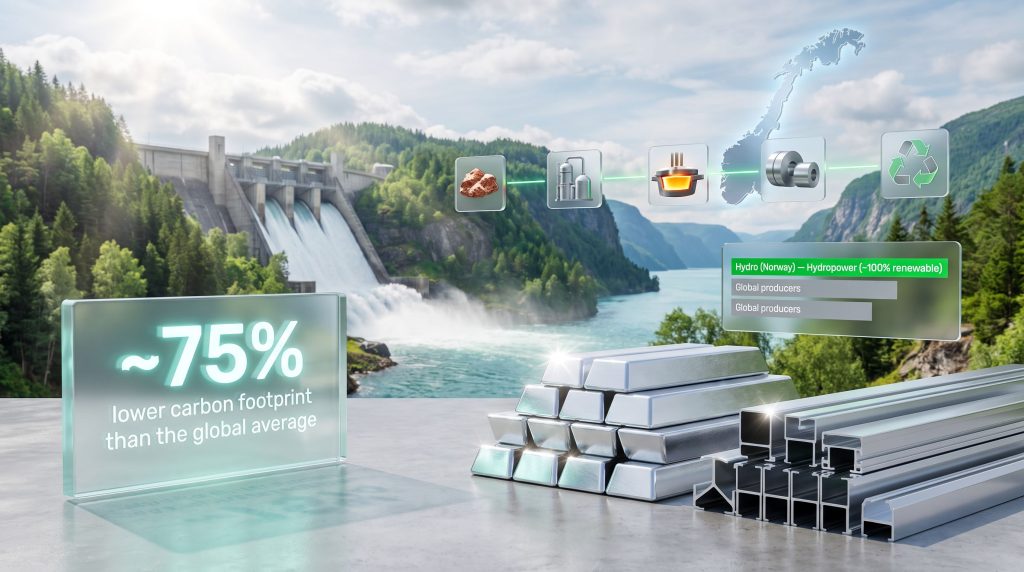
Featured Insight: Norwegian aluminium produced using hydropower carries a carbon footprint approximately 75% lower than the global industry average. This differential is driven almost entirely by the energy source used during primary smelting, where the Hall-Heroult process converts the electricity input directly into embodied carbon depending on the generation mix.
The mechanism behind this gap is straightforward in principle but profound in its implications. Primary aluminium smelting accounts for the overwhelming majority of lifecycle greenhouse gas emissions in aluminium production. When that electricity comes from a coal-fired grid, as it does for a substantial portion of Chinese and other emerging market smelters, each tonne of aluminium carries a carbon burden several times higher than the same tonne produced using Norwegian hydropower.
| Production Model | Primary Energy Source | Relative Carbon Intensity |
|---|---|---|
| Hydro (Norway) | Hydropower (~100% renewable) | ~75% below global average |
| Global average smelter | Coal/gas mix | Baseline |
| Emerging market producers | Predominantly coal | Above baseline |
As carbon pricing mechanisms expand, including the European Union's Carbon Border Adjustment Mechanism (CBAM), which applies a carbon cost to imports based on their embedded emissions, this gap translates into a direct and growing financial advantage for low-emission producers. High-carbon aluminium entering European markets will face increasing cost penalties, while Hydro's product profile becomes incrementally more competitive without any change in its own cost structure.
Competitive Positioning: Renewable Access as a Structural Advantage
Beyond regulatory mechanisms, end-market demand for verified low-carbon aluminium is accelerating independently. Automotive manufacturers working toward Scope 3 emissions reduction targets are increasingly specifying embodied carbon limits in material procurement. Green metals pricing dynamics are also shifting in favour of producers who can substantiate low-emission credentials with verifiable data.
Green building certification frameworks such as LEED and BREEAM are incorporating embodied carbon thresholds that make the source of structural aluminium a procurement variable rather than a secondary consideration. Certification schemes like the Aluminium Stewardship Initiative (ASI) provide a third-party verification framework through which producers can substantiate low-carbon claims in commercial relationships. This matters because greenwashing concerns have made procurement teams cautious about unverified environmental claims, and independent certification creates enforceable commercial differentiation.
Which Industries Depend on Hydro's Downstream Aluminium Products?
End-Market Breakdown: Where Integrated Aluminium Flows
Hydro's extruded and rolled aluminium products serve a range of industries where the material's physical properties, rather than simply its price, drive specification decisions:
- Construction and building systems: Extruded aluminium profiles form the structural basis of window systems, curtain wall facades, and architectural frameworks. Aluminium's corrosion resistance in coastal and urban environments reduces lifecycle maintenance costs significantly compared with steel alternatives.
- Automotive and transport: Lightweight aluminium components directly support vehicle weight reduction targets. For electric vehicles in particular, reducing structural mass extends battery range, making aluminium specification a platform engineering decision rather than a cost optimisation.
- Packaging: Rolled aluminium products serve food, beverage, and pharmaceutical packaging, where barrier properties, recyclability, and the ability to produce thin-gauge material efficiently are key performance criteria.
- Industrial engineering: Precision extrusions serve machinery, energy infrastructure, and manufacturing equipment applications where dimensional consistency and machinability are valued.
Why Aluminium's Material Properties Drive Demand Across These Sectors
What makes aluminium genuinely unusual as an industrial metal is the combination of properties it offers simultaneously. Its strength-to-weight ratio outperforms steel in applications where mass is a design constraint. Its corrosion resistance derives from a self-forming aluminium oxide surface layer that protects the metal without coating.
Critically, aluminium is infinitely recyclable without degradation of material properties, meaning that every kilogram of aluminium ever produced remains theoretically recoverable. This last property has significant economic implications. Recycling aluminium requires only approximately 5% of the energy needed to produce primary aluminium from bauxite. As manufacturers face pressure to reduce embodied carbon in their supply chains, the ability to specify recycled-content aluminium with verifiable renewable energy credentials becomes a measurable commercial advantage.
What Macro Forces Shape Hydro's Operating Environment?
The Three Structural Drivers Influencing Integrated Aluminium Producers
1. Industrial Demand Cycles
Aluminium demand correlates with construction activity, automotive production volumes, and infrastructure investment at a macroeconomic level. The electrification transition introduces new demand categories that did not exist at scale a decade ago. EV platform architecture uses aluminium for battery enclosures, structural crash management systems, and body-in-white components. Grid infrastructure expansion requires aluminium conductors in transmission cables. These are structural demand additions, not cyclical fluctuations.
2. Global Energy Market Dynamics
With energy representing 30 to 40% of primary aluminium production costs globally, producers without owned or contracted renewable power face continuous exposure to electricity market volatility. During European energy price spikes, multiple smelters without long-term supply arrangements curtailed or suspended production. Hydro's combination of owned hydropower generation and long-dated PPAs provides a degree of cost stability that spot-market-exposed competitors cannot replicate without equivalent infrastructure investment.
3. Commodity Price and Trade Policy Exposure
Aluminium price dynamics are influenced heavily by Chinese production decisions, given that China accounts for a dominant share of global primary aluminium output. LME price movements, global inventory levels, and trade measure changes all create revenue volatility for producers. Furthermore, vertical integration provides partial natural hedging here: when aluminium ingot prices fall, the margin compression at the smelting stage is partially offset by the value retained in downstream fabricated products, where pricing is less directly correlated to LME spot rates.
The next major ASX story will hit our subscribers first
What Is Hydro's Long-Term Decarbonisation Roadmap?
The 2030 Green Aluminium Ambition and 2050 Net-Zero Target
Hydro has framed its decarbonisation trajectory around two milestones: a 2030 green aluminium ambition that targets meaningful reduction in the carbon intensity of its product portfolio, and a 2050 net-zero commitment. The strategic framing is significant. Rather than positioning decarbonisation as a compliance obligation, Hydro treats low-carbon aluminium as a commercial product category with premium pricing potential in segments where embodied carbon is becoming a procurement criterion.
This distinction matters for investors assessing long-term value. A producer that views emissions reduction as a cost to be minimised will approach capital allocation differently from one that treats low-carbon certification as a revenue-generating asset. Hydro's continued investment in renewable capacity, its PPA strategy, and its recycling operations all reflect the latter orientation.
Recycling as a Circular Economy Pillar
Hydro's recycling operations serve a dual function. They reduce the proportion of energy-intensive primary metal in the company's overall output, directly lowering Scope 1 emissions per tonne of aluminium sold. And they provide a growing source of certified recycled-content aluminium for manufacturers who need to demonstrate circular economy credentials in their own supply chains.
Industry Context: As the EU and North American regulatory frameworks increasingly mandate embodied carbon disclosure across construction and automotive supply chains, integrated producers with verifiable renewable energy credentials and recycled content programmes are positioned to access premium market segments that commodity-grade aluminium producers structurally cannot enter.
The economics of recycling aluminium are compelling by any measure. The approximately 95% energy saving versus primary production means that recycled aluminium carries a dramatically lower carbon footprint even before the source of remelting electricity is considered. When that remelting electricity is itself renewable, the combined carbon advantage versus coal-powered primary production becomes substantial.
Frequently Asked Questions: Hydro's Integrated Aluminium and Renewable Energy Operations
What makes Norsk Hydro's business model unique among global aluminium producers?
Hydro's distinction lies in combining full value chain ownership, from bauxite extraction through to recycled product, with direct ownership of renewable power generation capacity. No other global aluminium major has achieved this combination at equivalent operational scale. The result is a producer that controls its emissions profile and cost structure simultaneously across every production stage. In addition, the scale of bauxite production secured through Hydro's Brazilian assets provides upstream supply security that purely smelting-focused competitors simply cannot replicate.
How does hydropower reduce the carbon footprint of aluminium production?
The mechanism operates through direct substitution at the most emissions-intensive stage of production. Primary smelting requires 13 to 15 MWh of electricity per tonne of aluminium. When that electricity is sourced from hydropower rather than a coal-fired grid, the associated CO2 emissions per tonne fall dramatically. Over the full production lifecycle, Norwegian hydropower-based aluminium carries a carbon footprint approximately 75% below the global industry average.
What is the Illvatn pumped storage plant and why does it matter?
The Illvatn project represents Hydro's largest hydropower capital investment in more than two decades, with a cost estimate ranging from NOK 1.2 billion to NOK 2.5 billion. As a pumped storage facility, it stores energy by pumping water to a higher reservoir during periods of low electricity prices or excess generation, then recovers that energy by releasing water through turbines during peak demand periods. For aluminium smelters that require continuous, high-volume electricity supply, this dispatchability is operationally critical.
Which end markets are most exposed to low-carbon aluminium demand growth?
Three sectors are driving the most rapid growth in demand for verified low-carbon aluminium. Automotive electrification is increasing aluminium content per vehicle while simultaneously making embodied carbon a platform-level specification criterion. Green building certification frameworks are embedding embodied carbon thresholds that make aluminium sourcing a compliance variable. And sustainable packaging mandates from major consumer goods companies are creating demand for certified recycled and renewable-energy-produced aluminium in packaging applications.
How do long-term Power Purchase Agreements support Hydro's energy strategy?
PPAs with Statkraft and Hafslund lock in renewable electricity supply at negotiated prices across horizons extending to 2038 and 2040 respectively. For aluminium smelters, which operate on continuous production cycles and cannot easily absorb electricity price spikes without curtailing output, this multi-decade cost visibility is a structural operational advantage. It converts what would otherwise be a variable and volatile cost input into a largely predictable element of the production cost base. Moreover, a strategic aluminium joint venture approach across the industry is increasingly reflecting this same logic of securing stable, long-term energy and supply arrangements.
Key Takeaways: The Strategic Architecture of Integrated Low-Carbon Aluminium
The case for understanding Norsk Hydro's integrated aluminium and renewable energy operations goes beyond a single company's strategy. It illustrates a broader principle: in industries where energy is the dominant cost variable and where carbon pricing is tightening, the configuration of assets matters as much as their scale.
- Full value chain integration from bauxite through to recycled aluminium products provides structural cost and emissions advantages unavailable to partially integrated producers
- Ownership of more than 20 hydropower facilities, combined with approximately 18 TWh of annual renewable power procurement, creates a genuine and replicable competitive differentiator
- A roughly 75% carbon footprint advantage versus the global industry average positions Hydro's aluminium for premium pricing as embodied carbon regulation intensifies
- Long-term PPA agreements extending through to 2040 provide multi-decade energy cost visibility, substantially reducing exposure to Nordic spot power market volatility
- The 2050 net-zero roadmap, framed around the 2030 green aluminium ambition, positions decarbonisation as a commercial growth lever rather than a regulatory compliance cost
Further Exploration: Readers seeking additional context on the global bauxite and alumina supply chain can explore industry research published by AL Circle, including their Global Bauxite and Alumina Market Forecast to 2036: Supply, Demand, Trade Flows and Price Outlook, available at alcircle.com. This resource provides complementary market data for those researching aluminium value chain dynamics.
This article contains forward-looking statements and projections regarding market conditions, regulatory developments, and company strategy. These involve inherent uncertainty and should not be relied upon as financial advice. Readers should conduct independent research before making investment decisions.
Want to Identify the Next Major ASX Mineral Discovery Before the Broader Market?
Discovery Alert's proprietary Discovery IQ model delivers real-time alerts on significant ASX mineral discoveries, transforming complex mineral data into clear, actionable insights for investors at every experience level — start your 14-day free trial today and explore historic discoveries that have generated substantial returns for early movers.